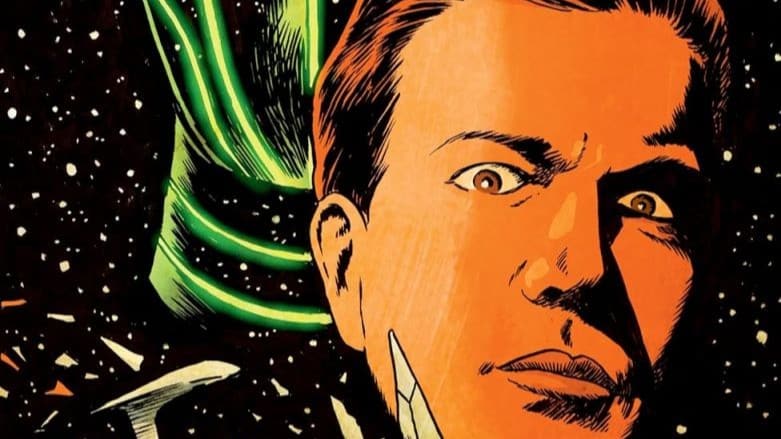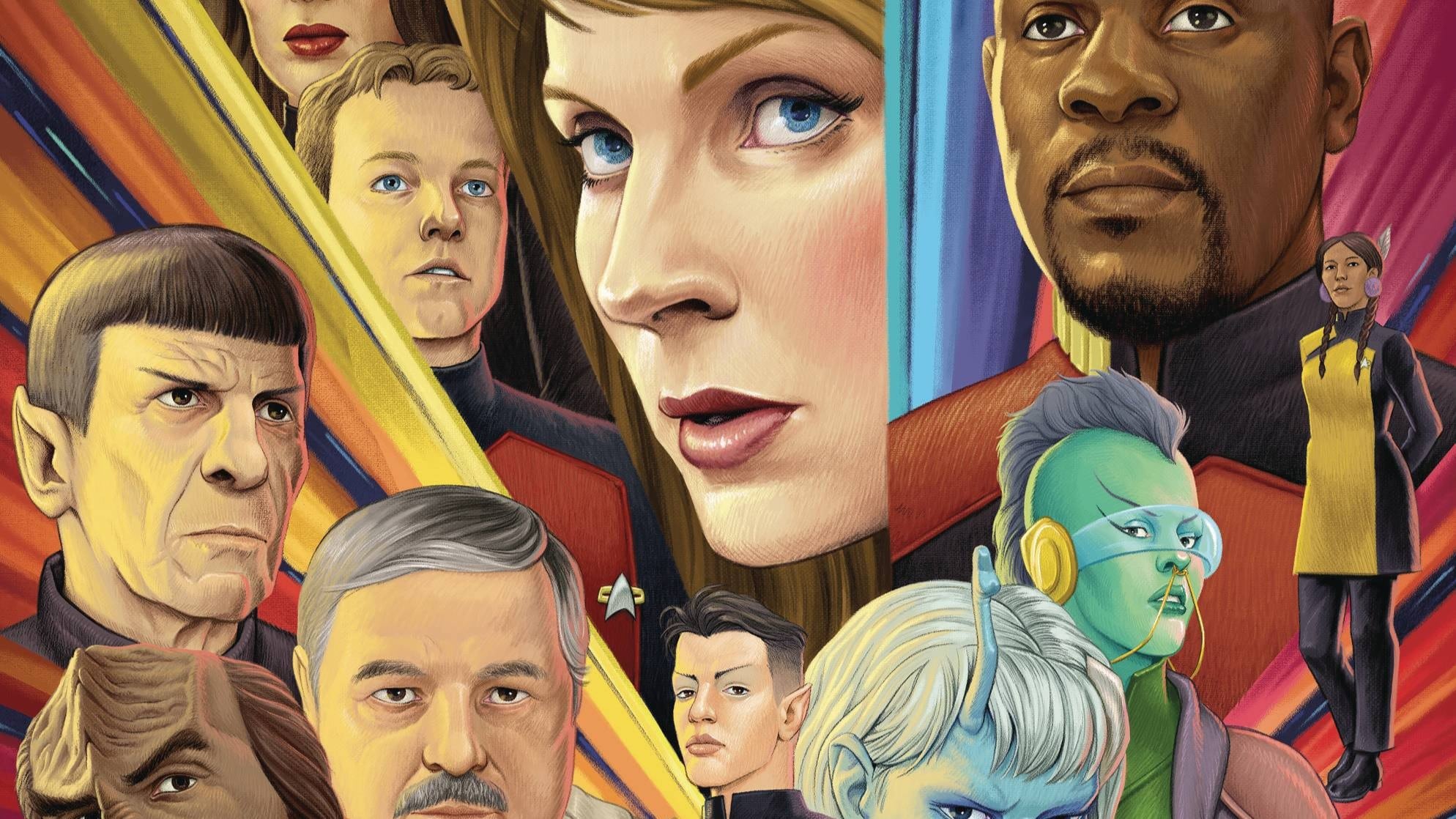
It’s the end of an era in Star Trek Omega, written by Christopher Cantwell, Collin Kelly & Jackson Lanzing with art by Oleg Chudakov, Joe Eisma, Mike Feehan, Tess Fowler, Angel Hernandez, Liana Kangas, Megan Levens, Travis Mercer, Ramon Rosanas, Rachael Stott, Erik Tamayo, Davide Tinto and Marcus To, colors by Lee Loughridge and Marissa Louise, and letters by Clayton Cowles!
Mark Turetsky: Well, the universe is back to normal, the pre-Nemesis status quo has been firmly established, and all of Kelly, Lanzing and Cantwell’s toys are ready to go back into their plastic packaging to be re-sealed and kept mint in box for their dates with their various destinies.
Tony Thornley: Heck of a journey here. It’s been kind of crazy to see how this grew. It’s interesting to draw comparisons to the entirety of Trek canon in some different ways, especially other serialized Trek. In some ways, this was something that could have only been done in comics (cast and characters aside), but in others, man, should the franchise ever take note.
The Visitor, Redux?

Mark: So… where to start with this issue? I think the most important part of it has to be Ben and Jake Sisko’s story, right? Looking back at our review of Star Trek #1 from 2022, I wrote,
Jake [is] on a very specific path in his life: he’s been repeatedly traumatized by war while living in a society that insists it’s a utopia. His mother was killed by The Borg when he was eleven, he was brought to live above a planet in crisis when he was fourteen. He saw the horrors of war, military occupation and his best friend lost a leg in battle. Then he lost his father. He wants to write about his experiences, but now that war is over, the average Federation citizen just doesn’t want to think about it. He’s still living on Deep Space Nine three years later, not on his stepmother’s starship with his little sister, not on Bajor in the house that his father built for them, not back on Earth with his grandfather in New Orleans. He seems to be on the road to becoming the broken man he became in an alternate future in the episode “The Visitor.”
Unlike a lot of the legacy characters in this comic, Jake Sisko hasn’t had any kind of onscreen appearances since the Deep Space Nine finale back in 1999. His story could really go anywhere. The big question he’s facing is, will he be able to escape the future we saw for him in “The Visitor.” Just as a reminder, that version of Jake lost his father before the start of the Dominion War, had written one novel and some short stories (later collected as his second and final book) and set aside his work as a writer when his father began to reappear to him briefly at certain intervals over the rest of his life.
Now, the Jake that we have in the comic has lost his father a scant few years later than that other Jake, has spent the intervening years dwelling on his loss, and his father has reappeared to him and, as we’re sure to gather before the end of the issue, is set to disappear again. It certainly seems like Jake might be doomed to repeat the past… err… alternate future.
Tony: That’s one of the most difficult things about this book. The series started by examining that as a pretty big B-plot. And he unfortunately was pulled away into the Sons of Star Trek series after “Day of Blood” and never really fully returned to the main series. I would have loved to have seen more Jake through the course of the series, especially in Ben’s life in the Loreworld.
I hope this team gets a chance to revisit some of this stuff soon (and I mean specifically with Jake and Ben, but man I could repeat that a lot in this conversation). There’s so much fertile ground between Nemesis and the destruction of Romulus that could give us amazing stories.
Mark: Let’s look at some of the other characters from TV Trek that haven’t received much in the way of revisiting since the end of their shows: Sela seems like she’s being kept aside for some greater purpose. Her scene takes place on the Kor Neeron (Noreen Rok backwards?) space station from Defiant #15, where we saw Nymira in flashback. She’s toasting the death of her father, the likely death of Romulus itself, and the new beginning she sees for herself. It leaves her in a rather tantalizing place, freed from her commitments to Romulus (which we know is about to go through some serious upheaval in Nemesis, leading into its destruction in Star Trek (2009)). There are so many places left to take this character, and I’d love to see her story picked up in some format, someday.
Tony: I think this entire mega arc has given a lot of characters a metric ton of development each, but man, was Sela ever one of the characters that benefitted from it the most. There was some serious meat here for her, and I agree, she’s one that needs more. Between her, Nymira, Paris and Torres alone, there’s a “renegades” series right there.
Mark: Kahless, the redeemed Klingon-fascist godkiller has been returned to where he was before the start of this series: onto the Klingon Imperial throne to serve as a figurehead, only now with Alexander keeping an eye on him. It’s good to see Alexander having found a purpose in life, isn’t it?
Tony: Proud of him. But really, everyone got a moment across the line, and giving some of these underdeveloped characters like Alexander their moment will be the legacy of this era.
Mark: We’ve got Tom and B’Elanna finally reunited with their daughter Miral, ready to take over control of the Theseus, at the request of Scotty.
Finally, we got Scotty. Back in Star Trek #13, he reflected on not having set foot on a planet for 70 years, and that he has no reason to return to Earth, as most everyone he’s ever known is dead. Here, we get a little surprise: he lands on Earth, in the Kenyan province of Kitui (though here it’s misspelled as “Kutui”), which has been established in other comics and non-canon sources as Uhura’s birthplace. He meets with Uhura in what comes across as a lovely in memoriam for Nichelle Nichols, who passed away shortly before this comic series started.
Tony: Both of these wrap ups are so sweet, but Scotty and Uhura’s fate is a payoff of Star Trek: Year Five. I’m so glad to see them get a happy ending, especially for the hell Scotty’s been through in his career. It’s a pairing that I think a lot of people don’t know about, but it makes a certain kind of sense.
Make Way For Nemesis

Mark: Now, there are those characters who need to be left in specific spots for their future canonical appearances. First up is Lore, who, it turns out, isn’t quite as “fully functional” as his twin brother Data, it would seem. Either that, or someone at the Daystrom institute has taken a souvenir from him during his disassembly. Anyway, he next appears in season 3 of Picard, having been merged with Lal, Data, B-4 and Altan Soong in a new body that looks suspiciously like an aging Brent Spiner.
Tony: You know, this is probably the point of the story that didn’t totally sit right with me. Data probably was the third lead of this epic at the beginning, but he totally faded into the background after the annual. Even in “Lorewar,” I don’t feel like he got the arc or the resolution that the beginning of the line promised, especially with this special literally leading up to his final moments.
Mark: From the Enterprise-D crew, we have Worf getting rescued by his cha’DIch Picard, and like all great lawyer-Picard moments, it comes with equal parts shaming and legalizing. Interesting to see that Federation president Antos (I see what you did there!) has demanded one of the two badmirals take the fall. If you’ve watched Star Trek: Prodigy, you know that it was Nechayev. Picard also invites Doctor Crusher back to the Enterprise to be his date at Riker and Troi’s wedding, setting the stage for her to have a very special adult son with him in Picard season 3.
Tony: These were probably the most satisfying non-Sisko moments of the story. I thought Bev needed more page time, but it was a solid little moment. Worf’s scenes here were great — both Picard giving Jellico and Nechayev the business, and Worf’s later scenes with Ro. They both show how much the gruff headstrong warrior has turned into a mature leader and commander.
Writer Christopher Cantwell has done such a fantastic job with Worf over the last three-ish years and these moments are exactly why I’m disappointed the line isn’t picking up a year removed from this. Dorn talked for years about Captain Worf. Now that we’ve gotten it, it’s getting cruelly pulled away.
Mark: Spock and Geordi discuss the creation of the Jellyfish, the experimental craft that brings Spock to the Kelvin timeline where he will spend the remainder of his days, and Geordi will be returning to the Enterprise “tomorrow,” just in time for Nemesis.
Tony: A few of these felt like comic book movie post-credits scenes, but my goodness, this one in particular. Now, we knew this was semi-canon from Star Trek Countdown all the way back in 2010, but it’s great to have it firmed up and set as actual canon (presumably, but also, why would they contradict it at this point?).
Mark: Harry Kim is back on regular Starfleet duty as a lieutenant, squaring with a mention of him having achieved that rank on Prodigy, though we know that he’s one of very few non-Ensign Kim’s, according to Lower Decks’ penultimate episode “Fissure Quest” (and perhaps for that reason he’s also evil?).
Finally, Worf sees Ro returned to a Starfleet prison, but we learn that Ro’s future posting in Starfleet Intelligence happened thanks to Torres turning down the job and recommending Ro instead. Star Trek: Picard still did the character dirty, I say.
Tony: I’ve always loved Ro, and I’m so glad she’s been such a major part of this line. This is the perfect conclusion for her story here, especially with Worf’s joke about reporting to her some day. The Picard series absolutely did her dirty, but this epic really gave her the justice she deserved.
Don’t You Forget About Me

Mark: Finally, we have the original characters: Descheeni gets a promotion to Lieutenant Commander and requests a posting on the Enterprise (I don’t know if there’s a Native American crewmember in the background of Nemesis, but I can assure you I won’t be rewatching it to see if I can spot her). Nymira Vondect, the Orion pirate/scammer/medical genius, has taken control of the Defiant and is headed off into the great black yonder. T’Lir confirms that their race, the Organians, are indeed dead, and they have taken on an entirely mundane, non-godly body permanently. They remain pen pals with Lily Sato, who, having escaped judgment from Starfleet, has chosen to join the Fenris Rangers. We have her meet a mysterious figure who certainly doesn’t look like Seven, so I can only conclude it’s Icheb. I liked these original characters, and I hope we get to see their story continue in some form.
Tony: Great endings for each character, and another reason that I hope we get more of this era. Lily’s time with the Rangers alone is fertile territory (are there more familiar faces than Lily and Seven?). It’s almost like there’s a set-up here for a post-Nemesis TNG series as well. I’m wondering if there’s multiple series and pitches behind the scenes that we’ll see materialize shortly.
Mark: The issue ends with a few small, but very meaningful, revelations: the first is about Sisko’s role as the Emissary of the Prophets. Throughout the issue, Sisko addresses them, telling them about the linear concept of endings, which, existing as beings outside of time, they can’t fathom, “Back in the beginning of it all, you saw an ending from a place beyond them. You thought you were immune, but you weren’t. And so you were afraid. You pulled a creature you didn’t understand into a world he couldn’t comprehend… all to accomplish a goal you couldn’t even express. But an ending came anyway.” This reframes his existence, his creation by The Prophets, to serve this purpose, to help prepare them for the destruction of the universe around them, and for their demise, but also to help them bring about their return and the rebirth of the universe. The other piece that it reframes is what exactly it means that he’s an Emissary. As he puts it, “they don’t need an Emissary from them to the world. They need it the other way around.” He’s off to spread the good word of Federation-style humanism to the gods themselves.
Tony: What a powerful statement about his role. This feels like it was the intent of his role as Emissary within Deep Space Nine itself, but just through the nature of TV they weren’t able to explicitly slide that in there. What a great ending for Benjamin Sisko (for now). He got to be a big damn hero again, and now is off to embrace what’s next.
Mark: What I think is the most meaningful piece of this ending, though, comes from Jake’s Afterword for his novel Anslem. He says that reading back the novel, “It’s the me I was, the me who was growing all those years. It’s the story I couldn’t stop telling. But I don’t think it’s me now.” If the Jake of “The Visitor” was a man who couldn’t let go of his past, who had nothing more to write after that first novel, this Jake has learned to move past it.
The final lines of the comic are Jake’s: “I’ve been here since I was fourteen, you know? Living a whole life of stories around this one lonely star. It’s time to see what all those other ones have in store.” I can’t help but feel like this is the writers’ saying goodbye to this specific era of Trek. For someone of my age, the Golden age of Star Trek was the era of The Next Generation through Voyager. And this whole double series has been a delightful return and a celebration of that era. But at this point, we’ve had many returns to it, from the animated Lower Decks and Prodigy to Picard. And while Strange New Worlds has been met with lots of (well-deserved!) praise, a show like Discovery that pushes the storytelling forward by centuries has been largely dismissed by the fandom (rightly or wrongly). But maybe it is time to look beyond “this one lonely star.” With Redshirts and The Last Starship being set closer to The Original Series and Discovery’s far future respectively, maybe it’s time we follow them along. The late 24th Century has been a wonderful setting to tell stories in, but maybe it is time to move along.
Tony: Yeah, I agree. I would love to see more here- getting other members of our casts before stuff like Prodigy and Lower Decks, seeing the original characters’ journeys, follow up on the lives of Worf, the Paris family, Sela, Ro- but if we never do, this is such a wonderful send-off to everyone. It’s not all happy ending, but it’s a “on to the next adventure.”
And that’s fantastic.
Prepare Yourself for Warp 10 Excitement!
- It seems like only the casts of these two comics series remember the Lore-verse. It’s certainly implied by Jellico telling Worf that he’s “been to hell and back[,] perhaps literally,” which doesn’t sound like what he’d say if he’d experienced it himself as well. So what determines who can remember it? It can’t be touching Kahless’ sword, because Worf didn’t do that. It can’t be the people who survived the end of the universe onboard the Theseus, because the cast of Defiant didn’t do that.
- Ending the recap with, “…and now, the conclusion” is just pitch perfect.
- Last time we saw Nymira (before “Lore War”) was Defiant #25, where it’s revealed she didn’t die on Starbase 99. In that issue, she says that the galaxy won’t let certain people die, and lists as an example “that guy James Kirk,” who will be coming back in The Last Starship.
- The special brings back pretty much every artist that worked on both series, and my goodness, it actually made for such a gorgeous book. It highlights how much of a high point the art has been the last three years.
- Normally art jam issues are incredibly disjointed, but the changes were organized by story beats, making for a good flow and it also shows that the art across the line was so complementary.

Tony Thornley is a geek dad, blogger, Spider-Man and Superman aficionado, X-Men guru, autism daddy, amateur novelist and all around awesome guy. He’s also very humble. Follow him @brawl2099.bsky.social.

Mark Turetsky is an audiobook narrator and voice actor who sometimes writes about comic books. Originally from Montreal, Canada, he now lives in Northern Louisiana. Follow him @markturetsky.com on Bluesky.