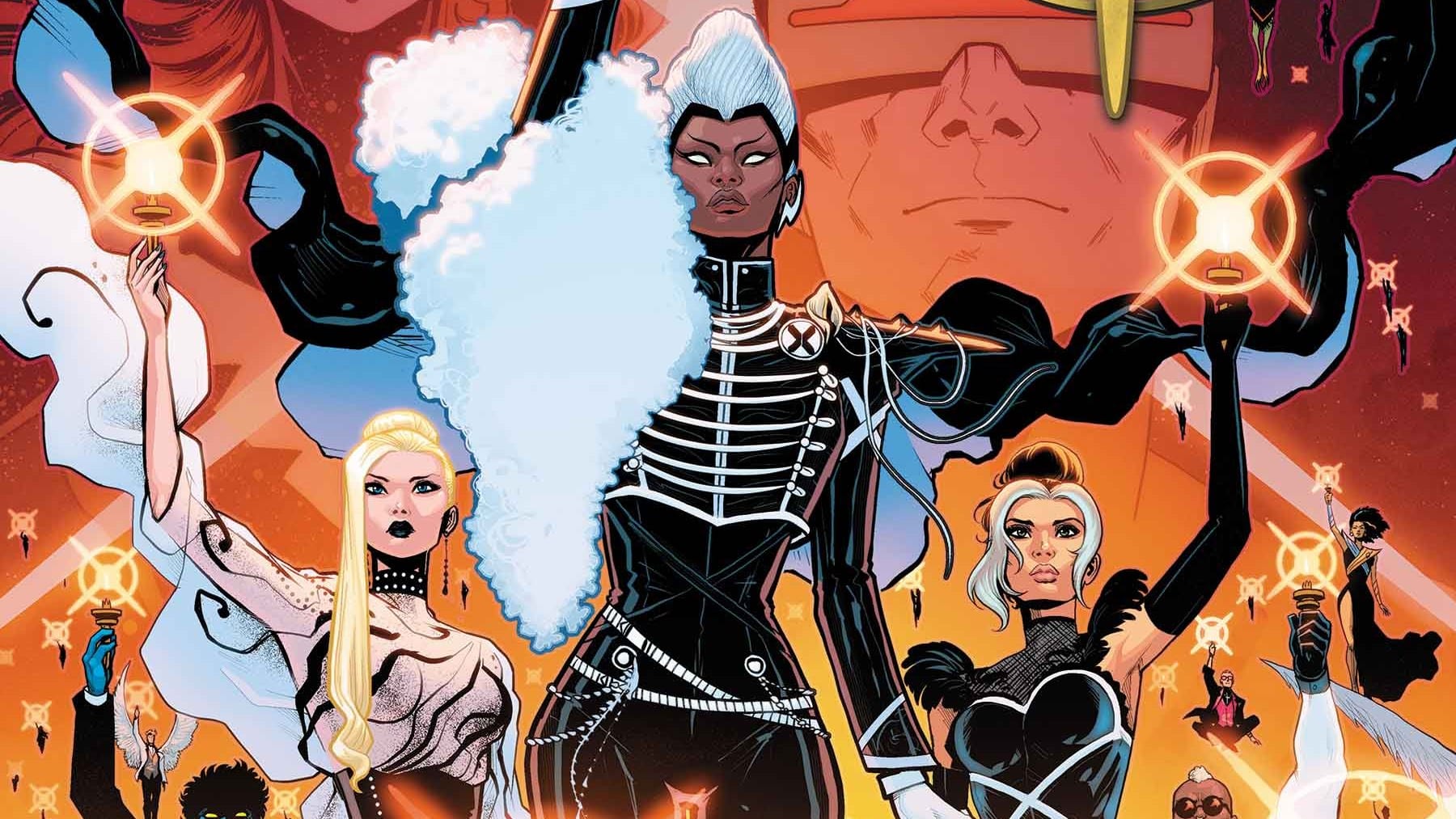
One year ago, at the final Hellfire Gala, the dream of a unified mutant nation was forever shattered by a cowardly sneak attack by anti-mutant forces. To mark the moment and to proclaim loudly and strongly to all concerned that mutantkind still stands, the time has come for X-Men of all stripes to come together in solidarity and celebration. X-Men: The Hellfire Vigil #1 is written by Jackson Lanzing, Collin Kelly, Jed MacKay, Stephanie Phillips, Geoffrey Thorne, Gail Simone, Eve Ewing, Alex Paknadel, Jason Loo and Murewa Ayodele; drawn by Javier Garron, Netho Diaz, Roi Mercado, Marcus To, Luciano Vecchio, Federica Mancin, Declan Shalvey and Sara Pichelli; inked in part by Sean Parsons; colored by Fer Sifuentes-Sujo; and lettered by Travis Lanham.
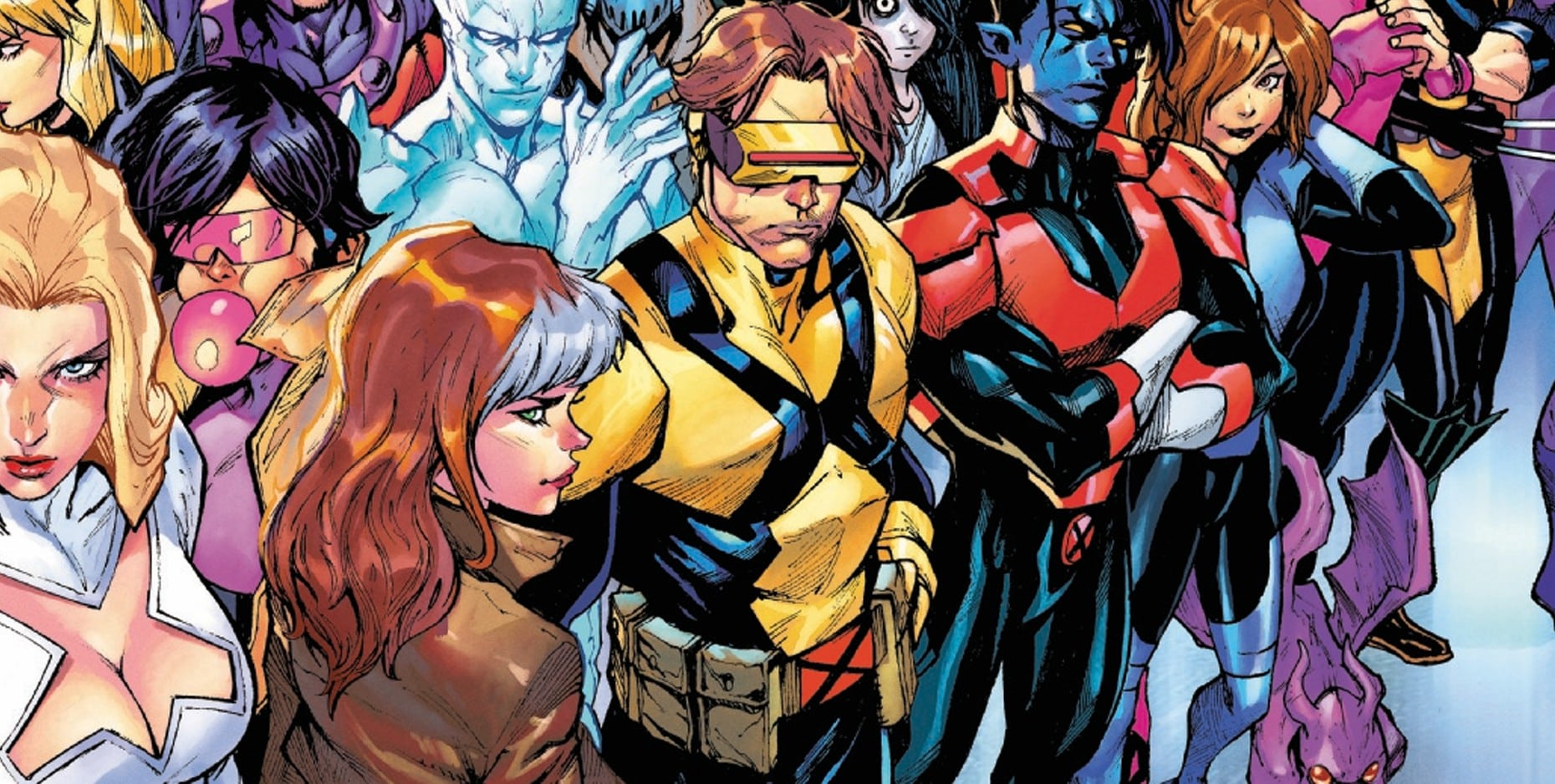
Anna Peppard: We are gathered here today to mourn the death of a place that isn’t actually dead and an idea that’s still worth fighting for but not with violence or words or any tangible actions of any kind. If we’re tagging ourselves in the first splash page: I’m Brian Braddock holding my candle like a shot glass, wishing I were less sober. But people are kissing, and that’s nice! More kissing, less candles, please.
Adam Reck: I feel like my fan fave Bishop here, wondering why I haven’t been in a book since last year’s Timeslide, wiping a nonexistent tear, staring into the middle distance and wondering why I’m allowed to be on page.
Austin Gorton: Doop here, staring side-eyed at Cable, wondering if he’s here before or after he was in the future falling in love (and chrome) and yelling at Jean Grey’s sister in space.
Jude Jones: I feel like I need to have a memorial for my record player too, because no matter what I put on, I keep hearing the same broken record over and over: I don’t like it, it’s not what it was, none of this makes any sense logically or in continuity. Sigh.
Jake Murray: Greetings from the White Hot Room! Wait … what are those candles and solemn faces all about? We’re still here! Guys?! Guys?! Hello?! (Fades into the ether).
Tony Thornley: I think this is gonna be the same crowd as what we saw at the final Hellfire Gala. But what a big issue, full of great character beats and weird platitudes and speechifying.
Why Are We Mourning?

Jude: The current iteration of ComicsXF in large part exists because of Krakoa. I, in large part, exist because of ComicsXF. So by the transitive property, both figuratively and literally, Krakoa is why I’m here. So excuses if my thoughts are a bit melodramatic, but this is ass and I’m personally offended. Not because it’s bad, not because it took a swing and missed (I’d prefer that!), but because it’s cynical, forgettable and unnecessary.
Tony: Yeah, I think that cynicism is captured perfectly in Cyclops’ grouchy unwillingness to attend. We get this out-of-left-field reverence for Krakoa, and then the ultimate defender and champion of the nation just doesn’t want to go because his wife isn’t around to be his date? It fails on any level to capture the spirit of that era.
Anna: This comic feels all kinds of fanservice-y, yet reading it I kept wondering: fan service for whom? The writers (or editorial mandate) that created this comic seem to think we liked Krakoa because it was a utopian safe space without any complex problems, a heaven where nothing, nothing ever happens. (Thank you, David Byrne.) But while Kamala Khan, a mutant who never actually lived on Krakoa, might feel that way, that’s sure not why I liked Krakoa. I don’t want to say the safe-space dream wasn’t part of it, because of course it was. But singling that out as the only thing worth commemorating about this place – and this groundbreaking era of comics – negates the sometimes intentional, sometimes less intentional messy complexity of this place and these comics. In addition, Krakoa wasn’t just a refuge, it was a provocative statement of identity, in which members of an oppressed minority claimed safety by embracing their power. I can’t catch a whiff of that provocativeness in anything that’s presented here.
Jake: The symbolism of a “vigil” — to stand in quiet contemplation, to observe, to remember — becomes an ironic self-criticism of what this era represents in that there’s no call to action, no defiance, no sense of community. There’s a lamenting acceptance of mutants’ marginalized existence, which comes from focusing on the individual rather than the collective. The dialogue is almost exclusively focused on individual characters’ situations, or just small talk. There’s almost no discussion about their experiences or reflections of Krakoa, or more importantly the lessons they as a community should take from it. I get that it’s partly about moving on from Krakoa, but no one could accuse this era of failing to do that in its first year of publication. Fundamentally, this issue raises the same question I have about a lot of this era: Why does this comic exist?
Adam: What are we even mourning here? Because an event like this makes it seem like the end of the Krakoan era was a somber, dark ending. It wasn’t! Yes, there were tears as Krakoa ascended, but this creative team seems to have forgotten the part where not only were all the victims of the Genoshan genocide resurrected, but all mutants were given the choice to stay on Krakoa. If we’re seeing them here, it’s because they chose to stay on Earth. So to have an entire event that’s funereal, with black mourning clothes and candles, doesn’t make sense with the ultimately hopeful ending of the previous era. So what are we actually doing here? Trying to catch a whiff of readers’ nostalgia? Banking on recapturing the magic of a rejected era? The central problem is that instead of doing something new, this era doesn’t seem to have enough “new” to substantiate a reason to bring all these characters together. So we get whatever this is.
Austin: This is crossing all kinds of weird boundaries between in-universe and real world motivations. On the one level, a “vigil” for Krakoa seems pointed directly at us — or at least the readers who mourn what that era of storytelling meant. Yet we also know the creators of the current stories — or at least the current “Conductor of X” — isn’t that big a fan of that era, which makes the publication of an issue dedicated to remembering and mourning it seem, at best, odd, and certainly crassly commercial at the very least.
What the in-universe characters are presumably mourning is the loss of political power, the feeling of safety afforded them by Krakoa — which is a thing that went away at the hands of the (real world) people crafting this story about how everyone is sad about their current status quo. So we end up with a story in which the creators have the characters mourn what’s been done to them by those same creators in their effort to repudiate the Krakoa Era, all presented as a means by the creators to try and cash in on the readers unhappy with their repudiation.
Jude: Why mourn Krakoa, since the island and its people still exist, just in another plane. They’re not dead! They made a choice! So if you’re mourning anything, you’re mourning the influence of the Krakoan state and mutantdom’s resulting freedom. But if you’re mourning freedom, then you wouldn’t let one of your own be captured by fascists on stage. A mourning Dazzler wouldn’t have told mutants not to resist. Mourning does not mean being complicit, as anyone alive in 1968 or 2020 can tell you.
Tony: More than anything, it feels like the mourning is strictly to connect the new kids and characters who had little to no connection to Krakoa (like Dazzler, Idie and Kamala) to the idea and dream of Krakoa. And for the former group, that doesn’t work at all. The latter, it does have some varying success — Dazzler, not so much, especially with her lyrics painting a Krakoa that didn’t ever exist because it was still in its growing pains. For Kamala, it does a bit, because she gets to reflect on her identity that she’s still struggling with, with her best superhero friend that she doesn’t get enough page time with, but then it never circles back around. And for Idie, it doesn’t at all, but she still gets this wonderful character moment that almost negates how poorly the special handles her mutant identity.
‘Star-Crossed Lovers’

Anna: At my insistence, Adam briefed me on this issue’s romantic pairings shortly before I read it, and at first I made a face like, I dunno. Then I read the thing for myself and was like, OK, you got me, those were some nice kisses, particularly the one where Jean lights Scott’s crotch on fire and the one where Idie tugs longingly on Ransom’s bottom lip. While I’m skeptical about these books maintaining this romantic juice (the fact that none of the constituent members of these couples are regularly in the vicinity of each other virtually guarantees it’ll be months before they even have the opportunity to kiss each other again), I will accept, with reservations, this salute to Krakoa’s famed horniness. (The reservation is that all the couples are straight, which is fine on its own but feels conspicuous because of how badly this issue seems to want to benefit from ideas of community that owe a heavy debt to queer communities.)
Tony: I’m with you so much on this, Anna. And as far as the couples being aggressively straight, yes, and it’s compounded by the fact that the X-Men’s two most prominent queer characters — Iceman and Kitty Pryde — actively avoided going to the vigil. Meanwhile, the line’s most charming new queer couple — Jitter and Calico — literally get a dialogue-less panel, and then they’re out.
But like I alluded to above, and Anna said right before this, Ransom and Temper’s moment is SO GOOD. It almost made me forget that Idie was in The Pit for the entirety of Krakoa, and it’s so out of character for her to be celebrating something that literally sidelined her.
Anna: THANK YOU. It is incredibly strange for Idie to be mourning Krakoa given that whole “being unfairly sentenced to The Pit then having to escape and become an on-the-lam revolutionary who could never return to the supposed mutant utopia” thing she had going on. If we’re mourning the idea of what Krakoa might have been, I sort of get it. But ignoring Idie’s presumably complicated feelings about this vigil is another example of this comic not really earnestly engaging with its premise. (There I go complaining again when I can just enjoy the kisses.)
Adam: While I appreciate the romantic efforts of coupling young characters from various X-books, I bump up against the idea that these are star-crossed lovers insofar as we still have no idea why these groups are oppositional in the first place. Wolverine makes a comment about Idie and Ransom that makes it seem like Ransom just went on a date with somebody from Orchis, which is enough to remind me that even a year after these books launched we still have zero clue what the beef is.
Austin: Adam, the beef is something something Cyclops, something something Xavier, something something the fate of all mutantkind.
Anna: They’re also like, it can never work; we live in different places! And I’m over here like, you know long-distance relationships are real, yeah? Also you have multiple friends who are teleporters? Romeo and Juliet wish they had it so good.
Austin: Idie is on a team with someone in the most long-distance relationship of all, something highlighted in this issue.
Tony: Scott and Jean’s From the Ashes reunion was SO overdue, and I was incredibly glad for that, despite how weird and out of place Jean’s vignette from earlier in the special was.
And hell, even one sweet moment that wasn’t romantic, just a great moment of interpersonal connection, melted me. Psylocke teaching Deathdream to dance was far and away my favorite character moment of the special. It was so sweet that it made me forgive the fact that the art made it unclear whether it was Kwannon or Jubilee teaching him for a moment.
Adam: For a second I had a cruel thought of Betsy’s ill-fated interactions with young Doug Ramsey before remembering that this was Kwannon and that this was actually pretty sweet given Psylocke’s backstory of a lost child.
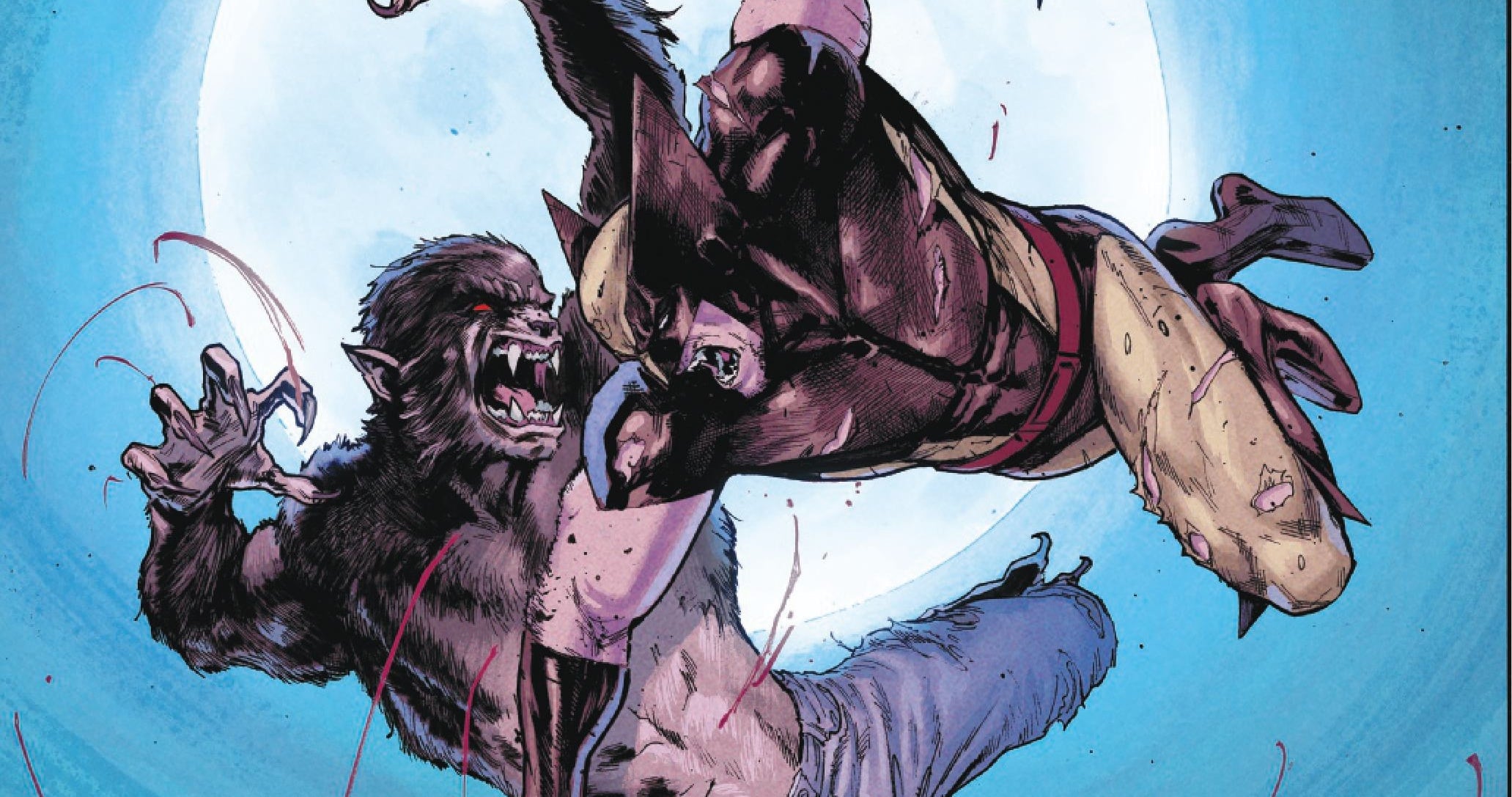
Jake: The Beast scene was interesting to me for a couple of reasons. I generally have some misgivings over the use of the “freak like me” trope, but the vulnerability Netho Diaz captures in Hank’s eyes during this scene sold me on it. Beast rediscovering his humanity after having been reset after an “alternate” version of him fell off the moral deep end is a beat MacKay has been carefully building, and I felt it paid off here. Framing the scene through Dazzler’s song “Beauty and the Beast” is fairly predictable but is still effective. As well as symbolizing Hank’s inherent duality, it’s steeped in history, whispers of past lives and hope for the future.
Austin: That said, Beast is another “why is he here/what is he mourning?” inclusion, since this Beast was barely on Krakoa, and if anything, probably doesn’t like Krakoa since it’s the setting of his alt self’s full embrace of genocidal supervillainy.
Anna: For personal reasons, I seldom want good things for Hank McCoy, who is a bad person and should rightfully be a villain. (I said what I said!) But I was extremely here for the callback to Ann Nocenti and Don Perlin’s extremely (wonderfully) strange Beauty and the Beast miniseries, in which Hank and Alison share a nascent romance and get embroiled in an illegal gladiatorial fight club run by the vengeful son of Doctor Doom.
Austin: Pour one out for Alexander Flynn.
Model Minorities Get Arrested Quietly

Jude: The essence of Krakoa was the disenfranchised becoming franchised with a vengeance. Thus, this interpretation of both Krakoa and mourning is disconnected from reality to the point of deceit. It gives, in my not so humble opinion, comfort to those who only want to see marginalized mutants (and non-mutants) if they’re hated, feared, yet still proclaiming fealty to those who espouse hate and fear toward them. This would be merely annoying in another time; in 2025, it feels irresponsible, bordering on dangerous to platform this ideology. Again, am I melodramatic? Maybe. Accurate? Always. More than I can say for the comic. Anyway, I’m off my soapbox.
Anna: My core complaint about the post-Krakoa X-books isn’t that they’re bad. In a vacuum, some of them are actually quite good, and most of them at least look very good, courtesy of some top-tier artists doing top-tier work. What these books are is safe, following an era that wasn’t, at a time when being safe is nowhere near enough to meet the needs of the moment. Dazzler deferring a conflict with quasi-governmental officials whose stated aim is imprisoning and eradicating mutants is yet another safe choice, where a book is ostensibly making a statement about minority rights and institutionalized racism, but it’s a point that basically boils down to: Oppression is sad but inevitable, let’s cope by mourning harder.
Austin: Mmm … mealy mouthed centrism …
Tony: It was even harder to swallow for me because Jamie, Guido and Domino fought SO hard leading up to it, and then it happened literally in front of some of the most powerful superheroes on the planet, including at least one Avengers reservist. What the hell?
Adam: Especially given the current context of *looks around* it’s especially dispiriting to see a gathering of this size, of this many heroes, simply allow Dazzler to be taken by what has been revealed to be a federally backed prison that tortures mutants. What is heroism for the mutant community if not to act heroically in protecting one of their one? I was not only taken aback by how much of this issue was essentially a continuation of Jason Loo’s Dazzler mini, but that the resistance offered was solely by her security detail. We’re not that far off from Cyclops’ speech in X-Manhunt where he argued that Xavier should stay in Graymalkin prison so they could maintain the appearance of a model minority. That this issue doubles down on that idea, especially because of the “world outside our window,” just makes me incredibly sad.
Jake: Seeing the parts awkwardly slotted together in this issue revealed the gaping lack in the whole for me. It’s timely to evoke Jim Shooter’s editorial philosophy of “every issue is someone’s first,” and large parts of this issue read like Cliff’s Notes summaries of the From the Ashes series, yet it was incredibly unclear what other purpose this issue served. By the time the creative team handover was complete and the current state had been established, there was little time for any new story ideas to emerge, and conveniently so. The fact that editorial decided to spend 50+ pages on the quiet shuffling of chairs back into orderly rows rather than even attempt a modest rearranging of furniture symbolizes this era’s lack of vision and clear perspective.
Austin: I was expecting this to be more of a launchpad for a new wave of From the Ashes books, or a recontextualization of the From the Ashes premise, or maybe, corporate forbid, an evolution of that premise. Instead, it’s like a sampler platter of all the current books, and also, a wrap up for others (X-Force, Dazzler) which … why?
If this was a Free Comic Book Day release, I could maybe see the point: “Hey, here’s a bunch of characters generally written and drawn by their ‘home’ creators. If you like what you read, check out their books!” But that’s not really what this is being sold as, chiefly because the unifying element is, at least theoretically, remembering the previous status quo (a status quo the current editorial regime doesn’t even like).
Tony: I completely agree. There was ONE thing in the entire special that genuinely felt like a launchpad for a new story. There’s nothing setting up new series, new status quos, new characters, anything. There should be hints here to roster shake-ups (specifically Colossus joining one of the many teams), there should be villain machinations (how did neither Mystique nor Destiny not have a single line of dialogue?), maybe some hints of what the Avengers are going to do next to help them, something.
Instead we got “Krakoa is dead, we’re sad, see you in this week’s issue of X-Men!”
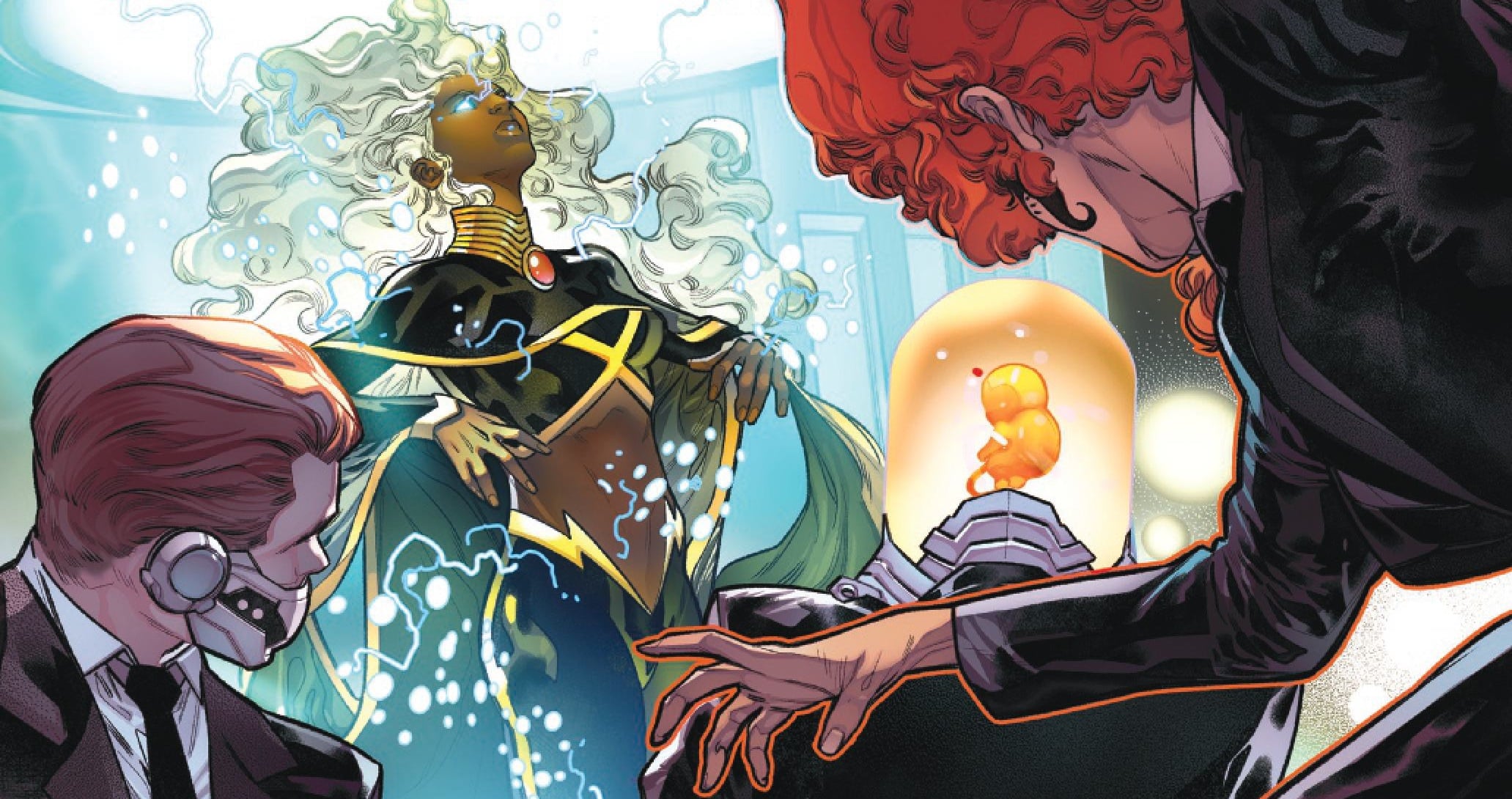
Ororo Mom-roe

Jude: For a woman often called mother endearingly, I was surprised to see Storm granted the title literally. In what I argue is the most (only) significant moment in the comic (not that I’m biased!) we find out that Storm, eventually, will become a mom to a child named Furaha, or Joy in Swahili. All kinds of questions arise from this: When will this happen, or is it just a fever dream granted by Eternity for her inspiration and our comic consumption? How will the pregnancy be portrayed? And, of course, who is the child’s father? Storm has more than a few kids in different timelines (see versions of Azari in Next Avengers and Aliens vs. Avengers), most of them with her former husband and, after today’s Avengers, maybe current(?) boyfriend T’Challa. The description of this father — black hair, fangs and a power set that deters bullies — clearly means to invoke Wolverine, whom Storm had a fling with (unless T’Challa kept his fangs from his time as a vampire). Will a lot of comic fans have feelings about this? Sure! Will those feelings be rational? Nope! Do I think Marvel editorial would change both characters so significantly to make them co-parents? Absolutely not! Thus, I’m more intrigued as to how this will be walked back than I am invested in seeing it play out. Still, given the numerous “616” references given by the future Furaha, the seemingly inevitable child of T’Challa and Storm appearing soon in the Ultimate Universe, and years and years of implications and attempts, it would not surprise me to see a pregnant Storm soon. Hopefully her suitor is tall, regal, with a full beard.
Not that I’m biased or anything.
Tony: Honestly though, I wouldn’t mind a short Canadian, even if Furaha’s complexion hints to a less European father.
Anna: There are a lot of superhero pregnancy stories that revert to tired cliches. There are also a lot of stories in which children of superheroes get forgotten or retconned out of existence because, besides putting them in danger to add emotional stakes for their parents, very few writers seem to know what to do with them. Given this history, this potential revelation involving Storm’s daughter makes me a bit nervous. But as Jude notes, there are a lot of variables and moving pieces and things we don’t know. For now, all I know for sure is that as always, Vecchio draws a gorgeous Storm, glorious in her irrepressible power and stinging, raw emotion.
Tony: Considering how literally every superhero child is either written out or aged up immediately, I kind of hope we never actually get Furaha on page, just a promise that she’s real and will someday be part of Ororo’s life.
Adam: I have huge reservations about this development. Only because superhero comics in general have such a difficult time with kids as valid characters. Right now, the storyline is meant to evoke emotion through the possibility of motherhood. When it comes to actual children being written into X-stories, they are either aged up (Cable, Hope) or written out (Shogo). Knowing that Storm has already had children in past stories — anyone remember Kymera? It’s OK, writers didn’t want to — doesn’t inspire a great deal of confidence in how this will go long term.
Anna: Speaking of motherhood, did anyone else find it odd that Krakoa, aka the island that walks like a man, was being described as a mother here? Obviously, living islands don’t need gender and/or can identify however they want. But I don’t remember the island being associated so heavily with maternal imagery in the past?
Tony: Oh, you’re totally right. Krakoa is heavily male-presenting when we see him in a humanoid form. It’s weird to call him mother.
Adam: And not a single mention of The Five. Or Hope. In a different version of this, the vigil could have been about the loss of resurrection, or the desire for a second age of Krakoa, but that’s not this book.
Party Crashers

Tony: I just have to wrap up on the final scene. I actually love the trope of a villain hijacking a broadcast to monologue. I think it’s great. And 3K outing themselves to the world, even better.
But man, it needed one more page to reveal the Chairman. What a missed opportunity.
Austin: Aside from the weird bit with Phoenix and crystal ghost people in space, this ending was the one bit that seemed like a look forward instead of a look back, at least in terms of potentially hooking readers to pick up one of the ongoing books. Also, there’s something mildly refreshing in 3K watching Magneto wield a Sentinel last month and saying, “wow, what a propaganda win this could be for us” and then immediately deploying it.
Anna: I liked it, because this vigil needed some stakes and revelations. But similar to a lot of the logos this era’s been using, it also felt very ’90s/early 2000s. Mutants fighting mutants is fine, I guess. But remember when we were trying something different? For all its gestures of mourning, I’m not totally sure if this comic actually remembers that.
X-traneous Thoughts
- The all-star art ranges from good to great. It’s almost good enough to recommend picking it up for the pictures. Almost.
- If Sobunar, Forge and Local can use their powers as a mutant circuit to recreate the gates, why not just leave them in key places so anyone with a pin could travel between them?
- Arakko didn’t RSVP. Wonder if that’s just because we already had too many mutants on panel or whether editorial doesn’t want to touch the red planet with a 10 billion foot pole.
- Siryn appears briefly, showing that while she’s under Podcaster Ellis’ control, she still maintains a bit of restraint and personality. Far from being a mind-zapped zombie.
- Bronze is looking for merch for Dazzler’s new mentee, Kitsune. Unclear who this is, as the character did not appear in the Dazzler mini or Concert of Champions.
- Really glad to see John Wraith speaking actual words and not just yelling Bible quotes.
- Jean sees dead people. Assuming these crystal ghosts will potentially explain the return of her sister, Sara.
- Now we know why Colossus was wearing that helmet while operating as Tank in X-Force (to prevent being mind-controlled). And what the name “3K” means (the group’s stated goal is for mutants to rule the Earth and all humans to have been eliminated by the year 3000, which, hey, at least they’re giving themselves a wider window than most to enact their goals). So that’s something.
Buy X-Men: The Hellfire Vigil here. (Disclaimer: As an Amazon Associate, ComicsXF may earn from qualifying purchases.)

Anna Peppard
Anna is a Ph.D.-haver who writes and talks a lot about representations of gender and sexuality in pop culture, for academic books and journals and places like Shelfdust, The Middle Spaces and The Walrus. She’s the editor of the award-winning anthology Supersex: Sexuality, Fantasy, and the Superhero and co-hosted the podcasts Three Panel Contrast and Oh Gosh, Oh Golly, Oh Wow! Follow her @annapeppard.bsky.social.

A proud New Orleanian living in the District of Columbia, Jude Jones is a professional thinker, amateur photographer, burgeoning runner and lover of Black culture, love and life. Magneto and Cyclops (and Killmonger) were right. Learn more about Jude at SaintJudeJones.com.

Adam Reck is the cartoonist behind Bish & Jubez as well as the co-host of Battle Of The Atom. Follow him @adamreck.bsky.social.

Austin Gorton also reviews older issues of X-Men at the Real Gentlemen of Leisure website, co-hosts the A Very Special episode podcast, and likes Star Wars. He lives outside Minneapolis, where sometimes, it is not cold. Follow him @austingorton.bsky.social.

Tony Thornley is a geek dad, blogger, Spider-Man and Superman aficionado, X-Men guru, autism daddy, amateur novelist and all around awesome guy. He’s also very humble. Follow him @brawl2099.bsky.social.

Jake Murray spends far too much time wondering if the New Mutants are OK. When he's not doing that, he can be found talking and writing about comics with anyone who will listen. Follow him @stealthisplanet.bsky.social.