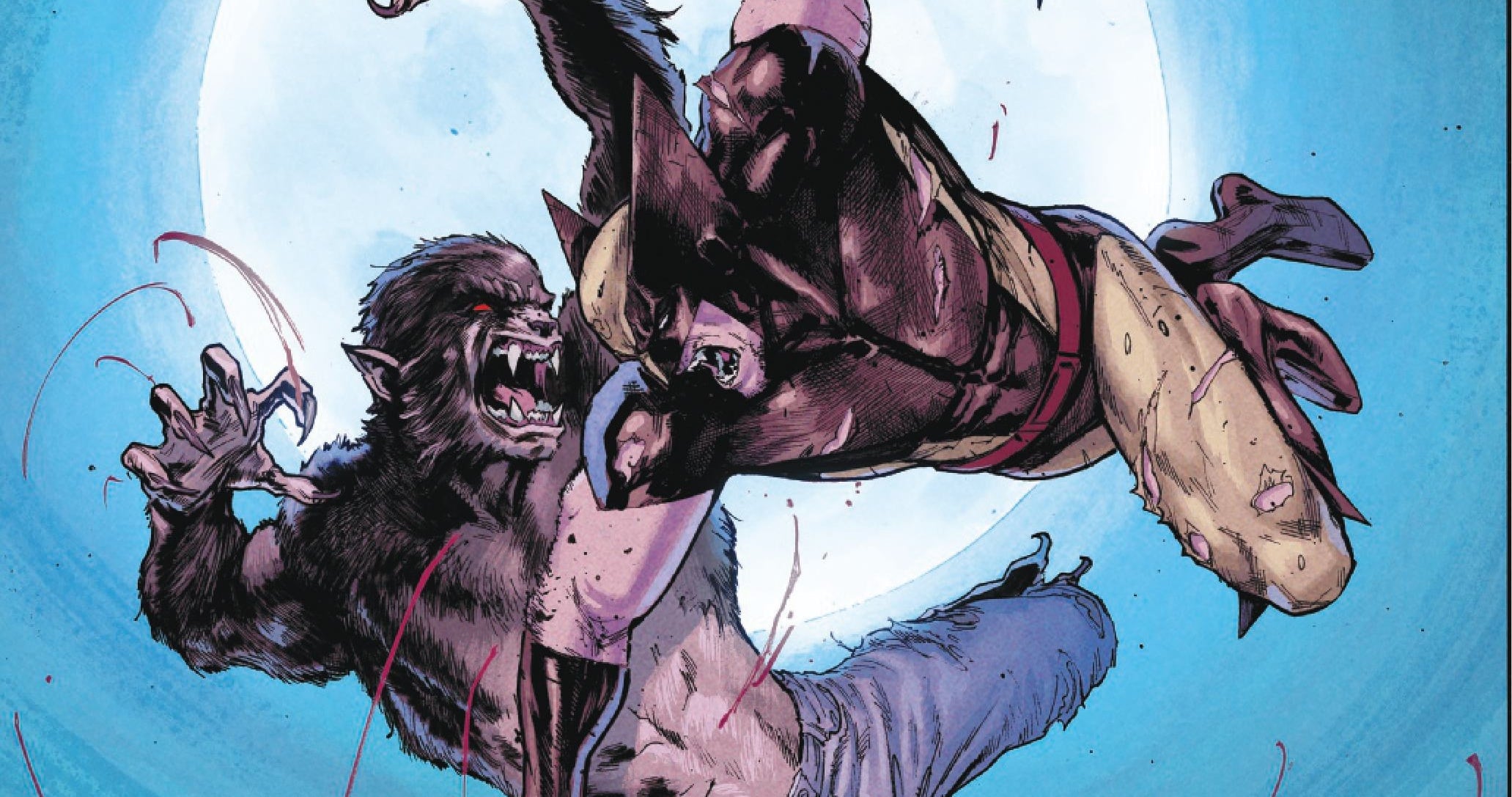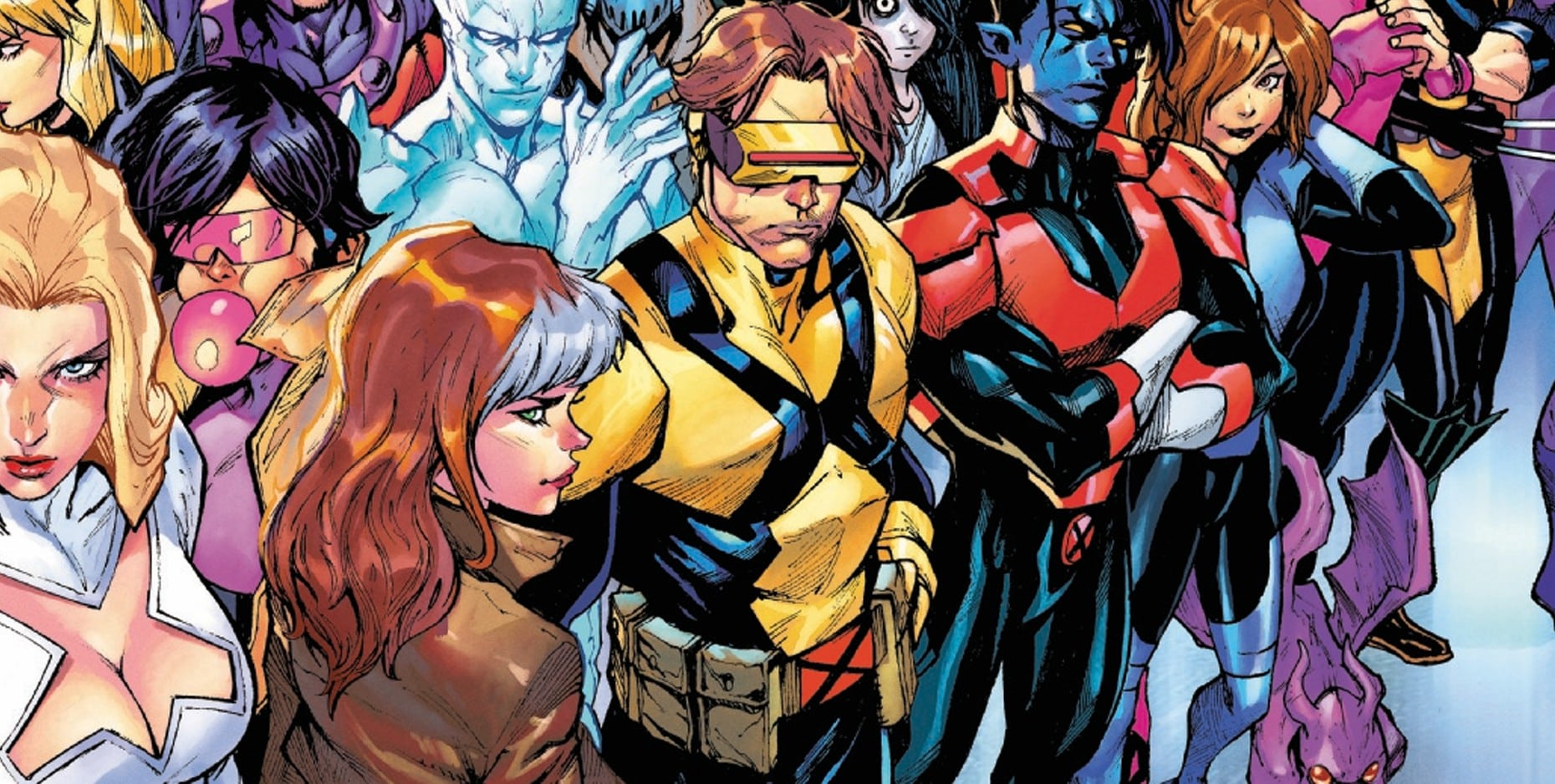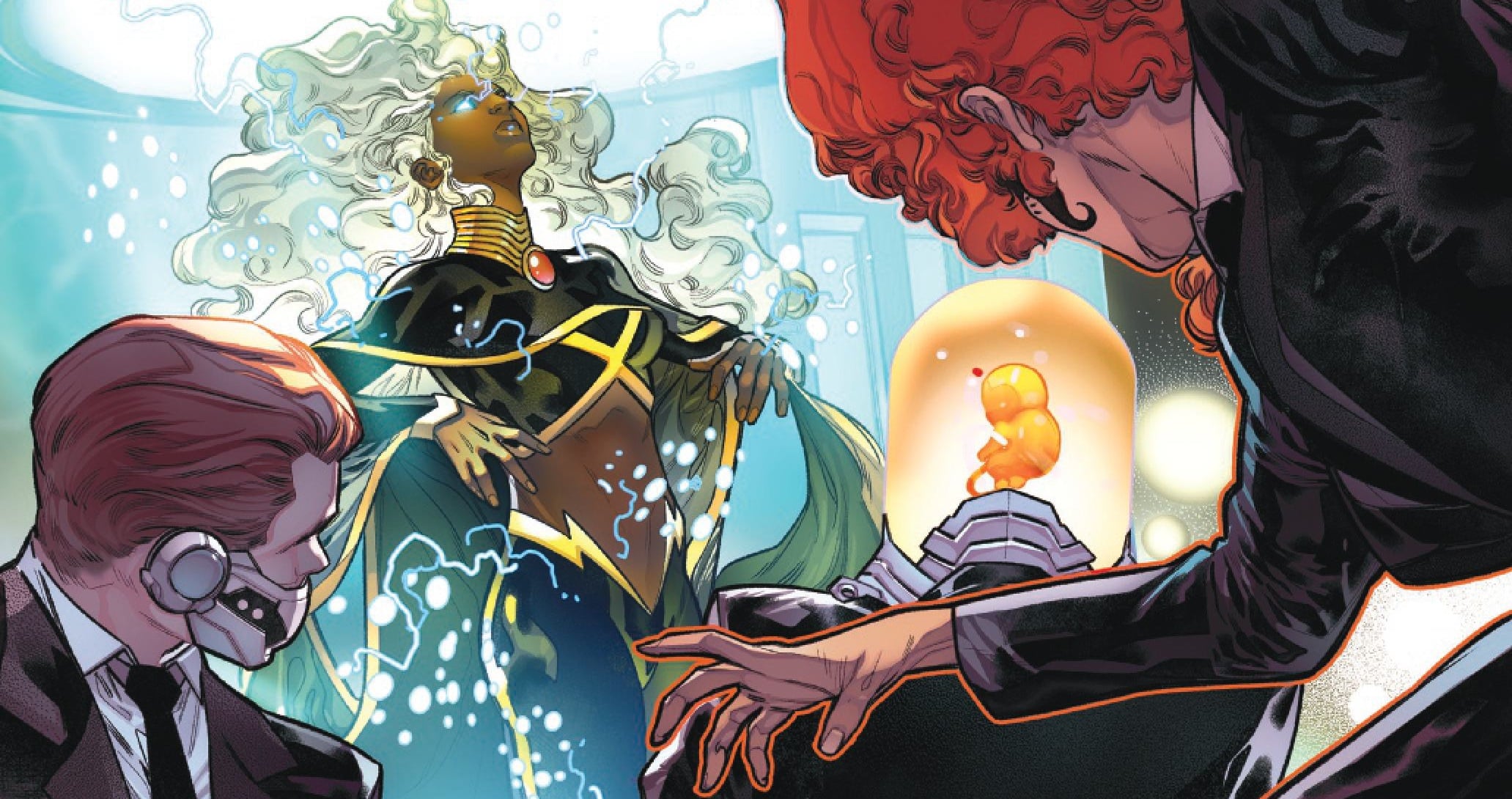
When a brilliant but exploitative Hollywood director makes a surprise hit horror film featuring a serial-killing mutant girl, there are protests at theaters around the country and a rise in anti-mutant violence in those same communities. But is it “just a movie,” or is something much more insidious going on? Will a malignant force make the X-team their prey? Will they get out alive, or will it all end in misery? Uncanny X-Men #17 is written by Gail Simone, drawn by Luciano Vecchio, colored by Rachelle Rosenberg and lettered by Clayton Cowles.
Adam Reck: I was really looking forward to this issue. Especially as a horror movie fan, the idea of the X-Men having their own horror movie character/villain in the universe, especially one that seemed more than a little modeled after M3GAN made me really excited. Now that I’ve read the issue, I’m not exactly thrilled.
Austin Gorton: In terms of its strengths and weaknesses, this issue feels like Simone’s run on this book in microcosm: A focus on the Outliers, who continue to be delightful and rendered as distinct, entertaining characters? Check. Gorgeous art? Check. Backpedaling the actual X-Men perhaps a bit too much (including an increasingly annoying depiction of Rogue as a wannabe helicopter parent)? Check. A villain that sacrifices clarity and distinctiveness for narrative mystery, thereby muddling whatever is trying to be said with that villain? Check.
Adam: I’m annoyed about this too because we both genuinely enjoyed the last arc and this marks the start of Vecchio’s time on Uncanny. We’ve been on a good run, but between this and last week’s Hellfire Vigil, I feel like we’ve taken a step back.
Tipper Gore Goes to the Movies

Adam: Hey, remember the Parents Music Resource Center? Where Tipper Gore tried to convince Americans that listening to Twisted Sister would send underage listeners on a killing spree? The one that resulted in the famous “Parental Advisory” sticker that just made kids want the records more? Or how about Joe Lieberman famously decrying Mortal Kombat as if children were going to suddenly start ripping each other’s spines out? Hearings that would inevitably result in the ESRB rating system for video games?
Austin: Boy, do I! I was just young enough to miss the impact of the early ’80s Satanic Panic, the attack on D&D, etc. But I came of media consumption (and flexing my own interests and tastes in such) age right in the midst of the Tipper Gore-driven panic. This opening clearly draws on all that.
Adam: I couldn’t help but think about our American history of hand-wringing over the media because the beginning of this issue reads like a straightforward PSA against horror movies, complete with talking heads. Specifically, we get a mix of Marvel characters and actual, real-life folks like Black Phone short story and screenplay co-writers (and son of Stephen King) Joe Hill and C. Robert Cargill, Wynona Earp TV writer Emily Andras and novelist Nancy Collins. While our industry pals have a variety of opinions, the X-Men all seem uniformly convinced that a mutant slasher is not just in poor taste, but that it will result in increased anti-mutant sentiment and maybe even anti-mutant violence.
And given the number of horror movies that come out every year with a wide variety of evil villains and monsters that don’t result in any widespread real-world violence, this is a very odd premise that not only suggests audiences don’t know the difference between fiction and reality, but that fictional media directly — and quickly — results in real-world behavior.
Austin: I just don’t really know what Simone is going for here. Is this a commentary on the concept of “moral panic” and the kind of talking-head interviews they inspire (which are recreated here)? Or commentary on “other-ism” in film and larger pop culture stories, of consistently putting non-white, non-male figures in the monster/villain role? And if it is, is it pro? Con? And/or commentary on the discussions of other-ism in stories? I can’t quite wrap my head around it.
Adam: I am also confused, since Simone is a widely respected genre fiction writer who also occasionally writes horror. So I’m really at a loss for what she wants our takeaway to be here. Even in the most transgressive of instances, horror movies can be adopted by the very communities they sought to exploit (think trans folks taking ownership over Sleepaway Camp for instance). But when I try to put the pieces together, I end up with real-world analogs like Candyman. But that film works as a scathing critique of racial stratification since Reconstruction, not a call to arms against Black people just because the movie’s “monster” is Tony Todd. I feel like something is really getting lost in translation here, and I’m missing the point.
Rated C for Cimmonom

Adam: Deathdream ordered EIGHT cinnamon pretzels and Ransom ordered TWO collector’s buckets of popcorn. That plus four night-time movie tickets could’ve easily cost the Outliers what, $200?
Austin: I mean, just the collector’s buckets are an easy $100 for the pair, and that’s in my Midwestern neck of the woods. Also, I know these are ravenous teens, but that seems like it’d be a lot of food even for my teen self at its most ravenous.
Adam: It’s a Tom Cruise level of popcorn, that’s for sure. Let’s talk about the movie itself, given we only see one scene of it. What did you think?
Austin: I think I’d rather have seen Otter Party?
Adam: Me too! That sounded fun.
Austin: It’s fine. Again, maybe I’m trying to read too much into it (but in my defense, the comic seems to be asking me to), but it seems notable that the victim is both a bully (at least as far as Mutina is concerned) and a non-white female, while Mutina is a, well, mutant. That seems notable. But I’m not sure why?
I love a good “bullies get their comeuppance” story, though.
Is Mutina Carrie?
Adam: Honestly, we don’t know! And as much as I can appreciate a good poolside slasher scene, the sole peek at the movie doesn’t really give us much insight as to why the Outliers aren’t into it, or what the film was trying to say (the director claims it’s not anti-mutant), or even how it ends.
Afterward, the Outliers are accosted by bullies over diner dinner. It’s unclear if the jerks were influenced by the movie or not, but after Deathdream causes one teen to see his dead dad, Calico yet again wonders if mutants are monsters or not. I thought we’d gotten past this character development, but old traumas die hard.
Austin: The Calico stuff feels like a continuation of her backpedal in the last issue. I don’t love it, but hey, not all character development is a straight line/progressive. Moreover, it sure seems like this sequence is meant to mimic the film — bully/bullies attack(s) mutant(s), mutant(s) fight(s) back — which … yah? I mean, I have no problems with that, but events later in this issue seem to suggest I should?
Two Thumbs Down

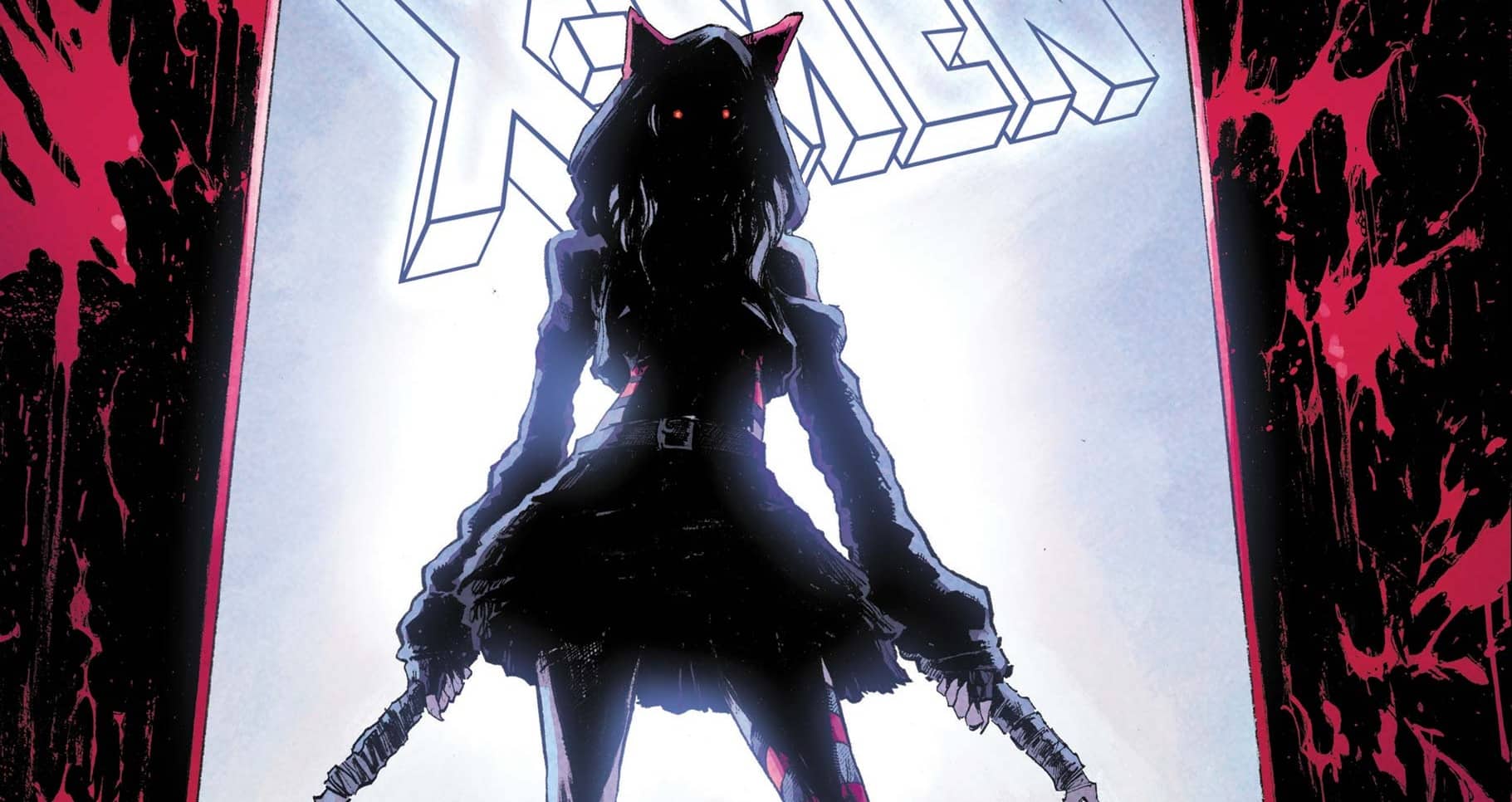
Adam: Jitter and Calico decide to check out what’s up with the actress who plays Mutina and find … she’s the literal character? Not someone portraying Mutina, just Mutina. That’s weird. I don’t think that’s how movies work. But I’m willing to go with it as long as Mutina is interesting. Unfortunately, she’s not much more than an (psychic, shadow-hiding) anime cosplayer who streams with a bag on her head about hating mutants, I guess.
Austin: Is she a mutant? Is she a telepath? Does she disappear in shadows like Nightcrawler sometimes? She has powers, so she’s not just a cosplaying anti-mutant human, but maybe she got her powers some other way? If she is a mutant, why does she hate mutants? Or does she just not like the X-Men? Does the director or the studio know their star isn’t acting? Does the fact that the villain of the movie is a real-life anti-mutant villain make the movie anti-mutant?
You might say none of those questions matter, or that there’s more to Mutina’s story and we’ll find out eventually. But in terms of a response to this specific chapter of the larger serial narrative, some specificity matters. It’s hard to parse out what this character and this story are trying to say without knowing more about how all this is supposed to work and what Mutina’s deal as a character is.
Squint, and you could see a scenario where the X-Men have learned a horror film is being produced by some kind of anti-mutant faction, or that they’ve cast an evil mutant as the villain, and thus, the X-Men are worried about the impact of the film on human/mutant relations should it prove a hit (like they are at the beginning of the issue). But that’s not what we get here. There’s just a movie coming out, as far as the X-Men are concerned, and the villain is a mutant, and they’re concerned with how that’ll play. Then it turns out the (movie) villain is an actual (comic book) villain. Which … OK?
Adam: I have to say, I think the actual character of Mutina is going to disappoint readers. I’ve already seen fan art from artists excited about the killer design. There are already variant covers for this issue featuring this character, and ultimately she’s a dud. Her master plan of movie stardom to spread hatred makes no sense given her already successful hateful internet presence. When she threatens the X-Men with a “greenlit sequel,” shouldn’t everybody just shrug? Maybe I don’t know how movies work.
Austin: Maybe Simone is going for Arcade-like patter, where everything Mutina says is framed through the lens of movies? Like, she tries to slash someone and says, “you’re going to end up on the cutting room floor!” “Villains always come back for the sequel!” she cackles as she makes her escape. Stuff like that.
Adam: I just don’t know.
X-traneous Thoughts
- You just know Nightcrawler was in one of those “poor circuses in winter.”
- Anybody else ready to go see Otter Party with the singing lobster? Sounds like a good time at the movies!
- The Outliers go back to school (the school they’ve only ever been to for one day) and already two of them are suspended because of a misunderstanding about locker graffiti.
- I like Gambit’s parenting strategy of barely commenting on the kids’ suspension and immediately offering them ice cream. Classic Remy.
- Lest Marquez have all the fun, Vecchio gets to draw Logan bare chested under some overalls and Kurt open-shirted. Check out the ComicsXF Interview Podcast to hear Marquez talk about X-nudity in Uncanny.
- All else aside, you know Mutina is going to take the cosplay world by storm.
- Aww, the Ravage Sentinel dog is named Waffles. That’s adorable!
Buy Uncanny X-Men #17 here. (Disclaimer: As an Amazon Associate, ComicsXF may earn from qualifying purchases.)

Adam Reck is the cartoonist behind Bish & Jubez as well as the co-host of Battle Of The Atom. Follow him @adamreck.bsky.social.

Austin Gorton also reviews older issues of X-Men at the Real Gentlemen of Leisure website, co-hosts the A Very Special episode podcast, and likes Star Wars. He lives outside Minneapolis, where sometimes, it is not cold. Follow him @austingorton.bsky.social.