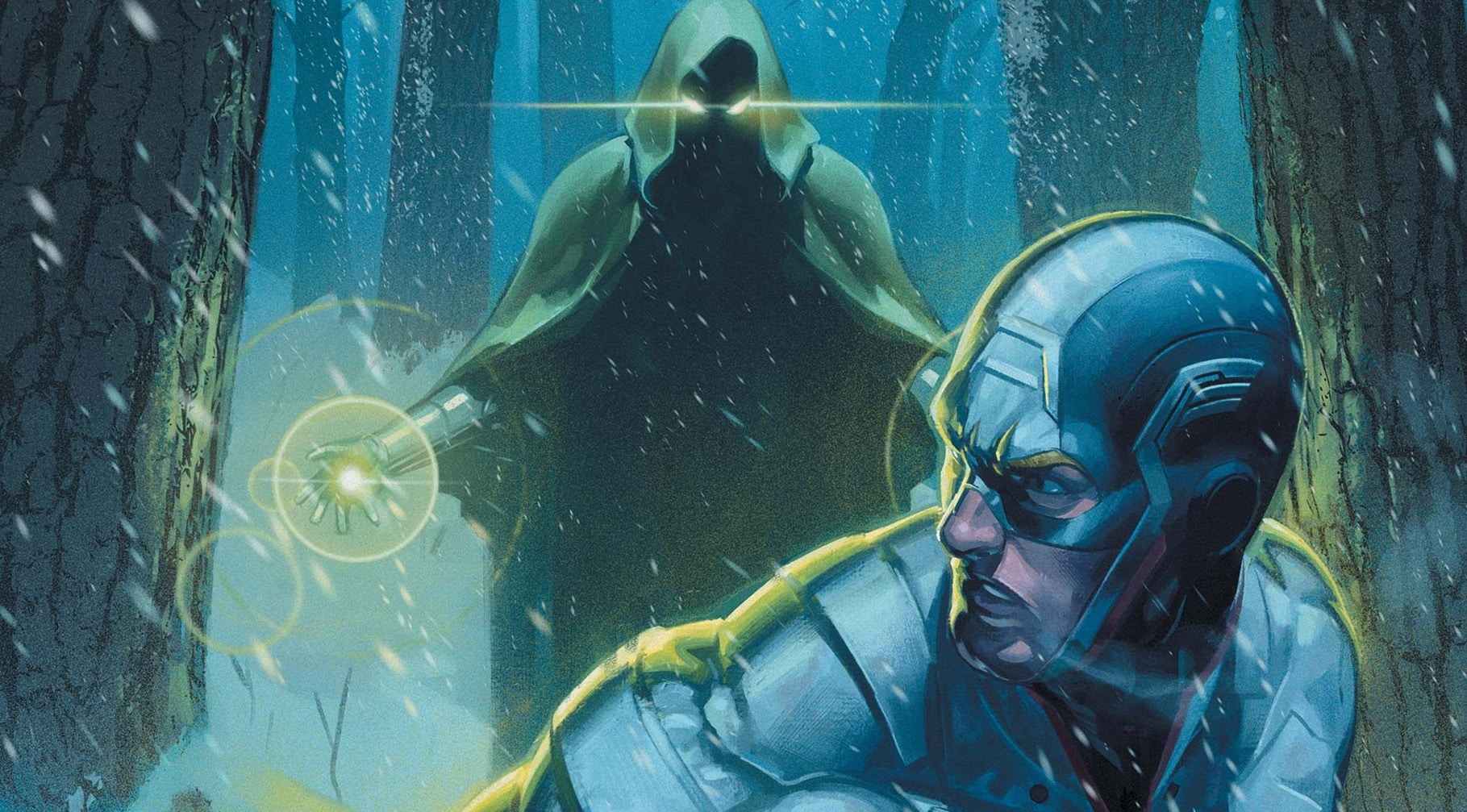
Witness the rise of one of Marvel’s most infamous villains as Steve Rogers comes face to face with Doctor Doom for the first time. Also, who is David Colton, and can Steve trust him to have his back as they infiltrate a hostile country with the new Howling Commandos? Captain America #2 is written by Chip Zdarsky, drawn by Valerio Schiti, colored by Frank Martin and lettered by Joe Caramagna.
This is an issue in transit. This is an issue about pulling back your fist to get ready for the punch, about winding up for the haymaker – and so it’s quieter, perhaps, than last time, but no less crucial. You have to wind up for a punch, after all. But this is an issue in a very deliberate stasis. It’s taut and unsteady – or, rather, unsteadying. We’re pushing Steve now, just slowly, just a bit – but he’s being pushed. And of course he’s being pushed through what he’s learning – and what we’re learning, just as Steve Rogers is learning. When Cap last walked this road, in the early aughts, it was with eyes as jaded as David Colton’s: It was with the eyes of the war machine, the eyes that tell us to not stop, to never stop until the mission is accomplished.

Now we see the past a bit differently. Instead of seeing the freedom we supposedly brought, now we can see the Soviet tanks, abandoned by the last empire to ravage Afghanistan (and itself, of course). The key, I think, is that we see David Colton see the red star rusting away this issue – when last issue, it was the reader’s eye that saw it. The Colton who opens this issue says he still has “horrors to accumulate” – by the time he and Cap are paratroops leading an Eagle Claw-esque raid on Latveria, he’s accumulated plenty. He’s seen them – because he’s become the eye at the center of the panopticon of American empire.

Last issue, we saw a Steve Rogers who didn’t know quite what the United Nations was (a line I found a bit hard to grapple with until I realized that, in fact, Stan and Jack depicted Steve baffled by the sight of the U.N. building in the 1960s). Now we see him taught very candidly and very forcefully what it – what American world hegemony – really has become.
The mirror to that hegemony is, well, Latveria. I’ve always been, frankly, more than a little conflicted and sometimes even uncomfortable with post-Kirby/Lee Latverias and Dooms. It’s always been profoundly difficult to know what to make of his government, his philosophy and his ego – I’m told there’s some kind of big event about this question ongoing at the moment, but I’ve been busy reading Conan and teaching – because it’s, well, frankly impossible to take the absolute dominion of a man in faux knight’s armor and a green cloak over a silly Ruritanian fantasy seriously.
I tend to think you see a few different kinds of Dooms – and, surprising no one – I prefer the earlier ones. In the Kirby issues, there’s a sense that Latveria is a bit like the Village from The Prisoner – outwardly benevolent, but ruled with a literally iron grip.

Over time, writers like John Byrne stressed (to my mind, overstressed) the idea that Doom was a noble foe, a man with much goodness in him. Of course, Kirby and Lee had given Doom his origin – as a Romani freedom fighter in a dictatorial interwar kingdom – so I suppose I can see where that nobility comes from. But of course in real life there are no noble dictators, no enlightened despots. Qasim, the translator for David Colton’s unit in Afghanistan, tries to tell him this – and gets killed for his trouble. The message David internalizes is a profound cynicism – that freedom is a mistake, or, rather, that someone must be in place to monitor freedom: He feels that the United States is, much like the nightmare vision of the superhero, a watchman on the walls of world freedom, making sure it does not ever get too free.

David Colton and Victor von Doom would probably agree on quite a lot in the way of politics: that order and control is necessary, is preferable, even, to freedom. That attitude, I’ve often felt, is the uneasy implication of the unironic Latveriaphilia you sometimes see in comics. A good, competent dictator is just as much of a fantasy as anything else in the Marvel Universe. Dictatorships and autocracies, as we can see just by looking at the world outside our window, are fundamentally, inherently petty, cruel, inefficient, xenophobic and corrupt.
So it makes perfect sense then that Captain America would see Doctor Doom as just another tinpot dictator – more tinpot than most, even. The problem is that Doom’s Latveria is just as much of a panopticon in its little world as the American world order is internationally. Colton and Doom have very, very similar politics.

Never mind the fact that this is a reprogrammed Doombot used by democratic rebels against Doom (it’s not as though the United States government has an interest in their fight, though Cap seems to). This is the fantasy of all-seeing Doom – the sometimes valorized fantasy – as what it is: an idea, a metaphor, a metonymy. Doctor Doom is so insecure in his ego that he only feels safe if he rules his homeland as a kind of amusement park for himself – and he would gladly rule the world the same way. To his credit, Captain America has far less certainty. Even when he joins up with the rebels seeking to take down Doom, it’s with a troubled conscience and a furrowed brow: Is this, indeed, another dictator for the world to righteously defeat? And what does that righteous victory even look like?


All at once, Steve realizes that the United States shouldn’t be here at all – but that if it should, if he’s here, Captain America should be there to make sure things get done by the book, legally and uncynically, not like David. The problem is, of course, that this way can’t really work. Victor von Doom can’t die in a retcon story set in the sliding timescale, nor can Steve Rogers impose his will as the last uncynical man in a very cynical world – this world under Doom in a kind of moral sense. Well … is this what Steve Rogers fought for? To make heroes of men like Doom, to make a world where war can be peace and freedom can be slavery – and where he and Doom can both be heroes?

Buy Captain America #2 here. (Disclaimer: As an Amazon Associate, ComicsXF may earn from qualifying purchases.)

Margot Waldman
Margot Waldman is a Mega City Two-based scholar, researcher and writer. Her great loves are old comics, Shakespearean theater and radical social justice – in no particular order. One day, she hopes to visit the 30th century.