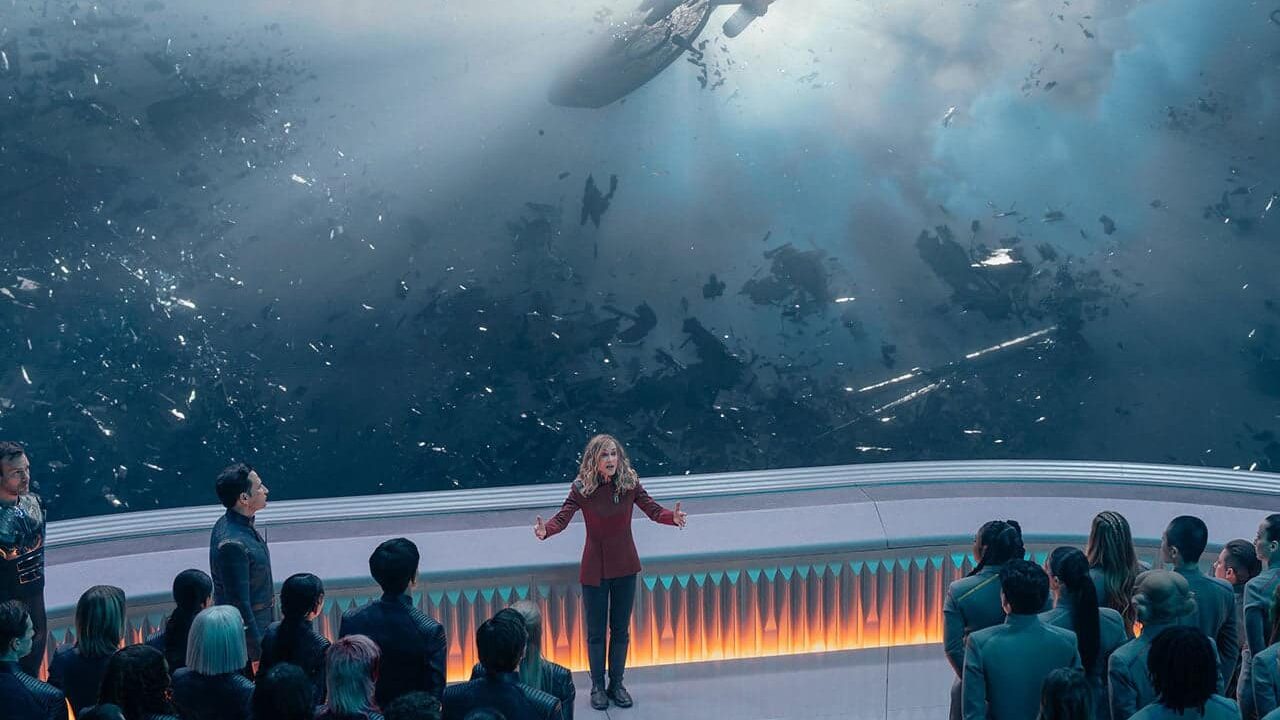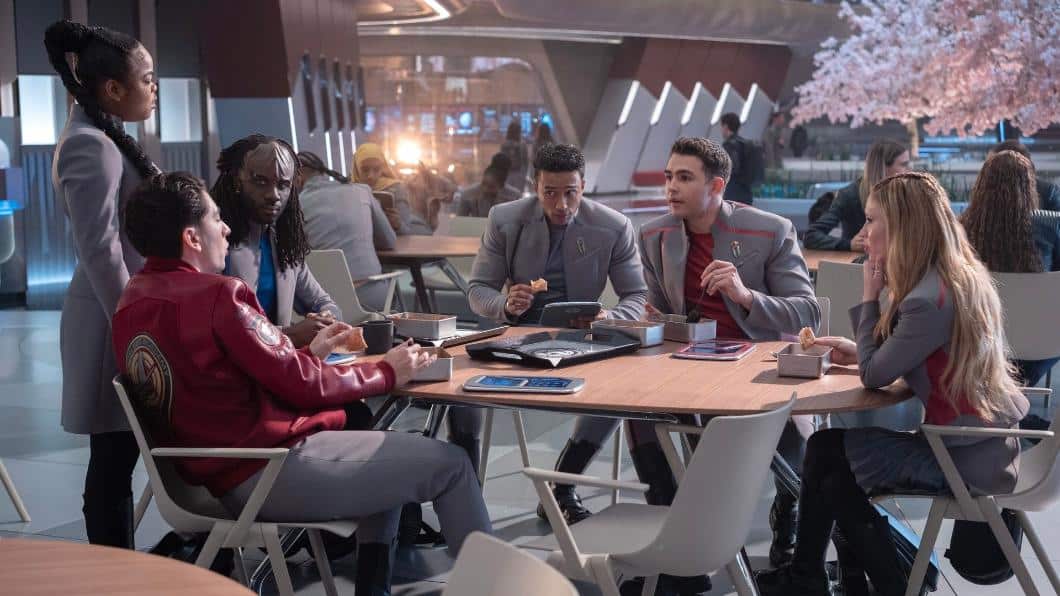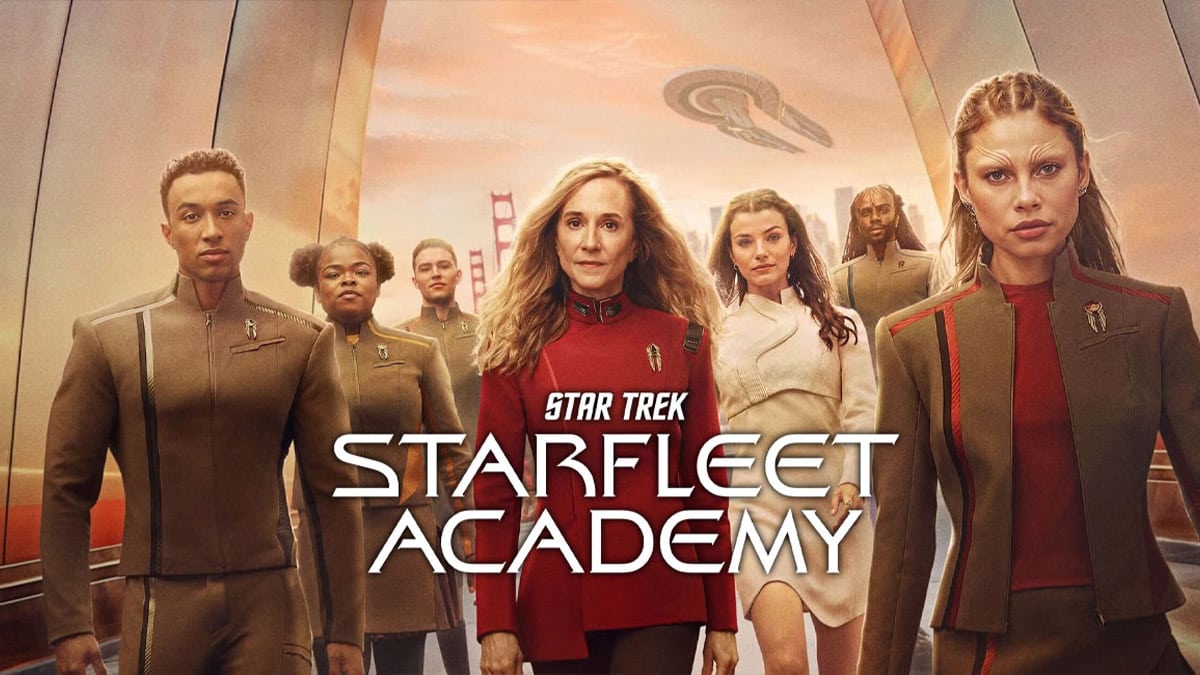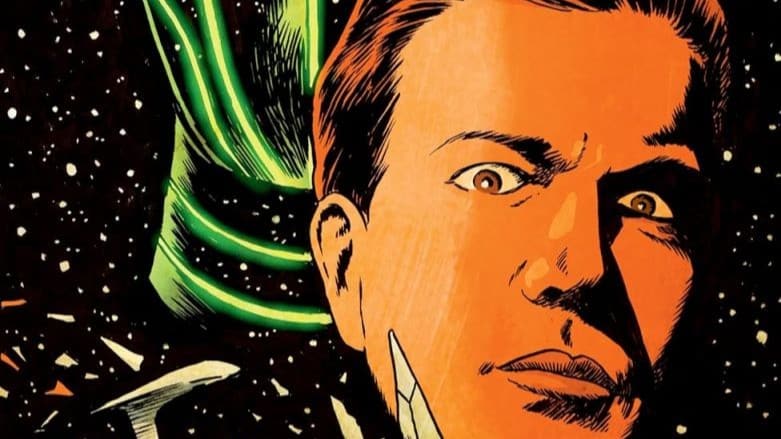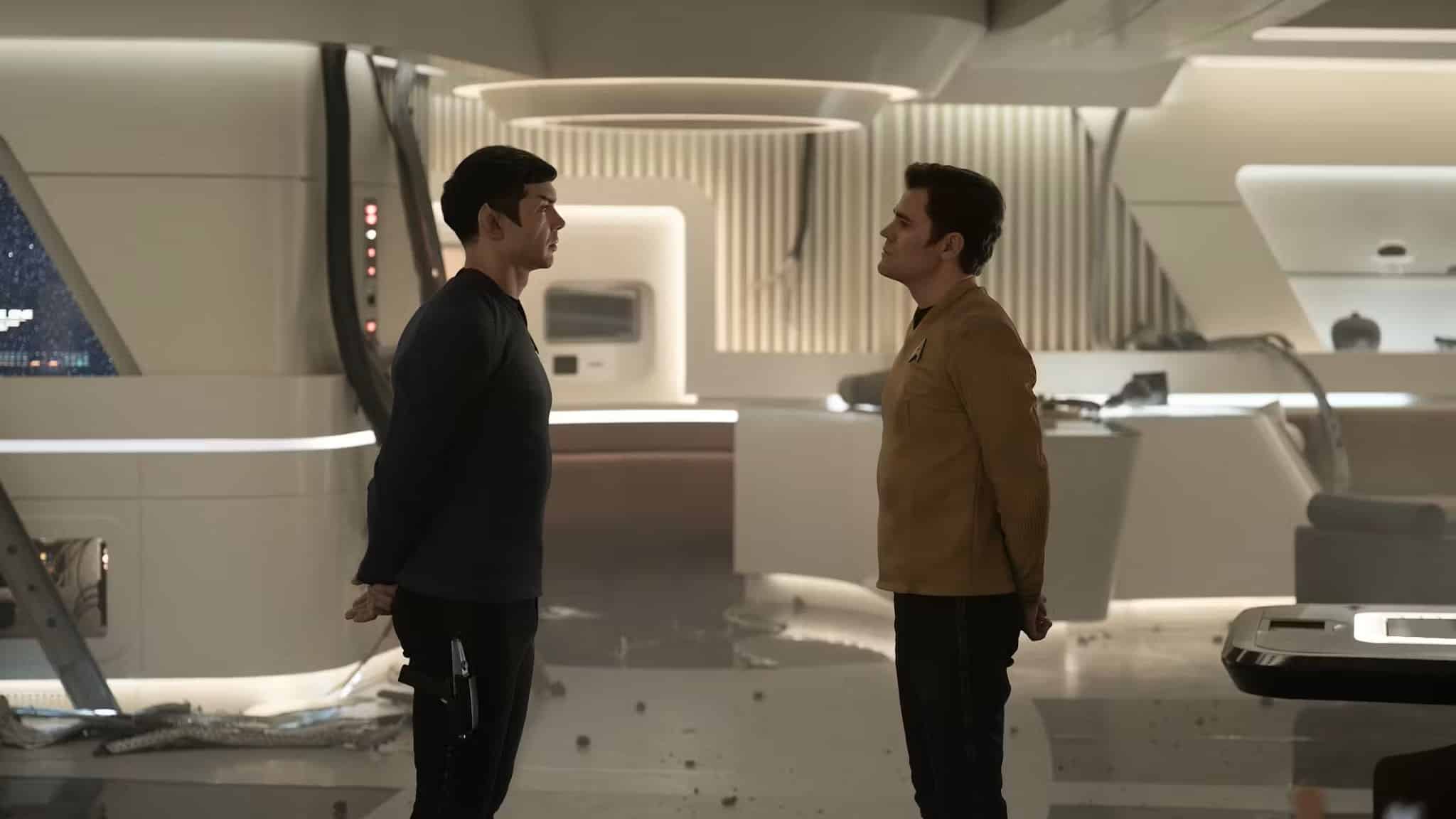
The Enterprise comes to the rescue of the USS Farragut, which has been disabled by a mysterious, massive ship, and is being commanded by the young James T. Kirk in “The Sehlat Who Ate Its Own Tail” written by David Reed & Bill Wolkoff, directed by Valerie Weiss.
Mark Turetsky: You know, we haven’t been recapping this series long enough for me to ask you, what’s your history with the original Star Trek?
Matt Lazorwitz: My dad was a casual TOS fan, and would occasionally watch an episode in reruns in my youth, and I’d watch with him. I stumbled across an episode of Next Gen one Friday evening, and it happened to be “The Best of Both Worlds Part 1” on rerun, just before Part 2 was about to air, so it might have been the perfect time to just stumble in. From there, I went back and watched as much of any Star Trek I could, which was easier for TOS, since it was airing in nightly reruns on some channel or another, so I have seen pretty much all of them in completely random order.
Mark: For me, it was more “that other Star Trek that didn’t look as cool.” I started on TNG, and of course watched the original crew movies, but to me, that’s where those guys belonged. I ask because this is very much an episode about TOS, isn’t it?
Matt: Oh, absolutely. It has very “Doomsday Machine” vibes to it, and an ending with a very Rodenberry twist and moral.
Farragutpunched

Mark: First off, we open with First Officer Kirk’s log, marking this the 26th episode where we haven’t gotten an Ortegas-focused story. Jim is champing at the bit over his Vulcan captain’s too-cool, too-by-the-book approach to trailblazing across the galaxy.
Matt: There’s a contradiction in the core of James Kirk. In the third episode of TOS, “Where No Man Has Gone Before,” Gary Mitchell describes Kirk at the Academy as “a stack of books with legs.” For this guy who is viewed, and at times portrayed, as a shoot from the hip cowboy, Kirk was at one point quite bookish. I don’t know what happened to change him, but whatever it is, it happened before the events here, because he wants to boldly go about as boldly as you can.
Mark: If you haven’t read it, I highly recommend Charlie Jane Anders’ reading of “Where No Man Has Gone Before.” To sum it up, it’s nearly impossible to approach the episode without any knowledge of the relationship between Kirk and Spock, but to the actors playing the characters, to the writers, to everyone involved (keep in mind this was the second pilot of The Original Series, the first one to even feature Captain Kirk), it’s a story about Kirk having to choose between his old friend Gary and his weird alien first officer Spock. Put into terms Charlie Jane avoids using, it’s about choosing whether he’ll be a Jock or a Nerd as a captain. But here, what we have is a man who isn’t quite ready to be captain, who’s thrown into the situation at the worst possible time, and who somehow prevails, despite himself.
Matt: We see Kirk going through various versions of what it means to be a captain, up to and including him freezing up almost entirely. In an earlier review, you commented that Pike is possibly the captain most likely to actually do what his subordinates suggest, and we see Kirk having to learn that lesson here. He shuts everyone down before he finally listens at the end. That cohesion even with interpersonal conflict is very much a part of this series, as we’ve seen over and over. The characters can not get along at times, but they always pull it out in the end.
Mark: At the start of the episode, he’s almost defined by his stubbornness. We have him bristling against V’Rel, we have him rejecting the suggestions of his subordinates from the Enterprise (his “I pick neither option” moment very much felt like a callback to his rejecting the premise of the Kobayashi Maru, the unwinnable scenario), we have him damaging the Farragut further than it already has because he didn’t listen to Scotty. As I’ve said in earlier reviews, it’s nice to see the TOS crew, who will go on to become somewhat hyper-competent, fail every now and then on their way there.
Matt: Yes! Kirk’s cocky attitude in TOS right out of the gate can be frustrating and come off as something of a Big Man on Campus/Jock sort of thing. But seeing him make mistakes and fail before he gets there, seeing him earn that attitude, is one of the highlights of the series for me.
Everyone who knows Kirk sees that he has greatness in him. Uhura saw it in an earlier episode (handily recapped in the previously on) when he saw her best traits, the potential for greatness in her. And here, it’s her having Spock talk to him to get him to see the greatness in himself, the potential to really be the youngest captain in Starfleet history, that raises him up. This group is already working together, even if the gears are a little squeaky and they’re not the well oiled machine they will become.
Mark: This is also only a few years after Kirk’s previous captain died while he was at the phaser station. While he was found to have done nothing wrong, Kirk blames himself for hesitating to fire and getting half the crew killed. That’s got to be weighing on him here (in fact, I was half convinced we were seeing the events described in TOS’ “Obsession” before I went back and checked that one out).
Matt: We also get the brief ready room scene between Kirk and Spock. It’s not a lot, but it’s really starting to establish that relationship. Kirk’s captain being a Vulcan means Kirk has an idea of the Vulcan mindset, but Spock isn’t your average Vulcan, which could lead to some interesting dynamics as Kirk tries to wrap his mind around how that relationship is going to change and grow as they work together more.
Scavengers

Matt: Before this season started, I rewatched the last couple episodes of season 2, but I didn’t go back any farther, and the events on the Enterprise got me thinking: have we ever seen Pike use the knowledge that he is fated to be maimed at a particular point in the future to his advantage? Like Arthur Dent in the Hitchhiker’s Guide to the Galaxy series, who is confident he can’t die until he’s been to Stavromueller Beta, Pike knows a particular event is going to happen, and while I have distinct recollection of his trying to avoid it, now that he’s accepted it, he hasn’t really started taking personal risks because he knows this is not his day to die, at least not that I can recall.
Mark: It’s something that Will and I have discussed here in the past, from the second episode of the series. I think there are certain times where Pike might act a bit more rashly, take a risk he might not otherwise. I don’t think it’s ever been made explicit, but I think that’s definitely a way to read some of his decisions. Will specifically thought he caught one such moment in our review of episode 4. Why do you ask?
Matt: While the whole, “Captains shouldn’t endanger themselves,” thing is much looser in this era than in the TNG era, I was just thinking about Pike leaving Number One on the bridge and going down to engineering with La’an himself. And then taking some of the more dangerous actions down there while with his security chief. It didn’t read as completely along those lines, but could definitely be taken as him endangering himself because the rest of the crew doesn’t have a defined date of near-death, so to speak.
Mark: That’s a fair point. Especially considering Una has superhuman abilities and could be much more able to handle the boarding parties as well as the possible environmental adversities she might face. Speaking of, the B-plot on the Enterprise is a whole lot of fun, especially where it concerns Pelia. We get to see her quarters, the result of centuries of being a packrat. We get her bizarre declaration that an old friend of hers said, “Let there be light!” I’m always a sucker for Pelia content.
Matt: You and me both! Carol Kane is a treasure. I also like any instance of needing to use antiquated tech to solve big sci-fi problems, so seeing her wire the entire Enterprise with landline telephones was a highlight.
Mark: Though I’m a bit shocked that the communication aboard the Enterprise isn’t hardwired to begin with. I guess wifi is a lot more reliable in the future. But yes, having Ortegas wonder aloud if the phone receiver was a “personal massager” is definitely a highlight. That and the retro-style split screen between M’Benga, Ortegas and Una.
Matt: The fun of that is balanced with the more tense confrontation between Pike and La’an and the invaders. These big, bulky suited things were a good visual, unlike most other Star Trek species. Their ease at operating in the irradiated environment and their ruthlessness until a very specific moment kept me guessing. I figured out the episode twist only moments before it was revealed.
Mark: Yeah, it seemed to be coming from a very un-Star Trek place of “faceless intruders who need nothing less than to be exterminated,” so I knew that there had to be more to it than that. Or, well, hoped, because Trek doesn’t always live up to those lofty ideals. The big reveal feels very much like a Twilight Zone episode, or, well, the big reveal in Star Trek: The Motion Picture.
The reveal that these scavengers who mercilessly stripmine the galaxy for precious resources are, in fact, not only human, but American, seemed to me a bit, at first to be several steps too on-the-nose, without even couching it in the metaphor of an alien race. But, well, (gestures generally). I buy it.
What I’m somewhat less willing to buy is that these pre-warp humans were able to develop or steal technology advanced enough that they outmatched the Klingons and the Enterprise. They are also extremely close to the Lower Decks version of the Pakleds.
The episode ends with Pike and Kirk having a discussion about the humans behind the Scavenger ship, about how they were the best and brightest that Earth had to offer, but then the centuries of being in space had taught them to regard other sentients, other humans even, as disposable. But is that what we actually see earlier? There’s that moment where Pike has been knocked down, his phaser picked up by one of the scavengers, and the scavenger can’t bring himself to kill Pike. Maybe the moment exists to show that even this far gone, the Scavengers still possess a shred of humanity, to make us as viewers even more uncomfortable with their deaths. That’s a good thing: good art should elicit feelings of discomfort. But if that’s what they were going for, they should have made it clearer.
Stray New Words
- I laugh every time Ethan Peck pronounces sensor as “sen-SOR.” I know Leonard Nimoy did it, but all I can think of is Mariner pointing it out in an episode of Lower Decks.
- “That’s a good sound, right? The ship is happy-screaming?”
- I hear the way to make aldentium unappealing is to boil it a bit too long. It gets too soft and ruins the effect.
- When Una ran off to do something with the airlock, were you expecting her to sacrifice herself? Also, what exactly did she do? It was very unclear.
- La’an being chosen to return to the Enterprise means that only the TOS-era cast (minus M’Benga) remained on the Farragut.
- Yes, the astronauts in the archived photo looked like they had Tesla logos, but they’re actually NASA Exploration/Development insignias.

Matt Lazorwitz read his first comic at the age of 5. It was Who's Who in the DC Universe #2, featuring characters whose names begin with B, which explains so much about his Batman obsession. He writes about comics he loves, and co-hosts the podcasts BatChat with Matt & Will and The ComicsXF Interview Podcast.

Mark Turetsky is an audiobook narrator and voice actor who sometimes writes about comic books. Originally from Montreal, Canada, he now lives in Northern Louisiana. Follow him @markturetsky.com on Bluesky.