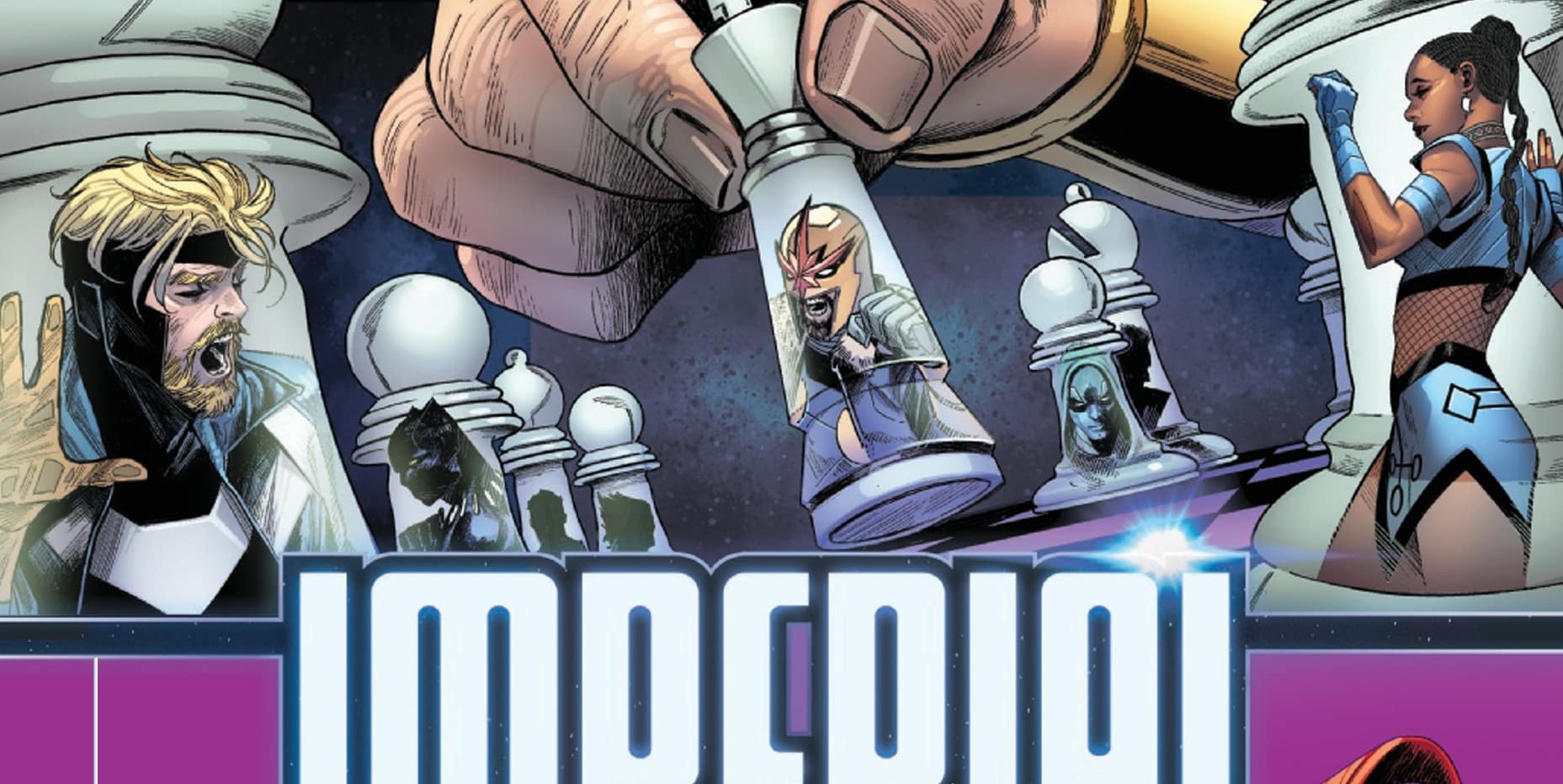
The conflict begins to spread out to the wider universe! Find out who’s really orchestrating the great game of cosmic houses as the last chance to stop a universal war presents itself. Imperial #3 is written by Jonathan Hickman, drawn by Iban Coello and Federico Vicentini, colored by Federico Blee and lettered by Ariana Maher and Cory Petit.
One of the foundational genre elements of superhero comics is the reveal of someone long thought dead, disappeared or retired back into the fold for a dramatic moment that gives the character new purpose and direction. One of the MCU’s many issues in recent times was its failure to understand that someone just showing up and hanging out doesn’t quite constitute a story choice as much as an empty viral moment, but I digress.
No one in superhero comics understands the art of playing with expectation quite like Jonathan Hickman. Imperial #3 is an issue that tests you. It almost leaves you disappointed, dejected that you got your hopes up; and just when you thought you were out, it pulls you back in. When you’ve got two artists of the caliber of Iban Coello and Federico Vicentini to not just steer the ship but navigate it through an asteroid field going into hyperspace while shouting “never tell me the odds,” you’re happy to overlook some of the flaws. It’s big, bold and fun. It’s a summer blockbuster. And despite a slightly laborious unpeeling of the first layer of mystery, this issue delivers a box office moment as it unveils the second.
The first layer culminates in the type of deus ex machina reveal you don’t want in a comic, because it fails the classic “show not tell” test. Having the Xandarian Worldmind immediately reveal “the hidden hand” to be The Grandmaster and Maximus zaps the fun right out of the mystery, which up to this point was the driving force behind this series — at least on face value. Even though what Hickman does with this setup later atones for some of these storytelling sins, he’s only partially absolved here. Firstly, the route toward this bait-and-switch is too direct — see for contrast the Rabum Alal reveal in his Avengers run (noting that this was an ongoing not a miniseries). The other issue is that once we’re there, the dialogue lingers too long. For example, while replaying scenes between the Grandmaster and Maximus discussing their wager from previous issues is intended to re-contextualize them, it doesn’t add all that much new information. Coello’s choice to repeat the panels from the previous issues doesn’t help, either. The pacing therefore grinds to a bit of a halt, which means the later reveal needs to be really dynamic to pick the story back up. Thankfully, it does just that as it unravels the game within a game — the second layer.
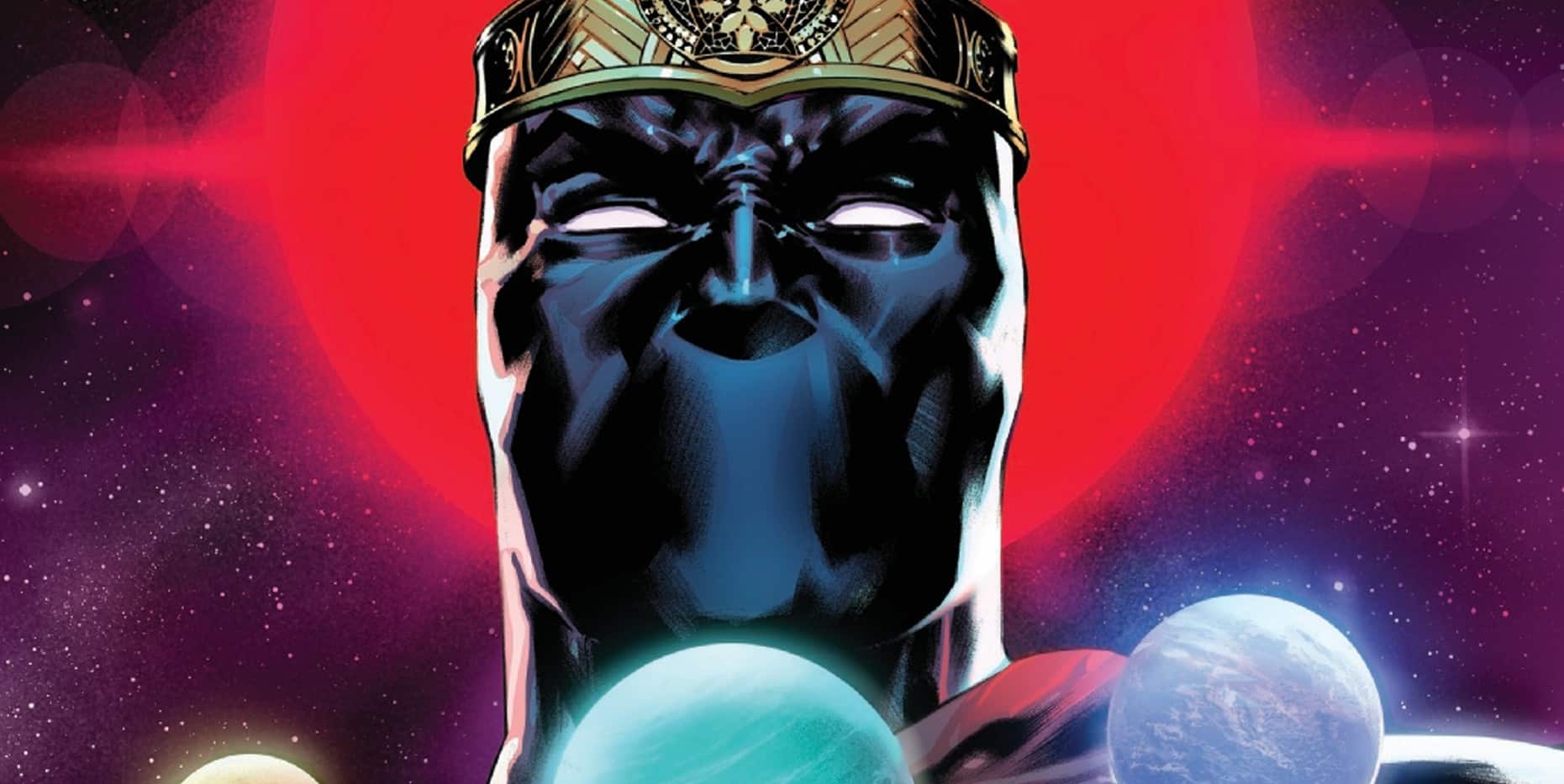
The scene that unfolds Maximus’ motivation to re-establish the Inhuman empire is masterfully scripted and perfectly executed by Coello. As Maximus describes his mastery over deception through dialogue, Coello uses three parallel inset panels to play out Maximus’ sleight-of-hand trick, which slowly reveals the literal and metaphorical missing piece from the story — Black Bolt. A flashing light, supported by a “FWWASSH” sound effect, draws your eye to the right side of the panel at the bottom of the page. The readers’ gaze then becomes aligned with the Grandmaster’s as he turns his head toward it. Finally, on the left side of the panel is Maximus’ face draped in shadow, which is a metaphor used frequently in Inhuman stories to characterize his relationship with his brother. However, it is apparent that he is relishing it here — his eyes and mouth pierce the shadows to reveal an extremely evil smile, combined with the classic supervillain flex of pressing the fingers of each hand together to create an arch. Throughout the scenes that follow, Coello’s use of body language belies the celebratory mood of the scene. Despite Maximus’ grandstanding, Black Bolt’s posture is just as evasive and detached as it always is with his brother, which lays the seeds for further conflict.
This type of story structure is very Hickman. You can’t really complain — it’s a winning formula, and it works here in injecting some narrative weight and new tension into Imperial and the Marvel cosmic storyboard moving forward. The 20 or so pages leading up to Black Bolt’s grand entrance reaffirmed the view I expressed in the review of issue #2 that Hickman is operating a little in second gear here. This is partly the product of Imperial being a miniseries. The “long runway” approach that Marvel editorial afforded him on previous runs yielded more intricate, interwoven mystery stories, whereas using the Xandarian Worldmind to cut right to the chase landed with a bit of a thud. There’s clearly more to come from Hickman in future cosmic titles, but it’s a shame that Imperial often feels like more of a story engine than a story in its own right. That said, this issue delivered a pretty unforgettable moment, and I remain excited for what’s to come.
Buy Imperial #3 here. (Disclaimer: As an Amazon Associate, ComicsXF may earn from qualifying purchases.)

Jake Murray spends far too much time wondering if the New Mutants are OK. When he's not doing that, he can be found talking and writing about comics with anyone who will listen. Follow him @stealthisplanet.bsky.social.