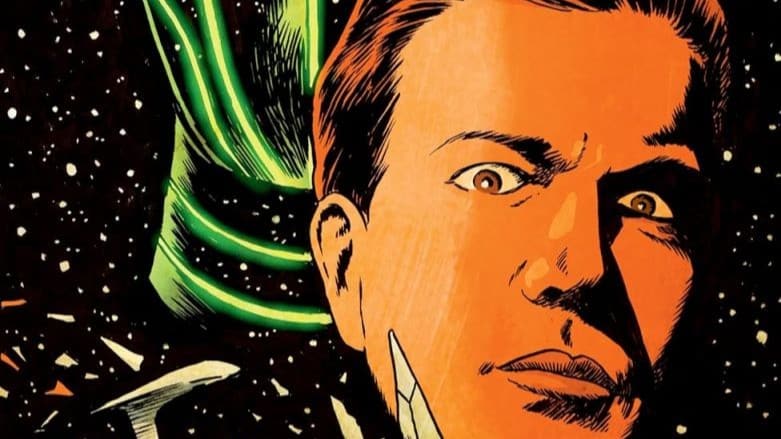
Beto Ortegas presents a documentary about a mission aboard the USS Enterprise that dares to ask, “What Is Starfleet?” in Star Trek: Strange New Worlds season 3 episode 7 written by Kathryn Lyn & Alan B. McElroy, directed by Sharon Lewis.
Mark Turetsky: Do you want me to look at you or look at the camera?
Matt Lazorwitz:Look at me. And make sure the light catches that Starfleet insignia.
To Boldly… What?

Matt: You called it back in our review of episode 2: Beto was here to give us this episode, the classic interviews with the crew, like in M*A*S*H*. And still, somehow, his sister gets way less screen time than pretty much anyone else.
Mark: The format of the episode is reminiscent of “The Interview,” but the politics of “What Is Starfleet?” are a bit less clear. Or, rather, I certainly hope that the politics of “What Is Starfleet?” aren’t what I think they are…
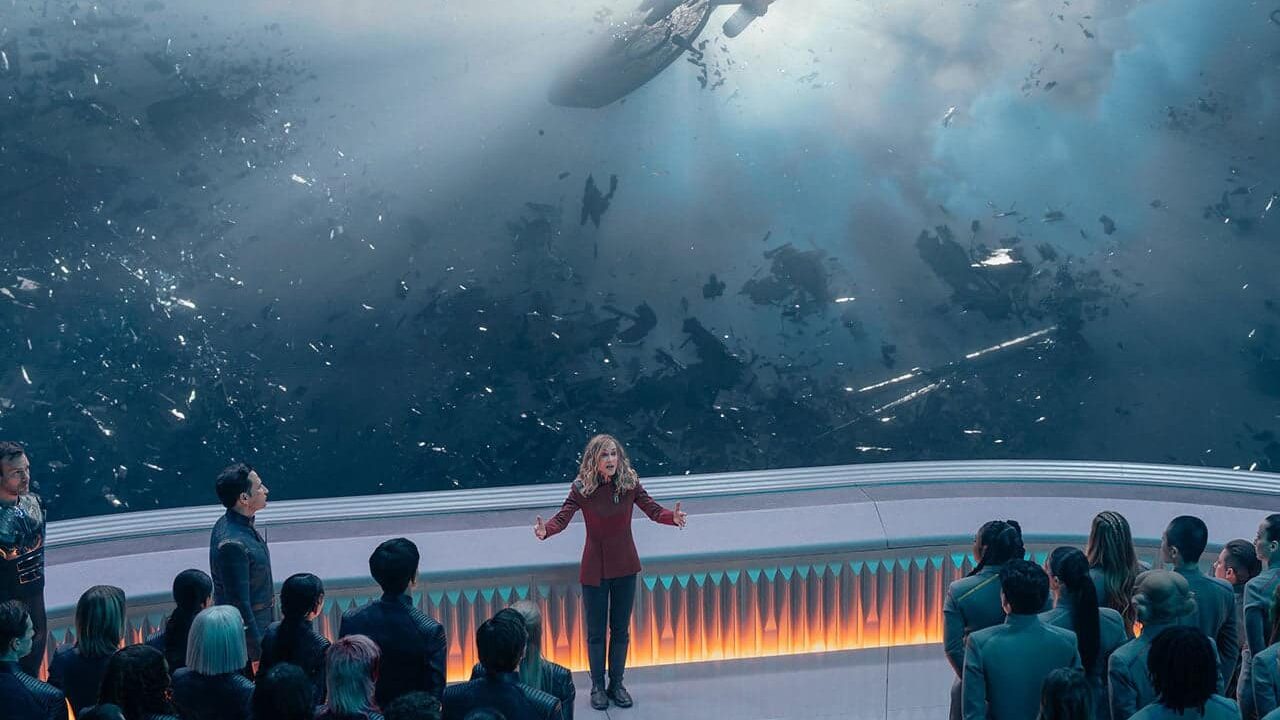
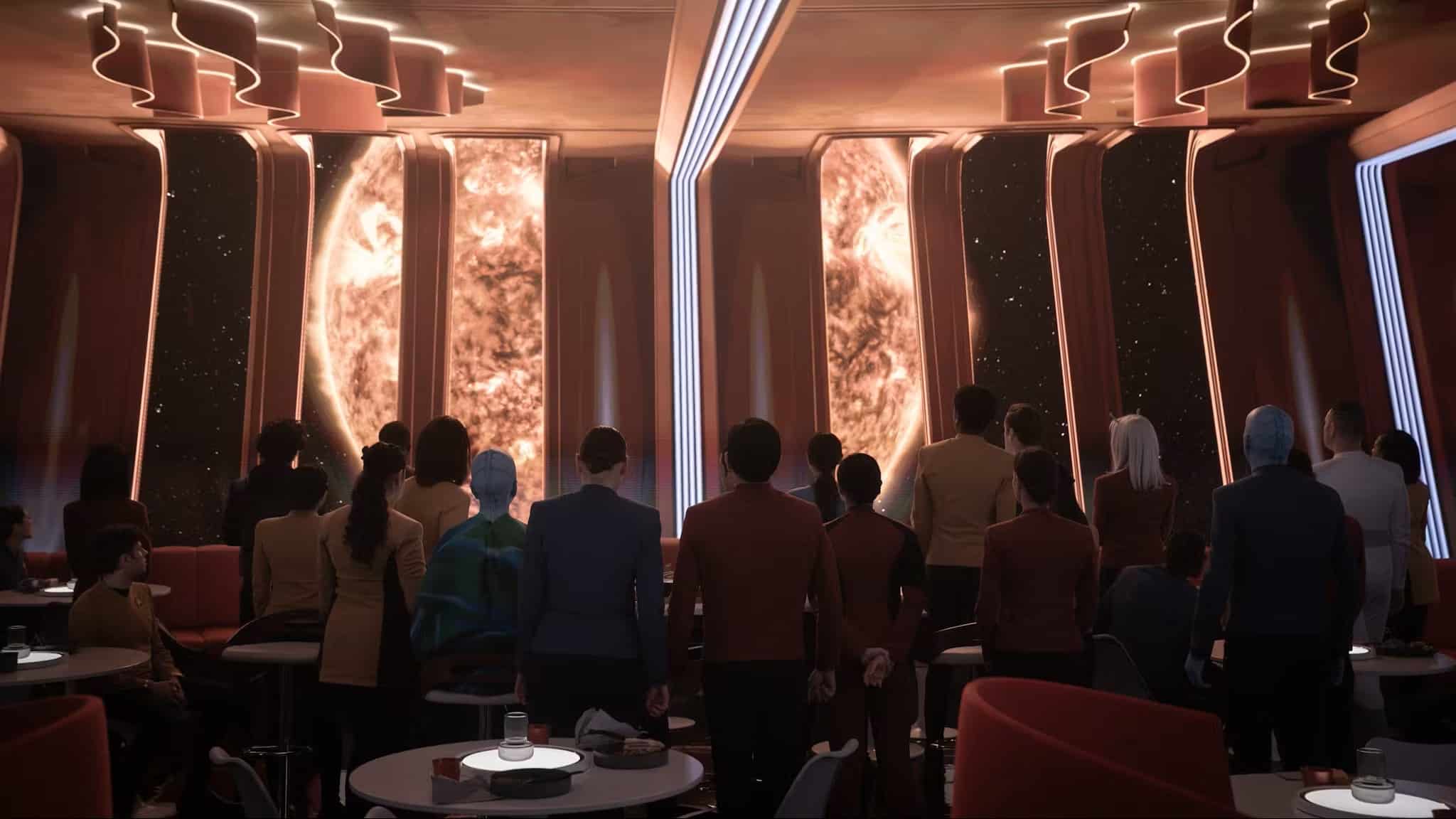
The plot, such as it is, is that there are two planets. One is the home of the Lutani, the other of the Kasar. They’re at war. The Lutani are getting badly beaten and the Enterprise crew are on a mission to help them out by transporting a vague “thing” from one planet to another. It turns out that the thing they’re supposed to transport is a spacefaring animal that’s been altered into a weapon of war. Not only that, it turns out that it’s sentient and capable of language. The Enterprise decides that they won’t be a party to this creature’s enslavement and allow the creature to fly into the sun where it will never be used as a weapon again.
In short, it’s perfect fodder for a Trek story. Perhaps the first pure Trek story we’ve gotten this season. And yet, this is treated as the b-plot. The a-plot is that Ortegas’ brother, Beto, is presenting it to us as a sort of radically-minded documentary about how you shouldn’t trust Starfleet. It’s plot that plays on a tension that’s existed in Star Trek since the beginning, and poses questions fans have discussed for almost as long.
Matt: Is Starfleet exploratory or is Starfleet military? I know I’ve had that discussion time and time again when hanging out with fellow Trek fans. And Beto absolutely has a specific side he falls on here. And he makes a lot of good points. But he comes at this hard. His interview with M’Benga stands out as probably the harshest, but if you’re looking for someone outside of Section 31 who has done some shady stuff in the name of Starfleet, it’s M’Benga.
In the end, though, we get back to your first statement. That the politics here are… dicey. Strange New Worlds has been accused of being a little too comfortably pro-war on a couple of occasions, and here we get the Enterprise not acting in any way that would try to stop the war in a peaceful manner, and, if not happily, at least willingly, transporting a weapon and only stopping when the creature that is the weapon turns out to be sentient. If it had just been an animal with no way of communicating, Starfleet command seems willing to just let it go. I feel like this is the kind of story that would normally see the captain (probably Picard) trying to negotiate a peace before any of this would happen, yes?
Mark: Absolutely, and Beto’s documentary is presented as voyeuristic, manipulative, and inflammatory. Much of it is filmed in a way to suggest he’s filming it without his subjects’ knowledge, much less consent. And that’s not just the scene where Uhura notices the camera while thinking they’re having a private conversation; it’s shots taken from awkward corners of rooms, where it seems like Beto’s drone cameras have been planted so as not to be noticed. We don’t even get to see Admiral April’s side of the conversation when Pike and Una come back to him asking for his guidance when things start to come to light.
And when Beto asks Pike if he’s ever killed someone, it feels like Beto is lucky Pike is too much of a gentleman to punch him in the face, but also, that somehow he’d be right to do it. It wants to take the position that because Beto has never served, that he’s just a muckraking journalist, that he’s somehow beneath the brave men and women of the Enterprise. It’s icky, to say the least. And the thing is, it turns out that Beto is 100% right in his read of the Lutani/Kasar situation, but the show presents him as being in the wrong because he’s come to the table with an axe to grind: his mother has died relatively recently, and his sister, Ortegas, was maimed and nearly killed, and he blames Starfleet for her near-death.
Matt:That last bit really bugged me. It makes Beto seem petulant; “Boo hoo, I’m a sad boy and I am scared for my big sister so let me take that out on what I blame for it.” When we have had episodes of Star Trek where we are looking at Starfleet from a more critical lens, we usually see the franchise punch up. We see Picard stand his ground against Norah Satie in “The Drumhead” or Admiral Dougherty in Star Trek: Insurrection. He is the little guy, or at least as little as Jean-Luc Picard can ever be. Star Trek should be about speaking truth to power. And here, that truth is actively infantilized by the end of the episode, which made me super uncomfortable.
Mark: Yes, it takes his literal older sibling to tell him he’s been a dick and an idiot to question Starfleet. This episode reads like the reactionary older cousin to Starship Troopers (the film). And yes, Starfleet is not canonically the United States military, but the show has always been allegorical. Can you imagine the reaction if this episode had been made during The Original Series, where the most obvious allegory would have been Vietnam? Releasing this right now, with its message of, “don’t question those in power, they know better than you and will always make the morally right decision” is somewhat abhorrent.
Matt: I think you can remove the modifier of “somewhat” there. I’d wager this was written and filmed some time ago, back when things weren’t quite so bleak, but I think some reshoots, or possibly shelving the episode, might have been considered when we now have power that actively calls for the muting of media it disagrees with on a daily basis.
Mark: And that it ends highlighting that Uhura enlisted shortly after the loss of her family and with Ortegas still reeling from the loss of her mother, it’s suggesting that Starfleet takes these fragile, broken people and recasts them into productive members of society, giving them a structure and a life that brings good to the galaxy. By implication, it thus suggests Beto would have been better off by enlisting than by becoming a journalist. And what about people like M’Benga? A doctor who joined because he wanted to help people, that turned into a murderer due to his service? It’s as if after last week’s stark lesson about how resource scarcity can transform the best of people into amoral monsters, they needed something to counterbalance things.
Matt: I’ve been staring at that statement for a minute here, and it’s a rough one. Starfleet has usually been presented as the best of us. It feels like they’re trying to do that here, but it just reads as so tone deaf.
Let’s move on, shall we, as I can’t stare into the abyss any longer…
Mark: Move on to the next episode, or onto other aspects of this one?
Matt: Onto other aspects, I’d think. There is a cool, classic Trek plot underlying this, as you said, with some interesting elements involving psychic space rays, Spock’s brain (not the episode) and Uhura.
The Devil In The Details

Mark: So the concept of the living ship that’s been turned into an unwilling sentient weapon reminded me a lot of the story of Talyn, a ship on Farscape. If you haven’t watched the show, I highly recommend it. It’s a goofy, more Star Wars-y type show, and if you enjoy James Gunn’s Guardians of the Galaxy movies, he pretty much lifted their vibe from this series. Anyway, on that show, there are living ships called Leviathans. They’re peaceful ships that an imperialistic race called The Peacekeepers have subjugated, enslaved, really, using control collars. But they’re unarmed, pacifistic creatures. That is, until the Peacekeepers make a hybridized ship called Talyn that’s armed to the teeth. It starts out as just a baby, but one that’s been bred for war. It’s emotionally something of a wreck (because, well), and it eventually sacrifices itself to save its family. Seem familiar?
Matt: Oh, I can see the rhyme, absolutely. Farscape has long been on my list of shows to watch, and I think I’ll have to move it up a notch or two. Star Trek has played with these sort of themes, the creature that seems to be an animal but is more, since “Devil in the Dark,” which was the first Star Trek episode I have any memory of watching. And I felt the rhyme there too, as here Spock is again the one to telepathically contact the creature and come out a bit worse for wear.
Mark: Yeah, I feel like we’ve had some Vulcan telepathy creep since the series began, but I think this falls well within the bounds set by “The Devil In The Dark” or even Star Trek: The Motion Picture with V’Ger. And in this case, the Jikaru could theoretically have communicated with any of them, it’s just Spock was the most receptive. We also get to see Uhura really take on much more of a leadership role here. She’s the ship’s communication officer, and the great crisis of the episode is solved through communication.
Matt: And for all my problems with the A plot, the B plot does feel very Star Trek in that respect. They don’t blast the Jikaru, they don’t even blast the Lutani (although Pike does threaten some, so it’s not exactly peaceful). There’s communication and in the end protection. Yes, the Jikaru dies because of what was done to it, but this wouldn’t be the first instance of a right to die plot in this universe. It’s a melancholy episode all around; not a lot of laughs to be found in here.
Mark: Note that neither Pelia nor Scottie appear in the episode (perhaps Pelia was too busy time traveling and appearing on the It’s Always Sunny In Philadelphia season finale). And while Spock is also frequently used as a comic relief character, his characterization is more focused on his childhood trauma (again, more Starfleet officers being made into functioning members of society by the life Starfleet offers them). Honestly, if the Beto storyline were handled only slightly differently, this could have been a great episode, a “Let That Be Your Last Battlefield” that touches on environmental and animal rights concerns, while questioning military interventionism. And yet…
Matt: And yet. I wonder what was going on in the writers room here. If you were going to do the Beto stuff and have him be right all along, then why cut it off at knees? Or if you were going to have his point be undercut, why not make him wrong? Was it trying to have that balance of right for the wrong reasons? That still feels really off here.
From a filmmaking standpoint, I really did like the look of the Jikaru, and having an episode where things were being recorded allowed for some nice visual trickery when it unleashes its light/EMP powers.
Mark: And I like the touch that it seems like every display panel is also a camera that’s recording constantly (though it makes the need for Beto to have cameras a bit redundant). And the direct address to camera in Beto’s interviews is effective and gives the actors a lot to play with. It’s reminiscent of Errol Morris’ use of his creation, the Interrotron. However, the Interrotron allows his subjects to look at him while looking directly at the camera, so I don’t see why Beto can’t re-create that with a few centuries more of technological progress.
Stray New Words
- This episode might have given Ortegas more characterization than any other episode so far.
- Also, is she building a speeder bike in her quarters?
- How did we get from the portrayal of Jake Sisko, journalist, to this?
- It’s apt that Peacemaker is back this week: “I cherish peace with all of my heart. I don’t care how many men, women and children I kill to get it.”

Matt Lazorwitz read his first comic at the age of 5. It was Who's Who in the DC Universe #2, featuring characters whose names begin with B, which explains so much about his Batman obsession. He writes about comics he loves, and co-hosts the podcasts BatChat with Matt & Will and The ComicsXF Interview Podcast.

Mark Turetsky is an audiobook narrator and voice actor who sometimes writes about comic books. Originally from Montreal, Canada, he now lives in Northern Louisiana. Follow him @markturetsky.com on Bluesky.