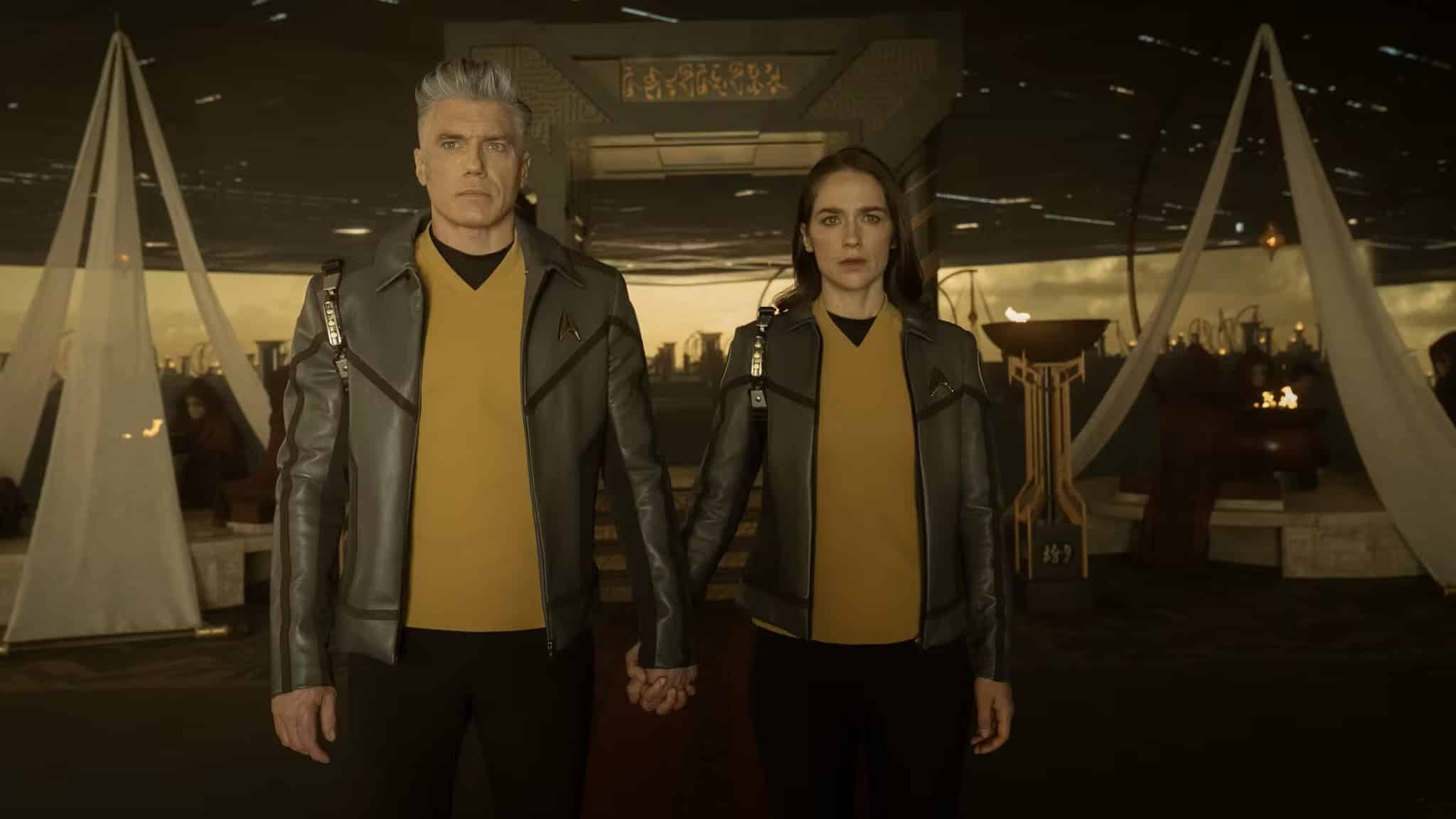
Roger Korby has gotten into another mess and it’s up to the Enterprise crew to fight the final battle between ultimate good and ultimate evil in their search for “New Life and New Civilizations.” Strange New Worlds season 3 episode 10 written by Dana Horgan & Davy Perez, directed by Maja Vrvilo.
Mark Turetsky: Matt, I’ve got a confession to make: I get bitten by a lot of mosquitos in my day-to-day. Also, I once got some pretty bad poison ivy on my arm. I think it’s turning me into something more. Something… different.
Matt Lazorwitz: Mark, do you have something in your eyes?
Mark: Yes, allergies and I hate it.
“Two batteries?”

Mark: So, the whole season has been building up to this, and this episode packs in a lot. We get the return of the Vezda/Ensign Gamble storyline, the resolution of Captain Batel’s various ailments (and her anxiety over her new job), Kirk and Spock finally taking their friendship to the next level (no, not that!) and a flashforward that’s part “The Visitor,” part “The Inner Light.” It’s an awful lot of Star Trek, and some parts of it work better than others.
Matt: It was indeed an awful lot. I didn’t expect us to get back to the Vezda/Gamble stuff this soon, if at all. I know that episode ended with the flicker on the screen, but I took that as just a spooky little tease. But you’re talking to someone who once hand-recorded every episode of The X-Files on VHS, so I am used to end-of-the-episode spooky moments that go nowhere and are just there to be creepy. Star Trek tends to pay off those moments. Well, except “Conspiracy,” which I thought this might have been tied into, but it turns out, doesn’t.
I agree that not all of these parts worked as well as others. How do we want to approach this? Talk about the stuff with the crew in general here, and save Batel and Pike for the next section?
Mark: Sounds good! The whole thrust of the episode is one of tying off plot threads from throughout the season, which, I concur with you, I didn’t think would happen quite so thoroughly; where have Captain Angel and Sybok been for the last two seasons, huh? First off, we have the return of Roger Korby, who, apart from being a walking red flag for academic misconduct, drops in, plays his part and the show is just done with him. It’s emblematic of a lot in this episode.
Next up we’ve got the return of Ensign Gamble as the evil Vezda. There’s a lot to unpack here. He escapes to a temple on another planet from where he can free all of his imprisoned Vezda buddies. Fine. But whereas his appearance in “Through The Lens of Time” was chilling, since M’Benga, and we the audience, couldn’t quite ever be sure if we were dealing with the optimistic Ensign Gamble or the calculating Vezda leveraging M’Benga’s paternal affection for him. Here, he’s purely the evil Vezda. And what do we know about The Vezda? They’re evil. What makes them evil? What do they do, apart from exist in a massive dimensional prison they try to escape from? That’s unclear. Do you know why Dukat worked as a Pagh Wraith? It’s because even when he was possessed by the Wraith, he was still Dukat, and Dukat was already evil enough. He was just Dukat with cosmic-level power behind him.
Matt: And that’s the problem with characters who are just plain EVIL isn’t it? They’re rarely that interesting. It’s always about the way the characters around them react to the evil. It’s why many of the best Joker stories aren’t about the Joker, but are about how Batman, his family and the people of Gotham deal with the chaos he brings with him. There’s that character test that a well rounded character can be described without describing their physical appearance and their job, and the Vezda are just professionally Evil.
I know this had to become the Captain Batel/Captain Universe (that’s a deep Marvel Comics cut kids, ask your parents) show, but it did feel like M’Benga got sidelined there pretty hard. So much of his arc for the season was tied up in Gamble, and in the end it comes down to just Batel and the Vezda. He gets a badass moment of being willing to sacrifice himself, then gets knocked out and that’s it. I guess he knew Gamble was gone so he doesn’t need that final moment of catharsis, but I would have liked a little more to tie up the whole thing.
Mark: Well, and M’Benga is the one who’s destined to open the gateway, and the reasoning the show gives (well, it’s his inference, and the show doesn’t give us any reason to doubt it) is that he “delivered the boy to the creature that took his body.” But is that even what happened in “Through The Lens Of Time?” He was up on Enterprise when Gamble got taken over, he just was the one left dealing with the fallout. It works from an emotional standpoint that he’d be the one to confront the Vezda, but it doesn’t make sense from a plot standpoint. [Ed. Note: Presumably the idea is that M’Benga authorized Gamble for the away mission that led to his possession, but that creates a chain of causality that diminishes M’Benga’s role; in those terms, is he any more responsible than whomever assigned Gamble to Enterprise? Or the person who inspired Gamble to join Starfleet? etc.] And yes, he has his moment in the sun, and more or less disappears from the episode.
Anyway, with M’Benga trapped in the cosmic prison with the Vezda, it’s up to the remaining Enterprise crew to open the gate back up and rescue him. This takes the form of a few fun scenes, the first involving Scotty and Pelia talking about how to channel enough energy to the gate to open it up (when he’s told a nuclear battery won’t cut it, Scotty hilariously suggests “two batteries?” with a perfect line delivery by Martin Quinn). It turns out that the only way to equal the entire energy output of a star is not one, but two starships firing their phasers at the spot. Matt. Do you know about the Kardashev scale of civilizations?
Matt: I do not. Please enlighten me.
Mark: It’s a theoretical concept about the power output of entire civilizations, basically something you put on a trading card next to “Intelligence” or “Psionics.” A type 1 civilization is one that can harness all of the energy of a planet. A type 2 civilization is one that can harness the entire output of a star. Type 3 is the ability to harness the entire power output of a galaxy. Now, we have no possible idea of how type 3 would work, but type 2 would require a Dyson Sphere: essentially, building a giant sphere around a star and harnessing all of its light, heat and other energies. It would be a massive undertaking and we are nowhere near even hitting type 1. The idea that two starships can produce that much power on command is absolutely bonkers.
Matt: Yeah. I mean, if we’re working under that logic, ships that could take multiple phaser hits from a ship at once, like a Borg Cube, would be… I don’t have a word for it. Godlike? I know they handwaved it with a bunch of technobabble about how perfectly coordinated it needed to be, but it really sounds like crossing the streams to tear a whole in reality. And we don’t cross the streams.
I am full of random references this review, aren’t I?
Mark: They could have just said, “a lot of power” and it would have been fine. No need to bring the power output of a sun into things.
Matt: Really, that was just to get us to Kirk and Spock working in tandem, moving their relationship to the next phase where they are…close friends. There’s a very fine balance with this kind of thing. You go too light on it, it frustrates people. You go too heavy it falls into a deep pit of fan service. I’m not sure where I fall on it here. It seems a bit handy, that these two characters who we know will be the best of friends shared one mind for a bit. It’s a shortcut to them being besties. But it gave us a great scene of the two characters playing chess and deciding to continue this relationship, so it’s not completely there from the jump. I like the dynamic and the interplay that Wesley and Peck give their characters (for its other faults at times, I do think the actors on this show do a good job even when given more awkward material to work with), so I think I’m willing to forgive the contrivance.
Be grateful Will isn’t here reviewing; if there’s one thing he never forgives, it’s contrivance.
Mark: Sure, that’s the surface text reading of the scene, but subtextually? Kirk and Spock are now definitely fucking.
Matt: I took that as read. That’s the subtext of pretty much every Kirk and Spock scene ever.
Mark: Are we still using the term “drift compatible?” Or is that so 2013?
Matt: I think you can go for it. I made a “crossing the streams” reference, and that’s 1984.
Mark: Oh sure, but Pacific Rim’s cultural impact wasn’t quite as lasting as Ghostbusters.
This leads us to the final phase of the imprisoning-the-Vezda/rescuing-M’Benga plan: get Captain Mrs. MacMurry in there because… help me out here.
Matt: Because of her being turned into a hybrid creature that now has the genetic memory of all these species that faced the Vezda in prehistory, which has given her magic energy glowy hand zappy powers.
… Wow, typing that felt weird. I know Star Trek is not the strictest science fiction; we’re not getting the deep technological explanations of things like with The Expanse. But even by the logic of a series that has Q, that one does stretch credulity a bit.
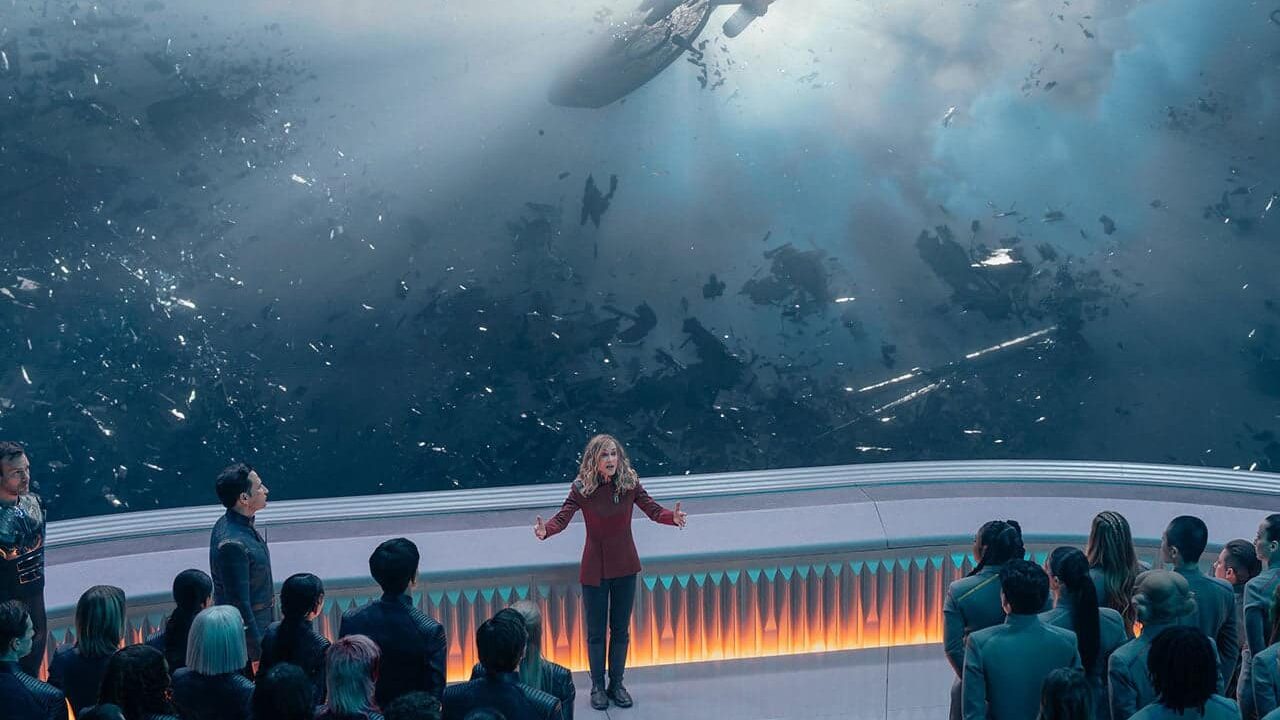
Mark: Melanie Scrofano does an admirable job of delivering this absolute nonsense, but you get the impression that the other actors in the scene didn’t have to pretend too hard to convey disbelief. The statue that guards over all the evil Vezdas is literally her, and since it exists outside of the normal chain of cause and effect, they need to get her in there and she’ll become “the beholder” (or “the sentry,” they never quite settle on one or the other). But it’s gotta be her, as evidenced by her Gary-Mitchell-style cosmic eyes. She and Pike make it in, and we flash forward to the future, a future where they’ve dealt with the Vezda and can finally move on to spending their lives together.
Matt: And here we move onto another topic, because this is its own thing.
“Hello movie house!”

Matt: Ok, I’m a sucker for sentimentality. I know I am. And I watched this episode after coming home from the emotionally draining new Stephen King adaptation, The Long Walk, so I was primed for the feels, and Batel and Pike living a full life, one without her becoming an interdimensional guardian statue and him not being trapped in a space-iron lung? It got me in said feels. You likened it to “The Inner Light” which is probably one of the top 5 episodes of Next Gen, and while this doesn’t quite hit those heights, I love how Mount and Scarafino just played off each other as we watched them age, watched them realize their life wasn’t going to be cut short, watched their daughter grow up.
Mark: It’s a lovely bit of storytelling, especially the moment where they realize that Pike has escaped the trap that time itself has set for him. Again, Mount and Scarfano do a great job with this, but it gets at what’s so frustrating about this series: it points to things that worked phenomenally well in other Star Trek series, and it doesn’t do a bad job by any stretch of the imagination, but it doesn’t quite hit those highs, and by calling its shot like this, it only hurts its reception. Because instead of it being its own thing, it gives us a compressed, pretty good version of “The Visitor.” But nothing will ever match “The Visitor” in being “The Visitor.”
Matt: “The Visitor” is peak Trek. Possibly the best episode of the best Trek series ever. Top three for sure.
That is the problem with a franchise at 60, isn’t it? It’s hard to find something new under the sun, and a lot of the fanbase just wants the old stuff repackaged. But a critical eye just shows that you’re not quite hitting the heights.
Mark: Pike and Batel’s simulated future also serves to lessen the impact of where we know Pike’s story is going. No, not the injury and disability, the ending of “The Menagerie: Part II,” where Pike rejoins Vina with the help of the Talosians and lives out a simulation of a happy life, free of his wheelchair. It’s now canonically the second time that’s happened to him.
It’s kind of fitting that the day this episode was released on the day that was as far removed from DS9’s “Trials and Tribble-Ations” as that episode was from TOS’ “The Trouble With Tribbles.” We passed the point where Trek was doing anniversary-based nostalgia in the 90s, and we’re back to it. The franchise is showing its age, for sure, where the most successful (from an artistic standpoint, rather than a financial one) series of this current era of Trek was Lower Decks, which was itself a comforting nostalgia romp. I don’t have the answers as to where SNW should go, but maybe to where things are…strange and new.
Would it shock you to learn that this episode was conceived as needing to serve as a series finale?
Matt: Thinking about it? No. I can see this being a fairly satisfying ending. There are definitely things left over I would want to see explored (I’ve been waiting to see who they cast as Sybok for two and a half seasons), but most of the characters come out of this with their emotional arcs tied up.
As for where the series could go? I don’t know either. I hope we don’t get the rest of Those Old Scientists showing up. We’ve gotten just enough of the original series characters now, bringing in Bones or Sulu would feel like a hat on a hat.
Mark: Here’s hoping the remaining two seasons don’t end up like Babylon 5, a series which tied up all of its plots, only to get renewed for a… not great final season.
Stray New Words
- Ley lines?! “They’re a real thing!”
- In “Dagger of the Mind,” Spock explains that he’s never mind melded with a human before. Of course, that was already undone by Discovery, but his mind-meld with The Angel was when he was a child and didn’t know what species the Angel was.
- Old age makeup has certainly improved over the years.
- Pike really should use hand protection when removing a roasting dish from a hot oven. Youch!
- James and Sam Kirk got to hang out together!
- They tied the series up so much that they even set up Captain Kirk’s five year mission.

Matt Lazorwitz read his first comic at the age of 5. It was Who's Who in the DC Universe #2, featuring characters whose names begin with B, which explains so much about his Batman obsession. He writes about comics he loves, and co-hosts the podcasts BatChat with Matt & Will and The ComicsXF Interview Podcast.

Mark Turetsky is an audiobook narrator and voice actor who sometimes writes about comic books. Originally from Montreal, Canada, he now lives in Northern Louisiana. Follow him @markturetsky.com on Bluesky.