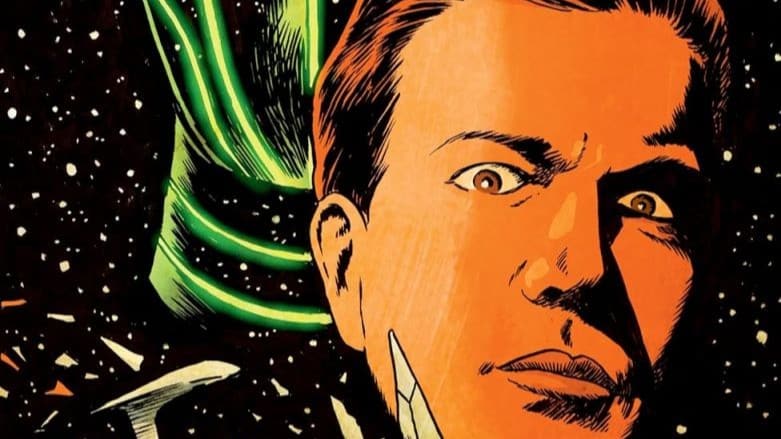
James T. Kirk lives again in the Federation’s darkest hour, as the USS Omega undergoes a dangerous mission with an ill-matched crew. Star Trek: The Last Starship #2, written by Jackson Lanzing & Collin Kelly with art by Adrián Bonilla, colors by Heather Moore and letters by Clayton Cowles.
Mark Turetsky: Gentlemen, I’ve created you from top secret Section 31 research and Borg nanoprobes because the world needs you. They need you… to discuss the new ongoing Star Trek flagship series from IDW, The Last Starship.
Scott Redmond: I would go on a whole existential crisis about who I really am, but by golly there is too much great Trek to be talking about. I’ll stow the crisis for later, maybe store it with the potential midlife crisis. Two birds, one space stone. Anyways, let’s talk about that Trek!
Tony Thornley: …
Mark: I think Tony is suffering from resurrection sickness this time around. Maybe next month!
Kirk: The Man or The Myth?

Mark: The comic opens with Kirk’s narration, asking himself who he is, and whether he’s the same James T. Kirk who lived a full life before his death in Generations, whether all of the memories he holds are his own, or if they’re just copies of another man’s. And it works as a metatextual question, one that the reader is surely asking of the comic’s authors: is this going to be the full Kirk? Is it going to acknowledge the highs (“My triumph at Khitomer?” [Star Trek VI]) as well as the cringeworthy lows (“My failure at Amerind?” [“The Paradise Syndrome,” aka the “I am Kirok” episode]). Will it be formed on the pop-cultural idea of Kirk like the Kelvin-verse incarnation, or to a lesser extent the one featured most recently on Strange New Worlds?
Scott: I’m just going to get it out there at the start, I’m not a huge Kirk guy. The whole “Kirk or Picard?” debate resoundingly gets a Picard from me, only to then be pushed aside for the true answer of Sisko (or Janeway depending on the day). I grew up on a steady diet of TNG, DS9, and Voyager with the TOS era just being the films. While I love some of those films (Wrath of Khan still is one of the best Trek films hands down), I never really cared too much about that era other than it being a foundation and delivering some interesting stories in other media. So I’ve seen far more of the aforementioned modern Kirks than the old school one.
That being said, it was Lanzing and Kelly who made me like Kirk more with their Star Trek: Year Five series years ago. So I too was curious what version of this character we were bound to get.
Mark: The answer comes on the very same page, when Captain Sato quotes (the Samuel Butler translation of) The Iliad and Kirk not only picks up on the source, but also the context for the quotation. It’s the Renaissance Man Kirk of the original series. Yes, that’s the two-fisted Kirk who strutted around the Enterprise, but he was also described as “a stack of books with legs.” Partially, I think, because of William Shatner’s portrayal of the character, and the needs of television and the varied hands that had a role in writing the character, he’s a mess of contradictions. But to Captain Sato, he’s dangerous, he’s “a man of war” whom Sato can’t trust, because Sato comes from a time of unprecendented peace. It’s odd that this is the characterization that Kirk gets, since, as far as Star Trek goes, the TOS era is relatively peaceful. Sure, there are cold wars and skirmishes with the Klingons and Romulans, but it’s not, say, Deep Space Nine or Discovery which both feature the Federation in an all-out war.
And Kelly and Lanzing perfectly capture this Kirk’s voice, you can almost hear the 1960s-era Shatner stating, “Yet war has still come to Troy,” as if this were a production of Troilus and Cressida, rather than a sci-fi show built on plywood. They even lean into the enforced social mores of 1960s television, with Sato declaring, “there is no such thing as God, Mr. Kirk,” to which Kirk replies, “Look at you. You’re so sure.” Note that he doesn’t say there is a God — that might be a step too far — but, well, he’s met some gods, hasn’t he?
It mirrors the moment in “Who Mourns For Adonais?” where he tells one of those gods, Apollo, “Mankind has no need for gods. We find the one quite adequate.” It’s a line which has always felt clunky, as if the first statement is about not needing god as a concept, and then quickly appeasing television censors by reassuring the audience everyone on board is a good monotheist. This statement, though, coming from a man who’s been pulled out of time, from death itself, who’s encountered powers beyond comprehension time and again, is fighting back against what he perceives as Sato’s cushy arrogance. He doesn’t know because he hasn’t seen what Kirk’s seen.
Scott: I definitely enjoyed this little exchange between the two captains. It’s only natural that Sato would not want this Kirk running around, there is no reason to believe that he’s truly Kirk or that there isn’t some ulterior motive coming from their tentative alliance with the Borg.
Their debate back and forth was illuminating about both characters. Far too often we see characters in these series who are in awe of Starfleet’s past, because (as Sato alludes) it often is truncated and glamorized in many ways. Sato is a true student of things and looks between the cracks of the hero stardom to see the actual legacy that is left by someone like Kirk. It tracks that Kirk would care enough about his crew to know how many members he lost, while being unaware of the higher toll of his actions. Both men are very set in their mindsets and beliefs, and their interplay going forward should provide far more intriguing scenes of this nature.
Mark: The Kirk that Jim settles on being, is, sadly, the one needed in the moment. He states that he’s moved past his pain at the loss of his son to Kruge, but he shrugs that off and embraces the hate that he worked so hard to move past. He needs it because there are Klingons attacking his home and he needs to stop them. But is this the Kirk that we’ll be stuck with for the rest of this series? I certainly hope not. The man who could never trust nor forgive Klingons for the death of his boy might be what Kirk needs in the moment, but Kirk’s legacy should be bigger than that.
The New Crew

Mark: Apart from the bombshell that is the reappearance of James T Kirk, we get to round out the crew of the USS Omega, in the form of Vi T’Galatheon and Zed. The former is the new tactical officer, a Ni’Varan spy (if you haven’t watched the latter seasons of Discovery, Ni’Var is the planet that was once called Vulcan, but is now home to the reunified Vulcan and Romulan races, owing to the ultimate success of Spock’s reunification plan and the destruction of Romulus). The latter, Zed, is the Ferengi medical chief, who spends much of the issue in a self-medicated euphoria.
Scott: I really need to finish my watch of Discovery, I fell off after season two, because there are definitely some very interesting things born of it. Such as Ni’Var, which I didn’t know on first mention till I recalled mentions of it in the past and put the pieces together as the scenes moved on. Also, good to see that the Ferengi continue to evolve and are very much still involved in things like Starfleet. Our boy Nog sure left a grand legacy.
Mark: For now, T’Galatheon remains the more intriguing of the two new crewmembers. The Ni’Varans we saw on Discovery were for the most part still divided between those of Vulcan and those of Romulan descent. T’Galatheon here is a perfect synthesis of the two. She’s a descendent, clearly, of Ariennye T’Galatheon, who showed up in the Glass And Bone arc of the previous Star Trek series, the Magistrix Mlitium of the Romulan empire, who had served in the government, the military and the Tal Shiar. Vi seems to be a member of whatever organization took over for the Tal Shiar (and possibly Section 31?) post-reunification. She brings with her some dire news: deep space outposts in the Federation have been attacked and destroyed by unknown assailants since The Burn. Dare we hope that the Omega might visit a certain much-loved Deep Space outpost? Perhaps the ninth such? It would be neat to see the DS9 (and Bajor!) of the 31st Century.
Scott: If we make a return to the future version of DS9, the sound of excitement that would be released would be off the charts. Kelly and Lanzing’s pure love for Trek, and all parts of it as showcased in the last series, remains strongly stitched into these pages.
While I usually am more of a shrug when it comes to the clandestine stuff, I’m already intrigued by T’Galatheon and what she’s bringing to the series. New characters are delightful when they come off the bat with hooks that make you want to delve deeper. That is achieved with both her and Zed, though as you said, the former is definitely much more intriguing at this point.
Mark: I also love the pop-art effect when they engage the transwarp drive. It’s like the color registers are misaligned, and we see the Ben Day dots, as if, by breaking the laws of physics, the ship disrupts the actual printing process of the comic book. It’s some really amazing work from Bonilla and Moore.
The Klingon attack on Ganymede is very reminiscent of the Red Path from the previous series, as well as T’Kuvma’s faction from Discovery. What’s neat to note here is that this is technically not the Federation, Starfleet, getting attacked by an outside force. This is civil war, since the Klingons are members of the Federation, and the ships they’re using are, technically, Starfleet ships.
Scott: Despite the fact that the Klingons have spent more time in Trek being allies than enemies, it is interesting how many moments like this we’ve seen. As noted, this time though it’s a sharper attack than any of those others because it features a fracturing within the Federation itself.
I wish that it wasn’t the Klingon’s again being part of the issue, but it makes sense with everything that we know. There still being instincts to fall back on and mindsets like this coming through even all this time later tracks. Where it goes from here remains to be seen, but the brutality and swiftness of it all does leave a mark. A very painful one.
Mark: The death of Hana, our Bajoran helmsman, comes as something of a shock, as it seemed like her and ValQis’ friendship would be a throughline for the series. Sadly, it’s not meant to be. Her letter home is heartbreaking, but also gives some insight into the state of Bajor in the 31st Century: we hear about the “day of reconciliation” with the Cardassians (we know that in the Discovery era, Federation president Rillak was of mixed human, Bajoran and Cardassian heritage), but they also still sing the “ancient songs of liberation” that are hundreds of years old at this point.
Scott: I didn’t like this.
There was an impact, for sure. Trek is rife with moments like this, characters barely known dying in different fashions. This is a series set in a period where the utopia and enlightenment was shockingly brought to it’s knees. So there was going to be darkness to it all, as the Burn already wiped out a lot of people. Hana, though, was a character with such a tantalizing hook that could and should have been explored far more. Both from her heritage and her relationship with ValQis’.
I’ll echo the sentiments about the heartbreak and the note home. It’s a shame that we won’t actually be able to spend too much time exploring how vastly different many of the civilizations and empires we know have changed in all these centuries. Just the references to the new century Bajor and it’s past references are enough to stir desire for more. I have a feeling that we’re not anywhere done with this thread of the story, maybe not even with Hana herself, but time will tell.
Looking Forward

Mark: Thanks to the generous folks at IDW, we’ve been able to read an advance copy of issue #3 of The Last Starship, completing what’s being called “Chapter One” of this title. It contains war atrocities, zero-g combat, bat’leth fights and some of the most boundary-pushing art I’ve ever seen in a Star Trek comic by Bonilla and Moore. And while it’s the end of a chapter, there is so much more to explore in this brand new, unseen era of Trek. And while the main selling point of this comic has been Kirk, I think the real star here is the captain, Delacourt Sato. From his starting point as a captain interested in “the classics” of the largely uneventful pre-Burn 31st Century to slowly becoming the man the galaxy needs him to become over the course of these three issues, it’s the biggest shift of anyone in the series so far, and I’m excited to see where his character goes from here.
Scott: While it’s no shock considering the previous work in this new IDW Trek era, the third issue was certainly jaw-droppingly exciting. Just beyond delightful to look upon artistically, as it once again feels so dynamic and tangible. There are definitive moments that really will set the course of this series as a whole, and it makes sense why it’s being billed as the end of a chapter. If this is the first chapter, the rest of this proverbial book is sure to be quite something to talk about.
This feels like the most “blank check” period that Trek has been able to explore in a long time. Sure, there are pieces of canon to contend with, but unlike the last books in this line, there are no nearby end posts or reasons to have to put any toys back in a box. There are no hold to bar as both the known past and futures are both very far away.
Mark: Yes! The only goalposts we know about are 100 years from this era, when the Discovery shows up. Until then, it’s an exciting setting to explore, one that hasn’t been touched by any Trek. Dare I say, Kelly & Lanzing, Bonilla and Moore are taking Trek where no one has gone before.
Prepare Yourself for Warp 10 Excitement!
- ValQis is a Klingon name used previously in Star Trek III, and is pronounced “Valkris.”
- We last saw Klingon cleave-ships in season one of Discovery.
- Zed is reminiscent of the Defiant series’ resident medical drug-addict, Nymira Vondect.

Scott Redmond
Scott Redmond is a freelance writer and educator fueled by coffee, sarcasm, his love for comic books and more "geeky" things than you can shake a lightsaber at. Probably seen around social media and remembered as "Oh yeah, that guy." An avid gamer, reader, photographer, amateur cook and solid human being. Follow him @scottredmond.bsky.social.

Mark Turetsky is an audiobook narrator and voice actor who sometimes writes about comic books. Originally from Montreal, Canada, he now lives in Northern Louisiana. Follow him @markturetsky.com on Bluesky.