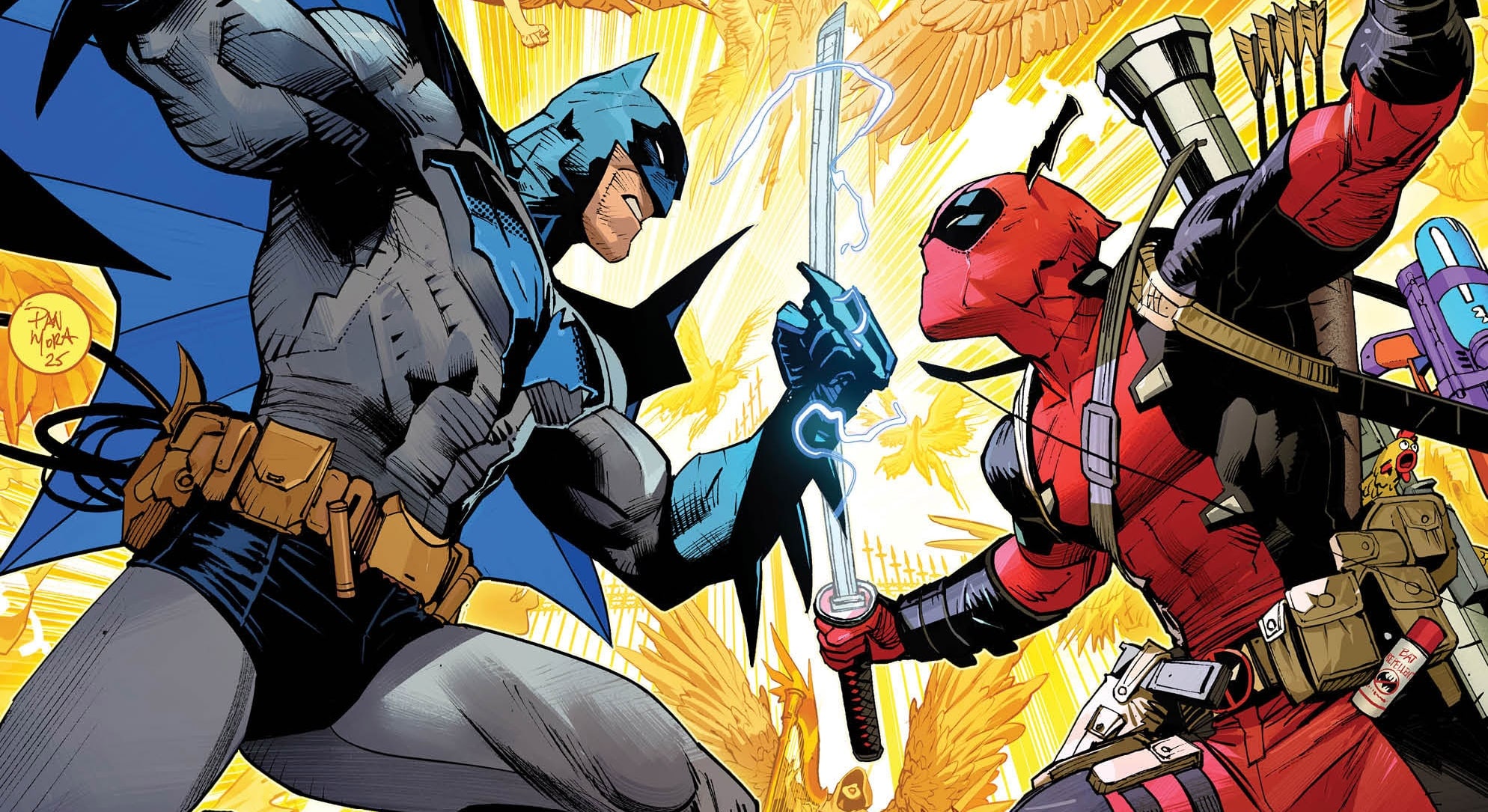
When an old enemy asks Batman for help, the Dark Knight and the Merc with a Mouth find themselves in an insane and absurd jungle full of cartoon ninjas, bizarre ruins and a giant typewriter. What evil mastermind lurks behind the scenes? Who could possibly be the wicked puppeteer who pulls the strings and makes them dance? Batman/Deadpool #1 features a main story written by Grant Morrison, drawn by Dan Mora, colored by Alejandro Sánchez and lettered by Todd Klein. AND:
- A John Constantine/Doctor Strange story by James Tynion IV, Joshua Williamson, Scott Snyder, Hayden Sherman, Mike Spicer and Frank Cvetkovic
- A Nightwing/Wolverine story by Tom Taylor, Bruno Redondo, Adriano Lucas and Wes Abbott
- A Harley Quinn/Hulk story by Mariko Tamaki, Amanda Conner, Tamra Bonvillain and Dave Sharpe
- A Static/Ms. Marvel story by G. Willow Wilson, Denys Cowan, Klaus Janson, Francesco Segala and Steve Wands
When looking at the prospect of yet another Marvel/DC crossover comic I can’t help but think of a quote from Grant Morrison’s Animal Man:
“It’s funny; some say that the superheroes are the next stage in Human Evolution, yet every time we meet, all we seem to do is fight one another. If that’s the future, it doesn’t look too bright to me.”
Nothing within Morrison’s segment of Batman/Deadpool suggests the quote. Indeed, most of the comics within the issue involve the superheroic figures of two worlds duking it out before inevitably having to team up to deal with a common foe (no doubt two members of their rogue’s gallery with some evil scheme involving a weather machine). And yet, it calls to me for some reason.
‘You Have Your Routine, and I Mine.’

When it comes to Late Stage Grant Morrison™, there have been two modes. The first mode is a reflective consideration of the limitations of their approach over the past 40-some-odd years of writing superhero comics. From Superman and the Authority’s engagement with the failures of the superhero model of heroism to The Green Lantern’s musings on aging in an evershifting landscape that seems to prefer nostalgia acts to something genuinely new. And, of course, Wonder Woman: Earth One actually went full utopian idealism via revolution, ideas rejected by the American superhero wheelhouse that often prefers resisting change in favor of keeping things the way they are.
Then there’s the second mode wherein they’re taking the piss. We can see this in The Green Lantern: Blackstars with its depiction of Superman being simultaneously extremely mean and, essentially, how literally everyone else writes Superman (to say nothing of how the book portrays Wonder Woman). Equally, there are aspects of this in Superman and the Authority with the Morrissey-inspired take on Manchester Black sneering at literally everything while puking up a storm (to say nothing about Iron Cross, the most hilarious Superman baddie).
And, of course, there’s Morrison’s last major engagement with Batman: “Detective #26.” Here, we follow one of the many, many precursors to Batman that almost, but not quite, gets the idea of costumed adventurers down to a T. The “almost was” looking at the future that surpassed him instantaneously. The story closes with the lines “I know this city and it knows me. It’s true familiarity breeds contempt. Shove it, Gotham. That’s the last time I ever make a vow.” Which, for a time, was the final word on Batman from the Scot.
That was, until Batman/Deadpool, what is now their final comic with DC and Marvel. In many regards, this retains the rather irreverent tone provided by that Batman short story, in that it feels very much like the old sport has taken it upon themselves to rectify the death of a minor baddie from some ’80s comic for the extremely petty reason of “I wouldn’t die of writer’s block.”
All told, it’s probably the weakest of the endings Morrison has written for their time with DC Comics. Not that it’s bad, per se. Dan Mora working with his Klaus collaborator is always a delight. There’s a charm to reading Batman being perfectly at ease with the Merc with a Mouth. The reveal of Cassandra Nova as the main baddie is a good page turn. And, well, Damian showing up at the last minute was a delight.
But there’s a slightness to this that none of Morrison’s other endings to their time working with Big Two comics has. The Green Lantern was their mournful “It’s time to move on” swan song, Superman and the Authority took their ideas for what Superman could be and engaged with the limitations. Even “Love’s Lightning Heart,” while also a minor work, felt a bit more substantial than a team-up with Batman and Deadpool where The Writer makes their grand return.
Tellingly, then, The Writer notes their irrelevancy. The macguffin at the heart of the story is their Cosmic Keyboard, lost during a tie-in to an event comic no one remembers despite being written and drawn by George Pérez. But, as The Writer notes, “it’ll never rewrite canon again.” A major theme within Morrison’s bibliography is the ways in which the young must surpass the old in order for society to progress. We can’t be hamstrung by old ideas, old stories, old continuities, old writers. To do that is to damn us all to zombie societies whose idea of progression is feasting on the past.
So then, the slightness feels like one more reiteration that they’re done. It’s time to move on. You can’t be a stronger, faster, better idea forever. You have to come up with something new.
‘Look at the World Sanity Has Built Us.’

The John Constantine/Doctor Strange crossover was doomed from the start due to the simple fact that no one involved with writing the book is British. It’s not as if DC or Marvel are sorely lacking in them. Si Spurrier literally completed a Hellblazer run in February with a nifty hardcover just waiting to be sold. Al Ewing, a steady hand over at Marvel, recently made the splash over at DC with Absolute Green Lantern and Metamorpho. Hell, I’m sure you could convince Kieron Gillen to write this, thereby finally making him a real British Comics Writer.
There’s something inherently British about the character of John Constantine that makes someone who isn’t American writing him feel off. The character of Constantine (and note how the pronunciation of the character sounds when in an American pen contrasted with an English one) is that of the British archetype of the wideboy conman. While Americans and other non-Brits can write pretty good con men, the specific blend of con artistry that Constantine exudes feels especially British. Even a good writer like Brian Azzarello working with artists like Richard Corben and Steve Dillon feels wrong for the character.
Putting aside the wrongness of it all, the comic feels half-baked. Where Morrison’s contribution feels slight in the way that comics written for clever 14-year-olds so often do, here the script feels like it was written on a napkin before being sent off to Hayden Sherman to make work. And while Sherman does good work here, it never fully lands.
The most telling aspect is the presence of both Neron and Mephisto. While one would expect the presence of these two figures within a crossover such as this (especially since we’re going with DC Universe “Con Man with a Heart of Gold” Constantine as opposed to Vertigo “Utter Bastard Who Tries to Do His Best, Even as He’s Fucking Over Everyone Around Him” Constantine), they don’t really do anything. Sure, there’s the climactic two-page spread where they seem to tussle … briefly (It’s honestly a bit unclear what’s happening in this spread beyond Constantine and Strange doing some magic rubbish to fix things), but beyond that, their presence within the 10 pages feels perfunctory.
There’s no confrontation between the two wizards and the devils they fight. Instead, two out of the 10 pages are spent with an interlude involving Swamp Thing and Ghost Rider tussling because the majority of the story is just John and Stephen talking about whether John Constantine is a good man.
This being the other reason a Brit should’ve written this strip: Working at 2000AD would’ve beaten writing compelling fiction in 4-6 pages into their skulls.
‘Until Then — Good Luck, Pine Marten.’

“There is nothing about this whole scenario that doesn’t make me so disgusted, I want to violently vomit out my own internal organs. I despise you both so intensely that I can’t tell if my vision is blurry from my near-death experience or from my unforgiving rage. If allowed, once I am back to full health, I will gut you with an honest to God smile on my face and then proceed to paint the home I build with your bodies with your very blood.”
— Scott Frerichs
‘He Might as Well Debate Ethics with a Tiger Kitten.’

Even more so than Morrison/Mora’s work, Harley Quinn/Hulk is slight. It’s a perfectly well executed farce wherein Harley and Hulk fight evil hot dogs because a robot crashed into them. It’s extremely turn-your-brain-off fun drawn amazingly by Amanda Conner. There’s just not a lot to say about it really.
‘They Can’t Get Rid of Us That Easily!’

In many regards, the final story of the collection, a team-up between Static and Ms. Marvel, is a fitting close to this collection. One of my major superhero texts growing up was the Static Shock cartoon. I have fond memories of the hero and his friends teaming up against supervillains. I recall in particular enjoying the episode with the time freeze ability, the Green Lantern crossover and the Batman Beyond episode, even though I’d only seen clips of that show beforehand. (I had just missed Batman Beyond in my cultural memory, though I might have caught an episode or two.)
Ms. Marvel, meanwhile, was a series that got me into reading monthly comics. While I had heard interesting things about Kelly Sue DeConnick’s Captain Marvel run, it never quite grabbed me as a teenager starting college. I’d read it, but I never fell in love the way I did Ms. Marvel. I think this was in no small part to Adrian Alphona’s artstyle, which felt like nothing else being published at the time. I was charmed by the world G. Willow Wilson created for Kamala to live in. I loved reading Kamala’s adventures with her friend group, how they grew and changed and fell apart. It was a lot more fun than, say, reading about her with the X-Men, dying in some Spider-Man comic or having crap energy shields for no good reason.
Seeing these two together makes me feel all the more disappointed that the final story is a dud. The problem is that it feels like the first five pages of a one-shot team-up between Static and Ms. Marvel. An absolutely smashing one-shot team-up drawn delightfully by Static co-creator Denys Cowan, but the first five pages nonetheless. We don’t really get a sense of their dynamic together beyond the awkward first few seconds of verbal sparring one would expect from a Marvel team-up. There’s no real engagement with how their powers work together or how they engage with one another when they have a sense of the other. It’s all gone in a flash.
Ordinarily, wanting more would be a good thing, but here it comes across as unsatisfying. A dud to end the issue on.
Amalgamated Afterthoughts
- “Todd Klein did the letters on Batman/Deadpool” feels wrong for a number of reasons.
- The “Deadpool does an Animal Man” bit was charming, as was the graffiti on the wall.
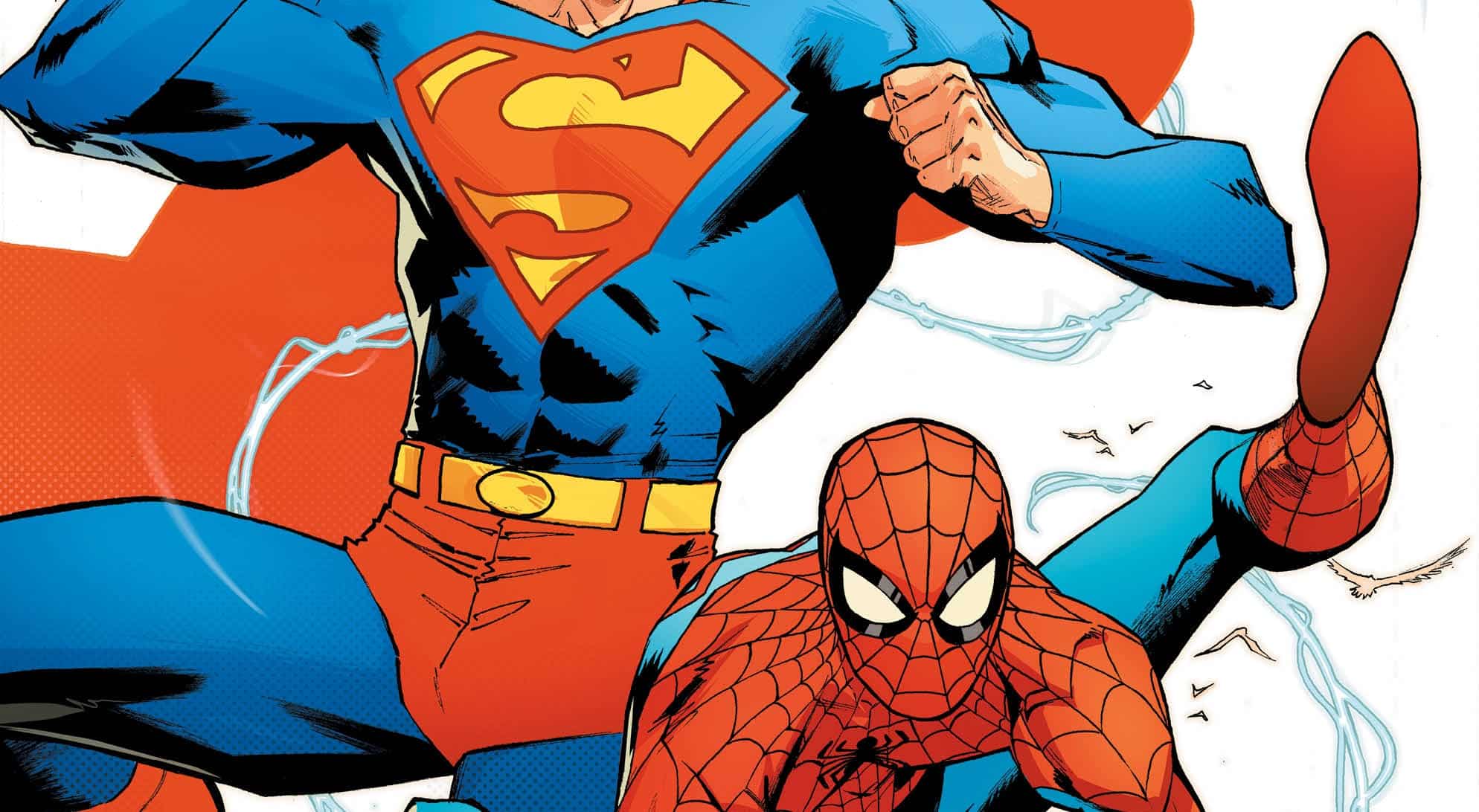
- I did like the appearance of Spider-Man and Superman in the background, even as I know we’re getting a proper crossover sometime in the near future. Bit weird that we haven’t learned who’s doing it yet. (My money is Spider-Man/Superman by J. Michael Straczynski and John Romita Jr. and Superman/Spider-Man by Tom King and Jorge Fornés. Though I could also see Al Ewing and Italiano DeFakenamea or Si Spurrier and Daniel Sampere doing one of them.)
- The ending of the Marvel Universe simply not being able to satisfy the DC Universe as a lover was the highlight of this whole affair.
- One gets the sense that the actual DC/Marvel crossover that should’ve happened instead of John Constantine/Doctor Strange was Swamp Thing/Ghost Rider. At the very least, it would’ve given the book some forward momentum. Failing that, Giant-Sized Swamp Thing/Man-Thing.
- No, seriously, Nightwing/Wolverine is the worst story in this whole event, even worse than Captain America/Wonder Woman. At least there, one would assume a Captain America comic from 2025 published by DC and Marvel wouldn’t have good politics. This, meanwhile, is also what one would expect from a Tom Taylor comic from 2025: extremely self-congratulatory, woefully inept, written solely to be taken out of context for tumblr users. And even then, it’s crap by those standards. Just an absolute nothing burger in the worst ways imaginable. An utter waste of eight pages.
- Both Harley Quinn/Hulk and Static/Ms. Marvel are the shortest stories within this issue, both at five pages. While the distribution of pages is more sensible here than in the previous crossover special, one feels like we could’ve had a more even distribution for the backups. Maybe add, say, four pages a piece to the five pagers?
- Seriously, those energy shields are crap. Just draw her embiggening powers like normal.
- Thoughts on the digital exclusive comics: Thor/Captain Marvel (Al Ewing, Jethro Morales, Erick Arciniega and Joe Sabino) is a bit of silly fun, though Billy Batson should never be drawn with real eyes. Really uses the infinite scroll to its advantage. Flash/Fantastic Four (Jeremy Adams, Adrian Gutierrez, Romulo Fajardo Jr. and Josh Reed) is a Fantastic Four comic where Sue Storm gets mind-controlled, but Reed Richards is strong enough to fight it and save the day. Fuck off.

Sean Dillon is a writer/editor for numerous publications, including PanelxPanel, Comic Book Herald, and Arcbeatle Press. He is the author of two books.