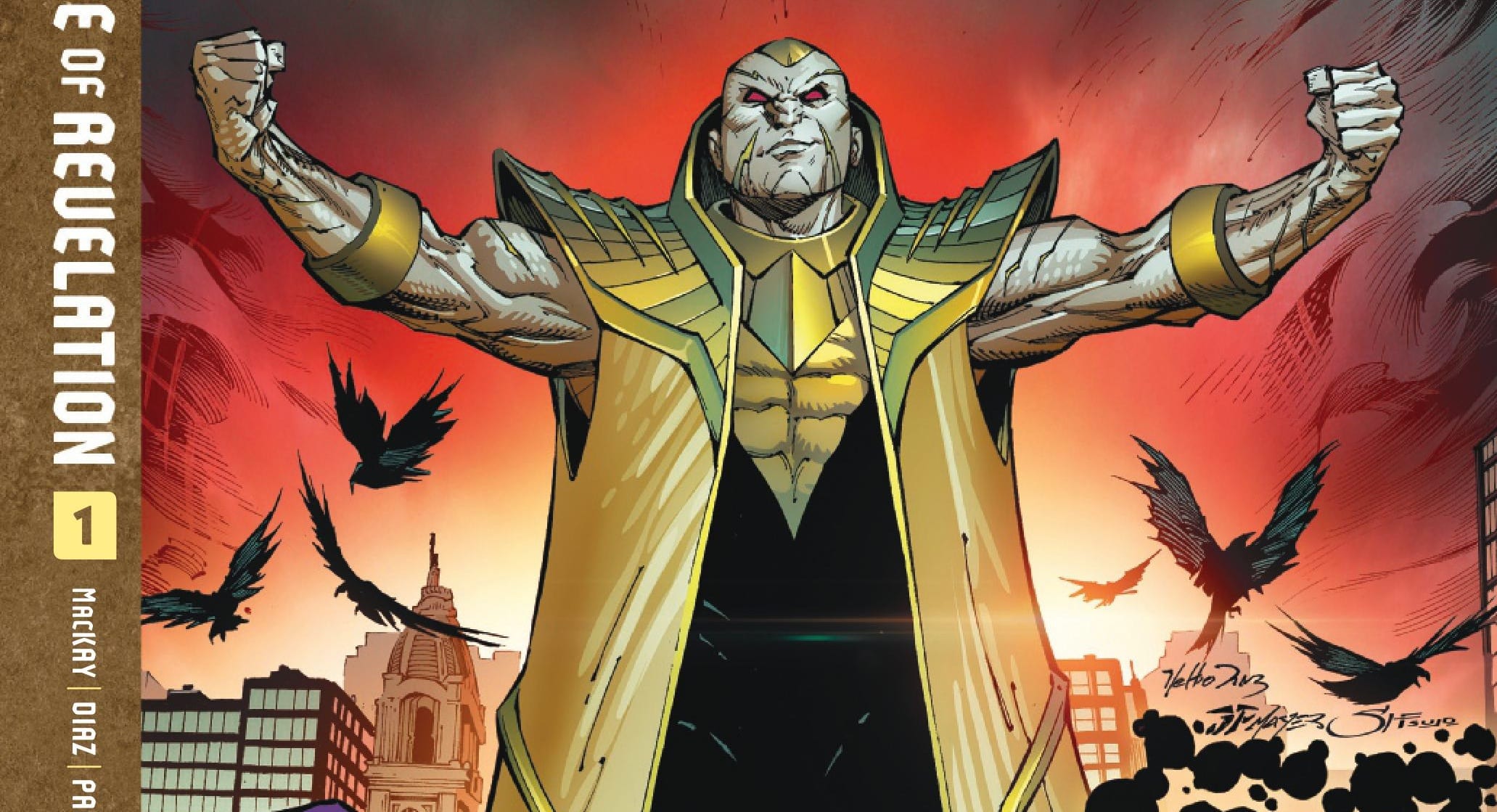
After a full month of covering “Age of Revelation,” the ComicsXF all-star chorus took a break last week, partly because there were no core books out, partly because, well, it was exhausting. And we don’t just mean the pace and volume. These books are exhausting to read and keep up with, and if this event has done anything, it’s pulled back the curtain on what problems the current X-Men line has.
To talk more about it, we sat down together to chat through the event, the big problems it has, its blind spots and why it’s been a microcosm of the current line’s problems as a whole.
Tony Thornley: Hey, gang. So we all struggled to start the roundtables we did through the first month of “Age of Revelation.” We completely skipped last week because none of the “core” titles were released (aka one with X-Men in the title), but this week … we couldn’t do it again.
And so here we are.
For you, our dear reader, we got to talking in our team Slack and collectively realized that it would probably be more productive to chat in this format than be critical of 5-8 issues that all had exactly the same problems as they did last month. In some cases, those problems stretch back even farther.
So I’ll pose the question: Why is this event such a slog, and what does that say about the line as a whole?
A matter of scale

Dan Grote: My goodness, where to start?
Maybe it’s the fact that Marvel is cramming 16-ish books a month into this event, pulling non-X characters like Spider-Man, the Avengers, and Cloak and Dagger into the madness. It would be one thing if this were a company-wide event like Infinity Gauntlet or … shudder … King in Black, but this is a distinctly X-Men event. You can’t sell Doug Ramsey as a 616-level threat when most MCU-pilled readers have never heard of him. They have a hard enough time selling Kang.
Maybe it’s the fact that all of this is taking place within three months. There’s no time to feel like you’re living in this world, and knowing it will end nearly as soon as it began means there’s no real NEED to get invested. Like DC’s “Convergence” in 2015, it’s a quickie event that might as well be an off-ramp for monthly readers. “You can get off here; not much else to see.”
Tony: I mean, I’m not buying a single one of these titles; I’m reading them through the review copies Marvel is generously supplying the site.
Austin Gorton: Because I am An Old Who Was There in the Before Times, I find myself constantly comparing this to the original “Age of Apocalypse.” Sometimes, I wonder if I’m being disingenuous in doing that, because, frankly, “Age of Revelation” comes up short in the comparison. But then I remember Marvel more or less invited that comparison in the initial marketing pitch of this event, as well as in its structure (“canceling” all the existing titles and relaunching them), and in the way the title plays into Doug as the heir of Apocalypse. But it’s not just nostalgia that makes “Age of Revelation” suffer in comparison. “Age of Apocalypse” had a focus and sense of import “Age of Revelation” lacks, and a higher floor of quality from book to book.
Scott Redmond: I can’t even begin to find a shred of care for this event.
Which says a lot when I’ve read a lot of really terrible, massively churned out events that I at least found something to grab onto. There are quite a few of the books that I haven’t even bothered to open at this point. There is something truly hollow not only about this event but about the X-line as a whole these days. Quantity over quality is never really a winning formula, but by golly, it seems like Tom Brevoort is hoping it’ll work out this time.
Not to mention, apocalyptic futures are a dime a dozen with the X-Men. They’re almost inherently shruggable at this point, because they never come to be and often leave only a smattering of characters around to drop into the already overstuffed toybox often referred to as character limbo. That being said, a sharper, tighter focus on something that actually matters and tracks could have done this event a world of good.
Adam Reck: I do think the sheer mass of this event has to be overwhelming for the average reader. If we think back to the last alt-future crossover event, 2023’s “Sins of Sinister,” it totaled fewer than 12 individual comic books across three titles, including bookend issues. The last one before that, Age of X-Man, totaled 32 with six titles and two bookends. “Age of Revelation” has SEVENTEEN(!) individual titles that, even with three-issue mini-runs, will end up being just over FIFTY individual issues of comics in three months. Aside from the financial piece of asking X-fans to shell out $3.99-$5.99 for each issue, 50 is just too many when the basic pitch and the connective tissue between the books is this thin.
Austin: I don’t even think they’ll be able to fit it all into one omnibus.
Dan: Indeed, ’tis the economy, stupid.
Tony: Not only that, but going back to what Adam said — the connective tissue is just missing.
The volume/economics of it wouldn’t be as huge an issue if you could see the throughline. “Age of Apocalypse” was roughly 40-45 issues, and you knew that they knew where it was going and what the purpose was of each of those books. They each had a mission. I do not know at all where Radioactive Spider-Man, Iron & Frost and Rogue Storm fit into the overall narrative (even with the variation in quality between the three).
That’s not even counting Unbreakable X-Men, which is just telling its own dark future for Gail Simone’s Uncanny X-Men that’s barely connected to the wider event, or Omega Kids, which seems to be in this world but not adding anything aside from “here’s what Quentin Quire is doing” and introducing new characters. I actually liked both of them to a certain degree, but sat there afterward thinking they were essentially pointless.
Hell, and that’s not even getting into the connective tissue of the plot. It wasn’t even clear to me until this week in The Last Wolverine #2 that the general public of this world doesn’t know that Doug was behind the X-Virus.
Austin: The wild variances among the settings, the way things seem “Age of Apocalypse” or “Days of Future Past” bad in some places but mostly fine in others, is maddening. I get that some of this is intentional — they’re trying to do a more layered alternate future/reality than the typical “dystopia/utopia-that’s-still-bad” approach. But the sheer volume of issues set in different places robs the setting of its impact.
It’s also inconsistent even within its various “regions” — there’s so much to keep track of across the different books, I still don’t have a good handle on whether the remaining U.S. government is as bad as Revelation says, or if that’s propaganda, or if most of the mutants inside the Revelation Territories are happy living in trees, or if Revelation is forcing everyone to be happy/stay put.
Scott: Comparing books to other books from other times is always tough, but there’s a reason we have to do it often. AoA keeps coming up because of what Tony just said — you knew what the status of the world and characters was. Each book slotted into a space in that world. Same with any other alternate realities we’ve mentioned here so far or haven’t mentioned yet. Seventeen distinct titles that roughly have very little in common other than the branding on the cover isn’t good.
Austin: Exactly. As sprawling as “Age of Apocalypse” was, each series managed to both build out the world and advance the overarching plot of the event. So even if one series was, say, mostly dedicated to Nightcrawler’s adventures in the far-off Savage Land, he was doing so to fulfill one aspect of Magneto’s larger plot to restore the “correct” reality, while also giving readers a glimpse at how the Age of Apocalypse has changed the Savage Land.
Too many players on the field

Dan: Another drawback to this event is all the new characters these books have introduced who won’t be around come New Year’s. The Omega Kids, Elbecca the Chorister, Temper and Ransom’s baby, Cloak and Dagger’s child, Laura Kinney’s son with Sabretooth’s son, the townspeople of Beverly, Massachusetts. Alt-realities/dark futures work when you mix up the existing pieces in new combinations, with maybe one or two new characters whose existence is narratively significant because it says something about how the other characters have changed. See: Baby Charlie in the Age of Apocalypse. Not everyone can be Baby Charlie.
Adam: Dan, no one cares about Baby Charlie. I think a better AoA comp is Morph or Blink, characters who had previously existed in other forms (X-Men: The Animated Series and “Phalanx Covenant,” respectively) and had new lives in that dark future.
Austin: Adam, this is Silver Age Changeling erasure. He died so Xavier could defeat the Z’nox!
Adam: It’s more likely that the bulk of the new characters we’re seeing come out of “Age of Revelation” will go the way of Abyss instead of Sugar Man. I simply don’t have much reason to engage with or care when I know these stories are ending so quickly. I’m also not really being given good reasons from the stories we’re being presented with. That’s me being a bad-faith reader in many respects and not giving these stories the individual attention and respect that maybe they deserve. But the quality simply is not there, so it pulls down the books that are doing interesting things.
Tony: I was a Bring Back Blink diehard for several years before Exiles. AoA did some truly great things with its characters.
Scott: I would read another Exiles with Blink, Morph and Mimic together again right now. Give the people what they want, Brevoort, more cowbell … I mean Blink!
Dan: Christ, I could have said Nate Grey. Why didn’t I say Nate Grey?!
Tony & Scott: Bring back Blink! Bring back Blink!
Dan: But when this event isn’t hastily introducing new characters, it’s sprinkling in blorbos from across the X-spectrum but not actuallying doing anything with them. Like, yes, it’s great to see Chance from Fallen Angels as one of Revelation’s Choristers, but why is she there? What are her motivations? How does she feel about being basically forgotten by mutantkind only to find herself in this position of power? It’s not enough to do deep pulls for deep pulls’ sake. You have to have a reason to exist in a story that’s going to be over before it starts.
Adam: I am totally fine with the inclusion of long-forgotten mutants, but yeah, you have to give us a good reason why they are there or give them something to do. If they’re just standing there, it’s completely pointless. It’s equivalent to throwing a character into a crowd scene and saying, “Look! There’s Soft Serve!” OK, but what is Soft Serve doing?
Dan: She’s serving, Adam. Serving her poop-based treats.
Tony: I said this in Week 1, it’s great to feel the depth of the X-line for the first time since probably the final Hellfire Gala. But everything since then has just been OVERWHELMING. And you’re both right — they’re not serving a purpose. Like most things in this event.
Scott: I’m going to repeat a word that I used at the start: hollow. There is so much hollowness to most of what is being done in and around these books. Great, you’re mining the depths of X-lore for stuff, but again, as the rest of you said, what’s the overall point? It really speaks to the overall focus of this era for the X-books, trying to be all “Remember this?” without any real substance other than stitching together random bits of X-lore into some haphazard shape that barely resembles a quilt.
This quilt has bulges, random round edges, colors that aren’t complementary at all, and halfway through the designer decided on doing a totally different pattern before losing their way.
Dan: And it’s getting cold outside, so Marvel knows some readers will just take the misshapen quilt because it’s the only warmth they can find.
[Miles Stokes voice] WHAT?!

Dan: But here, perhaps, is this event’s greatest sin: the fact that, according to Amazing X-Men, the real plot to stop Revelation is sending the Cyclops of X Years Later back in time to stop Doug before all of this starts, which means the important bits theoretically are happening off panel (at least until X-Men resumes in January), which just adds to the idea that this story is superfluous.
Scott: I absolutely detested this revelation. Just one of the biggest “slap in the face to the entire audience” situations possible.
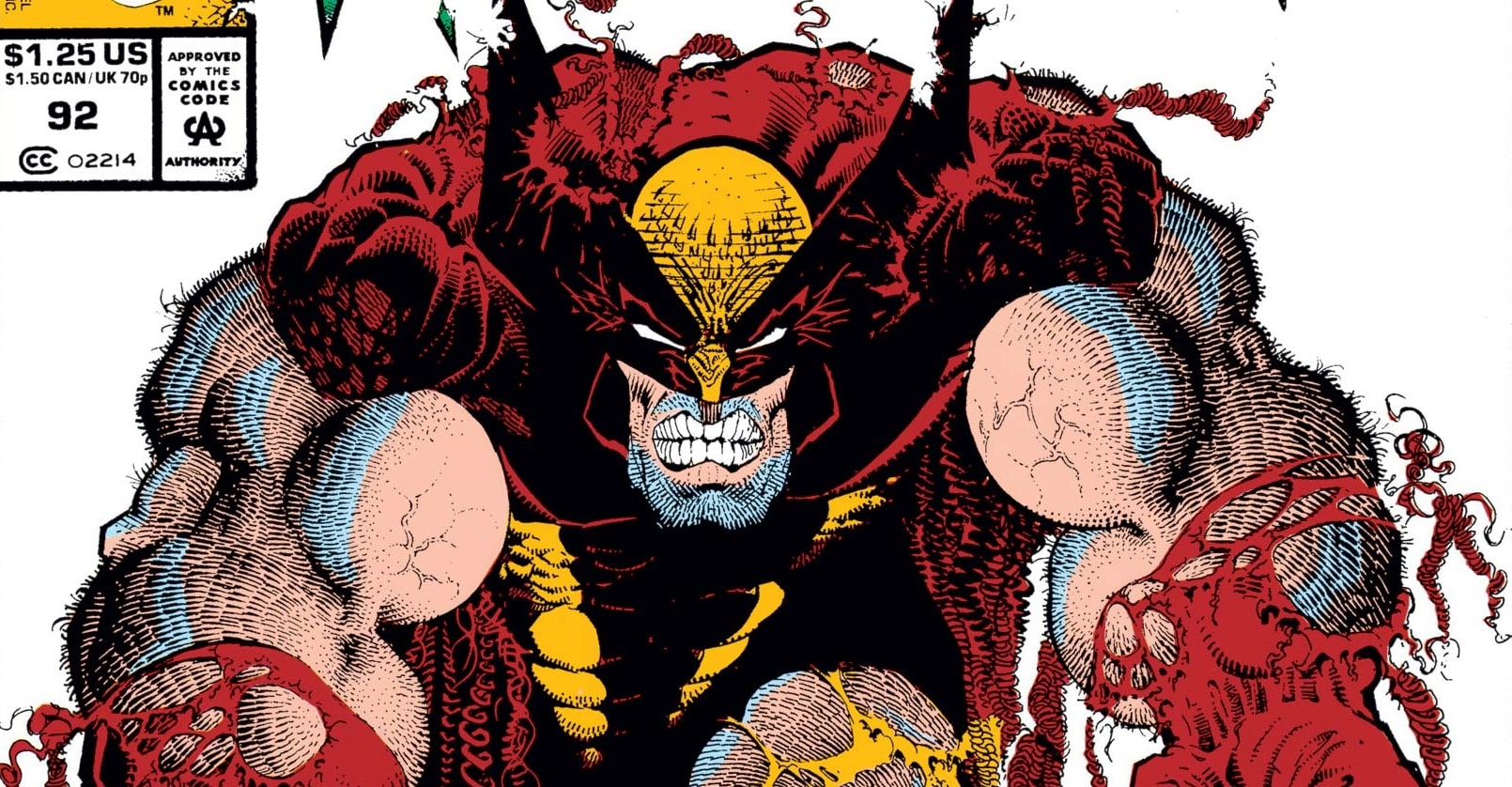
Austin: It’s utterly mind-boggling that they built a 17-series event around the equivalent of the half-issue future-set plotline of “Days of Future Past” involving three X-Men storming the Sentinel-controlled Baxter Building to kill time while they waited for Kate Pryde to change the future. And at roughly the halfway mark, we have yet to see a single image half as evocative as the sight of Wolverine having the fleshed flayed from his metal bones.
Tony: See I liked the plot point, I hated that it essentially told us that everything about this event doesn’t matter.
And that comes to one of my points — would this whole ordeal be better if it were just a five- to six-issue story in Jed MacKay’s X-Men? Is this an AXIS situation where it was proposed as a single story and then Marvel made the mistake of blowing it up? Regardless of whether it was or not, I don’t think any of us could deny we’d like it A LOT MORE if it were contained to just X-Men.
Scott: It certainly would have been more concise and far more focused had it been just in X-Men. It easily could have had a few pages of the future Cyclops and Beast revealing the dark future to someone. It would mean that the actual structure of this future wouldn’t be such a darn mess. There definitely would be far more tension and a reason to care and focus.
Austin: Absolutely. If this were a six- or eight-issue arc (with maybe one or two one-shots or short minis to build out the world) that revealed in Part 4 that the real plot was happening back in the present and then shifted to that, it would all hit with a lot more impact.
Dan: This jibes with the fact that the only books I’m really getting anything out of are Amazing X-Men and Book of Revelation, the two by MacKay.
Scott: The AXIS situation, as you called it Tony, seems to have spread through a lot of modern Marvel. Their events are becoming more and more small stories that had no business being so blown up, that often matter very little to anything else going on around them.
Adam: This to me is the point where I simply stopped trying to care about AoR. I was willing to give it a chance, and genuinely enjoyed some of the worldbuilding. But when your protagonist explicitly tells you that the resolution to the main conflict is either happening off-page or will happen when the regular books resume, I have to ask myself as a reader, what am I still doing here? Because frankly, putting the Cyclops of a decade later into the Cyclops of the present is a far more interesting pitch than almost everything happening in this future.
Tony: Agreed. And I think it’s completely valid to want to know what’s happening to Present Cyclops in this dark future, even before it goes back to Future Cyclops trying to kill Doug. But this is all about hats on hats. For example, even if the event were streamlined to just the main story, why does present-day Beast need to be in the picture?
Dan: For … science?
What remains

Dan: Anyway, did we cover all the big, gaping problems?
Adam: I think you’ve missed two: The first is that after this many issues, I still don’t have a solid idea of what the world is, what Doug’s ultimate goals are, what the rules of this alternate future are, and what our protagonists are trying to do. It’s wild to me that the map of the Revelation Territories was relegated to a non-comics page for previewing upcoming issues. It’s odd to me that I should still have questions about how the X-Virus works.
I’ll give AoR credit, compared to the absolute cluster that was X-Manhunt, this is incredibly more coherent, but the books all seem to exist in their own vacuums, in some cases on different parts of the timeline, and it’s difficult for me to put all the puzzle pieces together when I don’t particularly care what the picture is supposed to be.
Austin: There are at least three different series that seem, at their core, about an effort to cure the X-Virus. I’m all for creating a sense of scale for a problem, but that just seems excessive, and if anything, makes it even harder to get a solid grasp on how exactly it works when we see a bunch of different people trying to tackle it in different ways.
Scott: Pop quiz time! Summarize the X-Virus, Revelation Territories, status quo of mutants/humans/etc., in one concise sentence!
Dan: Ooh, I got this. The X-Virus turns humans into mutants but also it kills humans but also it may further mutate the already mutated and also … I’ve already failed.
Scott: Sorry, the teacher in me popped out there. Clearly a malicious bit of teacher since that assignment could not be completed. But here, let me try:
A whole event that is messy and unfocused, often wasting half of its books’ short lifespan trying to set things up while simultaneously concluding them.
Austin: I know we’re all complaining about this event having too many comics, but the whiplash from “setup in issue #1” to “setting up the conclusion in issue #2” is striking. Again, not to fall back on the AoA comp, but fewer series at four issues would probably work better structurally than the current “a million three-issue series” approach.
Scott: It’s like one or two people wrote out a vague outline of a premise, cut it into pieces and handed just one torn piece of paper to each creator, while Simone just went Rogue (sorry not sorry) and burned her piece while running away.
Dan: As on social media, so on the page. Gail’s gonna Gail.
Adam: The second, much larger problem is that what we’re seeing here is reflective of the pre-existing “From the Ashes” line going into the event: a jumbled pitch without a clear inciting incident, books that seem to exist in isolation from one another, the introduction of new characters instead of using the larger cast of existing ones, and a lack of forward momentum. Add to this the announcement of Eve Ewing’s X-Men United, a new flagship back-to-the-school book, and it gives readers all the justification they need to ignore everything happening right now and wait for the new status quo to drop.
Tony: You said exactly what I was thinking, Adam. Books that feel like they should be important — Unbreakable and Rogue Storm, for example — are so disconnected that I cannot read them without thinking WTF’s the point. (Also, I am SO frustrated with Spider-Girl’s extensive use of pidgin English in Unbreakable for no reason aside from her Hawaiian heritage. I’ve read most of her current series, and she might have used pidgin once. Maybe.)
I’d also add that the length of this event is so much to its detriment. And alongside that, the pacing of these books makes it so much worse. Amazing X-Men is a chase book, and is extremely fast paced. But Iron & Frost and Omega Kids have been three total scenes each across two issues of each series. If all the books were paced like Amazing, then maybe it wouldn’t feel that way, but none of these stories are going to make any plot progress before they end.
To Adam’s second point, this is the problem with the line as a whole right now. It’s all over the place. There’s no unifying pitch. There’s nothing at the core here to make me care, and it’s now been this way for a year. Once AoR ends, I may continue to read X-Men. I’ll probably pick up Generation X-23 because that’s an interesting pitch. I might read one or two of the solo miniseries. But as a whole, I’m finding myself caring about X-Men less than I have since probably Alan Davis’ placeholder run that led up to Chris Claremont’s return around the turn of the millennium.
I just don’t see the point.
Chasing ‘Shadows’

Scott: We’re people who, clearly, love the X-Men. You don’t write pieces like this generally when you overall are not fans of something and have a deep history with and love for them. Yet we’re struggling to find a single reason to care about what this event and the line as a whole are presenting. There isn’t a single thing about the new era announced so far that makes me feel any sort of way other than wanting to let out a massive sigh and go read better books from other publishers.
Austin: I’ve been at this a long time. There are definitely eras of the X-Men you enjoy, and others that you just have to get through in the hopes of reaching something better. “From the Ashes” was definitely a “get through it” era.
Scott: I’m not going to beat a dead horse. Yes, I deeply miss the Krakoa era, but that wasn’t the only way that I would keep reading the X-books. There is a universe where this new era began with a solid premise, inciting incidents, actual characterization, reasons for the characters to act the way they do, and more that would have piqued my X-Men-loving interest with ease. This is not that. This is the modern Marvel where nostalgia-tinged fare that just pumps out more issues to fill a sales quota is the key to decision making.
I want to care. Give me a reason to, Marvel. Because right now, I can’t find a single reason to keep flipping through these pages.
Dan: I think — I hope — we’ll find some things to love in the Shadows of Tomorrow. I’m looking forward to Alex Paknadel and Roge Antonio’s Cyclops mini. I really do like MacKay’s X-Men, even if I’ve had my problems with it. And I’m pumped to see Eve Ewing take a Justice League Unlimited approach to X-Men, even if I’m not sold on the return-to-the-school part of the concept.
Austin: Even in the “get through it” eras, there are usually at least a few series that make it easier to get through. Neither X-Men nor Uncanny X-Men are perfect, but they at least seem to have a POV and something to say (even as they both continue to exist in a maddening vacuum from one another). They’re also about the only two books in the line I don’t have to worry about being abruptly canceled. Speaking of, I also enjoyed both Psylocke and Magik, and am glad that Ashley Allen is getting another crack at Illyana. But my biggest frustration with “From the Ashes” is that even the bright spots all seemed to exist on their own; any sense of a unifying plot or theme was missing. Nothing I’ve seen about “Shadows of Tomorrow” suggests that’s going to change.
Dan: X-Men is a franchise made for dipping in and out. It ebbs, it flows, it sucks, it glows. Sometimes all at the same time. If the books aren’t for us right now, maybe it’s not the worst thing in the world to take a break.
Besides, even if the comics aren’t working, at least we get Season 2 of X-Men ’97 next year!

Tony Thornley is a geek dad, blogger, Spider-Man and Superman aficionado, X-Men guru, autism daddy, amateur novelist and all around awesome guy. He’s also very humble. Follow him @brawl2099.bsky.social.

Dan Grote is the editor and publisher of ComicsXF, having won the site by ritual combat. By day, he’s a newspaper editor, and by night, he’s … also an editor. He co-hosts The ComicsXF Interview Podcast with Matt Lazorwitz. He lives in New Jersey with his wife, two kids and two miniature dachshunds, and his third, fictional son, Peter Paul Winston Wisdom. Follow him @danielpgrote.bsky.social.

Scott Redmond
Scott Redmond is a freelance writer and educator fueled by coffee, sarcasm, his love for comic books and more "geeky" things than you can shake a lightsaber at. Probably seen around social media and remembered as "Oh yeah, that guy." An avid gamer, reader, photographer, amateur cook and solid human being. Follow him @scottredmond.bsky.social.

Adam Reck is the cartoonist behind Bish & Jubez as well as the co-host of Battle Of The Atom. Follow him @adamreck.bsky.social.

Austin Gorton also reviews older issues of X-Men at the Real Gentlemen of Leisure website, co-hosts the A Very Special episode podcast, and likes Star Wars. He lives outside Minneapolis, where sometimes, it is not cold. Follow him @austingorton.bsky.social.