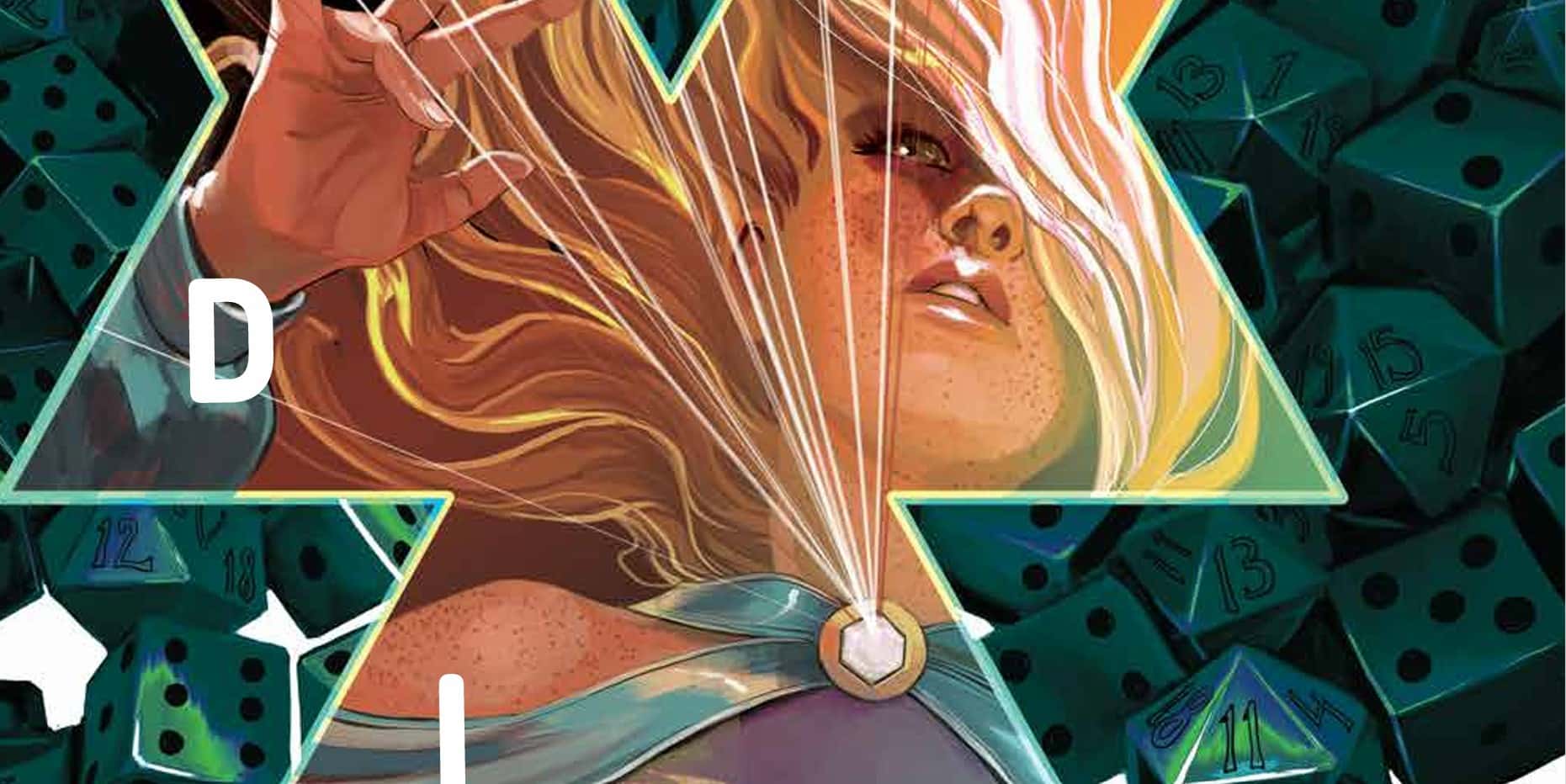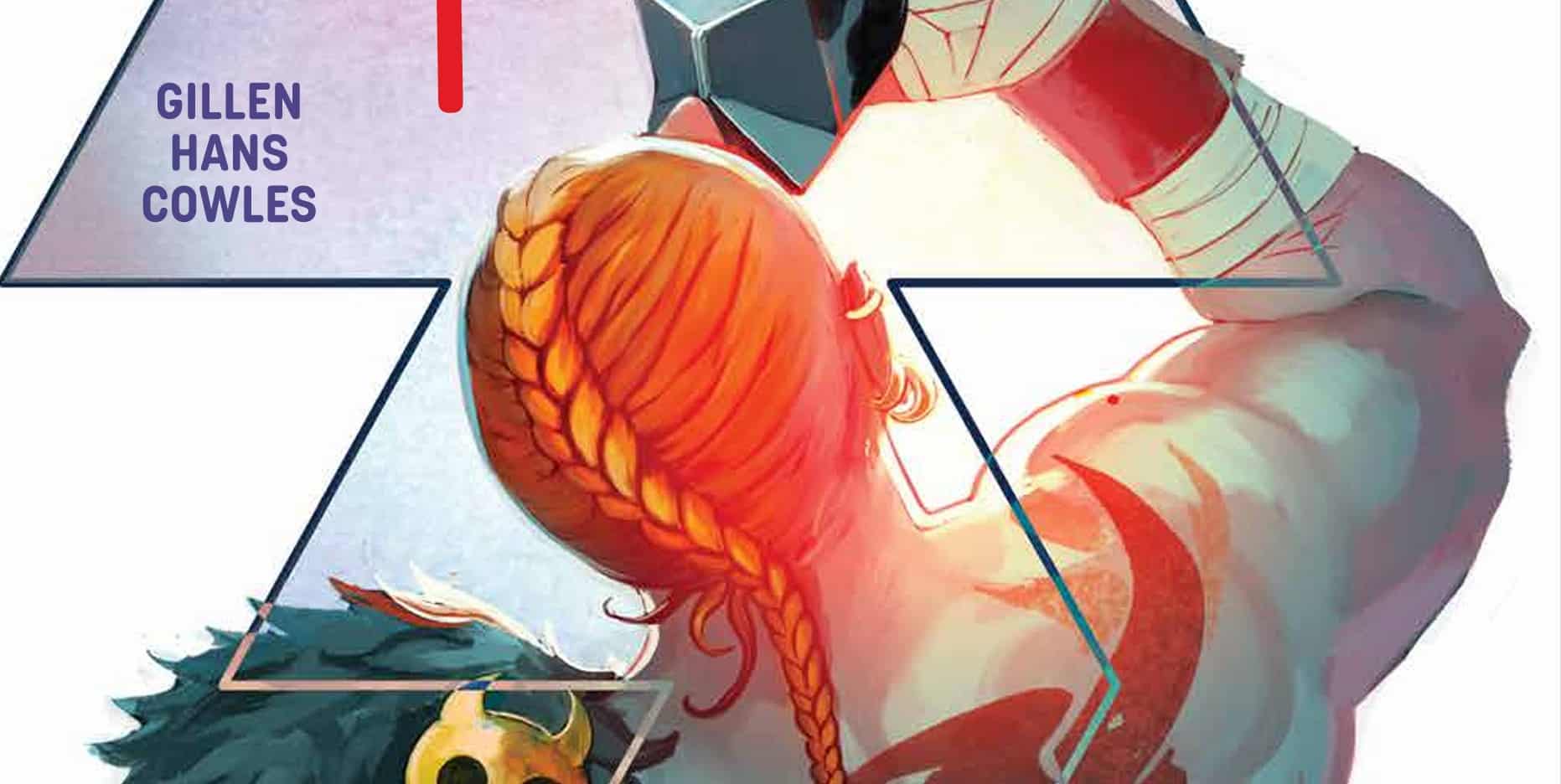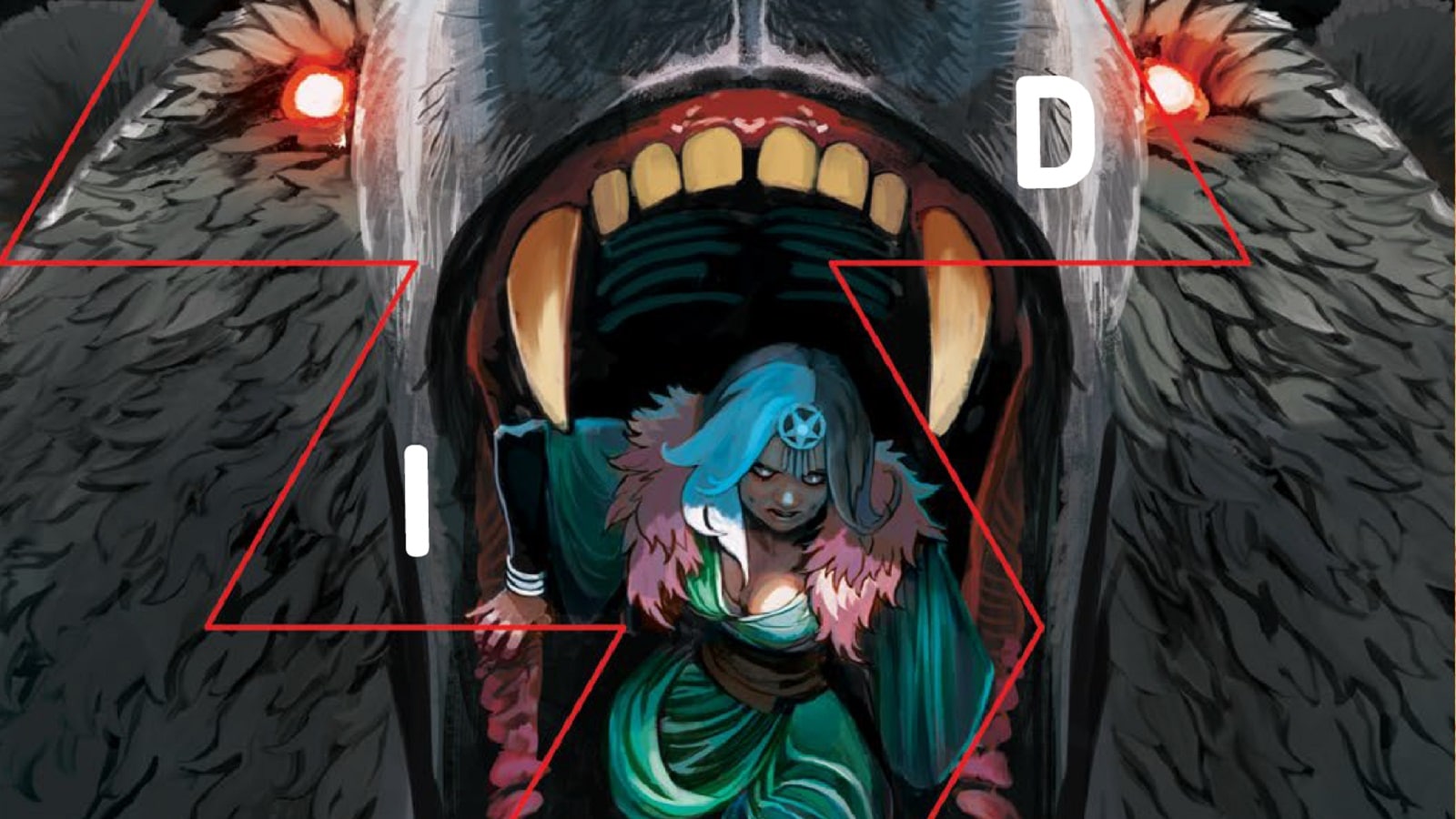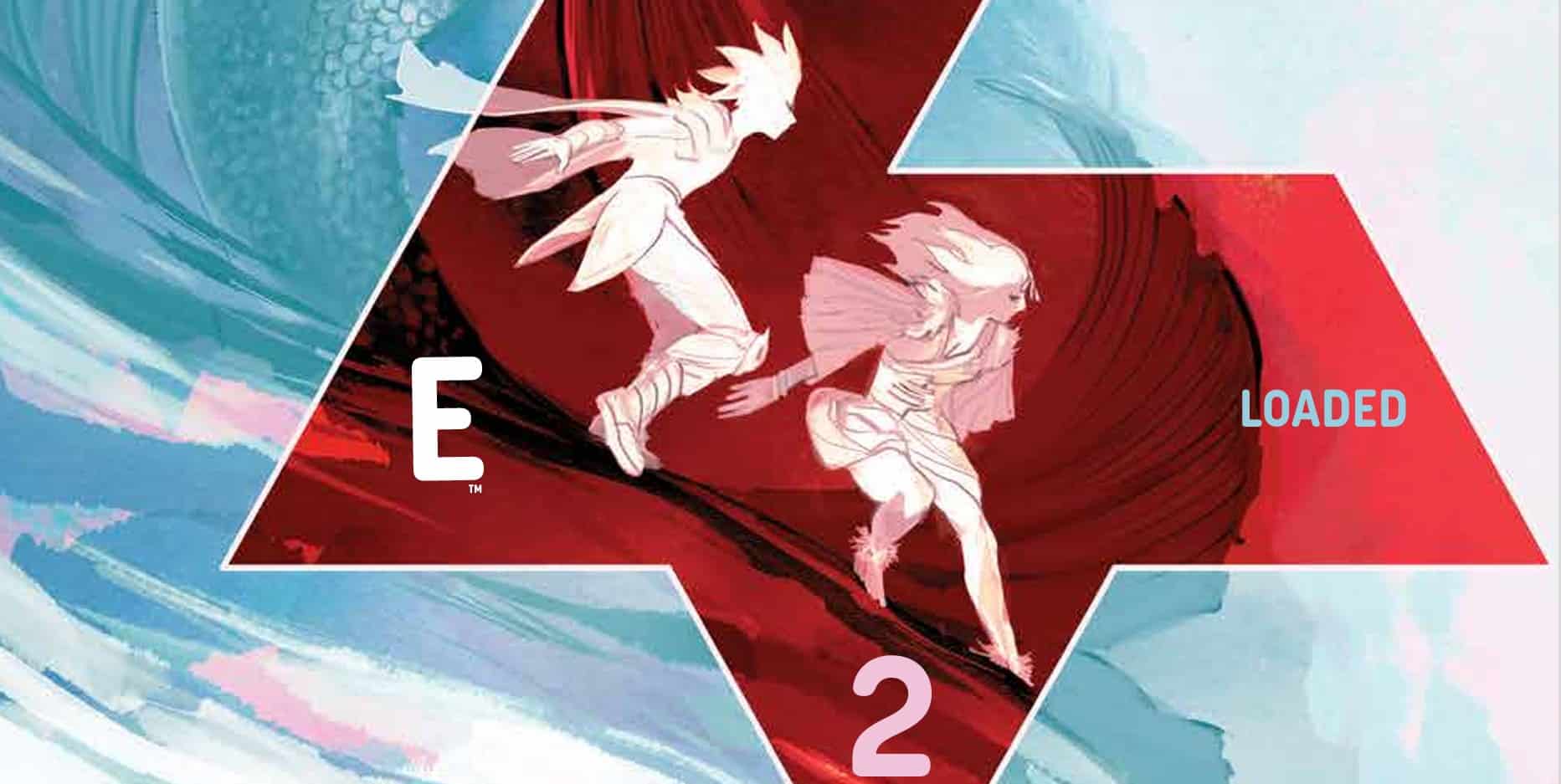
A Godbinder and a Rage Knight find themselves lost in a realm of endless artscapes, with little idea of why they’re there, and what they’re meant to do. There’s a steep learning curve, but with the help of a mysterious new Master or two, they just might figure things out before they face the game’s final boss — or will they? DIE: Loaded #2 is written by Kieron Gillen, drawn by Stephanie Hans, lettered by Clayton Cowles and designed by Rian Hughes.
Armaan Babu: So I spent the weekend running a session of DIE where the Games Master has been murdered and the players get to read all of his notes for the game. This is our first issue in the new volume with a backmatter essay from Kieron Gillen, which are kind of like a GM’s notes. All in all, I’m going into this issue with a lot of thoughts in and around DIE. Unfortunately, two of our team have been swallowed by a freak snowstorm of pastels. Rasmus, you’ve rolled high enough on your dexterity to make it here, how are you feeling about this issue?
Rasmus Skov Lykke: Great!
In our last review, I predicted that Molly’s class would be Rage Knight and that the disembodied voice was Isabelle. And I got both right! Plus I survived that freak snowstorm that seemed to devour Penn and Mark. Go me!
Oh, you meant about the actual content and craft of the comic?
Also great!
We learn more about the world, the characters and the stakes, while still giving a small taste of DIE’s theme of reflecting on what RPGs are for and how they work, with the art realm. We’re still very much in the introductory phase of the comic, but it looks like it’s going interesting places.
Tutorial Level

Armaan: TTRPGs are a quickly rising hobby in Bangalore. There’s a fast-spreading interest from people who want to get into them, who want to learn how to play. One of my regular gigs is running games for first-time players to introduce them to the hobby. One of the most effective ways of doing that, I’ve found, is to spend a good hour establishing characters — the human aspect, before we get into the nitty-gritty of stats and mechanics — to anchor the story in feelings that people can get invested in.
And then I immediately throw them into battle, because the nitty-gritty of stats and mechanics is still important.
It’s only after that that the game truly begins.
We have something of that here — #1 gave us the human aspect, and then a battle. Now we find out what happens next. It’s still a little backward, though, because while Sophie and Molly have a measure of what they can do, they still are learning a lot about what this game is.
Enter Isabelle. Gotta say, Rasmus, you absolutely called it here, well done!
Rasmus: Thank you, thank you!
The reveal coming this early means that I don’t think Isabelle is the person who dragged Sophie, Molly and the rest into the game. The first volume of DIE had a Master as the antagonist, but the RPG does list rules for having a non-Master Games Master, and I think that’s what’s happening here.
Which gives me comfort, because I couldn’t find a reason for Isabelle to do this. She just didn’t seem like the kind of person to inflict this level of trauma on someone else.
Which leaves the question of who did pull the cast into Die. I suspect the most obvious answer is the right one: Chuck, from beyond the grave. We know he’s still in Die, we know everyone got their die at the funeral and, for now, it appears the antagonist isn’t a Master. So why not a Fool?
Seeing the different expressions of DIE as a game is very interesting!
Armaan: One thing I can take solace in is that I did call that there would be a Master in this game. For those less than familiar, in DIE: The RPG, the Games Master gets a character sheet as well, one that allows them to warp reality in limited ways. Push the rules too much, use all your Cheat Tokens, and the Powers That Be take their revenge.
It is possible for the Games Master to give a player the Master sheet. The Games Master is still the one telling the story, but for whatever reasons, one of the poor, ignorant players being pulled into the game can gain the close-to-godlike powers of a Master.
Someone has orchestrated all of this. Someone has pulled Molly, Sophie and likely the other loved ones of the original party into the world of DIE — and given Isabelle the powers of a Master. Why did they do this? Is Isabelle meant to serve as a teacher, as someone who’s been here before? Is there more to Isabelle’s story we haven’t seen that her new role will help her find? Or is Isabelle simply the most compassionate one — someone who will help these new players see that the people of DIE are not just simulations, but in their way, real people?
To quote Gillen himself in the backmatter, “One theme of DIE: Loaded is ‘No-one is a non-player character.’” In the first volume of DIE, Isabelle was the one who argued they should treat the people of DIE like real people. She fought for it. She very nearly killed for it.
That kind of compassion is a powerful thing. That kind of compassion is a dangerous thing.
Rasmus: Well, we learn in the first issue that Isabelle isn’t at the funeral partly because she is working on her own book. Which we’re told isn’t sensationalist fiction like Chuck’s books, but instead appears to be a more academic look at what the group went through.
From the first volume, we know Isabelle is teaching English literature at a high school. I think it makes sense that following the harrowing experience of DIE, she would look into roleplaying games from an academic point of view. It would fit with her hovering over the cast, dropping pieces of knowledge about the world of RPGs, that it’s because of her studies.
She is the one of the cast who knows the most about RPGs, so of course she’s the Master. I can even see Chuck following that line of thinking: “Eh, let Izzy worry about the deep lore, the rules and all that boring shit, while I do the fun stuff!”
Armaan: An exploration of roleplaying games is an exploration of agency. With the kind of power you don’t have in the real world, and the freedom to do anything you can imagine, how do you save the world? How do you save yourself?
And what’s taking precedence?
Rasmus: If we look at what Sophie and Molly want, it’s getting the hell out of the game. Which is honestly a very fair reaction to being tricked into playing an RPG.
As a parent, the panels of Sophie thinking about possibly never going home again hit hard. She starts thinking about how she’s an older parent and what that means, before turning to the possibility of simply never going home. As she continues, she thinks “I could never see Stuart aga–” and cuts off her thoughts, because that idea is simply too much to bear. It is simply not a possibility. What follows isn’t a question of if they can get home, it is how. Because it is going to happen, no matter what. Sophie is going to see her child again, no matter what.
With that established, it is time for one of the absolutely hardest parts of starting an RPG adventure: Actually finding a group to play with.
3/5 Stars

Armaan: With Isabelle’s early tutorial quest handed out, Sophie and Molly head into a fog of the most gorgeous colors that Stephanie Hans has to offer. Pink, blue and turquoise clouds of swirling mists, with very little in the way of actual backgrounds. Like what dreams would look like, before given shape. Like art in potentia.
The 20 realms of DIE are each meant to represent some aspect of roleplaying games, and Realm 5, as it turns out, is art. The promise of art, the lies of art, and the exploration of what art is for.
Rasmus: My relationship with RPGs is — compared to my other nerdy interests — fairly new, with DIE RPG actually being the first RPG I played, when the beta rules were released alongside the first trade. I’ve only been playing for about 7 years, and only gotten more serious about it the last few years.
But as any geek knows, when we get serious, we get serious. So I’ve been trying to pick up more varied game systems, instead of just sticking to D&D and similar. And as much as good word of mouth matters, as well as interesting settings and rules, the thing that most determines if I’m going to purchase a book is the art (both the actual illustrations and the design).
Armaan: I write games, and will occasionally insert shameless plugs on this site, like I’m doing here, because I’m trying very hard to sell games. I’m aware that one of the reasons my games aren’t selling as well as they could be is because the art in my games isn’t great. Good art — a good cover — goes a lot further to sell a game than a dozen glowing reviews ever could. It’s about more than just selling your game, though; it’s about wanting to create something that makes people want to play. It’s about luring them in to this thing you’ve created with the promise of pure magic. It’s about hoping to trap them in dozens of hours of playtime, hoping they will see what you saw when you first created this magical thing.
They never will — never exactly, and never in the way the art promises. Never fully — but with luck, they find something more. Not a game as polished as that single piece of cover art, not a moment that feels as well-put-together as that piece they saw alongside the book’s explanation of its complicated rules. They don’t get Matt Mercer at the table. They come away with something much messier, and in a profound way, something that is more completely theirs. The art was always a lie, but one that lures players into something much, much more special.
Rasmus: I don’t think it’s so much a lie as just one interpretation of what the game can be. It is one artist’s interpretation of what the game is, how it plays, what it brings to the world and what you can take from it. This is what the game was for, for them. Yes, it will often be more polished, with all of the ill-fitting, ugly distractions filed off. But that is often where the magic lies. In all the little tidbits, the dumb moments that make each game uniquely yours.
It is not so much a lie as a lure — drawing you in, hoping the game can get its hooks into you. As long as the art has done that, it has done its job. Now it’s up to the game to do the rest of the work.
Armaan: We’re currently in an era that highlights the importance of art in a strange, roundabout way. Kickstarters and other promotions using Gen-AI art, people splitting hairs about how they’re using Gen-AI, or claiming that the art they’re using to ask for your money is merely a placeholder, for now. Whining, online, about how they’re not going to be able to sell their games without good art to draw people in. People are talking more than ever about how important art is — while entirely missing the point about what true art brings to the table.
Human artists understand the pink, blue and turquoise clouds of swirling mist. The magic that needs to be evoked. How to capture that feeling, to frame it, and to capture that pure in potentia magic in a single, awe-inspiring image.
Human art is important. Pay your damn artists.
Rasmus: Pay your goddamn artists!
Armaan: It’s not a straightforward path out of Realm 5. Art lures them into one adventure after another, and shows them visions of the past, or times that may or may not be. Molly gets a view of their mother in her full heroic Neo get-up, Sophie sees herself commanding a sledful of bears — and a glimpse into the mortal world, with two magpies.
One for sorrow, two for joy. We get another mention of magpies. Two issues of them being mentioned, without payoff. We’re building up to a big revelation here!
Rasmus: I’m disappointed in myself that it was only on my reread that I recognized the Molly and Sophie panels as straight Frank Frazetta homages. The Angela panel even has a classic Frazatta maiden clinging to her leg, while the sled is a very faithful redraw of a Frazetta painting. With the d12 added into the shield of the sled, interestingly.
Armaan: This issue, though, finally gives us a little more insight into Molly beyond them being an angry trans teen.
I had to look up what a Foundation Year was, and as I understand it, it’s the first steps toward college. First steps out into the real world — where your life, and your place in the world, is given perspective. Where the world expands, and so much of it isn’t about you. In Molly’s unfortunate case, the parts of it that are about them are unkind, cruel — and, worst of all for an artistic teen, boring.
One thing this issue brings up several times are all of Sophie’s reasons to go home. While Molly certainly seems eager to escape Die right now, as the story progresses, will they really want to?
Rasmus: Molly is right around the same age as the original cast was, when they first disappeared. When most people disappear into fantasy realms, really. Emotions are so heightened when you’re a teenager, that escape seems like the ideal solution, because everything around you sucks. Molly has a bad relationship with their mother, and in this issue we see that it’s the same with their dad. “Packed full of asshole genes, me” is their thought. There is their sister, Bea, who seems like a sole bright point in an otherwise dreary existence.
I suspect Molly could end up being hard to convince to leave, because life in Die is much more appealing.
Armaan: Of course, those of us who’ve read DIE know that Molly doesn’t leave Die at all, in the end. We also know that time is … strange. This is set after the events of the first volume. It’s also, somehow, set before the events of the first volume — which means that while we’re getting to know Molly the Rage Knight, Molly the Fallen might also be out there.
Fallen come back to life when they kill a player. Molly the Fallen could, feasibly, take Molly the Rage Knight’s life and finally go home — and close the time loop. Killing who you used to be so that the person you’re meant to be can come into the real world? I can’t think of a more Gillen thing, though I say this as someone with a Journey Into Mystery tattoo, so perhaps my pattern recognition is a little biased.
Rasmus: That is an overly convoluted theory that requires a lot of moving pieces to be placed just right, for a long-term plan of the authors to hit just right. It would leave a lot of the cast and readers in tears, as the character we’re going to follow in DIE: Loaded would end up dead, erasing a lot of their lived experiences. It sounds very far-fetched.
And I think you might very well be right.
The Long Con

Armaan: We’re not done meeting interesting new characters from the world of DIE. Sophie reaches out to one of the other gods — the Barnacle Witch. The Barnacle Witch fills in the Sea God slot of the game’s standard pantheon, though she’s stretching the art metaphor quite a bit to be there. We’ll be seeing her again, because she makes a deal with Sophie to find the Master of Realm 5 — and no player leaves Die without fulfilling their debts. Or depths, if you want to get all punny about it.
Rasmus: What I find interesting about the Barnacle Witch is that she is, in many ways, Stephanie Hans. And clearly deliberately so.
First of all, there’s the whole French thing. Then they’re both artists (and Hans is definitely the art god of DIE, DIE RPG and DIE: Loaded). And finally, she is the god of the sea, where Gillen often describes working with Hans as working with the ocean/sea. She has her own temperament, and when, in Vol. 1, he attempted to confine her to a grid, she burst free, giving the page a freeflowing nature instead. She cannot be tamed, nor should she be, as it is exactly the tempestuous nature of her art that is so stunning.
Armaan: I completely missed that! Great catch!
The Barnacle Witch — or Hans herself, possibly — leads our players to Realm 5’s Master, watercolor clouds parting to reveal a Conan-esque character, evoking the art of Frazetta in another breathtaking page.
Rasmus: OK, maybe I didn’t recognize the earlier Frazetta homages, but I do know the Death Dealer when I see him. An image so strong, it inspired several comics, a novel franchise and role-playing games.
The framing is interesting, as the camera shows the back of the Death Dealer. The focus is not so much on him as on his effect on Sophie and Molly. We’re nearing the end of our time in the art realm, and the focus is not on the actual art, but on art’s effect. Which in a very real way is all that art is: what we take from it.
Armaan: This single page could be a perfect cover in itself, but it’s worth nothing that this Master doesn’t speak. Nor is he directly named, like the other Masters we’ve seen have been, and that fits — how often is the artist’s name lost while the writers’ names are lauded for something that belongs to both of them? How often do we see the work of the artist as silence, despite it being the loudest thing on the page, the thing that makes you pay attention to it?
But it stays with you, even as it moves out of sight.
Rasmus: The amount of art works (comics, RPGs, movies, etc.) where I can’t recall what happened in the story, what the characters are named or what the themes were, but where I — in vivid detail — can recall images is vast and ever expanding.
Armaan: Wordlessly, the Master leads them to the end of their quest — the City, built on top of and around the stony corpse of a giant turtle. The weirdness of it, and the undeniable appeal of that weirdness, finally make it click in Sophie’s mind what her husband, Ash, loves about games so much.
Rasmus: The City — which in many ways is a miniature world — may well be a hint at another Master, whose world famously rests on the back of a turtle. That turtle isn’t dead in a desert, though. It is floating through space, with four elephants standing on its back, carrying another oddly shaped world. Not in the shape of a d20, but a disc. Terry Pratchett as a Master would certainly be interesting!
Armaan: Oh, I think we would both have a LOT to talk about with Pratchett as a Realm Master, especially with the Discworld’s own RPGs out there.
On the outskirts of the city, Sophie and Molly are finally at a place where they can hear Isabelle’s voice again, and Isabelle tells them that the City is a gathering place for players. It is, of course, another pun — both in significance as well as the play on words. It’s a con — a lie that brings you to where you want to be.
The very first time I played DIE in person was at a con, where the DM had gotten the extra pretty glass dice from the Kickstarter. I loved those dice — they’re heavy, and a little transparent. They catch the light in a unique way: Hold them at one angle, they’re ordinary dice. Shift them a little bit, and the glass shifts the light into glimmering blue. There’s magic in dice, if you look at them in the right light.
I am surprised, actually, that conventions don’t have a realm to themselves — but maybe the City is on a vertice, a connection point between several other Realms.
Rasmus: Technically, Isabelle tells us that the City is in the middle of the art realm. Which means it is far from all the borders of all the other realms. Though I suspect it is part of the nature of cons, that you travel to them from near and far, have an intense experience and then return home. The important part is the con itself, not the journey (shhh, don’t tell Tolkien), so it makes sense that they can teleport from the con to where they need to go.
Armaan: Isabelle provides more exposition, giving Sophie and Molly the next stage of their questline. Find the other players scattered throughout the Realms. Bring the party together, and as one, rescue Isabelle from whatever mysterious danger she’s trapped in to finally end the game. Sophie goes into Mama Bear mode and heads into the nearest teleportation table to take her to where the next player is — only to find the 20-sided face of Die itself, asking that age-old question:
What am I for?
In the first volume, this was a question that the players had to answer at the very end of the series to end the game. What do you think about Die and its question appearing so early in the series?
Rasmus: I think it is unfair to Sophie, a novice at RPGs, to be faced with that question already. As you’ve mentioned, this volume is deliberately about how no one is an NPC. But Sophie has little experience with RPGs, so she is almost bound to draw on what Ash has told her, framing her answer in his experiences, as she hasn’t had time to have her own yet.
This would be shoddy writing, which I don’t expect from Gillen. So I expect there to be a twist. For her to be pulled away from this situation somehow, before being forced to answer. Or for her to answer in a surprising way.
What I find most interesting about this ending, besides the sheer terror of it, is that the last time we saw Chuck was dead in the room with the embodiment of Die. Now this staircase that it is on now wasn’t where we last saw it, so maybe it isn’t the same place. But the implications are there, that we might see Chuck next issue, Fallen though he might be. Given my theories about him above, I would be very interested in that!
Roll a D6 for Miscellaneous Thoughts
- Sophie’s “Whoever did this is working digitally” is a nod to Stephanie Hans, who paints digitally.
- Dangerous though they may be, Molly’s barbed whips are mesmerizing on the page — as well as the blood splatters they leave behind.
- The lettering for the whips is wondrous work by Clayton Cowles. Such sharp angles. You can feel the vitriol in each word.
- And speaking of Cowles’ wonderful work, the balloon placement in the very first panel is masterful, with the comedic timing.
- We double down on Sophie’s protectiveness toward Molly, which makes Molly’s impending death all the more tragic.
- Molly and Sophie both comment on how easy it is to get home, once they’ve gathered everyone, which implies two things: One, it’s not going to be that easy once the party is together. Some people are going to want to stay. Two? Given how miserable the first party was in DIE, either Sol or Die itself took a very long time letting Ash & friends know how they could get home.
Buy DIE: Loaded #2 here. (Disclaimer: As an Amazon Associate, ComicsXF may earn from qualifying purchases.)

Armaan is obsessed with the way stories are told. From video games to theater, TTRPGs to comics, he has written for, and about, them all. He will not stop, actually; believe us, we've tried.

Rasmus Skov Lykke
Rasmus Skov Lykke will write for food (or, in a pinch, money). When not writing, he spends his time with his wife, their daughter and their cats, usually thinking about writing. Follow him @rasmusskovlykke.bsky.social.