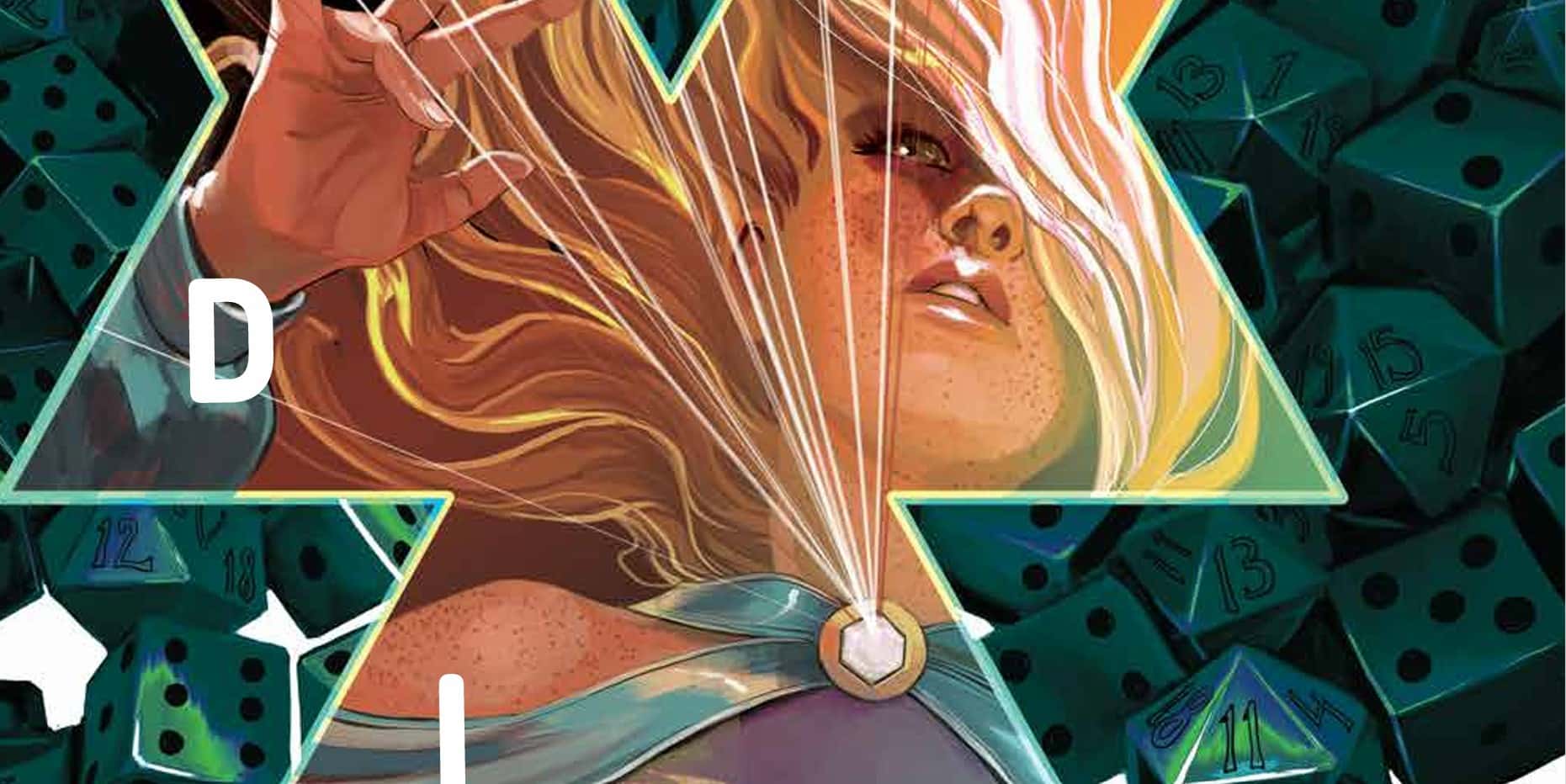
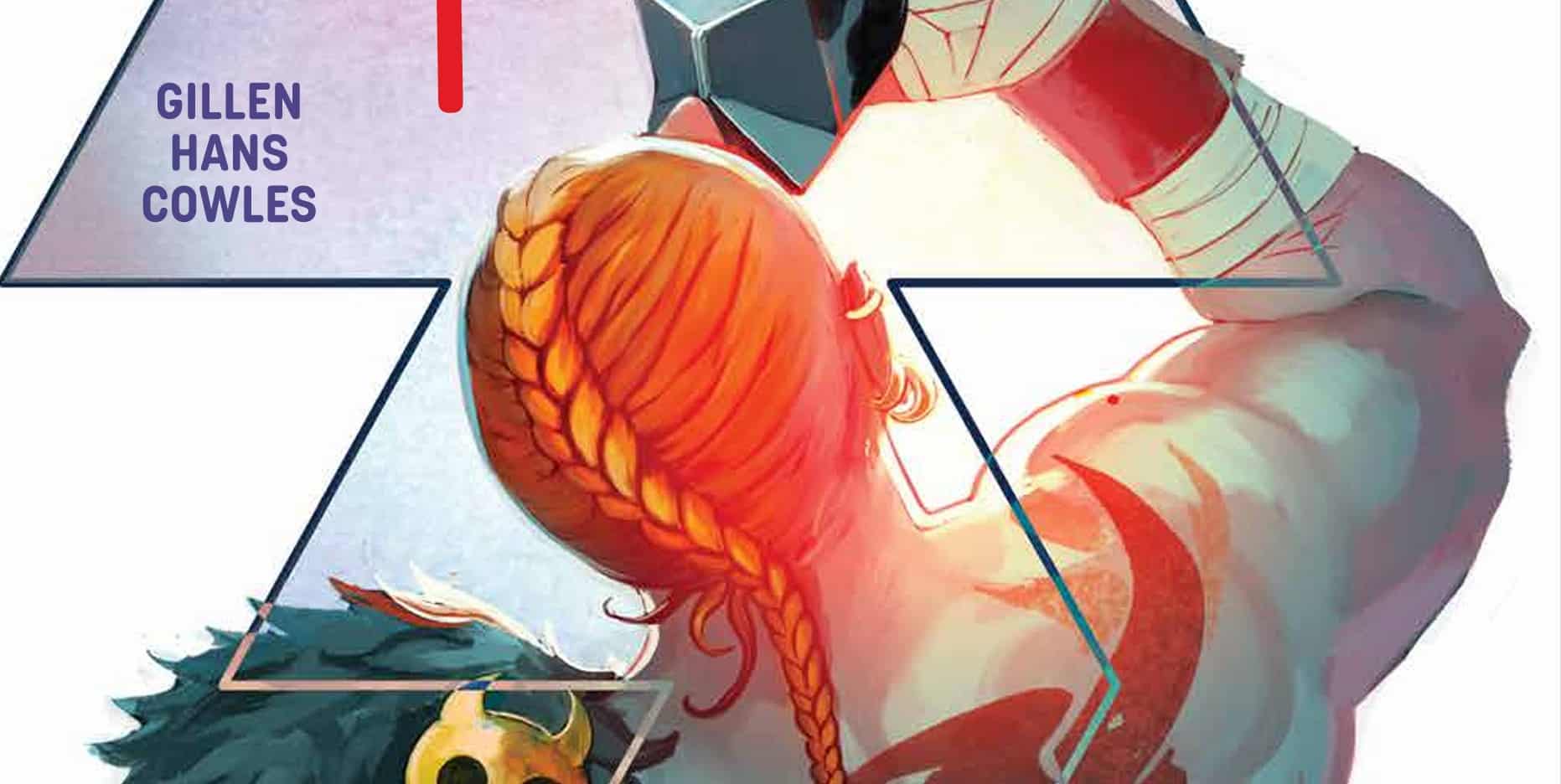
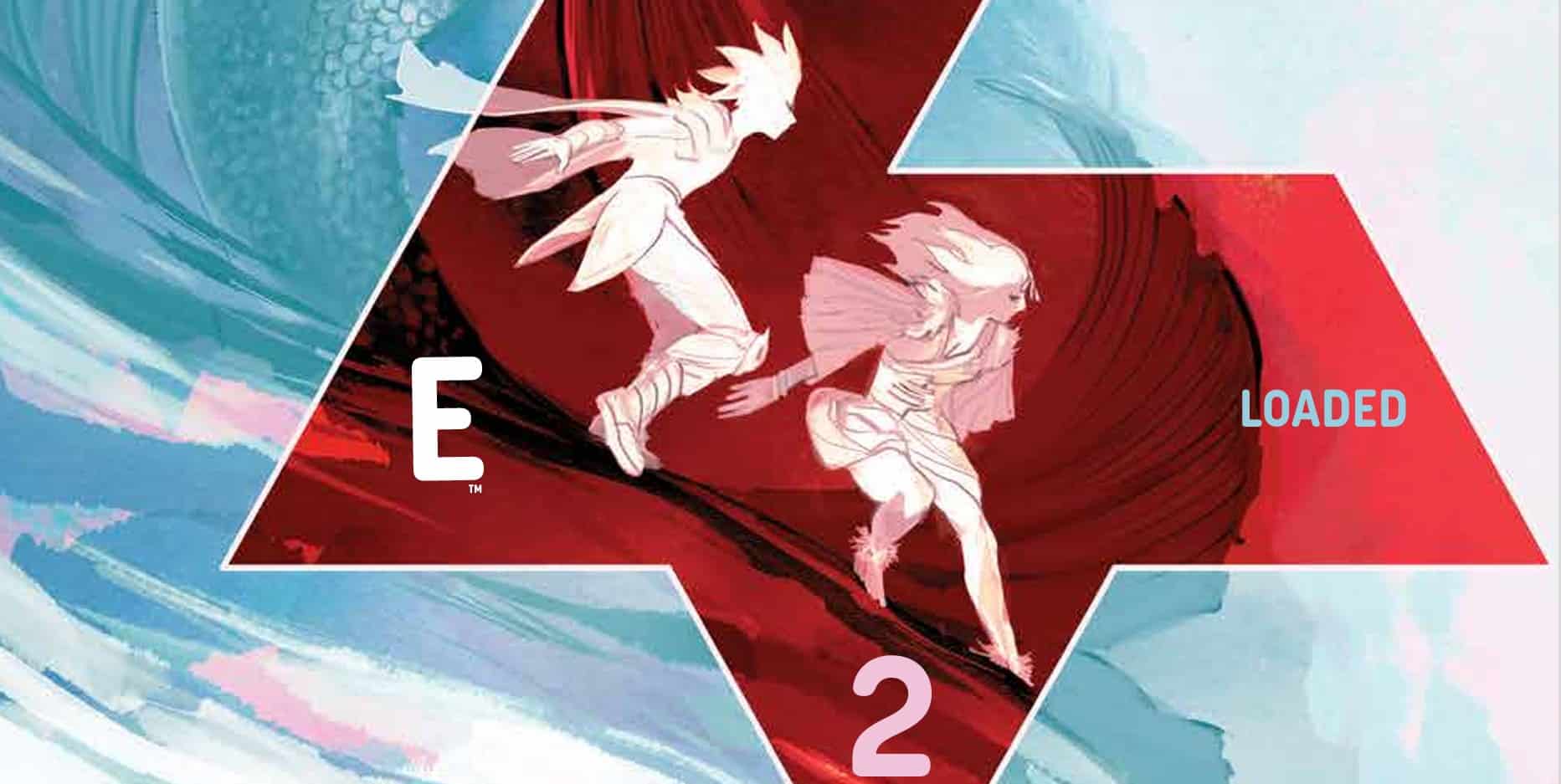
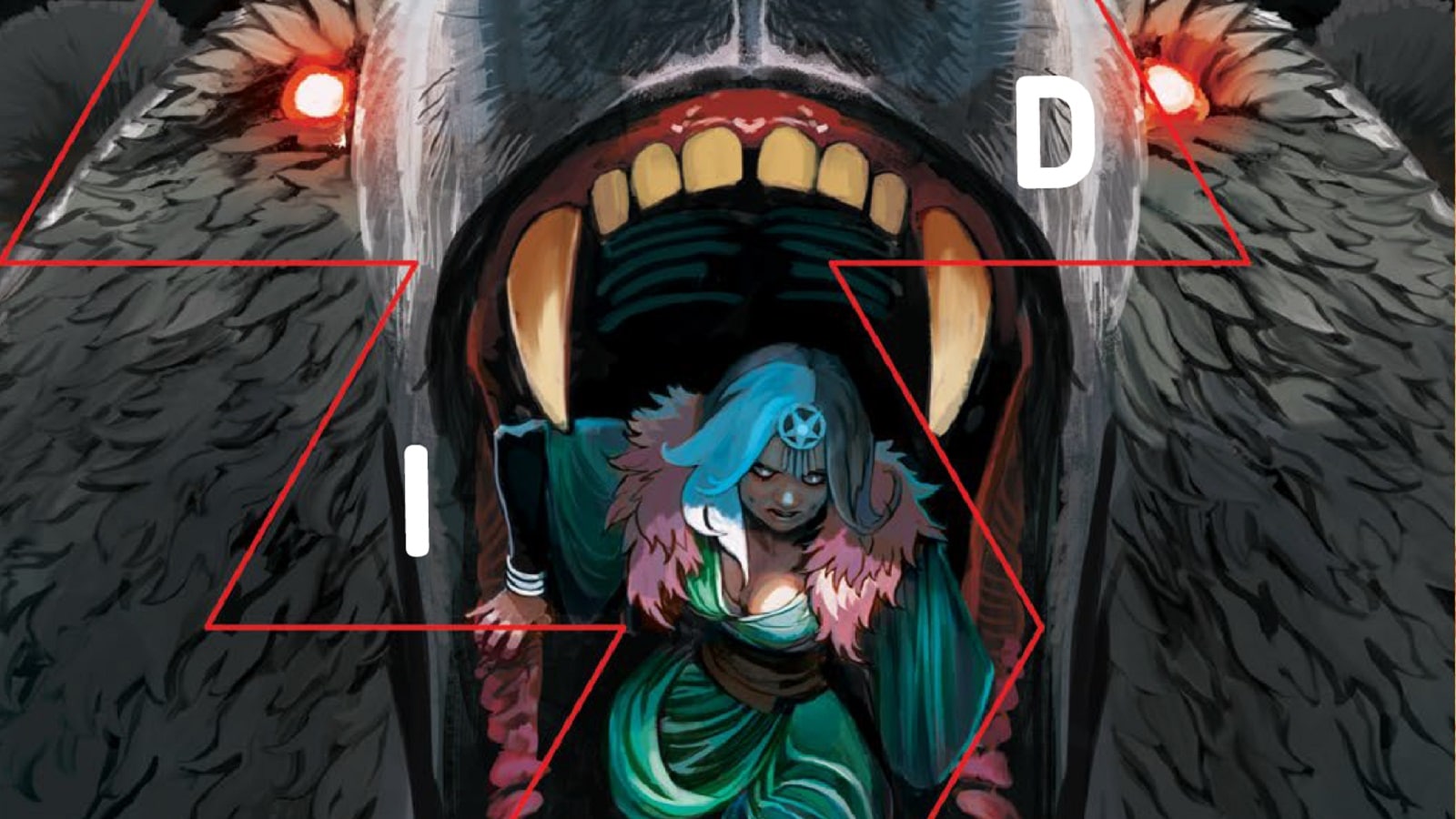
Ash’s wife. Angela’s child. Someone is bringing the family members of the original DIE party into that 20-sided world. Sophie is working to gather this new party — with one minor snag. The die-headed embodiment of the world itself has shown up, and would like Sophie to tell it what it’s for. Roll for initiative with DIE: Loaded #3, written by Kieron Gillen, drawn by Stephanie Hans, lettered by Clayton Cowles and designed by Rian Hughes.
Armaan Babu: New year, new DIE comic to talk about! I cast Summon Critic and roll a d4 to see who’s joining me this week.
Mark Turetsky: What the deuce? I was just visiting my family in Montreal and fell into a vortex of some kind. Or maybe I fell in the shower and you’re all dreams? In any case, let’s review some comic book!
Latonya Pennington: Whew, I’ve been away from DIE a bit and now I’m back again. I can’t believe how the plot has developed while I was away.
Margaret’s Tale

Armaan: We pick up right where we left off — Sophie is confronted by the personification of the DIE world itself, an amoral God that lures players into this world. With a fading connection, Isabelle tries to explain the nature of this being to Sophie, as well as what it wants, but there’s a little something lost in translation. DIE asks what it is for — it asks what people want from the game. Isabelle’s rushed explanation leads Sophie to think that DIE is asking her what she wants — and of course, what she wants is to go home.
That, however, doesn’t answer the question. What is DIE for?
It’s an important question, one the players in the first volume took a long time to try to figure out. It’s interesting that it’s being asked so early here — DIE offers little by way of explanation, little by way of context. It doesn’t try to get Sophie to understand why it’s asking the question, even though it must be aware of how little she understands.
Sometimes the point of a question is not just to get an immediate answer, but to get people to start thinking, to start looking at the world from a new perspective, to see things they may have overlooked.
It’s not just Sophie, then, who’s being asked the question. It’s the readers, too, one might imagine, as the creative team asks us to take a closer look at what’s happening in this comic, and why. What is DIE for, for Sophie? Or what can it be for? What purpose can it hold for her? Or for Molly? Or for our new party member introduced this issue, Margaret?
Mark: Or, it’s asking the readers and the creators why it’s still here. Why are we returning to DIE for DIE COLON THE SEQUEL? Wasn’t it finished?
Let’s look at what happened in DIE #20 when DIE asked the question: A bunch of different player characters tried to give it answers, Sol asked it for an infodump, a request it kindly obliged and revealed its history (and future).
But it wasn’t until Ash told it specifically what they, the players, got out of the game and then told it they’d had enough that they really — well, defeated it might not be the right word, but that’s when they activated the end credits sequence, as it were. Is the question meant as a kind of creative feedback questionnaire? But crucially, especially for what we see here in this issue, it’s the dictator that is able to tell DIE what it’s for. Is that, ultimately, what the role of the dictator is?
And it’s our new dictator who seems to be the only one to have any effect on the avatar of DIE. Margaret, Sol’s mum, is revealed in her new role, dressed, as Gillen calls it in this issue’s essay, like Evil Mary Poppins. She’s able to kill the game over and over with The Voice, or rather she blows up its polyhedral head, but it just keeps respawning. I have to assume she’s hitting it with supernatural levels of emotion, the head-explodey levels.
To get back to something you brought up in your review of last month’s issue, Armaan: Gillen said that “no-one is a non-player character.” What about DIE itself?
Armaan: That’s a fascinating question, Mark. DIE is clearly intelligent, but now that it has secured its existence, what does it want? What does it do? What is DIE for, for DIE?
For Margaret, however, DIE is for revenge.
We’ve only seen glimpses of Margaret before — she’s been stuck in the role of the mother broken by Sol’s disappearance, left with little more than bitterness and anger. As Gillen notes in the backmatter essays, when the first volume was being scripted, she didn’t even have a name.
Now she does, and with it, comes her story.
It’s only this issue that I really begin to notice the color choices for the flashbacks. Both the Emotion Knight and the Dictator based their powers on Robert Plutchik’s emotion wheel — and though I may just be projecting, it feels like the colors of that wheel correspond to Margaret’s flashbacks.
Somewhere between disgust and loathing, we see her purple feelings about Sol’s obsession with his hobbies come to the fore.
When the children come back — all but hers — colors show her violet apathy toward the group against their background mixes of yellow joy, renewed orange vigilance and blues of amazement.
Margaret’s own orange vigilance as she watches, ready to keep ruining Ash’s life for daring to live while her son’s disappeared, contrasted with the bright yellows of that happy day.
The reds of pure rage when Margaret finally snaps at a friend who just doesn’t understand what pain Margaret has been going through.
DIE understands, though. With her new Dictator powers, Margaret is quite literally inflicting her pain on it, as many times as she can. She’s oblivious to all else — and I love the way Hans depicts these hallways. A magnificent castle, filled with Fallen dressed as creepy school children, tailor made to mess with Margaret’s mind — and Sophie’s the only one who notices them. Sophie keeping an eye out for danger, twisting around with her dagger to stay vigilant, really brought this scene to life for me, my favorite bit of art from this issue.
It ends up being up to Sophie to interrupt Margaret’s obsession, however.
Latonya: Anyone else wondering what DIE is for Molly? I mean, I know Molly is supposed to literally die, but then why would they appear in DIE again as a Rage Knight? Will their anger be their downfall?
The Archivist

Mark: We get introduced to yet another new god of DIE, which is, I guess, one of the benefits of having a godbinder as our main point-of-view character. The Archivist shows up looking cool for exactly one panel, a Baron Samedi-style figure, but in the very next panel, when we actually get a good look at him, he looks, well, cringe, for lack of a better word. He’s the awkward kid who got a leather jacket and figured that would sort him out socially.
He shows the tragedy, the absurdity of collecting for its own sake. I mean, we’re all comics fans here, so I’m guessing we all might have some tendencies in that direction. I certainly have more Steam games sitting untouched in my account than any reasonable human could play through in a lifetime.
Armaan: You’re not alone there, Mark.
Mark: But I also like to think that I’ve grown a bit healthier in that I’m willing to get rid of books that I’m done with or have come to the conclusion that I’ll never get around to. Not so with the collector. He’s the darkly obsessive end of that spectrum: He wants all living things to be slabbed, graded and put up on a shelf, excuse me, a display. It’s the acknowledgement that once that comic has been slabbed, once that vintage Nintendo cartridge has been graded and encapsulated, it ceases to be a comic, or a game. It is, functionally, dead. Just an inert object whose value only comes from a values guidebook or a list of sold eBay listings.
Not only that, he disparages any body that comes to him not in “mint condition,” implying that his ideal human is one who hasn’t lived at all, one who’s died shortly after birth. It’s frankly a horrific extrapolation of a certain conservative obsession with a supposed Edenic innocence of infants. And how does this god feel about, say, people who make changes to their body for pleasure or to better express their own identities?
He makes a deal with Sophie: He’ll make a facsimile of DIE for Margaret to kill so that she’ll leave with Sophie in exchange for a month of memories, specifically, August 2018, when Stuart was only 3 months old. Speaking as the only parent here, I can vouch for Sophie’s amnesia for this period of parenthood. When you’re looking after a small baby, your sleep suffers so badly that you’re barely able to form memories. It might be an adaptive trait: You forget how miserable you were the last time you looked after a baby, so you’re more inclined to have another one. Honestly, most of my memories of this period in my own life eight years ago are thanks to the ease and prevalence of taking photos or videos of that period.
Anyway, back on the subject, I have to ask, why that specific month? Is it something important that Sophie might need to remember later, at a crucial moment? Did she just screw over the team at some later date?
Armaan: We must also remember that Ash and friends were missing during this time, trapped in DIE. Did Sophie learn something during this time that might have been of help?
While we’re theorizing, this may or may not be important at all, but this is the first issue we’ve had where Sophie has not mentioned magpies at all.
The creative team continues to do a fantastic job of fleshing out the world of DIE with new gods, while bringing new stories from new characters in old roles. You think there wouldn’t be space for it all, but they’re so far managing things beautifully.
Sophie’s gambit works. Margaret is fooled into thinking she’s killed DIE once and for all, finally agreeing to leave — and DIE shows up one last time just to let Sophie know it’s letting this happen.
Whatever its motivations, we know DIE is seeking to learn, and you learn a lot more from a full party than you do from a single player.
Latonya: Armaan, I agree with your theory that Sophie may have learned something crucial that has now been erased. When you are tired and going through the motions of things, it is easy to ignore something that may be important later.
A Short Rest

Armaan: Back at the City (or what I’m beginning to think of as The Long Con), Margaret meets Molly, and we learn another key facet of Margaret’s personality — she used to be a teacher. Molly, in fact, was once her student.
Given their roles, this doubles down on a fascinating dynamic. An Emotion Knight like Molly grows more powerful the more deeply they feel something. A Dictator like Margaret can make people feel things to a supernaturally intense degree. It can make for a powerful combo — especially when you think about how much of an effect some teachers can have on your emotional state to begin with. I can certainly think of teachers that brought out feelings of deep rage within me.
Mark: I’d also like to point out something Margaret very casually does here. She uses The Voice to force Molly to sit down, against their will. It’s not a suggestion, or even the command of a teacher in a classroom, it’s a magical removal of her companion’s free will, and she does it as if it’s nothing. If Margaret is willing to exert such enormous power so offhandedly, well, it’s the work of a lowercase d dictator.
Armaan: As Margaret and Molly catch up, Isabelle fills Sophie in on a little more important exposition: mainly that the Fallen are all former (or future) players from the Real World, and that Isabelle’s group saw a Fallen Molly in their travels.
What Isabelle doesn’t say (but almost does), is that Fallen can return to life — if they manage to kill another player from the Real World.
It’s dangerous information. Whom would you let die if it meant bringing a loved one back? Who would let you die for the same reason? It’s exactly the kind of information that gets a party to mistrust each other immediately. Maybe that’s why Isabelle didn’t tell her.
Maybe not.
It’s also worth noting that while this ghostly figure that looks like Isabelle claims she’s the party’s Master character, the recap page still shows the Master role to be blank.
In any case, Sophie springs into action to ensure Molly stays safe. Off panel, Sophie tells Margaret about the situation, and as a mother, teacher and Dictator, Margaret ensures that Molly stays out — inspiring some rage already, I’m sure.
With Molly benched once again (that’s only going to work for so long), Sophie enters the realm of our next party member, only to find herself standing above a roaring crowd.
I was minorly confused here — is there a voice, off panel, claiming they’re a Chosen One to a roaring crowd, or is everyone in this crowd themselves claiming to be the Chosen One, clamoring to get into the fort to save the day?
Certainly, there are a lot of Chosen Ones in fantasy. When you think of it, too, all players are Chosen Ones, chosen by their friends or Game Masters to be heroes in fantasy lands. The players of DIE are certainly chosen — for good and for ill.
Mark: I also found the last two pages confusing. I also thought maybe the giant voice is the Sophie that’s standing above the table, appearing to the people below as a giant as she manifests into their portion of the world. And if it’s someone else making this proclamation, which I presume is the case, why is the crowd looking at Sophie?
Armaan: Either way, I believe we’re about to meet our Fool! The Chosen One aspect made me initially think Neo, but the cover for the next issue makes me think more Fool than Chosen One. Could this be one of Chuck’s kids, taking on their father’s role in more ways than one?
Latonya: I was confused by the last two pages as well. I can’t tell who is speaking to Sophie, but I am interested in seeing where this story goes next. Also, I feel for Molly and cannot stand Sol’s mom. She reminds me of some teachers I’ve disliked.
Roll for Miscellaneous Thoughts
- Backmatter includes more information on the Archivist, as well as last issue’s Barnacle Witch! We have confirmation that the character is based on Stephanie Hans, and the whole bit is written with a lot of love and a lot more teasing.
- Speaking to the backmatter essay, there’s a lot to be said for names, roles and the struggle to put non-Western names in fantasy stories, but that’s a whole other essay, really.
- Is Dark Mary Poppins really the first thing that pops into mind when you see Margaret’s outfit, or is that a British thing?
- Bringing Sol’s mother to both the place he was trapped in and the place he was obsessed with — the place he left her for for so many years, on so many levels — is powerfully cruel. Whoever brought this new party to DIE is horrifically cruel.
- Sol’s castle is gorgeous!
- Is it just me, or does the Long Con contain a long-bearded Gillen GM-ing a game that has a player with Loki’s horns at the table?
- And maybe Old Man Gillen is wearing some Iron Man-adjacent armor?
- I pointed it out in the previous series, but DIE’s dialogue uses the design font that’s used in the comic’s title page and location captions. So when we’re reading those pages, DIE is talking to us. Spooooooky.
- “Alive or dead or being fed” has such meter and rhyme that I have to wonder if this is a song lyric.
Buy DIE: Loaded #3 here. (Disclaimer: As an Amazon Associate, ComicsXF may earn from qualifying purchases.)

Armaan is obsessed with the way stories are told. From video games to theater, TTRPGs to comics, he has written for, and about, them all. He will not stop, actually; believe us, we've tried.

Mark Turetsky is an audiobook narrator and voice actor who sometimes writes about comic books. Originally from Montreal, Canada, he now lives in Northern Louisiana. Follow him @markturetsky.com on Bluesky.

Latonya "Penn" Pennington is a freelance contributor whose comics criticism can be found at Women Write About Comics, Comic Book Herald, Newsarama and Shelfdust, among others. Follow them @wordsfromapenn.com on Bluesky.