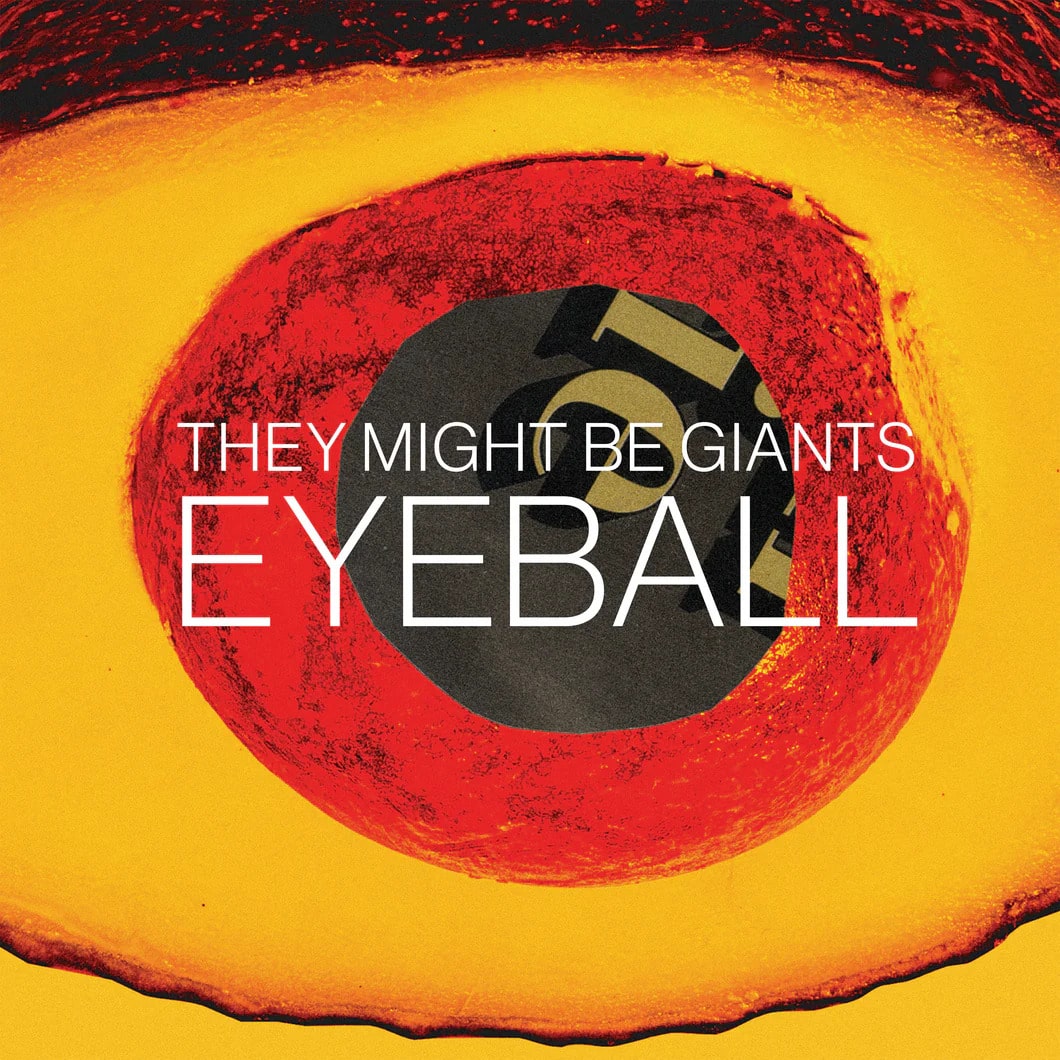
They Might Be Giants, Brooklyn’s Ambassadors of Love, on Thursday released their first collection of new music since 2021, a four-track EP called Eyeball. Like their previous EP, Pamphlet, Eyeball serves as a herald of a new album, to be released in the early spring. When this new, as-yet unnamed 24th album comes out, it will end the longest gap between albums in the band’s 40 year career. To put it bluntly, it’s been a long wait.
Eyeball EP consists of two original songs, “Eyeball” and “The Glamour of Rock,” one instrumental, “Peggy Guggenheim,” and a remix of “Eyeball” by The Elegant Too.
The John Linnell-sung “Eyeball” presents itself as an amusing enigma of a song about identity, mind control and unreliable narration with its opening lines, “Someone’s got control of my mind/Nothing that I do is my responsibility now/No, wait, ignore the thing/I just said, it wasn’t true and this is/This is the real me talking.” Right from the start, the song is telling you to listen with a skeptical ear to every statement that comes after it, with repeated encouragements to “look me in the eyeball.” Such unusual phrasing and awkward discussion topics lead the listener to conclude that the person speaking isn’t used to colloquial English phrasings, or perhaps even to speaking at all or even human experience. It’s hard not to think of the eyeball parasite from Alien: Earth, quite frankly.
The themes of mind control and a dubious narrative voice are far from new ones for TMBG, with songs like “The Spiralling Shape” or “Dirt Bike” exploring those more deeply. You might even hear an echo of the “Bells Are Ringing” line, “They’re not responsible for anything they do” in “Nothing that I do is my responsibility” from “Eyeball.” But what are we to make of the narrator’s description of his preferences in interior design or his musical predilections?
The answer lies in a bit of rock history: Linnell sings, “I know what modern jazz is, and/I’ve got no kick against it just/As long as they don’t play it/Just as long as they don’t play it,” paraphrasing Chuck Berry’s “Rock And Roll Music,” which contains the verse “I have no kick against modern jazz/Unless they try to play it too darn fast/And change the beauty of the melody/Until it sounds just like a symphony.” Berry here is defining rock ‘n’ roll as the superior form, opining that modern jazz has stopped being about dancing and started becoming a kind of intellectual art music (“like a symphony”).
What’s interesting is that “Rock And Roll Music” is an attempt by Berry to reach a younger popular audience. His earlier song, “Roll Over Beethoven,” defined the genre of music that Berry was working in, not as rock ‘n’ roll, but as rhythm and blues. This wasn’t a change of genre in the music itself, though, it was a change in the kind of audience Berry was seeking for it: a younger, more pallid audience that was looking for loud music to dance to. This is also not the first time They Might Be Giants has riffed on ideas by Berry. Their early song “Hey, Mr. DJ, I Thought You Said We Had A Deal” plays on the opening verse of “Roll Over Beethoven,” “Well, I’ma write a little letter/I’m gonna mail it to my local DJ/Yeah, it’s a jumpin’ little record/I want my jockey to play/Roll over Beethoven/I gotta hear it again today.” In “Hey, Mr. DJ,” Linnell tells the story of how he’s sent all of his money to his local DJ to play his song, but the DJ just takes the money and never plays the song.
I should note that a lot of my knowledge about Chuck Berry and the circumstances around the writing of his songs comes from Andrew Hickey’s excellent podcast, “A History of Rock Music in 500 Songs,” which TMBG’s John Flansburgh has praised on the band’s Tumblr, so it’s not impossible to think that the podcast’s analysis played some role in the writing of this song.
So here we are, more than 35 years after “Hey, Mr. DJ,” and Linnell is pondering the place of rock music, a genre that has largely moved on from being the music that young people seek out, having been supplanted by pop music and the rhythm and blues that Berry pivoted away from in the first place.
While “Eyeball” is the EP’s most straightforward rocker, “The Glamour of Rock” is a bluesy, horn-heavy lament sung by Flansburgh about having to do laundry the day of a performance. The song began as an improvised accompaniment to a video of laundry being washed in a machine which Flansburgh posted to Instagram in 2022. The spinning of laundry causes the narrator to descend into a depressive spiral (“admit we’re machines/Then you fall into that cauldron of loathing/Hypnotized by the cave of the clothing”).
The song has evolved significantly in the intervening years, now beginning with a mournful riff by the band’s longtime trumpet player Mark Pender. While it might be sung from the point of view of a somewhat successful rock star (one who can reliably tour and fill up midsize venues, but certainly not stadiums or arenas), it doesn’t seek to emulate that sound. Instead of the melody being carried by the virtuosic Dan Miller’s guitar, it’s carried instead by the horn section, the Tricerachops Horns, completed by Stan Harrison’s saxophone and Dan Levine’s trombone.
The Tricerachops Horns also get a wonderful showcase in “Peggy Guggenheim,” which Flansburgh describes as sounding like “car chase” music. While this isn’t the first TMBG instrumental to put the horns front and center (“Another Weirdo” and “Too Cool Girls” come to mind), it might just be the best. Propulsive, bass-heavy, exuberant, it’s the sort of just-plain-cool jazzy composition you’d want for a modern James Bond update. But as fantastic as the horn section is, Marty Beller’s drumming and Danny Weinkauf’s bass provide a rock-solid foundation upon which the piece is built.
Finally, rounding out the EP is the Elegant Too remix of “Eyeball.” Unlike some of Elegant Too’s remixes of TMBG songs, their version of “Eyeball” is fairly restrained, doing more stripping back of the music bed and allowing Linnell’s vocals to shine. Their additions are tasteful and suit the song, giving the original mix a run for its money as to which version of the song should be considered the canonical one.
To sum up, Eyeball EP seems to ask the question: What does it mean, in 2026, to be a rock band that’s been performing and recording for more than 40 years? The answer is playful, eclectic, clever and idiosyncratic. In short, it continues to Might Be Giants.

Mark Turetsky is an audiobook narrator and voice actor who sometimes writes about comic books. Originally from Montreal, Canada, he now lives in Northern Louisiana. Follow him @markturetsky.com on Bluesky.