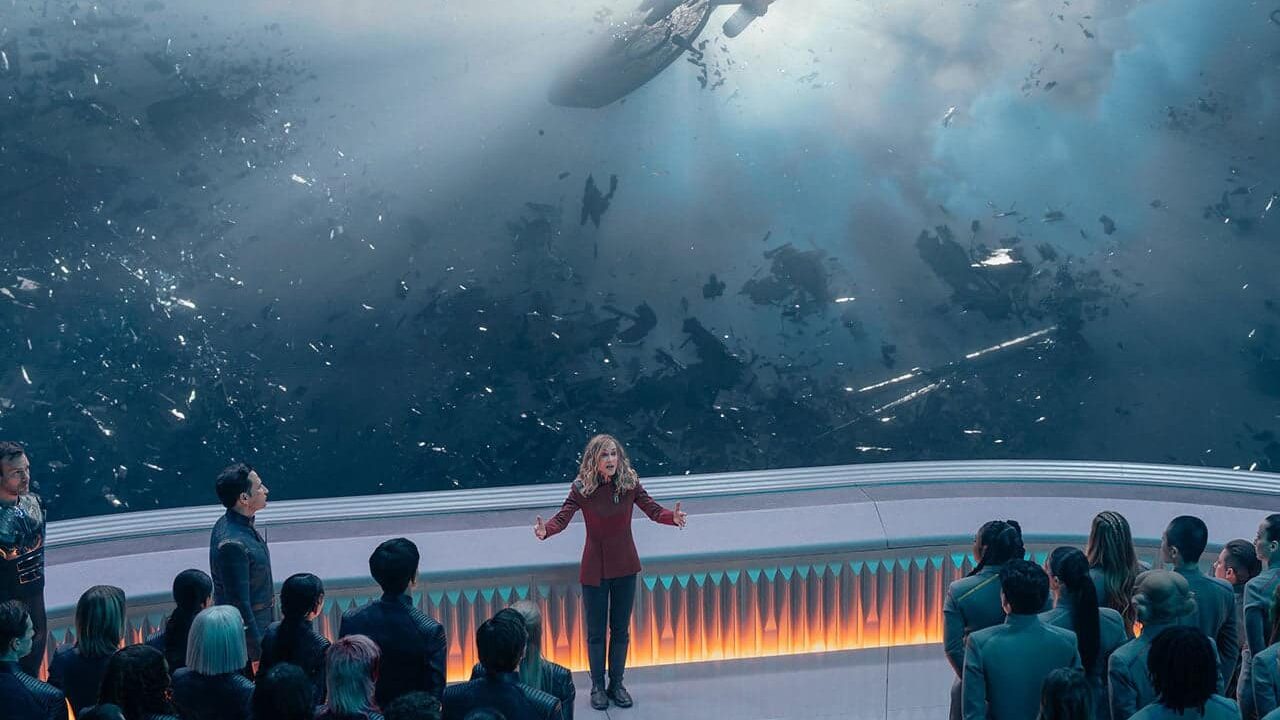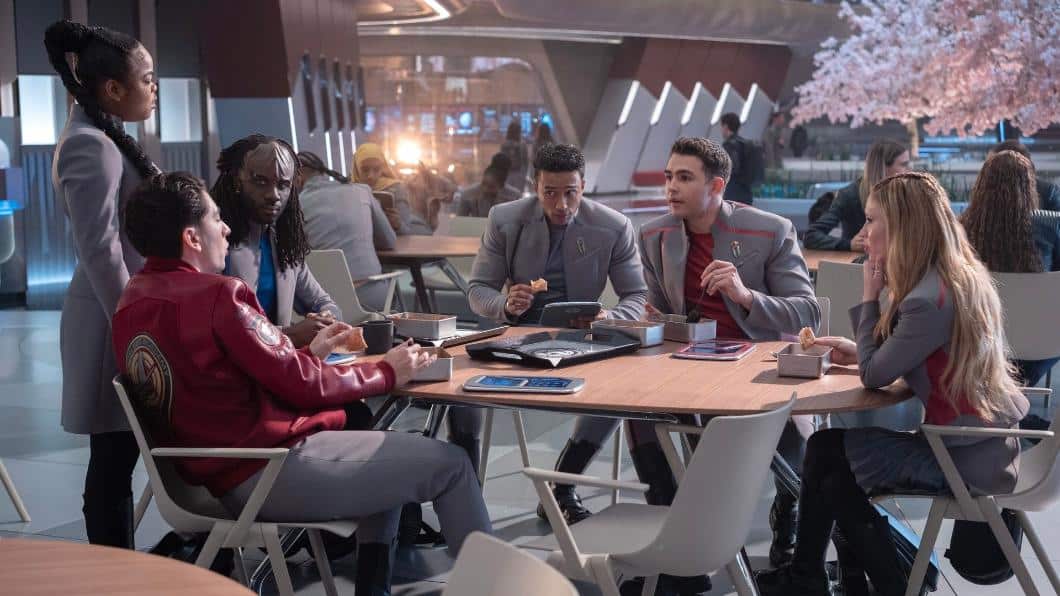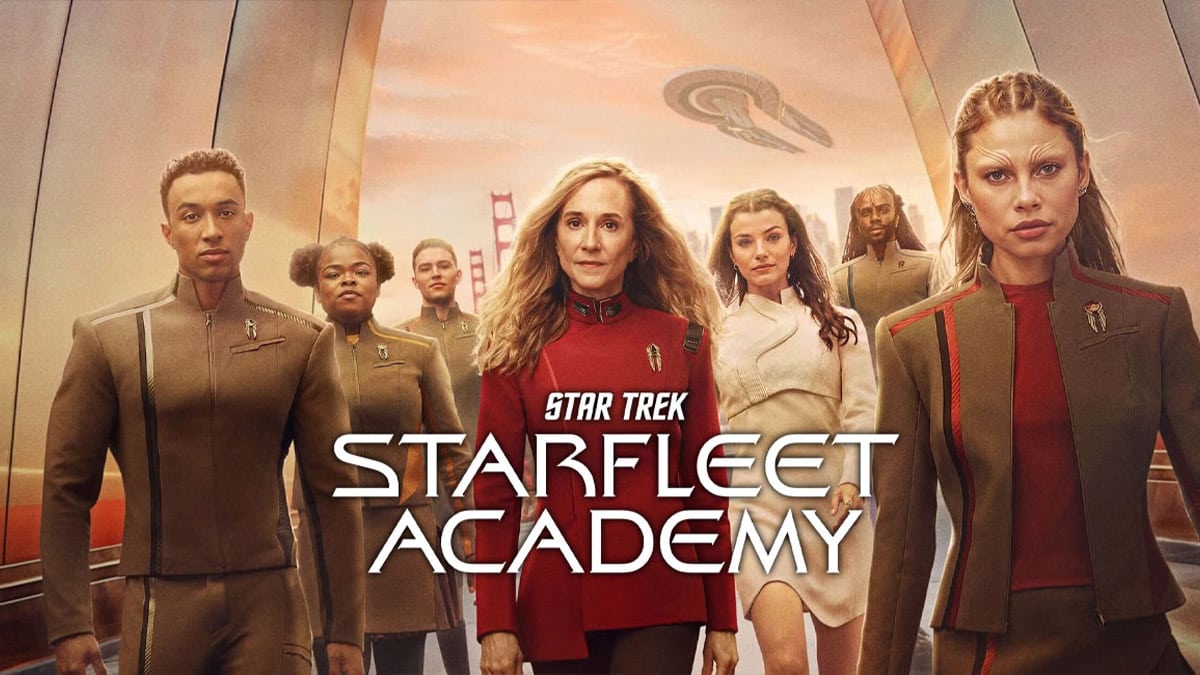
Star Trek boldly goes where it’s never gone before (WB-style teen drama) in Star Trek: Starfleet Academy! Join Captain Ake as she assembles the first post-Burn Starfleet Academy class then leads them straight into a confrontation with pirates in “Kids These Days”, written by Gai Violo & Eric Anthony Glover and directed by Alex Kurtzman. Then watch as misfit student Caleb makes googly eyes at the Betazed First Daughter during important negotiations in “Beta Test” written by Noga Landau & Jane Maggs and directed by Kurtzman.
Austin Gorton: It’s been a scant few months since the uneven third season of Strange New Worlds wrapped, but Star Trek is back on our streaming devices of choice with a show featuring a general concept — kids at Starfleet’s academy — that’s been kicking around in one form or another for over forty years.
Mark, are you ready to matriculate back into the world of Trek?
Mark Turetsky: A bold new starship design, a ragtag crew of misfits who have to learn to get along together to learn what it means to be Starfleet, a decorated captain in charge of teaching them, the return of The Doctor, I can’t wait for season 3 of Prodigy! Wait a sec… [consults notes] “canceled” you say? Okay, then enroll me in Starfleet Academy!
Curling up with a good book and a tasty piece of scenery
Austin: “Kids These Days” kicks off with a very extensive, decade-spanning cold open which introduces the two characters who, at least through the first two episodes, are clearly positioned as the key members of the cast: Holly Hunter’s Captain Nahla Ake and Sandro Rosta’s Caleb Mir. At the start, Caleb is little more than six years old when his mother (whom I absolutely didn’t even clock was played by Tatiana Maslany til I looked at the IMDB credits) is sentenced to a work camp by Holly Hunter for being a known accomplice of pirate Nus Braka (played with a mouthful of scenery by Paul Giamatti).
It’s clear Ake doesn’t love separating mother and child, but feels her hands are tied. Caleb peaces out however, disappearing into a sandstorm and next appearing as a muscly twenty-something prisoner aboard a shuttle, who busts some heads in order to try and find his mom. As cold opens go, it’s all quite loud and in-your-face.
Mark: The cold open needs to do a lot, in not just establishing our lead characters, but also in establishing the era the show takes place in, considering they don’t want to limit their audience to people who have seen the latter seasons of Discovery. The era of the cold open is rather brutal: The Federation has effectively fallen apart (Earth isn’t even a part of it anymore!), interplanetary trade is stagnant because of a lack of dilithium, so it’s led to all kinds of shortages, including food rationing, and so Anisha Mir has stolen food for herself and her starving son. Yes, she got that food from a pirate who killed some people to get it, making her an accomplice, but effectively, it’s the same crime Jean Valjean commits in Victor Hugo’s novel, Les Misérables; stealing a loaf of bread to feed starving children. It’s an interesting comparison to make, because that comparison has existed in Star Trek in the past, namely with Maquis member Michael Eddington’s self-identification in Deep Space Nine’s “For The Uniform.” In his case, it… didn’t quite fit, but in Anisha’s case… yeah. It’s there.
And can we also just acknowledge that Ake resigns because of one single child separation? While the Federation may not be what it used to be, it is still downright utopic compared to the work of our government, which considers child separation just one of many tools in its arsenal against migrants.
Austin: One could find it puzzling, given everything else the Federation of the time is doing, that this is the hill Ake chooses to die on? On the other hand, it speaks a lot to Ake’s character — and to your point, the lack thereof amongst many in our current era — that child separation is this huge red line for her.
Not only does she resign from Starfleet over it, but finding Caleb becomes something of an obsession for her, so much so that it’s the carrot Admiral Vance (Oded Fehr, reprising his role from the latter seasons of Discovery) uses to lure Ake back to become Chancellor of the newly-relaunching Starfleet Academy. So that completes the initial setup: Ake goes and arranges the release of Caleb from prison, and in exchange, he agrees to join the Academy.
From there, the focus of the show expands, and we get to meet both the larger cast and the USS Athena, the show’s school-as-ship.
Mark: In addition to Ake and Caleb, on the student side, we get Kraag, a Klingon student interested in medicine, SAM, an awkward but enthusiastic sentient hologram (or “Photonic”, which is what I’ll use from now on), Reymi, who fills the role of bro-ey asshole (who maybe will turn out to have a heart of gold once you get to know him?) and Genesis, who is legacy admission (her parent is an admiral). On the faculty side of things, Admiral Vance, the Admiral who’s now dating your mom and just wants to be pals from latter-season Discovery, Lura Thok, a half-Klingon, half-Jem’Hadar who serves as a no-nonsense first officer and cadet master and The Doctor, who is, as they say, The Doctor. Where should we start first?
Austin: My favorite of the bunch — or at least the one I’m most intrigued by — is Kraag. I’ve never been a big Klingon guy, but I like the inversion of expectations here, a Klingon who wants to be a doctor and likes bird-watching. Also, Genesis is little more than a collection of tropes (most of the kids are, honestly), but Bella Shepherd plays her with an effortlessness that makes it seems like she’s been playing the character for years.
On the staff side of things, honestly, Ake is my fav. She’s half-Lanthanite (the same species as Pelia over on SNW), so she’s seen some shit (including the pre-Burn glory days of the Federation), and Hunter plays her with a touch of the blunt whimsy of Pelia without going as all-in on it as Carol Kane does (which works for a supporting character moreso than a lead). She has a library of physical books, and when shit’s not going down, she lounges in the captain’s chair as much as she sits in it, reading. Can relate.

Mark: I’m also very interested in Kraag; there’s a part in episode one, after Caleb stands up for him against Reymi’s bullying, where Kraag tells him, “A warrior does not let a friend face danger alone.” And here’s the thing, he’s the friend in this situation, Caleb is the warrior. Klingons are one of the more fleshed out species in Trek, but they do suffer from the whole, “each species has one profession” issue that one sees in sci fi. There have been some exceptions, of course, like Ron Canada’s particularly brilliant turn as Ch’Pok, the Klingon lawyer in DS9’s “Rules of Engagement.” But here, we seem to have a particularly sensitive soul in Kraag. I’m really, sincerely hoping that they don’t give him some kind of inner turmoil plot where he needs to fight off his barbaric urges. We didn’t see any Klingons in the latter seasons of Discovery, and I’m really excited to see what’s going on with them in this post-Burn era. A lot of shit can go down in a millennium! Just let us have our Klingon soft boy doctor. Please!
Austin: For all my disinterest in Klingons generally, given how deliberately Discovery avoided them once it jumped into the future, I am legitimately curious what they’ve been up to.
Mark: I’d also like to talk about SAM. From the start, Trek has had characters that have become touchstones for neurodiversity, notably Spock, Data and to a lesser extent, Bashir (let’s just set aside the Jack Pack). Now, I feel like in those cases, the characters created to represent certain sci fi concepts (Spock’s Vulcan logic is based on Gene Roddenberry’s understanding of stoicism, Data as an artificial person who strives to be more human) and other readings came about from fan interpretations of those characters (readings that are absolutely valid, I should add!). It feels like in SAM’s case, they’ve created a character who’s on the spectrum, then came up with a sci-fi reason for it, as if there couldn’t just be a human being who has those traits at Starfleet Academy. I’m interested to see where they take her character.
Austin: There is a valid question as to whether SAM is a case of putting a hat on a hat.
Mark: As for Reymi and Genesis, we really don’t have much to go on yet, for either character, except that Reymi’s confidence is a shield for his insecurity (surprise, surprise) and Genesis seems… nice? But also somehow has Commander Thok’s access codes? There’s something more going on with her, and I’m interested to see what we learn about her moving forward.
Speaking of Thok, I love this character: it makes total sense that Klingons and Jem’Hadar would hook up. They’re clearly simpatico. Well, okay, the Jem’Hadar admired the Klingons, and the Klingons hated the Jem’Hadar because they were subservient and considered the Founders to be gods, but once the Jem’Hadar have thrown them off? Mutual admiration societies, I’m betting. As for the Jem’Hadar having offspring at all? It’s such an easy lay-up: there are so, so many ways for the Jem’Hadar to have fixed the genetic limitations put on them by the Founders.
The Athena itself is an amazing ship design. I love that it can detach from its nacelles and become a piece of architecture. I noted that with its massive atrium, it looks even more like a hotel than the Enterprise-D did, but also, it very literally is a building, so that bit just makes sense to me.
Austin: It’s a very cool looking ship. I did wonder if the feather-like nacelles would prove a liability in combat (even though this is meant to be an academic training ship, it was drawn into violent combat in the first episode), but I’m probably overthinking it. The idea of having the ship “land” in the San Francisco campus is a clever way of having their cake and eating it, too – it keeps the traditional “Earth-bound school” element in place, but makes it easier to also tell the kind of space drama stories we expect from Trek.
Mark: Also, it was kinda fun seeing the bridge crew of the Athena in this first episode, but considering they’re nowhere to be found in episode 2, I think, much like Discovery, they’re minor characters who essentially do not matter.
Austin: Yeah, I got big “Discovery bridge crew vibes” off the Athena crew. I guess we’ll see, but this is a pretty big cast just with the students, and they’re clearly meant to be the focus. If this was a traditional 22 episode season, maybe we’d see more of them, but with only ten episodes to work with…

Mark: Speaking of the pirate attack, let’s talk a bit about Paul Giamatti. He is great as Nus Braka, space pirate who holds a grudge against Ake and wants to recruit Caleb. He follows a rule I’ve just made up: the more shit they put on your face, the bigger a ham you get to be. He’s a great addition as the longterm big bad for the series (at least for this season, I’m guessing), but also he’s there for what I found the least interesting part of the show: I just do not care much about the Caleb backstory arc in general. It’s the least interesting part of the show for me.
Austin: No one is having more fun in this episode than Giamatti, and his glee at just chewing up and spitting out the scenery is infectious. That said, he’s such a presence that he tends to suck up all the energy when he’s onscreen — he’s pitching his character on a whole ‘nother level from everyone else. So while there’s definitely potential in the character as a recurring antagonist (especially in the context of the Venari Ral being an organization that grew out of the earlier neglect/failures of Starfleet), hopefully he’s deployed sparingly.
Mark: Holly Hunter! Holly Hunter can hold her own against Giamatti! May they have many more scenes together! Also, he’s supposed to be a Klingon/Tellarite hybrid?! Either of those gives you an out to do whatever you want onscreen. Both together? Forget about it!
Austin: It is wild that we’re getting a Star Trek TV show featuring Holly Hunter and Paul Giamatti. Who ever would have guessed?
But the other problem with Nus Braka is that, yes, he’s intricately tied to Caleb’s backstory which, like you, is the least engaging thing about the show for me. Which…well, let’s get into the second episode.
Teens Gonna Teen
Austin: A grand tradition in new TV series is the idea of the “second pilot.” Back when TV shows weren’t available on demand, new shows would often take pains to repeat the general premise and restate the show’s central conflicts and or themes in the second episode (and sometimes the third, and fourth…). The idea being, if you missed the pilot cuz you got home late from work last week, you can watch the next episode and still get the gist of everything.
It’s less common — and necessary — in the modern TV landscape, but it was such a fundamental technique for so long (and still is beneficial even with on-demand TV) that you still see vestiges of it from time to time. All of which is to say that “Beta Test,” in addition to having a pun for a title (Starfleet’s patience is tested by the Betazoids! Get it?!?) that is also a term for a trial run of something, is very much written in the “second pilot” tradition. To its credit, the setup of the show allows a bit of variation — you can read the first episode as the “starship pilot” and this has the “Earthbound pilot” — but this also means a lot of the elements from episode 1 get repeated, running the risk of making them tedious and/or annoying.
Tl;dr: I already can’t stand Caleb.

Mark: I have to say I agree. He’s just not really a likeable character. I think part of it stems from the premise: He’s lived on his own for much of his life, doing what he can to survive, usually as a criminal, and along comes Captain Ake bailing him out as long as he’ll agree to go to Starfleet Academy. He doesn’t want to be there, and really, why should he at this point? Starfleet took his mom away from him, they sweep in and effectively conscript him into their military… He’s got a whole lot to be angry about, but it doesn’t precisely add up to a character I want to spend a lot of time with. Especially since it’s tonally way off from the genuine eagerness we see in our other cadet characters. Still, it’s early days, and this is a character who’s designed to grow and change, a protagonist, if you will.
Austin: Right, there’s potential here, and Sandro Rosta has presence. I could just do with less of his too-cool-for-school schtick, as logical an expression of his character it may be. I want less Jack Crusher, more Beckett Mariner. This is where the double pilot, hammering home that characterization for everyone in the back, isn’t doing him any favors. Hopefully he grows past it soon.
Mark: Anyway, this episode introduces us to a few new concepts: first, the Starfleet War College. I’m wondering if this is a remnant of Earth’s post-Burn isolationism? Like, since Earth left the Federation and therefore lost Starfleet, they established the War College to train their own fleet? Hard to say. But I’m guessing that it’s being set up as a rival school, a Jocks vs. Nerds, Snobs vs. Slobs type thing. You know, like Animal House or Caddyshack.
Austin: I am 100% expecting some intraschool jocks vs nerds rivalry, especially because our last regular cast member ends up…at the rival school (something I was genuinely not expecting).
Mark: That would be Tarima Sadal. She’s the daughter of Betazed’s president, also literal royalty, as a daughter of the First House (Lwaxana was only a daughter of the fifth house), though we don’t know if she’s heir to the Holy Rings or who holds the Sacred Chalice of Riix in this century. There was kind of a recurring theme in the third season of Discovery, where they would spotlight a civilization that had left the Federation and then bring them back into the fold, be it the Trill, the Ni’Varans (nee Vulcans and Romulans) or Earth itself. It seemed like it happened about once a week, though that’s probably unfair. Here, we get a bit of a continuation of that in the return of the Betazoids into the fold. Apparently, Betazed surrounded itself and its territories behind a psychic wall in space. Does it sound scientific? No. Does it work in the context of Star Trek? Yeah, I’d say so.
I’ve seen a lot of flak lobbed at the show that, somehow, the writers don’t know that Betazoids are telepathic and that Troi was only empathic because she was part human, and haven’t the writers even watched Star Trek before, etc, etc. First off, in TNG-era Trek, Betazoids are shown to have varying degrees of telepathic ability, from the strongest (like Tam Elbrum) to the weakest (Lon Suder). It seems like, for whatever reason, in the intervening millennium, the average strength of Betazoid telepathy has gone down, and by the end of this episode, it’s pretty clear that Tarima’s on the high end, maybe even higher than Tam Elbrum, but her powers are being repressed. Why? How powerful is she? It’s an ongoing story about one of the regular characters on the show, I’m sure we’ll find out in due course.
Austin: I’ve seen some of the flak about Betazoid telepathy online, and rolled my eyes pretty hard. Given we have a telepathic Betazoid in the cast — one who is specifically having her psychic abilities inhibited, there is clearly more to this particular story. And that aside, we’re so far in the future, it’s easy enough to speculate on how things could have changed — for all we know, all the super strong telepaths are locked in a basement maintaining this psychic wall thingee.
The other thing the introduction of Tarima does is amp up the show’s teen drama factor. It’d be easy enough to watch “Kids These Days” and come away assuming this is a pretty standard Star Trek show with an extra focus on students. But “Beta Test” really establishes the soapy Gen Z tone that was much ballyhooed in the lead-up to its launch by more or less unfolding its plot through the blossoming attraction between Caleb and Tarima. How did this work for you, and are you excited about the prospect of Star Trek by way of Dawson’s Creek (or Euphoria, to pick a less Old Man example)?
Mark: So, teen drama isn’t really my genre. I’ve only ever really watched it in the context of some other genre blending (like, say, Buffy or Veronica Mars to use some other Very Old Man examples), but I’m not against it. A good story is a good story, regardless of the questions of genre. It seems like, as a Star Trek show, the teen drama tropes of revealing a lot of skin or depicting widespread drug addiction aren’t going to be the genre tropes that Starfleet Academy is going to take from the genre (though, to be fair, Discovery did feature some nudity very early on). What it does amp up is the cursing, carrying the torch from Discovery and Picard. Maybe I’ve been desensitized to it, since HBO shows have been doing it for, oh, nearly 30 years now, but it seems entirely appropriate. So, to answer your question, I don’t really mind that this is a teen drama. They’re setting a show at Starfleet Academy. What did people expect?
Austin: A universal truth in any timeline: teenagers are roiling sacks of hormones, and if you cram a bunch of them together into a finite space and then apply various pressures (school work, roommates, personal ambitions and anxieties, space pirate attacks), there’s going to be drama! As a minor fan of the genre, I do hope this batch of writers finds ways to blend the teen drama tropes with typical Star Trek tropes in fun ways. I appreciate how, in this episode, Caleb responds to Tarima’s whole, “why didn’t you tell me about your mom, you’re just using me!” outburst with the thoroughly logical, “you’re cute and all but no, I’m not going to unload my trauma on someone I just met.” Not only does it make sense for Caleb to react that way, it speaks more to the differences in the characters, both specifically and in general – of course someone from the planet of telepaths is going to assume openness as the default setting. That’s good teen drama writing.

Mark: I do have some quibbles with some of the storytelling decisions in this episode, though: why is Admiral Vance, the commander-in-chief of Starfleet, but still, just a Starfleet officer, in charge of negotiating Betazed’s return to the Federation? Should that be done, by, oh, say, a Federation Ambassador, if not the Federation president herself? I get that president Laira Rillak isn’t a regular on the show, and it’s much more effective to give a regular a showcase, but it’s a really strange call. It’s like if Colin Powell had made a deal to move the US capitol.
Austin: That definitely A) felt like a case of the Economy of TV Storytelling at work and B) was very weird.
Mark: I do like the overall message of the story, though: sometimes change, and even concession is necessary in order to move forward, especially after alliances have been dissolved acrimoniously. It’s a welcome, if somewhat sobering lesson to be teaching in the current political climate.
All in all, I’d say this is a promising beginning. I might like Caleb more if he skewed more roguish than surly, and the cast is great, the characters are interesting (though, understandably, some are underdeveloped so far) and its heart is in the right place.
Class Notes
- Before each episode starts we get a cool “60th Anniversary of Star Trek” bumper featuring the notable ships from the different series; Deep Space Nine is represented by the Defiant, but it would have been cool if it morphed into the station briefly.
- The Doctor’s “tricoder… medical tricorder” is a line from his first scene in “Caretaker,” the Voyager pilot.
- It’ll be interesting to see how the existence of the War College affects the whole “Starfleet is a science/diplomatic organization that also does a lot of military stuff because it’s good for TV spectacle” dichotomy.
- Tig Notaro returns as Jett Reno. I was expecting her to be teaching engineering, but temporal mechanics works so well. They’ve got a stranded time traveler teaching temporal mechanics. It’s perfect!
- Lura Thok’s and Reno’s exchange, “One on one. Their best, our best. To the death.” “What is wrong with you?” Reader, I LOLed.
- We went back to Bajor, if only briefly! Now if only we could have seen a certain space station…
- Starfleet Academy has an Exocomp officer, named Almond Basket! It seems that Peanut Hamper’s naming scheme lives on in the far future. Let’s just hope Almond Basket doesn’t turn evil on us.
- There’s also a Brikar, from Prodigy.
- It seems like every classroom is a Volume (and probably the same Volume). I’ve gotten a bit tired of the overuse of the Volume, but… it does make sense in the context of a classroom.
- A quick note on the opera duets sung in this episode: we have two duets, “Pa-Pa-Pa-Papageno” from The Magic Flute and the opening duet of Beethoven’s Fidelio. The first has Papageno finally achieving his goal of winning the hand of his perfect mate, Papagena, which he’s achieved through a series of Freemason initiation tests. It’s a weird opera. But I should point out that the skill levels of the performers is exactly right. Papageno was written for Mozart’s friend Emanuel Schikaneder, who was a skilled actor who could sing, not a full-time singer who could handle more difficult singing parts. As such, Papageno is not a particularly challenging singing role, as far as opera is concerned. The production hired Jamie Groote, a professional opera singer to be Picardo’s partner. The second duet has two young lovers, Jaquino and Marzelline, meeting, but Marzelline turns down Jaquino’s proposal because she’s in love with Fidelio. What neither of them know is that Fidelio is actually a woman in disguise. So, we’ve got a rejection, some secret information that’s hidden from the characters; all in all an apt duet to have paralleling the plot of the episode.
- The school has something of a space-Hogwarts vibe. There’s always something zany going on in the background, the teachers have a cavalier “this could be lethal but you’ll be fine” attitude.

Mark Turetsky is an audiobook narrator and voice actor who sometimes writes about comic books. Originally from Montreal, Canada, he now lives in Northern Louisiana. Follow him @markturetsky.com on Bluesky.

Austin Gorton also reviews older issues of X-Men at the Real Gentlemen of Leisure website, co-hosts the A Very Special episode podcast, and likes Star Wars. He lives outside Minneapolis, where sometimes, it is not cold. Follow him @austingorton.bsky.social.