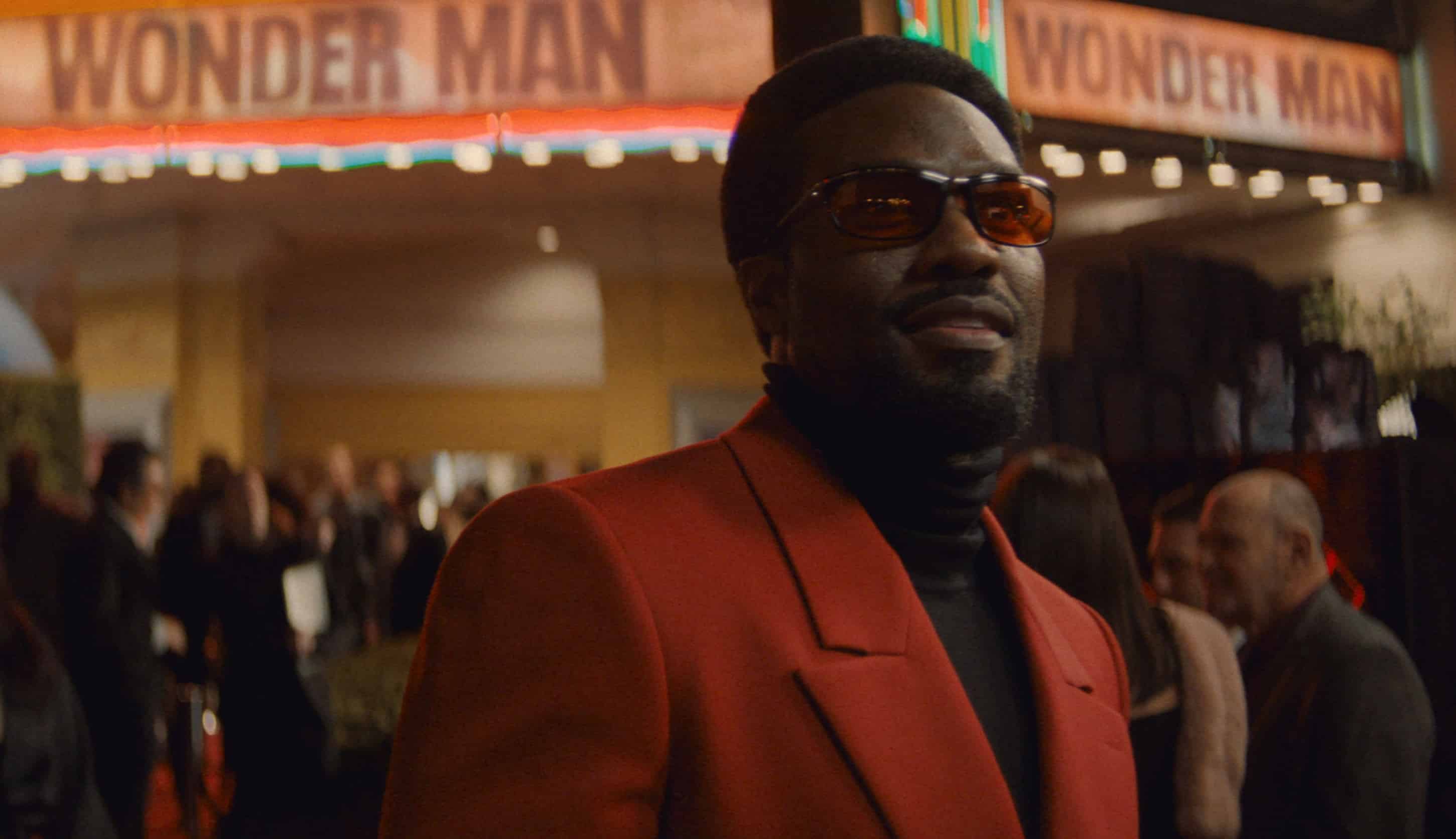
From the very first scene of Marvel’s Wonder Man, I knew that I did not like its protagonist, Simon Williams.
While I loved the show, I did not find myself liking the man any more as the series went on. I did, however, grow to sympathize with him. I grew to care for him. Worrying, I even grew to identify with him on a deeply personal level — something I’m going to have to unpack at a later date. It’s important, though, to recognize that a character need not be a likable person for their story to resonate.
It’s a story about acting, and it’s a story about being different. It’s a story about how being different can isolate you from the world around you, and what it takes to let someone in.
And at the heart of all of that — don’t let anyone ever tell you different — it’s a romance.
The Theater of It All

Simon Williams (Yahya Abdul-Mateen II) is an actor. He’s not one that’s pleasant to work with. I know, because in my nine years as a theater professional, I’ve worked with actors like him. His process is frustrating — adding his own backstory to the script, changing technical aspects of a pre-planned scene and talking to the writers about what the script really means.
The opening scene tells us three things about Simon:
1. He’s in his head a lot, overthinking things to the point it actively hinders what he and those around him are trying to do.
2. He has a tendency to center the story around himself.
3. He is a romantic.
Anyone involved in a storytelling craft — be they actors, writers, directors, video game designers or dungeon masters — can be tempted to fall into the trap of overromanticizing storytelling. To overestimate the power that a story can hold, and to add layers of meaning where none was originally intended. It’s good when it’s the thing keeping you inspired as the world tries to drag you into mundanity. It’s bad when it gets in the way of the actual story that’s being told.
A lot of actors I’ve seen have tried to think their way through a performance, under the belief that if they just understand the character well enough, they will trick themselves into embodying the character. If the script doesn’t give them the depth they need, they add in additional backstory to give them the layers they’re searching for. They try to create a real person and then step into that person’s shoes, and even if that’s a thing they *could* accomplish, the result is that it makes everyone else’s jobs that much harder.
A real person would not be thinking of the angle of moonlight that’s been put there by a whole tech team and more money than I like to think about. They’re not thinking about what it means to have a camera in their face, they can’t re-feel their emotions through a dozen or so takes all shot from different angles. Most importantly, you can’t always see what a real person is truly feeling. In a visual medium like television, all that matters is what the audience can actually see.
An actor with too many notes is one trying to take on the role of writer, director and performer all at once. They tend to forget their scene partners — and they definitely forget to do simple but important technical things like making sure the lights are hitting their face right. They run roughshod over the hard work the rest of the team is putting in by thinking their stories are the only ones that matter.
Acting is not about recreating something real. We never see how many times a character goes to the bathroom in the day, whether they’re drinking enough water, what they had for lunch or sit with them through a two-hour commute. We skip the mundane small talk about the weather, and suspend our disbelief when we see people being able to say the most emotionally resonant thing in the moment it matters most. Acting is a concentrate, all the extra bits squeezed out. It’s an artifice — a carefully constructed lie that, if crafted just right, manipulates people into feeling something that is real.
And that’s where Trevor Slattery comes in.
Don’t Let Anyone Tell You It’s Not a Rom-Com

I’ve talked before about the structure of a good romantic comedy. You establish the characters, set up a meet-cute, introduce a bump in the road, and fill out the bulk of your story with a number of amusing and/or heartfelt encounters. Then, toward the end, disaster separates our couple before a grand gesture brings them back, a gesture that shows how much our protagonist has learned from our paramour and grown from the person we saw in their establishing scenes.
Wonder Man has it all.
There’s something to be said for a take on the series that reads Simon Williams as gay, or bisexual. His talk of having to hide his secret, how different it makes him, and how it’s never allowed him to truly be himself. It wouldn’t be the first series that uses superpowers as a metaphor for queerness, and it won’t be the last. Even without that read, however, there’s no rule that says that romance is reserved for sexual attraction alone.
We’ll get back to that, however. We were talking about manipulation.
Trevor Slattery (Ben Kingsley) is no stranger to manipulation. He was manipulated into taking the fall as a fake terrorist in Iron Man 3. He’s being manipulated by the Department of Damage Control into finding the evidence needed to bring Simon into custody, and now Trevor himself is manipulating Simon into providing that evidence.
He knows exactly what Simon needs to lure him into Trevor’s orbit, and to trust the man. He arranges their meet-cute at the theater, the advice that helps Simon nail his audition, the chance to be a part of a project as big as Wonder Man — all while presenting himself as a sympathetic ear to Simon who, as far as we can tell, has kept everyone in his life at an arm’s distance.
It’s a well-crafted role that Trevor’s created — one that keeps the story centered on Simon, that requires Trevor to pay less attention to his own role than he does to Simon himself. It’s an artifice that quickly falls apart when Trevor begins to see something of himself in Simon; someone who truly loves the art of performance. A fellow romantic.
The strength of Wonder Man comes from the growing relationship between the two characters. As a more experienced actor, Trevor recognizes just how much Simon is stuck in his own head, and the walls that Simon has built up between himself and the rest of the world. Bit by bit, Trevor lures Simon out to a place of vulnerability — a place where true good acting begins.
That is the flipside of being an actor. It requires vulnerability. The lights are on you, the eyes of the audience are on you. You have more attention than you ever expected, asked for or accounted for, and the audience judges you for every minor deviation you make from their expectations. It can warp you — as we saw with the unfortunate case of DeMarr “Doorman” Davis (Byron Bowers). It can force you to throw up walls of ego around yourself just to be able to hold on to your own identity under the weight of other people’s expectations.
When you can get past that, and open yourself to something truly new, to allow something to flow through you, you can create something truly magical. Trevor quoted Shakespeare, “To hold as ’twere the mirror up to nature” — but a mirror reflects little if a preconceived image is already placed upon it.
It’s not easy getting to that place of vulnerability. It involves time. It involves reassurance. It needs an actor to be able to connect to someone, anyone, on a genuine emotional level, and through the series, we see Simon and Trevor provide all of that for each other.
It’s why I’m so fond of the slow, final scenes that wrap up the series that replace the more conventional last-act super-battle. The rom-com’s requisite disaster has happened, and Simon and Trevor are apart. It’s time for the grand gesture — and Simon does it with patience. By sinking into a role. By opening himself up to a small-town family, by connecting to someone, by showing us all in the audience that he has become a man who can truly listen to someone else and see where they’re coming from. It’s good acting that sets Trevor free — and quite likely, Simon himself.
The Review You Came For

Wonder Man can be fun, it can be silly, but it’s always deeply heartfelt. Simon and Trevor anchor the show, their growing connection working to bring out the best in each other. Abdul-Mateen II gives us a phenomenal performance. It’s one thing to be able to portray a bad actor (trickier than you’d think if you’re not going for a wholly comedic effect), it’s another thing to be able to get in the zone and have that character deliver a deeply compelling line in the middle of an audition, filling the camera with emotional depth despite none of it being attached to a whole story that we can see.
It’s not really a superhero show, but nor is it just a show about acting. It does something unique, blending both elements to show our lead’s isolation. The isolation that comes with choosing a non-conventional career telling stories, spending years with your head just above water, barely getting by, trying to make it in an industry you can barely explain to your family when they ask how you’re doing. The isolation of having to keep a part of yourself hidden — be it superpowers or some other aspect of your identity — and the ache of wanting to be seen.
Being a celebrity, hiding behind a mask, having to hide a piece of yourself away from a world that hates and fears you — these are all parts of the superhero story that are only lightly touched on by most previous MCU projects. Wonder Man takes a close look at them all through a lens that allows for a delightful amount of meta comedy while still grounding the tale in something deeply human.
We will not likely get another Wonder Man any time soon — or at least, I hope not. We may get stories of the same quality, that have the same depth of storytelling and performance, or even something that touches on very similar lines, but Wonder Man is a show that has crafted a beautifully unique identity. Anything that attempts to copy that is just going to be a cheap imitation.

Armaan is obsessed with the way stories are told. From video games to theater, TTRPGs to comics, he has written for, and about, them all. He will not stop, actually; believe us, we've tried.