Back in December, Marvel announced a new five-issue limited series called Captain Marvel: Dark Past, written by Paul Jenkins and penciled by Lucas Werneck. According to the solicit, this series will compel Carol Danvers to “confront the parts of her history she’d rather leave buried.”
This announcement was accompanied by the release of two cover images, both of which depict Carol in what her protégé Kamala Khan once called “the politically incorrect black costume.” This costume consists of a black bathing suit accompanied by long black gloves, thigh-high black boots, a black domino mask and a gold sash slung low on the hips. By way of an identifying iconic symbol, a gold lightning bolt clings across Carol’s ample breasts, which are somehow always significantly ampler when she’s wearing this costume, despite the evident absence of any supportive undergarments.
Carol’s black costume was introduced in 1978 and retired in 2012, when it was replaced by a brightly colored ensemble that finally allowed this former Air Force colonel and feminist magazine editor to wear pants and graduate from Ms. to Captain Marvel. Whether the politically incorrect black costume is one of those parts of Carol’s dark past she’d rather leave buried remains to be seen.

What we can currently see is Carol wearing the black costume on the cover of two brand-new, ostensibly collectible #1s. On the main cover, drawn by Werneck, an image of Carol soaring through space in her current costume, featuring a full-coverage leotard in primary colors accessorized with a cropped, military-inspired jacket, is pictured alongside the black costume, featuring headlight bursts of highlighting on each of Carol’s individually articulated breasts. The second cover, a foil variant by Ejikure, is more overtly sexualized, foregrounding a generous swath of bare thigh between the top of Carol’s boots and the high-cut hem of her seemingly thong-backed suit. When I Googled Ejikure’s cover, one of the first things I found was a Reddit thread that affectionately refers to the return of the “gooner costume” and chastises Brie Larson for not wearing this gooner couture in the MCU.
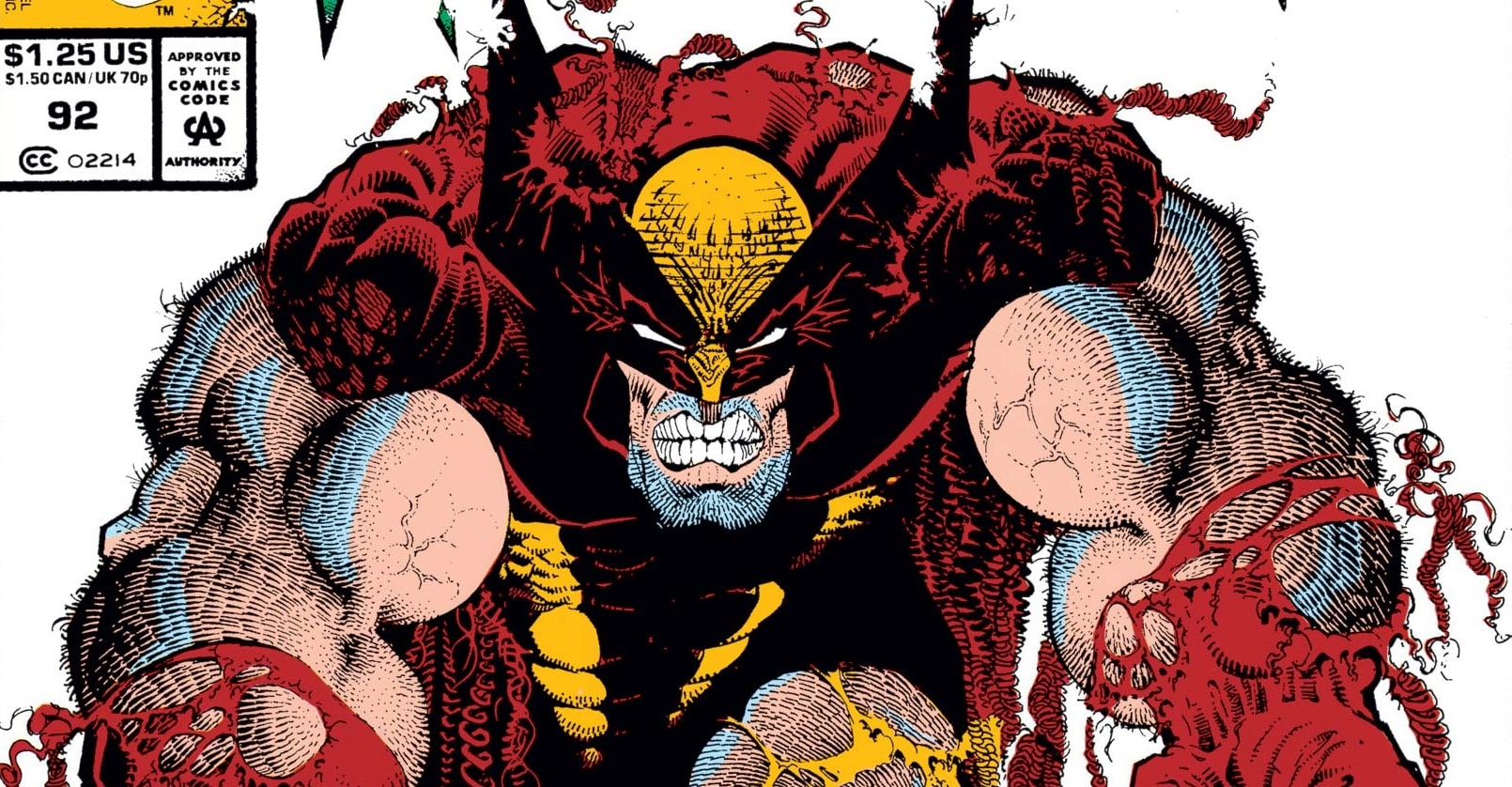
Carol Danvers isn’t the only empowered woman who’s recently re-donned retired duds. In 2025, Marvel released two other five-issue miniseries featuring superwomen getting back into generously revealing getups they haven’t worn in years or decades. Rogue: The Savage Land, written by Tim Seeley with art by Zulema Lavina and covers by Kaare Kyle Andrews, spends five issues bedecking Rogue in the tattered bikini originally fashioned by Jim Lee for 1991’s Uncanny X-Men #274. The throwback series Emma Frost: The White Queen, written by Amy Chu with pencils by Andrea Di Vito, reaches even farther into the past, reuniting Emma with the dominatrix corset getup she wore in her villainous 1980 debut, before she had much of any character. This series also features covers by David Nakayama, who deploys indulgent cheesecake pinups of Emma that are largely innocent of any awareness of plot, and which strongly evoke the Maxim-inspired covers created by Greg Horn for the White Queen’s 2003 solo series.
Hot on the heels of the cancellation of the Psylocke solo series written by Alyssa Wong starring Kwannon in some new-to-her pants, Marvel also announced the 2026 debut of another ’90s throwback series titled Psylocke: Ninja, starring white British lady Betsy Braddock, who, for Reasons, used to share Kwannon’s Japanese body. Again written by Seeley with pencils by Nico Leon, this series was solicited with a cover by Derrick Chew depicting Betsy copping a spine-contorting squat in Kwannon’s visage and vintage costume, which includes another combo of long gloves, thigh-high boots and a thong-backed bathing suit, plus more of those boob headlight starbursts that seem to be so popular right now.

I’m sure these costumes are iconic for somebody. Maybe they’re even iconic in general since, with the exception of Rogue’s one-off bikini, these characters wore these costumes (and, in Betsy’s case, this body) for many years. But saying something is iconic is a lot like saying something is fanservice. We often toss around these words with the presumption that characters have a single iconic legacy or that comic book fans are a succinct demographic desiring an identical form of service.
Yet this has never been true. The preferred meaning of any superhero has always been contested. And the meanings attached to female superheroes are often particularly contentious, mostly because some very loud men will always be various degrees of outraged and terrified by the concept of women who don’t profusely prioritize the needs of dicks that apparently can’t get hard without an endless supply of softcore stereotypes they learned to love as kids and tweens.
I could end this essay here with the obvious observation that, according to the accumulated anterior and posterior cleavage of Marvel’s recent throwback series and solicits, reductive pubescent dickservice is clearly back on the table at the House of Ideas. But because I’m personally very tired of observing reductive pubescent dickservice, I want to look harder at something better.
So let’s talk about the concept of iconicity and how it relates to the convention of the superhero costume, and how the superhero costume subsequently relates to character. Along the way, we’ll consider whether sexiness severed from character really sells as well as someone somewhere seems to assume.
Superhero comics iconically indulge in iconicity, and superhero costumes are a preeminent element of this iconicity. Superhero costumes are a lot like advertising logos, except in addition to being products promising power, perfection and plentitude, they’re also attached to specific imaginary people whose identities are distilled by iconic costumes that transform characters into brands. In effect, superheroes are walking advertisements for themselves.
In his 1994 book Super Heroes: A Modern Mythology, which was one of the first academically informed analyses of superhero comics, Richard Reynolds identifies the superhero costume as a “sign of individual identity” that signals “the inward process of character development.”
“Generally speaking,” writes Reynolds, “a hero’s costume (the sign of superpowers) is linked in some (permanently visible) way with his origin.”
In his influential 2006 book Superhero: The Secret Origins of a Genre, Peter Coogan sings a similar tune. Referencing Scott McCloud’s theory of “amplification through simplification,” Coogan argues that superhero costumes exploit comics’ inherent facility for “stripping down an image to its essential ‘meaning.’” For superheroes, this involves the creation of a specific iconic costume, and even a specific iconic symbol, that embodies a character’s mission, powers and identity. While the pulp heroes that predated and helped inspire superheroes sometimes had secret identities or wore flamboyant costumes, none of them were like Bruce Wayne, who, in the wake of watching his parents die in a violent mugging, is inspired by an encounter with a bat to strike fear into the hearts of criminals in the form of a bat-man called Batman who wears the symbol of a bat on his manly chest.
Most superhero costumes are less iconic than Batman’s. But the most well-known — and, not coincidentally, the most voluminously adapted and consumed — comic book superheroes tend to have the most iconic costumes. Whether a costume can effectively distill a superhero’s identity reflects the success of their brand, which in turn reflects the resonance of their character. To put it simply: Good concepts inspire good costumes that reflect good characters that are more likely to have more fans and thus, more likely to make more money.
Fans of Carol Danvers have always appreciated the connection between costume and character. And I do mean always, because readers have been emphasizing the importance of giving Carol a properly iconic costume since her superheroic debut in 1977’s Ms. Marvel #1. In the first issue of this series, written by Gerry Conway and penciled by John Buscema, Ms. Marvel is explicitly designed to become one of Marvel’s premier female superheroes and specifically its premier feminist superhero. When she’s not tossing cars as a Superman-inspired powerhouse, Carol works as the editor of a feminist magazine called Woman, underscoring an unsubtle connection to feminist icon Gloria Steinem, co-founder of Ms. magazine. (Where Steinem put Wonder Woman on the cover of Ms. magazine’s 1971 debut, Carol puts Ms. Marvel on the cover of the debut issue of Woman.) Judging by the Ms. Marvel lettercols, fans appreciated this premise but were decidedly divided on its denouement. Complaints frequently find fault with Carol’s costume.
Across the 23 issues that comprise the first volume of Ms. Marvel, Carol wears three different costumes. Initially, she sports a red bathing suit with a cut-out back and exposed midriff accessorized with a dangling red scarf, sort of like a sexy Spirit Halloween version of the costume most recently worn by her male precursor Mar-Vell, aka Marvel’s version of Captain Marvel. In Ms. Marvel #9, the costume is modified by closing the cut-outs, and the black costume debuts in Ms. Marvel #20, initially possessing a full-coverage backside whose fabric would substantially shrink over the years. Fully half of the lettercols (9 of 18) feature at least one letter addressing Carol’s costume. Most of these letters are attributed to folks with connotatively feminine names, so assuming these letter writers are real people (always a bit of a gamble with lettercols), most of these letters are probably written by women. Here’s a sampling of what they say.
In Ms. Marvel #5, Jana C. Hollingsworth compares Carol to the Silver Age Jean Grey, using a backhanded compliment of the latter to argue that making Carol an offshoot of Mar-Vell diminishes her individuality: “Marvel Girl did have weak powers and an insipid personality, but at least her powers were her powers and her personality was her personality. There’s probably no way you can negate Conway’s origin for Ms. Marvel, but I hope you can change her costume if it’s at all possible, and keep her on her own instead.”
Roger Klorese puns in Ms. Marvel #6 that the title character is “at best a hit-or-Ms. proposition” and declares, “Any super-heroine who has to bare her navel isn’t my type.”
In Ms. Marvel #8, Debbie Lipp says she’s “having a very hard time deciding whether or not I like Ms. Marvel” and asks: “where is a woman who wears long sleeves, gloves, high boots and a scarf (winter wear), and at the same time has a bare back, belly, and legs? The Arctic equator? The costume requires a few alterations.”

Ms. Marvel #11 features a letter from none other than (Mary) Jo Duffy, who had recently received her first editorial role at Marvel. Duffy’s letter praises writer Chris Claremont’s recent additions to Carol’s story while trying to talk herself into ignoring what was apparently widespread criticism of Carol’s costume: “the uniform doesn’t thrill me. It doesn’t thrill any of us and I guess you’ve heard that one to death. It does serve as an instant reminder of her Kree-ness and plenty of good characters have survived ugly costumes.”
Ms. Marvel #12 features some interesting commentary regarding the first alteration of Carol’s costume. In response to a letter from Ann Nichols, editor Archie Goodwin writes: “As far as the costume goes, a lot of readers have commented on our filling in the flesh cut-outs… that was partly an aesthetic decision, but mostly a production one—it was simply too difficult for artists, inkers, colorists and printers to deal with them… So we simply filled them in. Not as sexy, perhaps (sorry, young fellas in the audience) but a lot easier to handle.”
There is, as the internet is wont to say, a lot going on here. By declining to address the content of any complaints about the costume and using production restraints to justify a supposed decline in sexiness, Goodwin sidesteps any discussion of the relationship between costume and character, a dynamic conversely foregrounded in most of the published letters about the costume.
To be fair, Goodwin & Co. correctly anticipated some complaints. Ms. Marvel #14 features a letter from Wallace Hopkins griping about the closed-up cut-outs, and in Ms. Marvel #17, Bob Hughes similarly uses the costume to complain that Carol isn’t sexy enough; Hughes claims the costume’s colors are “too harsh” right after declaring that Carol has too many muscles.
Because Carol’s black costume debuted so close to the series’ conclusion, only one published letter addresses it. In Ms. Marvel #22, Karen R. Kantola heaps praise on everything save the new costume: “My feelings are mixed on her new costume, but it will serve to emphasize her separateness from Captain Marvel.” Karen’s letter concludes with another paean to the importance of foregrounding character and maintaining Carol’s individuality: “On a final note—keep Carol’s romantic independence for a while. So often, comic heroines are paired off right away and, while I realize the stories could be interesting, working it on your own can be, too… Don’t get me wrong. Romance is nice. After seven years of a happy marriage, I love it. I found out who I was, first. Carol deserves it, too.”
Karen was probably displeased by what happened next. Ms. Marvel was promptly canceled, and Carol took her new costume to the Avengers. There, her most prominent storyline occupies most of the supersized Avengers #200 (1980), co-written by James Shooter, George Pérez, Bob Layton and David Michelinie with pencils by Pérez. This story involves Carol being brainwashed, raped, impregnated and forced to give birth to her own rapist. Because the aforementioned brainwashing convinces Carol she loves her rapist, she then leaves the Avengers and Earth itself to live in another dimension with said rapist, a nightmarish fate that’s celebrated with the hearty congratulations of Carol’s fellow Avengers.
Thankfully, the fucked-up-ness of this story didn’t go unnoticed. In the fanzine LOC, Carol A. Strickland published an essay calling it what it was: “The Rape of Ms. Marvel.” And Chris Claremont wrote a powerful rebuke of the story in Avengers Annual #10 before giving Carol new life as the cosmically conscious Binary.
The black costume and Ms. Marvel moniker returned in the 1990s, just in time for Carol to suffer a power loss and crisis of confidence that, combined with the traumatic incidents described above, contribute to her developing a drinking problem and eventually becoming an alcoholic. She also wears the black costume throughout the 50 issues of her second solo series, which debuted in 2006 with Brian Reed on writing duties and Roberto De La Torre on art. Ostensibly, the plot of this series involves Carol recovering from her trauma and declining relevance to fulfill her true potential as “the best of the best.”
But this mission was arguably undercut by the series launching with a collection of bondage-themed covers by Frank Cho, followed by a lengthy run of covers by our old friend Greg Horn doing the thing Marvel paid him to do, which is make all of Marvel’s female superheroes look like ’90s Pamela Anderson clones posing for the covers of lad mags.

Carol didn’t succeed in becoming one of Marvel’s premier superheroes until she finally got a good costume. In 2012, writer Kelly Sue DeConnick spearheaded Carol’s rejuvenation, promoting her from Ms. to Captain Marvel. This was accompanied by a new costume designed by Jamie McKelvie. While continuing to pay tribute to her connection to Mar-Vell, McKelvie’s redesign eschews the awkward cut-outs, thongs and side-boob of the past in favor of a full-coverage leotard with flat boots and military details that reference Carol’s personal history.
In an interview with Newsrama, McKelvie described the new costume as “a result of us trying to create something that came out of [Carol’s] character and background in the military. I think the best and strongest costumes arise from the character’s personality, backstory and so on.”
In an introductory letter that appears in Captain Marvel #1, series editor Stephen Wacker only tentatively addresses the politics of the costume change, limiting himself to saying that, although Danvers’ black costume “was definitely titillating… it wasn’t always the attention we wanted for arguably our strongest female character.” This letter is followed by an entire page of fan art depicting the new costume, which Wacker says he received, unsolicited, in advance of the series’ debut. Significantly, all of the fan art is attributed to women.
Expanding Carol’s audience and finally giving her a costume that properly reflects her character was very good for business. Since the debut of the McKelvie-designed costume, Carol has consistently starred in solo books and become the leader of the Avengers. She’s also achieved a previously unimaginable level of recognizability beyond the confines of comics. Despite a misogynistic review-bombing campaign that forced Rotten Tomatoes to revise its commenting policies, the 2019 Captain Marvel film raked in an actual billion dollars at the box office. The film’s 2023 sequel, The Marvels, was less successful, but the fact that Captain Marvel inspired a sequel with a $300 million budget speaks to Marvel and Disney’s faith in the saleability of Carol Danvers’ post-2012 incarnation.

This saleability extends well beyond the box office. In 2006, Ms. Marvel merch was largely limited to sexy statuettes appearing in specialty catalogs or on the high shelves at the back of comic book stores. But by the time Carol hit the MCU in a version of the McKelvie costume, Captain Marvel merch was all over, her newly iconic costume and logo appearing everywhere from kids’ Halloween costumes to Vans and Adidas sneakers to action figures and Lego sets readily available at the Disney Store, Walmart and Target.
Sex sells, but so does character. Both Carol Danvers’ specific publication history and the larger history of the superhero genre suggest the latter might even sell better. Where the larger history is concerned: Take the Silver Age reintroductions of characters like the Flash and Green Lantern, which included new costumes that quickly became iconic, contributing to these once-defunct concepts becoming household names. Where Carol’s history is concerned: In 1979, Carol’s black costume preceded her series getting canceled; conversely, in 2012, her acquisition of a new character-based costume precipitated an era of unprecedented popularity.
It’s also worth underscoring that within a genre that’s always been heavily invested in celebrating conventionally ideal bodies cavorting in skin-tight costumes mimicking nudity, sex and character don’t have to be mutually exclusive. Emma Frost didn’t stop selling décolletage when she became a teacher, mentor and leader. But her sustained popularity is inseparable from those things. Similarly, if you don’t think Betsy Braddock looks sexy making out with her also-sexy girlfriend Rachel Summers, or that Kwannon doesn’t look sexy in her impossibly form-fitting full-coverage leotard, I don’t know what to tell you. And regardless of your sexual orientation, if you don’t think Carol Danvers looks sexy when Jen Bartel draws the Hellfire Gala version of her Captain Marvel costume, you may actually need to check your pulse to confirm you’re still alive.
Some forms of superhero sexiness extend from character, others don’t. The former includes images that emphasize agency and preserve character-based iconicity. The latter includes images where superhero costumes only exist so you can tell one female superhero apart from another because otherwise, they’d all look exactly the same.
Partly, I’m frustrated by these “legacy” titles that want to regress Marvel’s superwomen back to the 1980s and ’90s because a lot of these legacies are objectively bad. Whatever fans are serviced by bringing back eras in which female characters were subjected to thoughtless rape, dehumanizing objectification and, in the case of the whole Betsy/Kwannon situation, became synonymous with deeply problematic orientalist exoticism, arguably deserve less respect than Marvel apparently thinks they’re owed. But it’s also frustrating because there’s lots of history — both recent and far-reaching — to suggest this regression is simply bad business.
While only some of Carol Danvers, Rogue, Betsy Braddock/Kwannon and Emma Frost were ever considered “bad girls,” there are lessons to be learned from the late-’90s collapse of the bad girl comics boom. In his recent book Killer Bodies: The Rise and Fall of “Bad Girl” Comics, Joseph Crawford argues that by the late ’90s, cultural changes — including the increased availability of pornography — made bad girl comics irrelevant: “the only remaining reasons to continue buying such comics were if one had an enduring crush on a specific ‘bad girl’ heroine or a persistent attachment (or fetish) for the genre’s specific aesthetic. Every other economic, artistic, or erotic need they had previously met was, by this point, better catered to elsewhere.” If comic books basing the bulk of their appeal on generic softcore images of scantily clad superwomen was a market of diminishing returns 30 years ago, it’s arguably even more so now, when both comics fans and fans of fetish art have access to a mind-boggling plethora of alternative entertainments. Just ask the once-monthly industry giant Playboy, which stopped publishing a physical magazine in 2020 before relaunching as a single annual magazine in 2024.
If you’re excited about seeing Carol back in black, or getting Betsy back in Kwannon, good for you (I guess). But if you care about the continued existence of Marvel comics as a publisher of comics, it’s worth observing the stink of desperation attending these attempts to appeal to supposedly dependable demographics that are actually increasingly niche. Eventually, Marvel will run out of suckers to buy their sexist sexiness. And when that happens, they’ll wish they’d had enough character to invest in better characters.
The women writing letters to Ms. Marvel in the late 1970s, who badly wanted Marvel’s flawed attempt at creating a feminist superhero to find a way to succeed, knew this. Almost 50 years later, it would be great if more of the folks in charge of making comics, including the folks in charge of making comics make money, finally started listening.

Anna Peppard
Anna is a Ph.D.-haver who writes and talks a lot about representations of gender and sexuality in pop culture, for academic books and journals and places like Shelfdust, The Middle Spaces and The Walrus. She’s the editor of the award-winning anthology Supersex: Sexuality, Fantasy, and the Superhero and co-hosted the podcasts Three Panel Contrast and Oh Gosh, Oh Golly, Oh Wow! Follow her @annapeppard.bsky.social.