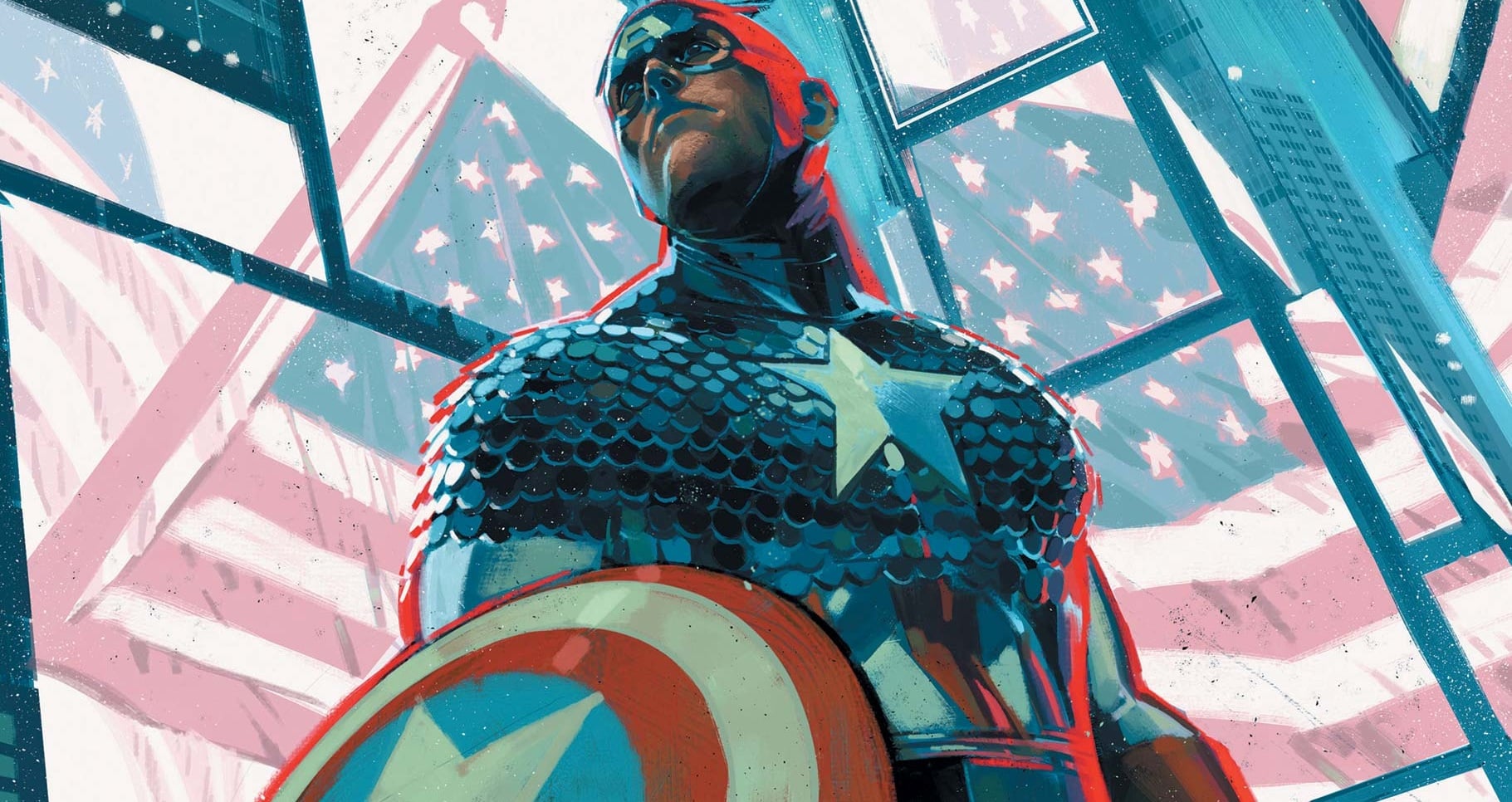
While Captain America slumbered in ice, the world changed, for better and for worse. Steve Rogers awakens to a reality where battles are fought in the shadows through secrets and subterfuge, and villains aren’t so easy to identify. When a fledgling dictator named Victor Von Doom conquers Latveria, Steve faces a critical decision: adapt to a new kind of warfare, or forge his own path? And what will the choice he makes in the past mean for his future? Captain America #1 is written by Chip Zdarsky, drawn by Valerio Schiti, colored by Frank Martin and lettered by Joe Caramagna.
In John Ney Rieber and the late, great, John Cassaday’s Marvel Knights: Captain America, we see what I imagine a lot of comics readers wanted to see in 2002: We see Steve Rogers there.

Marvel Knights: Captain America was published as immediately after 9/11 as Joe Quesada’s Marvel allowed, and it had a simple premise: What if Captain America was there, at ground zero? Of course, I should say that Steve Rogers actually says the opposite in the comic proper: He says he wasn’t there, at the World Trade Center. He is a fictional character, after all; he can only witness its aftermath, and respond to the repercussions of what Rieber frames in the issue as another Pearl Harbor, another sneak attack on America by the “eastern hordes” – Cap has a hell of a lot of experience fighting those, doesn’t he?
So in 2002, the War on Terror was to be another great patriotic war for the greatest patriotic superhero. Oh, sure, Rieber has Cap make sure to remind the reader that not all Muslims are the bad guys, and then mouth platitudes about how “we the people” can make sure the terrorists don’t win, that sort of post-imperial pablum. But this is war – he wants his readers to remember that. Cap’s liberal enough to express concern for the children of Afghanistan, but enough to not go to war. He moves on.
The story moves on, too, to standard SHIELD shenanigans with an eerie patriotic hue. This run isn’t well remembered, nor should it be. But for a moment in 2002, this was Captain America’s new war – and there was a new Red Skull, an ersatz Osama Bin Laden called al-Tariq. Captain America, as close to a moral center as the Marvel Universe affords, doesn’t mince words: al-Tariq, he says, is a “monster.” To fight him, Cap swears to become a monster, too – to Rieber, being a monster is all he can do, since Cap wasn’t there.

I should say for the record that, well, neither was I. I was born after 9/11. The America I have known for my whole life has been busy losing the so-called War on Terror. You could say that war was well and truly lost in 2021, when President Joe Biden withdrew troops from Afghanistan – but I don’t think that’s true.
After all, we brought the war home.
That injust, stupid, racist war is being fought every day – and like it always was, it is being fought against innocent people. No, I wasn’t there – but the America I have lived in and seen my whole life has been. This country has fallen and continues to fall prey to its own crudest depravities because of it, and victory against that depravity is not guaranteed.
And yet, as someone who doesn’t love America, it’s strange, then, that I love Captain America. I shouldn’t be surprised, but always am, when friends from other countries tell me, very reasonably, that they find it a bit hard to love the star-spangled Avenger, the man who is America. But I’ve always felt that his iconography is completely different – and completely heroic.
Over the course of the last 60 years, Cap has become Sisyphean, fighting tirelessly to keep the arc of progress from bending backward so much that it shatters. His results are mixed, but through it all, Steve Rogers is and will remain a sentinel; he will remain virtue qua virtue, with the plain-dealing unimpeachability of Abraham Lincoln and the cheekbones of Paul Newman. He is impossibly corny and impossibly earnest. He is a superman locked in endless, paradoxical conflict with the forces of fascism. He is also a 4-F dreamer with a pencil and a sketchbook. He is probably my favorite non-mutant Marvel hero – and mercifully, the Ney Rieber/Cassaday run was too inconsequential to change him from what he truly is.

I say all this to explain why Captain America is a very, very, very hard character to write in 2025. Chip Zdarsky (no relation, I’m told, to Steve Murray) has a hell of a job with this new run of Captain America. He has his work cut out for him – I mean, for one thing, he’s Canadian (joke).
But his approach to Cap is bold, and it’s deceptive. It asks the very same question that Rieber did in 2002, only for an era that knows what answering that question really means – selling our so-called soul to the Mephistopheles of industrial-colonial empire. It reminds us that Captain America’s story is very easy to misread. It reminds us that it is very easy to see Steve Rogers and want to be him, and it is very easy to not understand him.
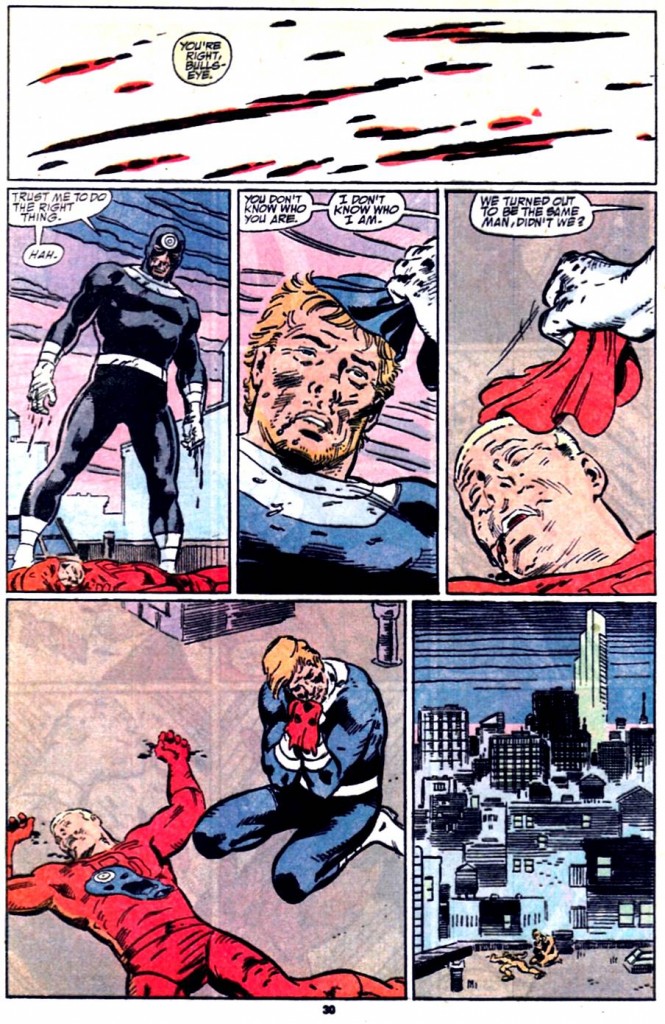
We’ve seen false Caps before. First there William Burnside, the Joe McCarthy Cap of the 1950s, then USAgent and Nuke, the Iran-Contra Caps, and Christopher Priest’s Afghanistan-era, David Coltonish Anti-Cap. But none of these has ever been quite so like Cap: Scrawny, asthmatic Colton is so shocked and appalled by 9/11 that he becomes a new Captain America for a new America, one scared by a new foreign war and a new Eastern threat. Sure, he reminds me of Burnside and of Nuke, but he reminds us of Steve most of all. There’s no comfort in this issue – no clear delineation between thee and me, like we’ve always had before. By the time we meet ‘50s Cap, we’ve seen Steve Rogers work comfortably (and shirtlessly) alongside a Black man: We know he’s no racist. But this is a Steve Rogers who isn’t yet able to realize what standing out of time means – this is a man newly lost in it, and a man less sure and less certain than we’ve seen him in ages.
That uncertainty serves as the core of this issue. Look at that deft little gutpunch reveal that the war-drum of a Frank Miller monologue about a shy, bullied kid pledging his life to the wars of his country after an awful act of violence is Steve’s, not David Colton’s.
In hindsight, it makes perfect sense – and it shows us something very sobering: that these two stories are the same story. These are, more than any Cap and Anti-Cap, the same man. (David Colton and Steve Rogers’ stories are also not too dissimilar from the story of a kingly writer at the Distinguished Competition, but I’ll say no more about that – he’s said more than enough.)

So the question that hangs over this issue – that I imagine will hang over the whole run – is that of the Good War. World War II, we’re told and taught, was a good war, the good war – and frankly, I think it was. But to David Colton, the War on Terror is also a good war – just as it was for John Ney Rieber in 2002. The fascinating power of Marvel Comics’ eternal present – the fascinating power that means Tony Stark was making smartphones at the same time as he was unconvincingly pretending to just be Iron Man’s boss – means Captain America wasn’t there for the Marvel Knights run – he couldn’t have been. He was still in the ice.
I think a Cap with a freshly thawed morality is why this comic has to be set in that slippery past for now: Cap’s morality here should be freshly thawed. (Frankly, to my litigious taste, he’s maybe too much of a geopolitical fish out of water: I think it is a bit silly that the living mascot of the United Nations, as the Allies often called themselves, could not make an educated guess as to what the post-war United Nations would be.) Emotionally, it’s perfect: This is a Cap for whom Bucky’s death still bleeds. Certainly when you read the Silver Age stories that are set during this same period, you realize that for Steve, he is barely at a stage where his agonies register as post-traumatic. They are still living and present for him. If nostalgia is the pain of an old wound, then Captain America is truly the greatest nostalgia hero.
But with that pain comes a sincere and profound belief in life – and a naive belief in the United States of America’s interest in same. This has to be a young Cap because he does not yet know that trust is a radical act. Preparing to face Doctor Doom, he does not even know the rules of the Marvel Universe yet.

But Chip Zdarsky knows those rules – he knows very well who and what Captain America is. On some level, the act of displacement this comic is performing is perhaps a little gauche – these Marvel Knights stories are not too long ago, after all. They are real Captain America stories – just as the ‘50s Cap was, indeed, really Cap, at least at the time.
You could accuse the book, then, maybe, of having it both ways – but I don’t think that’s right. ‘50s Cap has done his time – he seems almost quaint. But ‘00s Cap is nothing of the kind – because we know what he did, what he chose when he was there. He made the choice this country made – and can’t ever unmake.
And then there is the question – what would you do at ground zero? In 2002, we had one answer, because there was one Captain America. But today we have two: one for each. If Captain America is the man who is America, and if we have two Captain Americas, we have two Americas, if not more. But we still have one question.

Oh, yes, we are willing – we always have been.
Buy Captain America #1 here. (Disclaimer: As an Amazon Associate, ComicsXF may earn from qualifying purchases.)

Margot Waldman
Margot Waldman is a Mega City Two-based scholar, researcher and writer. Her great loves are old comics, Shakespearean theater and radical social justice – in no particular order. One day, she hopes to visit the 30th century.