While the Chris Claremont/John Byrne run of Uncanny X-Men is rightly regarded as a creative high water mark for the series, containing some of its best-known and beloved stories (including “Proteus,” “The Dark Phoenix Saga” and “Days of Future Past”), their run ended somewhat abruptly, with Byrne departing after one-too-many “Colossus ripping up a stump” moments made him realize his input/takes on the characters wasn’t making it to the page. With Claremont remaining on Uncanny and Byrne moving on to take up the writer/artist reins on Fantastic Four, it wasn’t long before a sort of unofficial cold war emerged between the two former creative partners, as each began to see in the other’s work creative decisions that bothered them for one reason or another, prompting a thinly veiled response in their book.
Usually, these were quick asides in otherwise-unrelated stories (like Byrne going out of his way to establish that the Doctor Doom whom Claremont wrote in Uncanny X-Men #145-147 was a Doombot, because Byrne didn’t like how Claremont wrote the villain, whom Byrne, as the FF writer, viewed as “his”). But in one case, the back-and-forth sniping led to one of the most acclaimed Fantastic Four stories of Byrne’s run: The Trial of Reed Richards.

It all started in Fantastic Four #242-244 (May-July 1982), a story written and drawn by Byrne in which a dying Galactus returns to Earth and, rather than let him die or outright kill him, Mister Fantastic decides to try to save Galactus’ life, believing (as does Captain America) that as a sentient being, they have a responsibility to help him, that the threat he poses is a result of what he must do to survive, not evil intent. In the end, Galactus is spared and leaves Earth.

For whatever reason, this didn’t sit very well with Byrne’s old partner Claremont, who wrote a sequence (drawn by Paul Smith) into the otherwise unrelated Uncanny X-Men #167 (March 1983) in which Lilandra, Empress of the Shi’ar, while hanging out as Professor Xavier’s consciousness is transferred out of his Brood-riddled original body into a new clone body (comics!) learns of Mister Fantastic’s actions.

Enraged, she drops into Reed and Sue’s bedroom via hologram and basically tells him that the Shi’ar will hold him personally responsible for any deaths caused by Galactus from this point forward. Perhaps Claremont objected on moral grounds, or perhaps he was miffed that editor-in-chief Jim Shooter had forced Claremont and Byrne to change their ending to “The Dark Phoenix Saga” after Phoenix destroyed a world but now was allowing Galactus to live.

Byrne, in seeing Claremont’s response to Galactus’ salvation, was mostly torqued off to see the Fantastic Four — characters whom he considered “his” at the time — once again appearing in another story without his or his editor’s knowledge. He took his concerns to Shooter, who suggested Byrne write his own response to Claremont’s response to Byrne’s story.

While Byrne had more or less mapped out his FF run at that point, he decided to use the “Assistant Editor’s Month” gimmick (a one-off event in 1983 in which every Marvel title was handed over to its assistant editor for one month, on the grounds that the “main” editors were all away at San Diego Comic-Con, leading to a variety of humorous or done-in-one stories that didn’t necessarily fit the usual tone or current storyline of the book being published; these subsequent issues came out in October 1983, cover dated January 1984) to wedge in a story in which he would further litigate the existence of Galactus and Reed’s actions in saving him.

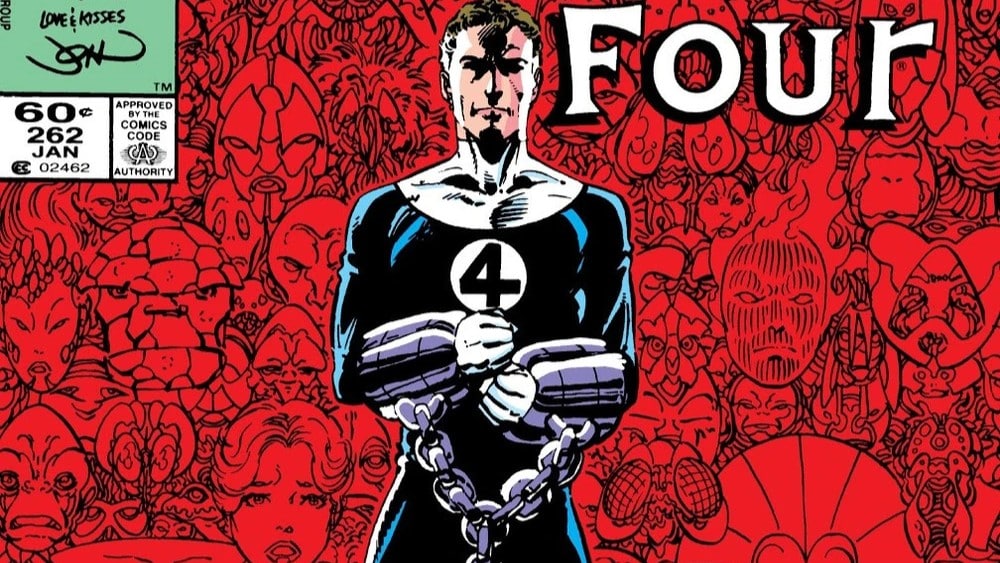
The end result is “The Trial of Reed Richards” in Fantastic Four #262 (January 1984), in which Reed is hauled before an intergalactic tribunal and put on trial for allowing Galactus to live. (Something I don’t know: Did Byrne receive permission from Claremont and/or Louise Simonson to include Lilandra and Gladiator, who basically serve as the prosecuting attorneys, in his story?) Reed’s trial in turn becomes a de facto trial of Galactus, and in the end, the verdict asserts Byrne’s earlier point: that Galactus is essentially a force of nature necessary to the overall existence of life in the universe on a macro level even as he ends life on the worlds he consumes on a micro level, a being beyond the concepts of good and evil (this is also the story that establishes that Galactus appears differently to each species, meaning not everyone sees him as a giant man with a purple G belt buckle; Byrne loves trying to “fix” Silver Age goofiness).

While born of the simmering tension between Claremont and Byrne and their conflicting views on the nature of Galactus and who gets to use whose character when, “The Trial of Reed Richards” is generally regarded as one of the standouts of Byrne’s generally well-regarded run on Fantastic Four. It’s ultimately a decent-enough resolution to a preordained outcome — all morality and comic book mumbo-jumbo aside, there’s no way the story could end with Reed being condemned and executed or forced to live on the run from all the galactic great powers — though Byrne inserting himself into the proceedings as a witness to the trial (presumably to play up/take advantage of the Assistant Editor’s Month gimmick) reads like an eye-rolling expression of Byrne’s egotism (even though yes, Stan Lee and Jack Kirby did stuff like that all the time back in the day).
Certainly, the notion of Galactus as a force of nature becomes the accepted reading of the character after this, and arguably fits better with his thematic presentation, dating to his first appearance in a story that is essentially constructed as “what if the Fantastic Four fought God?” than considering him on the same level as FF villains like, say, Mole Man or Diablo. All of which makes this particular entry in the Claremont/Byrne cold war another example of the way, just like in their Uncanny X-Men run, the tension between the two creators often resulted in better stories — even when they’re not directly working together.

Austin Gorton also reviews older issues of X-Men at the Real Gentlemen of Leisure website, co-hosts the A Very Special episode podcast, and likes Star Wars. He lives outside Minneapolis, where sometimes, it is not cold. Follow him @austingorton.bsky.social.