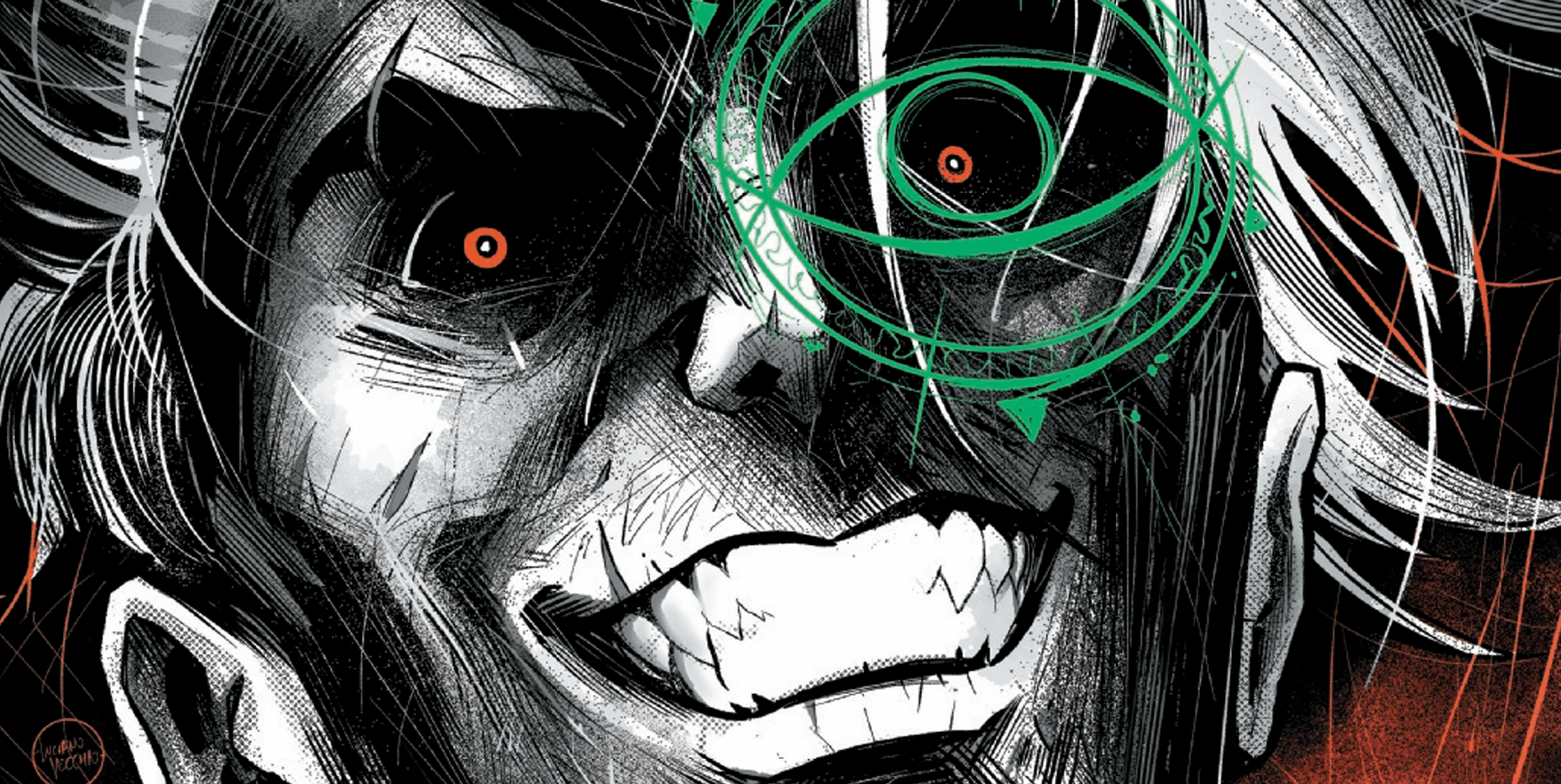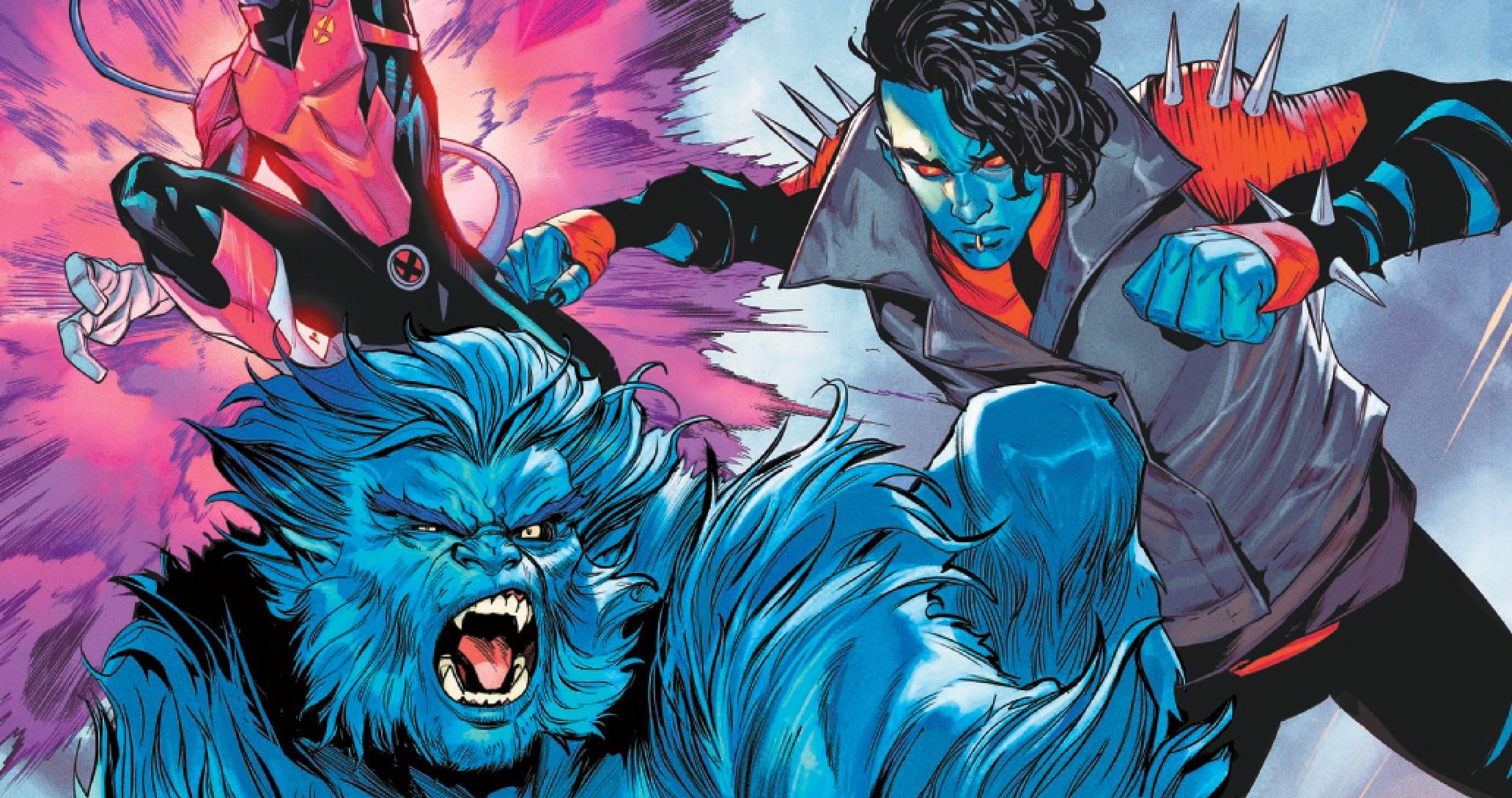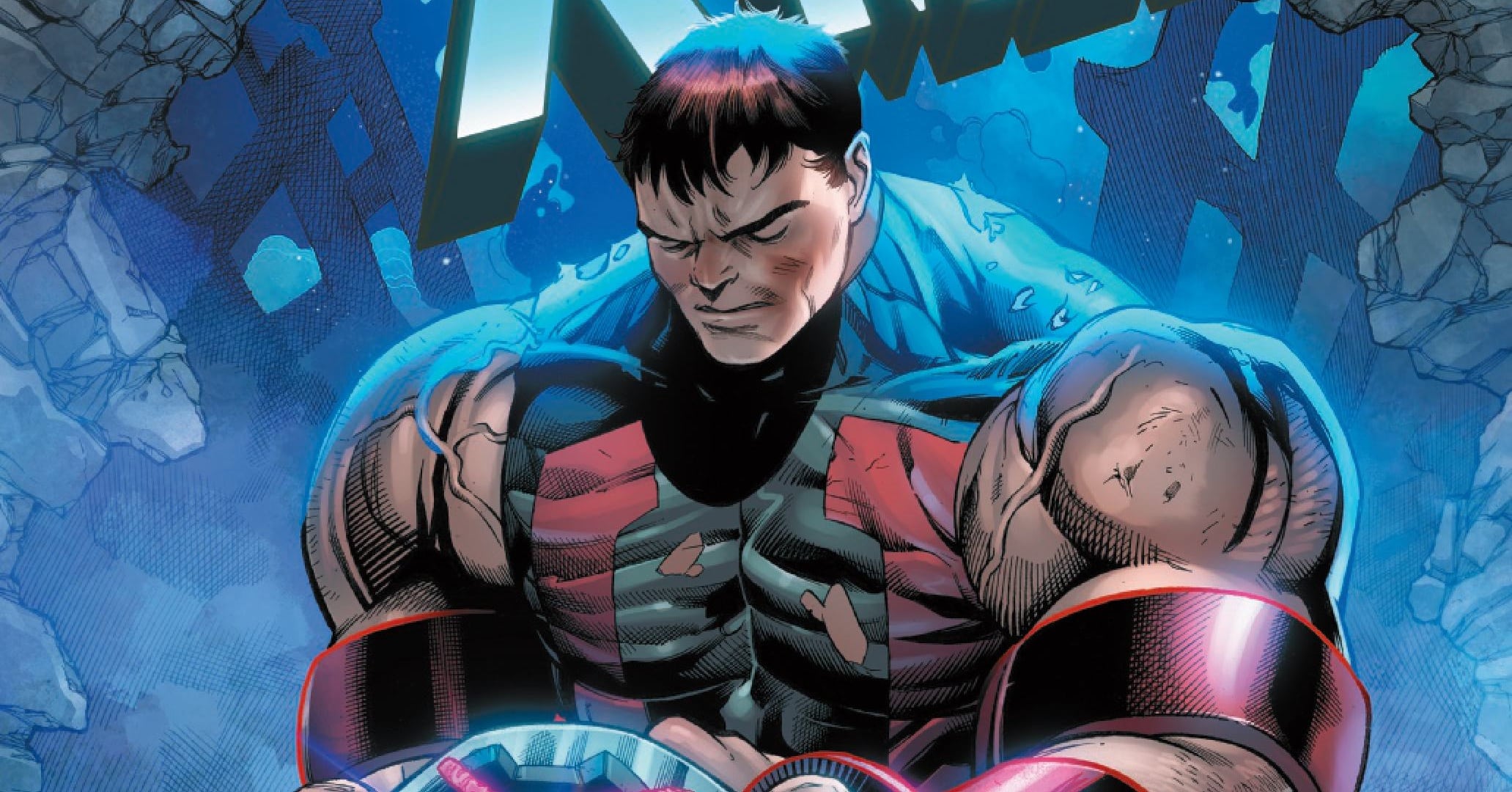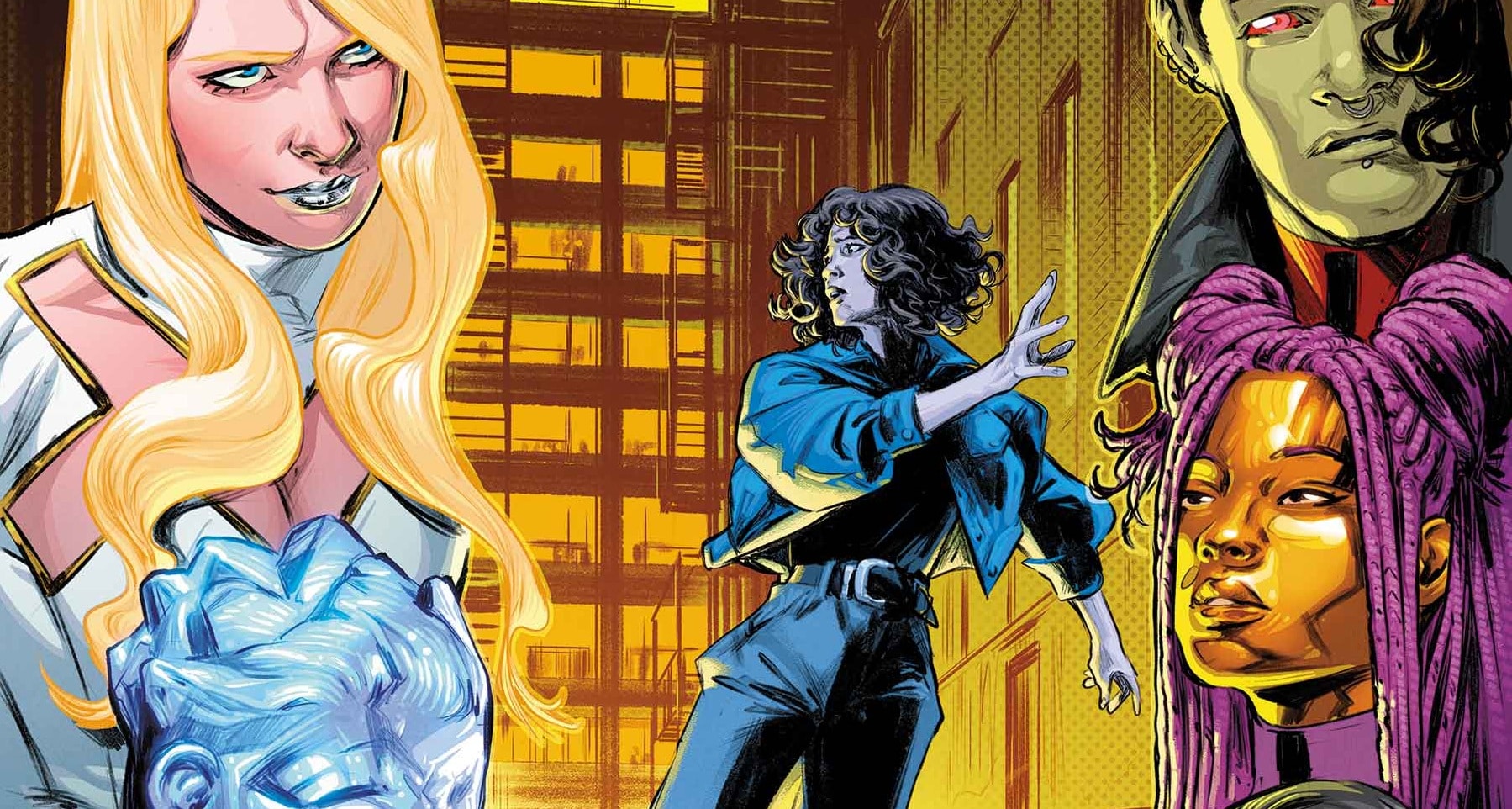
Kitty Pryde’s stuck in her past, and a Sentinel’s chasing her through the suburb she once called home. Can her teenage students from Chicagoland save her present-day self, or her past self, or both, before all of X-reality gets erased? You already know the answer in Exceptional X-Men #13, written by Eve Ewing, drawn by Federica Mancin, colored by Nolan Woodard and lettered by Travis Lanham.
Sometimes I think Eve Ewing’s been reading my mind. Every so often I wish she would stop, but at this point I’m mostly OK with the way she knows what I want, and how I’ve been feeling, a few pages before I do. Not by coincidence, that’s how Kitty Pryde has come to feel about her onetime nemesis, then frenemy, then pedagogical mentor Emma Frost. It’s how she became the teacher that Kitty finally knows she’s supposed to be. It’s also why this series’ journey for Kitty (though not the series itself) can come to an end, at least for now, before the editorially mandated crossover alternate future event called Age of Revelation begins.
To tell you why — most clearly, if not concisely — we’ll have to take a two-paragraph break from the X-Men to look at my favorite tabletop role-playing game, Masks: A New Generation, written by Brendan Conway and published by Magpie Games. In the same way that Dungeons & Dragons simulates various sword-and-sorcery stories, set in a world derived loosely from Tolkien, Masks simulates teen superhero stories: Player characters represent archetypes, each corresponding to the familiar plot arcs of your favorite teen heroes. The Beacon has chosen the superhero life despite having almost no superpowers (think Kate Bishop/Hawkeye). The Outsider comes from a world elsewhere and has to figure out life on Earth as they go (think Warlock, or Starfire). The Janus has to preserve a civilian identity, usually (but not always) secret (Peter Parker comes to mind). Heroes get stat blocks not from what they can do, but from how they feel about their identities: Your character might grow more confident about their ability to pass as a normie and relate to people as equals (a stat called Mundane), or more willing to start a fight (a stat called Danger), and so on.
As Masks characters grow into their identities and figure out (as teens must figure out) who they are, their stat blocks change, their backstory grows, and — eventually, if you play the game long enough — they encounter a Moment of Truth, becoming the center of the game’s plot and making irrevocable decisions. And, after a few such cruxes, they’ve likely grown up: They’ve figured out who they can be, and what they will do with their powers, and they age out of being teen hero protagonists, either retiring from life as a hero or becoming adult NPCs. The game, and the fun in the game, relies not on fantasies of ever-increasing power and larger stakes, but on the way the players, and their characters, can experiment, get hurt, widen (or narrow) their sympathies and learn what they can, and what they choose to, become.
Kitty Pryde entered the X-Men, at the start of the now-classic “Dark Phoenix Saga,” as the only teenager in the loop. Discovered at age 13-and-three-quarters in safe, upscale Deerfield, Illinois, by Emma Frost and then, five minutes later, by Professor X and the Claremont-Byrne X-Men, Kitty had a long set of decisions to make: join the team, save her teammates (again and again), date Colossus (or not), find love, know grief, move to Britain, decide not to die, quit, try to lead a normal life, rejoin her team, accept Magneto’s help, become a teacher, quit, rejoin, rinse and repeat, before the Krakoan experiment and again afterward, in the series we’re reading right now.
Unless you count her time as the Red Queen, she’s never seemed settled, or not without massive second thoughts, in any of those roles. The closest she’s come (if it counts) is the alternate House of M Earth, where she’s an attentive, effective teacher in a Cinncinnati junior high. Between the X-Men, the University of Chicago and her current gig as a mentor for Bronze, Melee and Axo, Kitty has likely spent most of her life since childhood either as a student surrounded by teachers, or as a teacher surrounded by students. Her life as a childhood genius, acing all the tests and growing apart from her age-mates, predates her powers and stands at the core of her character.
Each time she can’t decide what to do, or wants to die (as she has, more than once), it’s her belief in her mission, and in a next generation, that saves her. And so — if you had to predict a consistent future for her, a life for her as an adult, as a Masks NPC — you’d probably (I would) think of her as a teacher, working alongside or quarreling with the adult teacher she’s known best, and longest, the one who’s taught her the most (at first by fighting her), the onetime White Queen of the Hellfire Club, Emma Frost. That’s where the arc of Kitty Pryde’s overextended adolescence logically ends.
And that’s where this latest — I hope not the last — issue of Exceptional X-Men ends too, thanks to Ewing’s unparalleled-since-Claremont sense of the character, and thanks (but also: no thanks) to the pretzel-logic time-travel shenanigans that shape this issue’s plot. Last issue, a newly empowered mutant named Reggie accidentally shoved Kitty back into her own Deerfield past, to the moment right before her origin story, when Emma and Professor X came to her door. A Sentinel, programmed to kill mutants, followed. Whoops.

With help, and a mind-link, from present-day Emma, the present-day X-teens, Bronze, Melee and Axo, showed up in Deerfield themselves, hoping to rescue young Kitty, bring back adult Kitty and neutralize the mutant-hunting machine. That’s where we start: with adult Kitty, recognizing herself, and then her time-traveling students, and then her younger self (in exactly what she wore back then), coming out of her beloved dance studio, at 13, months “before I first used my abilities.” Youthful Kitty looks exactly the way she should look: recognizably the girl whom John Byrne, inker Terry Austin and colorist Bob Sharen first drew, almost but not quite at home in her dancer’s outfit. Mancin and Woodard get adult Kitty’s facial expressions exactly right, though I wonder about the way her complicated hair flattens her head: it’s the one art detail I know I would change.
If you could go back to your teenage self and set her on a different course, would you do it? Why or why not? What data, and whose advice, might change your mind? That’s the question we see Kitty ask — a very trans question, not by coincidence — and Ewing, gloriously, delightfully, will show us the predictable answer. First, though, Kitty’s going to get confusing and arguably pointless advice, via thought balloon, from Emma: “You cannot under any circumstances interact with your younger self. Doing so might change the course of your life. … If you intercede, you could end your life as you know it!” These adults might know better: Talking to younger you might be unwise, or counterproductive, or pure frustration, but in the Marvel multiverse as we know it, that kind of time travel won’t erase your current life or destroy your current timeline. It just creates a new one, as a former teammate and confidante of Rachel Summers (who grew up on Earth-811) and Lucas Bishop (Earth-1191) and a trained particle physicist ought to know.
In any case, adult Kitty takes Emma’s advice and watches as the kids she’s trained befriend her teenage self, and defend that teenage self from a wolf-shaped Sentinel. Mancin and Woodard, once again, design clean, centered panels for reflective character moments, and off-balance, energetic diagonals for the vicissitudes of fast-paced combat. Then they show young Kitty saving her own life by learning to phase when the Sentinel attacks: “Wow!” she says. “I’ve never done that before in my life!” She gets the canonical powers-emerging headache. But she’s happy. She stretches out, still in her leotard, sweater tied around her hips. And then she lets Melee and Axo walk her home.
What about adult Kitty, who’s not sure she wants to be who she grew up to be? What did she grow up to be? Could she have turned out otherwise? What did she miss by forgoing — or never seeing the chance to lead — a “normal” life?
That’s the big question that ends this issue, and this arc, and (if we’re unlucky enough) this series: The comic even ends with the words “the end,” and an advert for Expatriate X-Men, the crossover book with Melee and Bronze and Kamala Khan — but perhaps not Kitty — that Ewing’s signed on to write. Before the end, though, we see Bronze and adult Kitty chatting, on (of course) Deerfield playground swings. Mancin and Woodard’s panels start with a view from above, then slant disorientingly before they find stability and a close focus on the student and teacher, just talking. Would Kitty “take it all back if you could”? Should Bronze go to young Kitty’s house and instruct her, in this timeline, “that she shouldn’t go with Charles Xavier”?
It’s tempting. But no. “I should say that I don’t want to take it all back,” Kitty says to Bronze, her eyes wide open, birds in flight far behind her, looking right at the reader. Why? Not “because of Charles and Ororo and Bobby and Kurt.” Not “because of the adventures we had. The lives we saved.” That’s not what makes Kitty’s present-day choices worthwhile. It’s “being a teacher.” Showing up for the kids. Becoming — because of what she knows, what she’s learned, what she’s done and (not least) the privilege she has — the right person to help those kids find their own way. That’s why (it’s not much of a stretch to say) it’s worth being alive. For Kitty. YMMV. As for me, I’m right there with her.
Then the kids fight a big-ass, throwback, bipedal Sentinel all on their own, and adult Kitty says “Thanks for saving me.” Group hug! Emma gets appropriately acknowledged as “the best teacher I know,” perhaps because Professor Xavier is a jerk. And we’re out.
Except that we’re not. “Way later,” our Kitty, seen from above, in her bed (yes, fully clothed) gets off the phone with someone she trusts (likely Nina, her baseline-human sometimes-gf) and on the phone with Rogue. She’s coming back to the X-Men proper, for some set of editorially mandated new adventures. Whoever takes charge better make sure she finds new students, or the same set of students, there.

Points of Pryde
- Ironheart’s in here too, and Kitty — as you’d expect — teaches her how to be a good teacher: “yelling ‘Focus’ at him” (Reggie, the portal kid) “is not going to help him focus.” Kids need support, and sometimes boundaries, but not yelling and judgments and grades.
- Bronze reminds Axo — and herself — that a wolf-shaped Sentinel is a “murder robot, not a dog!” Twice. Because otherwise Bronze simply could not bring herself to rip apart a “dog.”
- Ironheart also refers to our girl as “Captain Kitty.” A callback to her Red Queen era — but how would Ironheart know?
- Kamala Khan’s on the same dystopian future Expatriate X-Men team with Mystique. However will they get along?
Buy Exceptional X-Men #13 here. (Disclaimer: As an Amazon Associate, ComicsXF may earn from qualifying purchases.)

Stephanie Burt is Professor of English at Harvard. Her podcast about superhero role playing games is Team-Up Moves, with Fiona Hopkins; her latest book of poems is We Are Mermaids. Her nose still hurts from that thing with the gate.