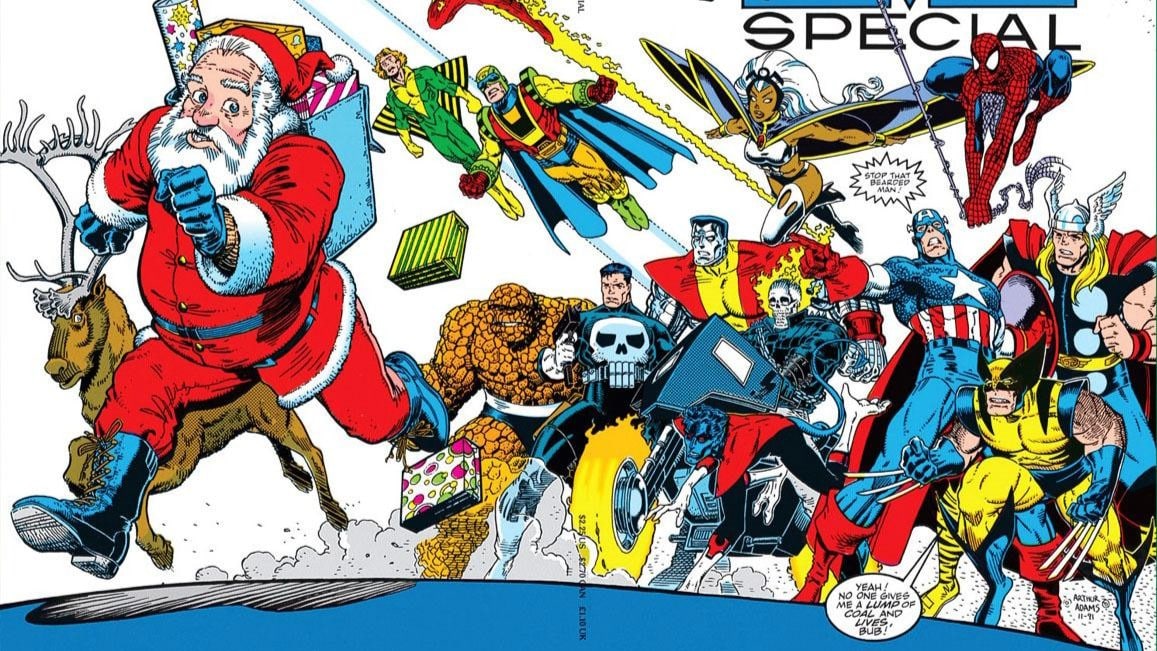
The X-Men count among their number some of the most powerful mutants ever, including omega-level telepath/cosmic being Jean Grey, elemental Earth goddess Storm, and a short, hairy dude with knuckle knives. But one of the most powerful mutants ever has never donned the blue and gold of an X-Men uniform: Santa Claus.
With comic sales booming on the backs of the relatively new direct market, hot artists and a culutural speculator mentality, 1991 saw the publication of Marvel’s very first dedicated Holiday Special, an anthology issue of yuletide tales starring the company’s most popular characters under an Art Adams cover. “A Miracle A Few Blocks Down From 34th Street” is the first story in that issue, and it stars the hottest characters Marvel had at the time: the X-Men.
Featuring some of the last X-Men art from Dave Cockrum and inks from Joe Rubinstein (who teamed up with Cockrum for a lengthy Uncanny X-Men run alongside writer Chris Claremont after John Byrne left the series) it is, chiefly, a fun little continuity-insert story, set in the early days of the “All-New, All-Different” X-Men. But it’s also the story that heavily implies Santa Claus is a mutant. The way it dances between the raindrops of continuity/the X-Men’s creative history while also playing around with the Santa mythos makes it both a notable X-Men story and a touching Christmas story.

“A Miracle A Few Blocks Down From 34th Street” opens with the “new” X-Men — Storm, Colossus, Nightcrawler, Wolverine and Banshee — trimming the X-Mansion’s Christmas tree. Dialogue establishes it is early in their time together (Storm has never before decorated a Christmas tree, for example) and channels the spirit of those early post-Giant-Size stories, when the team was still gelling and Claremont was still finding everyone’s voice. There’s a naivete to Storm, a playfulness to Nightcrawler and a grumpiness to Wolverine (early Wolverine is almost psychopathically grumpy). The retro vibes are furthered by the way clunky exposition is worked into the dialogue, a technique that was already passe in 1991 but would have been right at home had this story been written in the mid ’70s.
After Cerebro alerts the X-Men to the sudden presence of a powerful mutant in New York City, the X-Men rush out of the mansion and into a confrontation with the Brotherhood of Evil Mutants. The Brotherhood — who have also been alerted to the presence of the powerful mutant and hope to win him to their side — are a less effective example of the story’s dedication to fitting into a particular moment in narrative time. Far from the original Silver Age Brotherhood or the later Mystique-led team, this is a variation on the “hiatus years” Brotherhood, when the X-Men had no series to call their own and less iconic configurations of the Brotherhood would pop up in various places, like the Beast serial in Amazing Adventures, the original “Secret Empire” story in Captain America, and Defenders, where Magneto and much of the Brotherhood which appears in this issue were de-aged to infancy.

And that’s the problem with the use of the Brotherhood in this issue. Magneto is eventually re-aged by Erik the Red in X-Men #104, a story that takes place explicitly after the events of this one. Champions #17 establishes that the rest of the infant Brotherhood was restored to adulthood due to spillover from Erik the Red’s effort. Which means they should all be babies in this story, which also means that, logically, we’d be denied the glorious moment when Blob is mistaken for Santa Claus.
That continuity snafu aside, the resulting X-Men/Brotherhood fight is fun, with the script peppering the fight with bits of Christmas references (like Wolverine declaring he’s got the whole twelve days of Christmas to work on slicing through Unus’ forcefield). In the Christmas-y coup de grace, the fight concludes after the Brotherhood are transformed into action figures by the mystery mutant for which both teams were searching: Santa Claus himself!

The action figures bit is a cute gag, given both the Christmas setting and the fact that this comic was released right around when X-Men action figures were beginning to storm toy store shelves. But the really special moment comes when Santa Claus wipes the X-Men’s memories of their encounter with him, then teleports them to Rockefeller Center, smack dab into the events of X-Men #98, the very first X-Men Christmas story.

It’s at this point that the Cockrum/Rubinstein art becomes all the more impressive: While their work throughout the issue was comfortably of a piece with their earlier X-Men art, seeing them recreate Cockrum’s opening splash from that issue (originally inked by Sam Grainger) in a story from 1991 is downright (pun intended) uncanny. Even better, the new version of that sequence is colored by Cockrum’s wife, Paty, giving the whole thing an appropriately “all in the family” feel for a Christmas story. Far more than the implication that Santa Claus is a mutant — which is a fun little Marvel Handbook/Wiki kind of detail that isn’t really meant to be more than that — seeing the story visually synch back up with the classic tale, serving, in a way, as a swan song to Dave Cockrum’s not inconsiderable contributions to the X-Men, is what really makes this Christmas story special — a worthy kickoff to the Marvel Holiday Special tradition.

Austin Gorton also reviews older issues of X-Men at the Real Gentlemen of Leisure website, co-hosts the A Very Special episode podcast, and likes Star Wars. He lives outside Minneapolis, where sometimes, it is not cold. Follow him @austingorton.bsky.social.