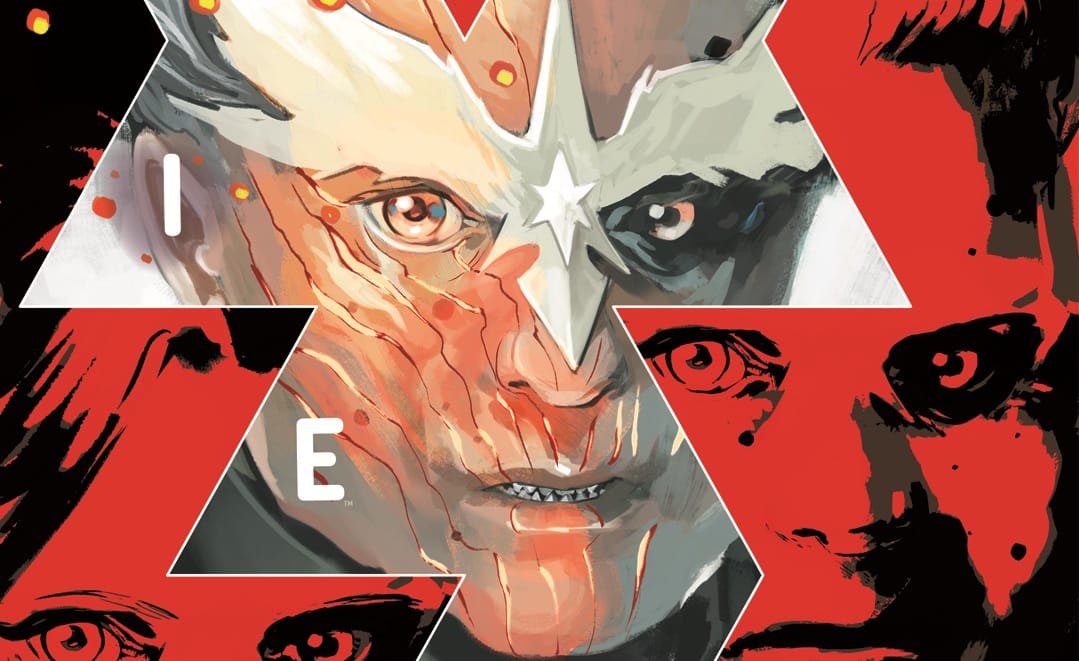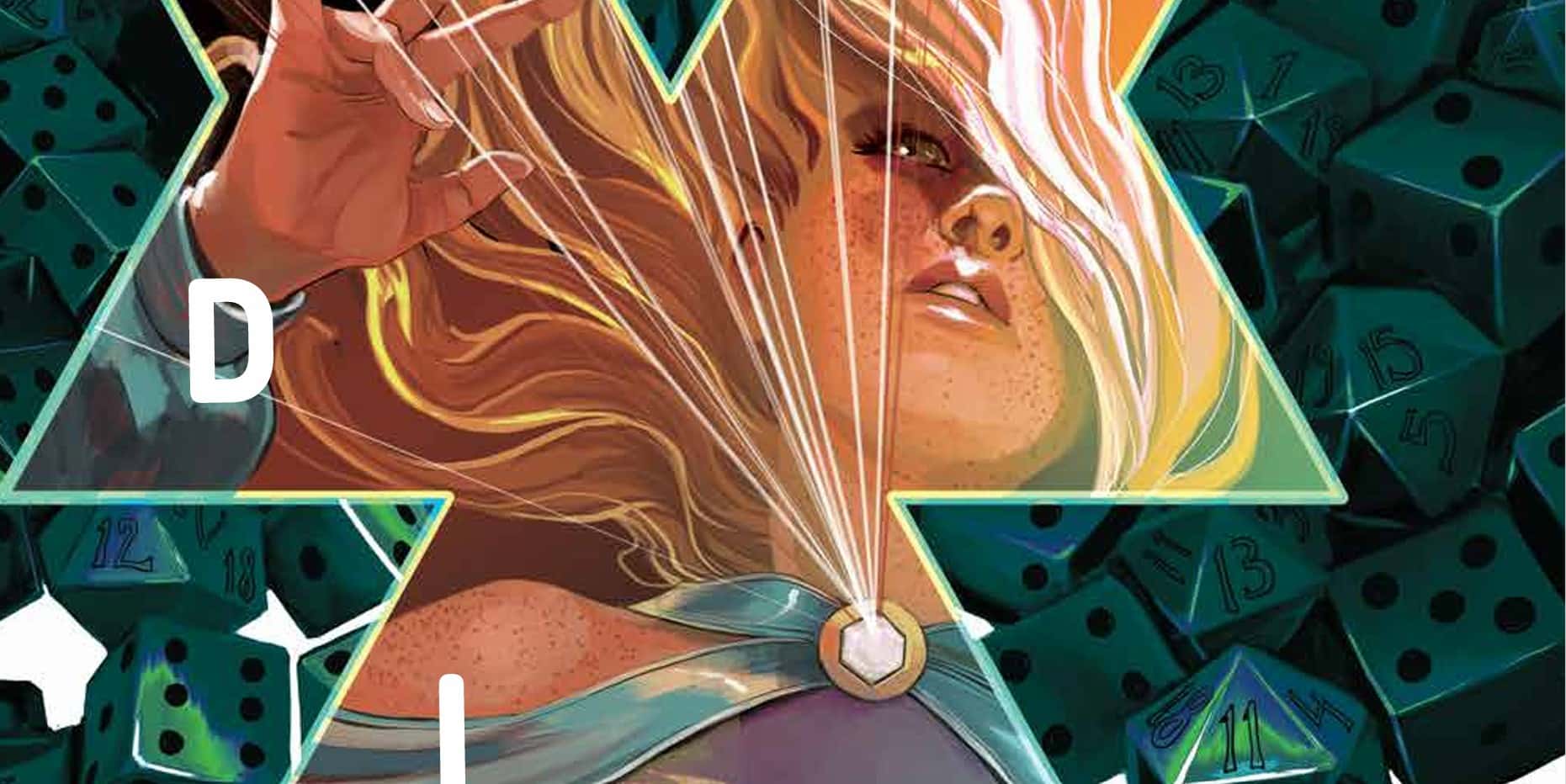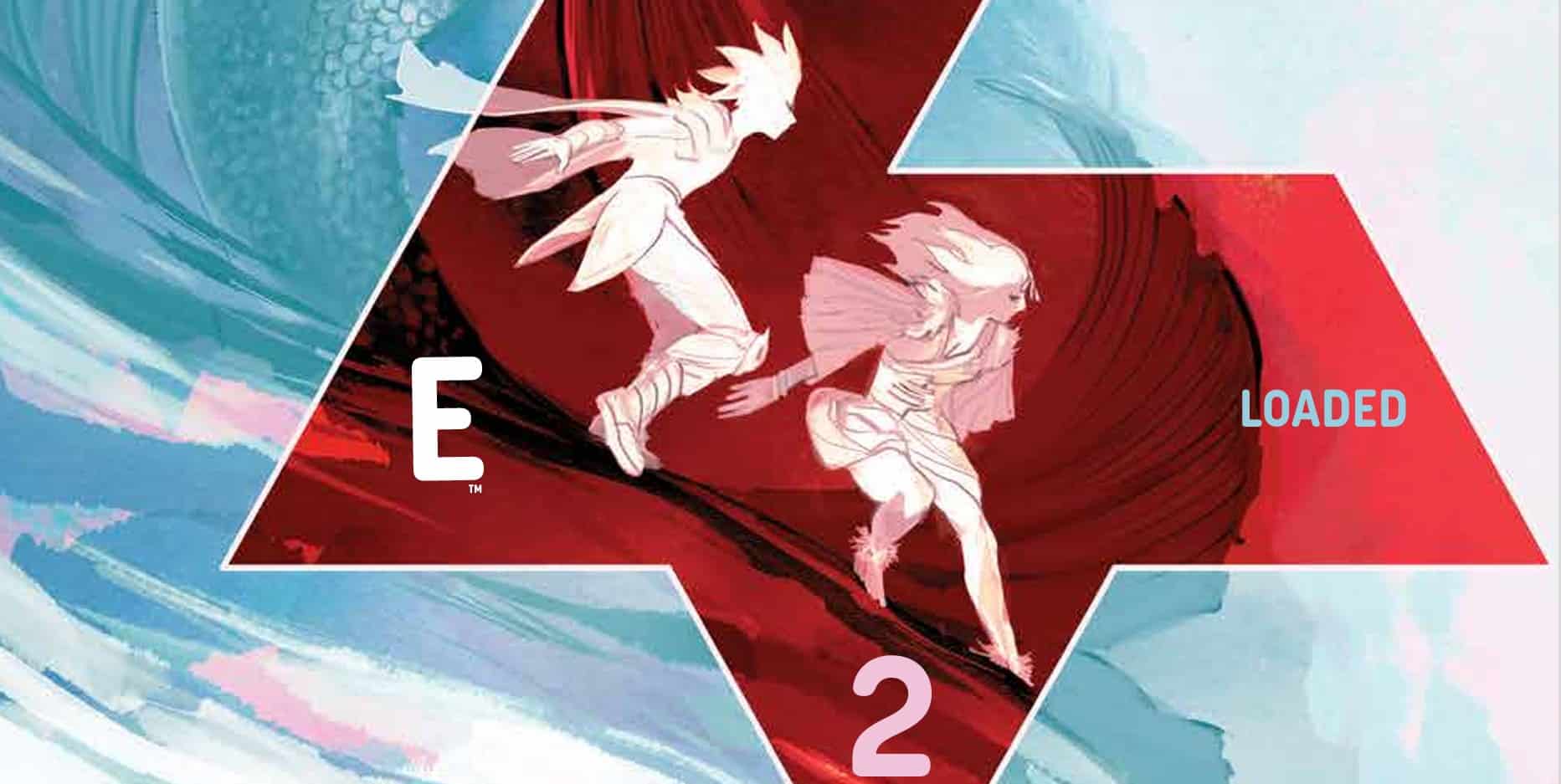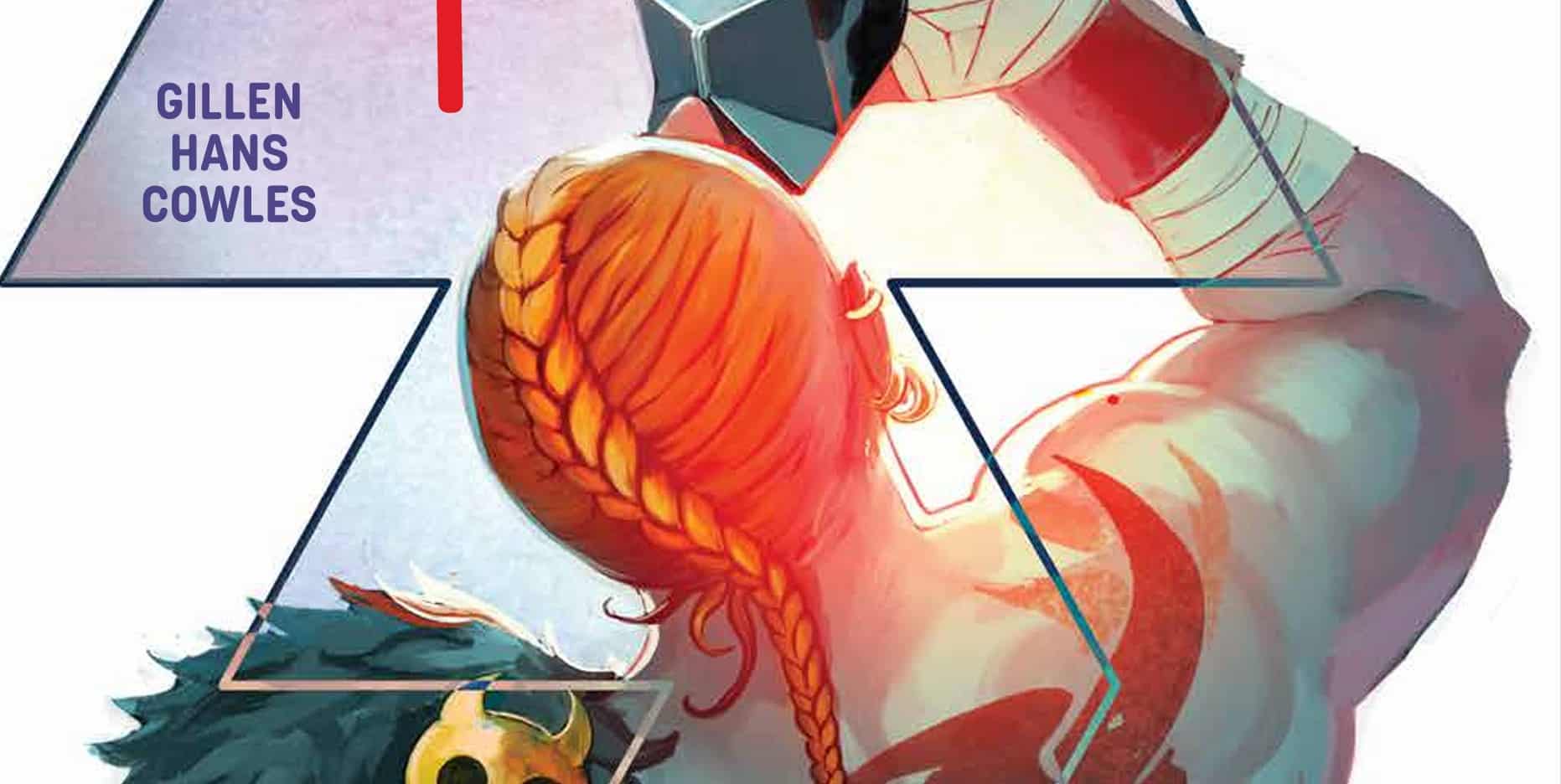
What happens when you give a child a world where they can pretend to be an adult, are treated as such, and the world itself bends to their desire for mayhem? You get disaster. Meet our Fool, Callum, in DIE: Loaded #4, written by Kieron Gillen, drawn by Stephanie Hans, lettered by Clayton Cowles and designed by Rian Hughes for Image Comics.
Armaan Babu: In this issue, we find our Fool, giving us the most comedic issue so far. It’s still DIE: Loaded, however, and horror is never too far away — and there is nothing more horrifying than a teenage boy with the freedom to roam unsupervised in a world without consequences.
Rasmus Skov Lykke: As a former teenage boy, this would have been among my biggest dreams. As an adult man, this is one of my biggest nightmares. Teenagers are awful, and the world young men live in today makes everything worse. Good thing our Fool is in another world entirely then, where nothing awful will come from his actions!
Mark Turetsky: Hilariously, as I read this issue, it didn’t even occur to me that Callum was funny. I guess the horror of him just hit me too squarely, but having reread, yes, it’s funny (but still horrific).
The Chosen Many

Rasmus: Right off the bat, we get answers to our confusion from last issue. It was an entire crowd of people chanting that they’re all, each and every one of them individually, the Chosen One.
All of them feel like the worst player at a D&D session. The gritty rogue with 16 pages of backstory that he refuses to explain. The one whose whole character is what weapons they use. The feisty one. The vampire, but with a twist. All players not buying properly, but still expecting to be the main character. Of a corroborate, team player storytelling game.
(I will hear no ill spoken of the Chosen rat in a human suit, though. That’s awesome.)
Armaan: Chosen Ones in games are fascinating. You go through Character Creation, you hand your GM your backstory, and you show up to the table assuming that everything in this world has been built for you — because to an extent, it has been. You are the protagonist. Everything the world is bends toward your backstory. What does it mean to play with that mindset? What does it mean for the story of your character, who would realistically have no right to believe the world revolves around them? The extent to which that character would be an asshole depends a lot on how much the line is blurred between a player and the character they play — whether or not they recognize their place in a larger story, whether they’re willing to even listen to other stories, or whether they just rush in, as Fools are wont to do.
I don’t necessarily think of them as the worst player, but they do represent one of the worst impulses everyone has in a game of D&D: the belief that your character, and your story, is more important than anything else. The belief that the world not only revolves around you, but that everything in it has been placed there to give you exactly what you want. For the Fool, that can be literal. For straight white men, that can be doubly so. It speaks to everything that this particular series is thematically aimed against: the idea that other people’s stories matter less than your own, that everyone else around you is little more than an NPC.
The examples of Chosen Ones we see are hilarious, though. There’s a real failure of imagination here — the Chosen Ones are funny, but there are almost no character ideas here that are compelling (sorry, Chosen Rogue-atouille, but it’s true).
Rasmus: A pox on you, Armaan!
I agree with you that RPGs by their nature do tend to make the players believe their characters are chosen. Because quite literally they are. Chosen by the player, fleshed out and then the story is built around them by the DM.
But all of the examples we get here are just the most bare-bones concepts of characters. There’s nothing to build around, nothing to hang a story on. They’re the Chosen One because they’re chosen by their players, with no justification for it. As I said, the worst kind of players. Those who put no effort in but expect the world to serve it up to them.
Which, to be fair, some DMs do. But more on that later.
Armaan: Interestingly, Sophie seems to believe that herself, to an extent. She believes the people that populate DIE aren’t real, and that any harm that may befall them doesn’t really matter. We’ve seen Isabelle start wars on the belief that the people of DIE are people — and that there’s been no mention of this from her yet should be the biggest clue that our Master is not what she seems (though more on that later).
It’s the perfect setup to introduce our Fool, who, like the many around him, also believes he’s the Chosen One. In the game of DIE, the more that the Fool is acting happy-go-lucky and doesn’t take anything around them seriously (heh, the more they play the Fool), the more powerful they are. Which makes our new Fool, Callum, potentially more powerful a hero than even Chuck could have hoped to be.
That is very, very scary.
As silly, as fun as this comic was, I’ll admit that it was also disturbing. It’s hard to guess Callum’s age, but even in his hulking warrior form, he’s drawn with a bit of a babyface, and he talks like someone with all the maturity of a 13-year-old.
Rasmus: Given the sexual antics he gets up to, I suspect he is at least 18. If nothing else, for legal reasons. Though his babyface does make that hard to believe.
Armaan: This child, essentially, is in the world of DIE, a world that is bending toward his every whim, treating him like an adult when he very much isn’t. He is unsupervised and gets to act like his worst self, and the world does nothing but reward him for it. He should not be here. I am aghast at everything he’s saying.
It’s what teenagers around the world have been doing for years, on message boards, social media and MMORPGs. We still haven’t found a way to regulate that (although lord knows we’ve tried).
I feel so old.
Mark: I remember way back in the original series, Stephanie Hans designed this cool-looking tiger man who only showed up in a panel or two, and Kieron Gillen promised they’d get back to him at some point if they ever finished the story. The presence of the Chosen One tiger person here seems to be teasing us.
The scary thing about Callum, for me, is something that extends from his listing of his only male role model: Joe Rogan. He’s very much a boy who’s grown up with unrestricted access to the so-called “manosphere,” telling him in no uncertain terms that people who aren’t him are less than, that they’re actual, real-life NPCs whose lives, bodies and experiences are literally meaningless compared to his own. And now here he is in a place where that might actually be true at first glance.
The Tyrant and The Judge

Rasmus: A big part of DIE: Loaded is getting to see more of the gods than we did in the first series. A lot of fans have been clamoring for this, eager to see which gods fit which emotional pairing, according to the emotion wheel that powers the world of DIE (being fundamental to the Dictator, Emotion Knight and the combinations of the gods for the Godbinder).
I never really cared about all of that. I just want a good, entertaining story. So meeting the Bear and the Barnacle Witch has been fun, sure, but nothing too exciting. I found the issues focusing on Wells, Tolkien, the Brontes and Lovecraft much more interesting.
That was all before we got the GM God of Railroading and the GM God of Sandbox. This is awesome.
I GM myself and I know the trappings of both all too well. I love the way Gillen depicts them here, with neither being the right option, both being clearly wrong, clearly egotistical and clearly uninterested in whether or not the players are enjoying themselves, they’re all about their own philosophical beliefs being right, and less about what actually works.
Armaan, Mark, I know you both play RPGs as well. What did you make of our GM gods?
Armaan: This Tyrant is another one of those reflections-of-our-worst-impulses. GMs work so hard. They craft a story, they craft a scene, they craft dozens of characters and track even more numbers all so they can lead you into a scene that makes you feel as devastated as possible. The Tyrant is a good name for this god, because all GMs like this truly want is to be the Dictator.
A Tyrant-like GM is someone who the players are fighting against at every turn (pun entirely intended), derailing the story every chance they get. Sooner or later though, when your back is against the wall, the Tyrant is going to offer you a bargain that you’ll take because sometimes it’s just easier to go along — even if you know that all this does is give the Tyrant the power to make you feel the pain of what you thought was your decision.
Rasmus: The Tyrant-like GM is exactly the kind of GM that the barebones Chosen Ones want. The kind of blank canvas that they can use to drag through their carefully planned story. Where it doesn’t matter if it’s a halfling orphan ranger, a lion paladin from nobility, a sci-fi character transported to their fantasy world or a rat piloting a human suit. They’re going to follow the GM’s story, no matter what they want.
Or he’ll make them regret it.
Armaan: Sophie doesn’t know this, however. She’s never had to deal with railroading GMs. What she does is actually a very clever bit of Godbinder work, playing the Gods against each other to get a little extra out of her bargains. She’s starting to get a better sense of how this game is played, learning how petty and jealous the Gods can be, and how to make that work for her.
I am looking forward to seeing her face the consequences of her decisions, and more of the Judge. The Judge is more of a freeform GM, but that doesn’t mean they’re on your side. A Judge-like GM knows there’s no torture they could inflict that’s worse than what you can do to yourself, especially in a world like DIE.
Callum is playing the Fool, and it’s infectious — nearly everyone around him is playing along. A Trojan Horse gambit should not work, but that’s the magic of the Fool — things just work out when you’re having fun. This is DIE, though — sooner or later, consequences are going to catch up to everyone.
Mark: It’s such a vivid experience for me: You and your party craft a cunning plan, you put all the pieces together, and then you’re forced to deal with the fallout of things going spectacularly wrong. It’s probably more satisfying than if the plan had gone right in the first place (it’s why Heist exists as a genre!). It’s basically the style of play the Fool is designed to embody.
What I’m curious about is what it is that makes The Judge such a negative in the other direction. Yes, I understand, fundamentally, that no guidance is just as bad as too much, but I’d much rather play with a Judge DM than a Tyrant. Though perhaps the biggest problem with the Judge DM lies right there in the name: Judge. If The Tyrant acts, as Gillen declares in the backmatter, out of a fundamental love for his players, to paraphrase Elie Wiesel, The Judge acts out of a ruthless indifference to her players. It’s not what you want out of a GM, and it’s probably not what you want out of a judge, either.
Armaan: I don’t know if The Judge is indifferent. I imagine her as the other end of love for the players. Where The Tyrant loves the players as the objects of his torture, as pawns in the story he wants to create, The Judge kind of GM-watches. Sets up the board. Forces you to choose between a rock and a hard place, and judges you for all that you have done. I think The Judge, for all her airs of impartiality, is deeply unfair: a GM who offers you nothing but terrible choices, and tells you that everything that happens is your fault, and she will offer no forgiveness for the choices you’ve made.
Rasmus: I think both of the gods fail because ultimately they’re more concerned with their own version of the game. The Tyrant has prepped everything, and the players have to do what he wants them to. He sees this as coming from a place of love, but it is heavily misguided, because he fails to listen to the players.
The Judge is the same. She doesn’t care what the players want. She is about being impartial, about judging fairly, about making sure the players get what they deserve — all according to her understanding of the rules.
Neither of them cares about the players — what they want, what they think is fun and what excites them. A good GM knows all your prep and all the rules are only in service of the fun you’re all having at the table. If any of it gets in the way, throw it out. If the party wants to spend an entire session talking to Gobby the Goblin, let them. If they’re enjoying themselves, you’re doing your job as GM. (Though preferably you should be enjoying yourself, too. The GM is also a player. No one is an NPC. Not even the person controlling the NPCs.)
The truth about Isabelle

Rasmus: So it’s revealed that Isabelle (probably) isn’t the Master of this group. We already called that back in our review of issue #2, but it is very interesting to see Sophie’s reaction to it. She simply uses one of her favors from The Tyrant to get rid of Isabelle, sending her god knows where (in Gillen’s spirit, pun fully intended). Removing her from the board, but still having her in play, is a very interesting situation.
Callum’s half-sister apparently being the Master is an even more interesting situation.
Armaan: It is fascinating. We suspected that Isabelle might not actually be the Master — and from the way Callum’s sister said “I’m sorry” when handing Callum his die, it seems like she’s fully aware of what she’s doing, dragging people into this world.
The question is why. If she’s looking to punish her father, or to search for him and bring him back, it would make more sense to bring Chuck’s friends back into DIE — Ash, the real Isabelle and the rest. Why has she drawn in people who have only a tangential connection to Chuck, and even less of a connection to her?
“What am I for?” is a question DIE asks again and again and again. What DIE is for our new Master is the most intriguing question of all right now.
Another interesting thing here is getting a whole page of flashback dedicated to add depth to a single facial expression as seen through Sophie’s eyes. She tells the readers a story of a liar, caught in the act, doubling down on his denial with outrage. A whole page dedicated to that one reaction, instead of getting to learn a little more about Callum’s half-sister herself. That’s a choice, and for someone who emphasizes the importance of space as much as Gillen does, that’s an important choice.
The takeaway seems to be this: Our new Master will take what she wants, and she may never admit to wrongdoing no matter how much she’s forced to confront it.
Another dangerous youth, given powers beyond fathom by DIE.
Another interesting thing though is Sophie’s description of this boy from her past. “One student was less student than the rest.”
It’s a cold description. There are kinder ways to describe someone who doesn’t quite fit in, or who takes their role less seriously than others around them. It’s the kind of phrasing a Chosen One might use, even if they’d never call themselves that.
If Sophie is meant, in this comic, to learn that there’s no such thing as an NPC, and that people are more than the roles they’re assigned, then it’s not going to be a lesson that comes easy. I wonder who is going to suffer the most for it.
And I think we all look forward to reading it when it happens — because there’s a little Tyrant in all of us.
Mark: With the revelation that Isabelle probably isn’t Isabelle, and that Callum’s half-sister is likely the Master, we get a bigger glimpse of the full picture of the party for this volume, and interestingly, we have three younger people and two older people, with the Neo being the wild card. Now, lumping them in like this is probably unfair: Margaret is old enough to be Sophie’s mom, Sophie is middle-aged, Molly is university-aged and Callum is significantly younger than her, but broadly speaking, we might clump these people into Children and Parents. It’s a dynamic that Gillen has become more and more interested in with his recent work, which he freely talks about in looking back on, say, The Wicked + the Divine and in his newsletter. Where the first volume of DIE was concerned about contrasting the people the party were when they first visited the world of DIE verses visiting as adults, here we’re starting to see this group, brought together by the tragedy of having people go missing in their lives for long periods, brought together at very different points in their lives. Are we seeing Shakespeare’s Seven Ages of Man reflected in this (leaving out the youngest, because nobody wants to see an infant brought to DIE)?
Armaan: No infants in DIE, though Stuart is never far from Sophie’s mind. The generational gaps between our players are great, though. It’s not a dynamic we often get to see, and I can’t wait for the whole group to get together.
Rasmus: My money, for the Neo, is on Matt’s dad.
We have Ash’s wife, Angela’s child, Sol’s mom, Chuck’s son and Isabelle showing up as a God/narrator (I think it is the real Isabelle, somehow. It certainly doesn’t appear to be the half-sister, nor an entirely new character, though I could be wrong). Which means the final member of the original party, that still needs to be represented, is Matt. Which also fits Mark’s read, of it being split between parents and children. We saw him in the first issue, so he’s already introduced, which would make it easier to reintroduce him in DIE, too.
Either way, the party grows next issue. This horrifying teenage power fantasy was the fun issue, according to Gillen. So happy days ahead!
Roll for Miscellaneous Thoughts
- The theme-park-ride Chosen One is a delightful nod to the inspiration for this series — the children who got lost in the world of D&D on a theme park ride of their own.
- I (Armaan) get a real kick out of the mention of The Little Prince. The only campaign I’ve run was a book-club scenario; one of the players’ favorite book was The Little Prince. They got to meet a fox of their own.
- “None of us are real until love makes us real” is an awful way to think of real-world people. But fictional characters? A game’s NPCs? Loving them is the only path to being real they will ever get.
- Speaking of love for fictional characters, my heart goes out to the poor, anxious Skywatcher described in the backmatter: a god just doing everything in his power to make sure people are OK, forever worried the sky’s going to fall on their heads.
- We get what may be an important, throwaway reminder here of how the Dictator’s powers work — she can only affect one person at a time.
Buy DIE: Loaded #4 here. (Disclaimer: As an Amazon Associate, ComicsXF may earn from qualifying purchases.)

Armaan is obsessed with the way stories are told. From video games to theater, TTRPGs to comics, he has written for, and about, them all. He will not stop, actually; believe us, we've tried.

Rasmus Skov Lykke
Rasmus Skov Lykke will write for food (or, in a pinch, money). When not writing, he spends his time with his wife, their daughter and their cats, usually thinking about writing. Follow him @rasmusskovlykke.bsky.social.

Mark Turetsky is an audiobook narrator and voice actor who sometimes writes about comic books. Originally from Montreal, Canada, he now lives in Northern Louisiana. Follow him @markturetsky.com on Bluesky.