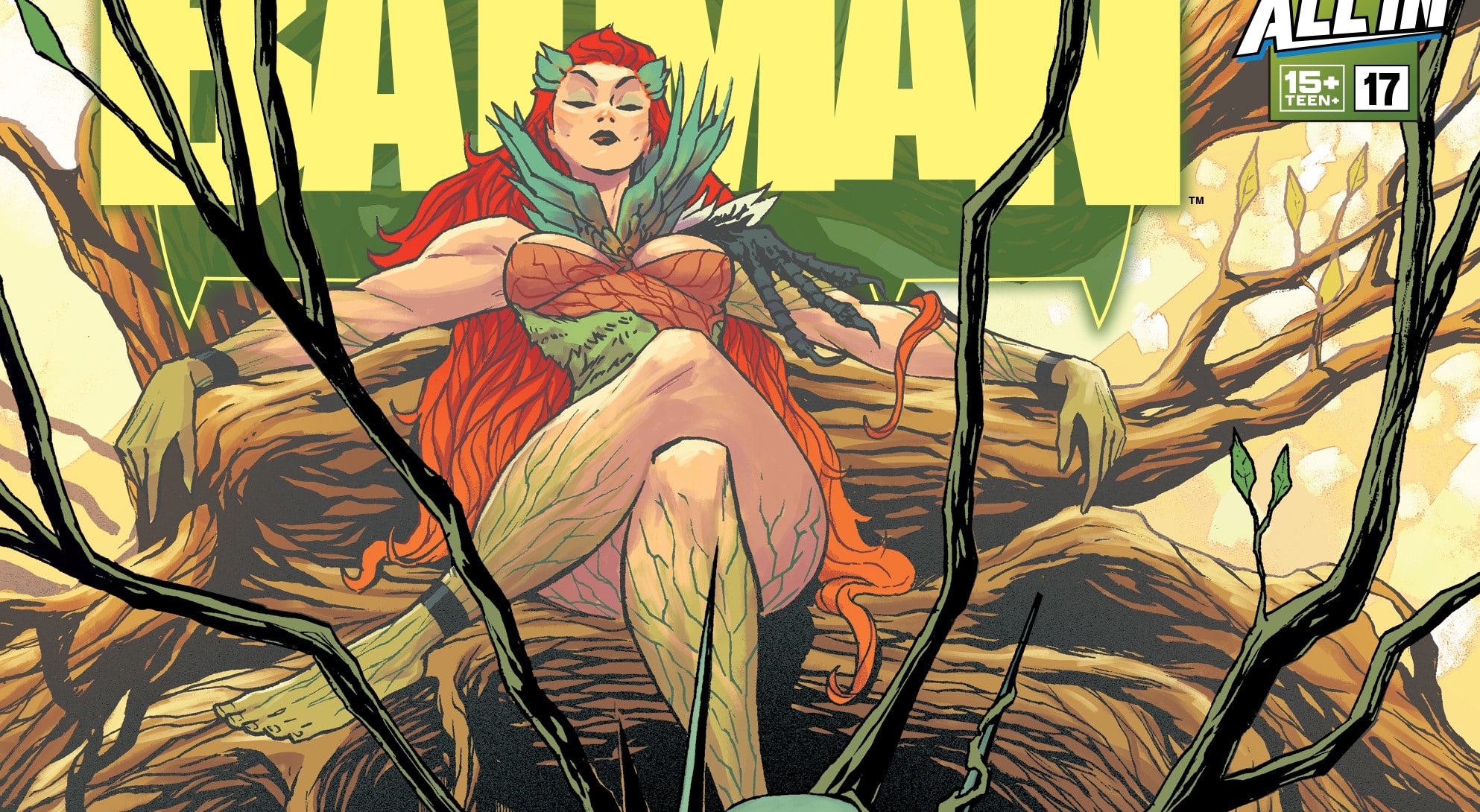
The Heart Building stands at the center of Gotham City. And it is now covered in vines and plant growth. Batman must climb his way to the top to face his newest foe: a more monstrous incarnation of Poison Ivy. Absolute Batman #17 is written by Scott Snyder, drawn by Eric Canete, colored by Frank Martin and lettered by Clayton Cowles.
Will Nevin: The Dark Knight Returns is 40 years old, and DC is planning a year of celebrations and re-releases. Forty years of modern comics. How do you feel about that?
Matt Lazorwitz: DKR is a seminal text. I can understand why it’s happening. While I believe it is somewhat overrated, that doesn’t mean it’s not an important comic, and one that DC continues to sell year over year in dozens of formats as it is.
Will: Consulting the Big Board of almost 700 stories, The Dark Knight Returns jumps in at a more than respectable No. 8 — behind, of course, the far better Miller text of Year One at No. 1 and Long Halloween at No. 4 (to grab a few). DKR is a great book. But there are better ones.
Matt: I look at this in the same way I look at a lot of classics in the literary world. As someone who was a lit major, I had to read a lot of classics that I didn’t particularly like, but that doesn’t mean I didn’t understand why they were considered important. So make your money, DC. If it keeps the company afloat (or at least in the good books of their corporate overlords) and allows for new and interesting modern comics to come out, then good on them.
Will: Reasonable people can disagree as to its merits, but there’s no arguing about its impact on the industry. For four decades, comics — almost by necessity — have needed to be violent and edgy and damned near mean to be taken seriously. We’ve seen entire lines and publishers rise to push nothing but edgelord comics. Some of this owes to Killing Joke, of course, but I think we’re finally on the other side of the crested wave.
Comics can have joy and light again and still be a respectable art form.
Crawling Up


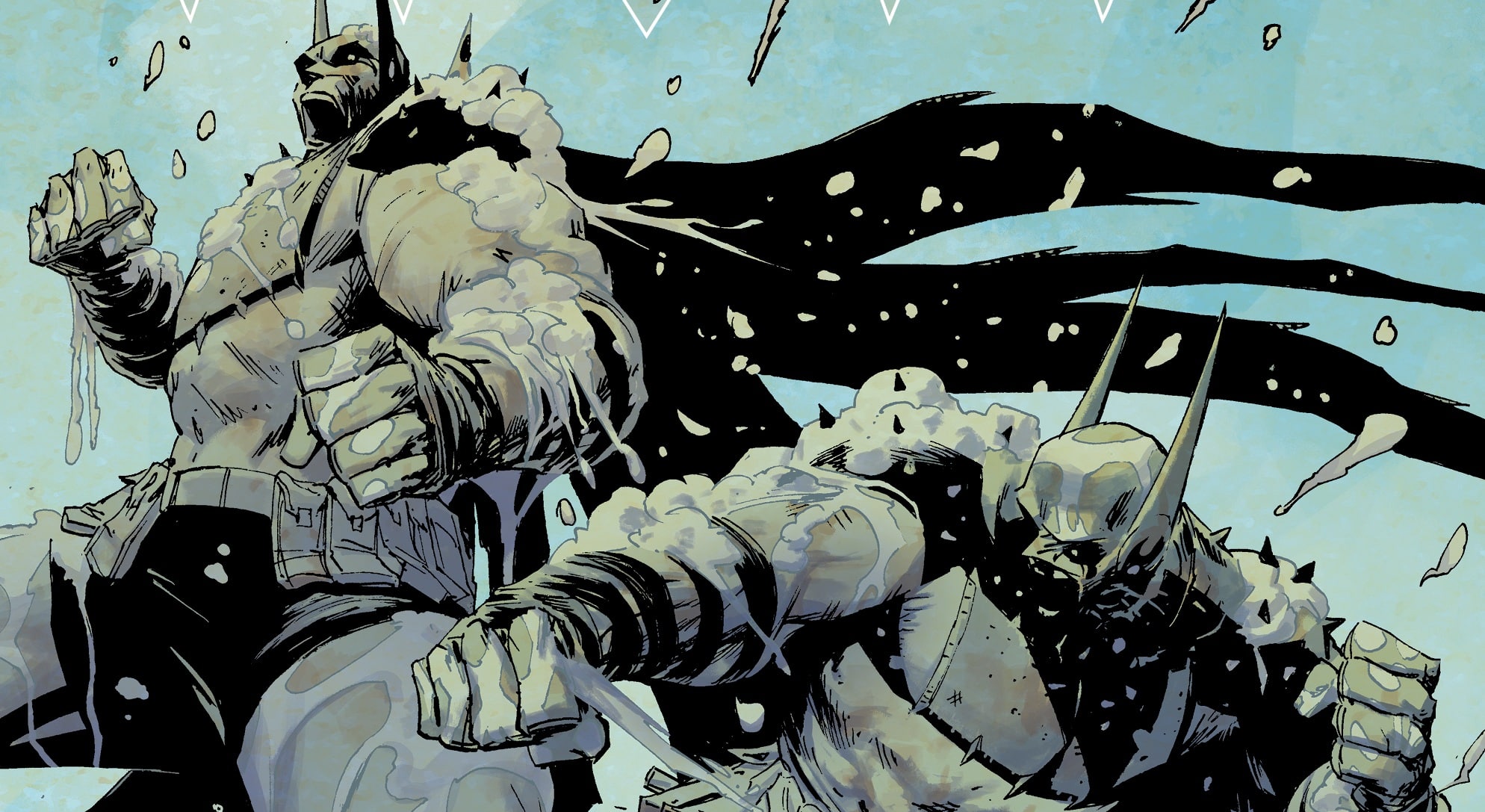
Matt: I think we have said this about each classic character as they are reintroduced in this new world, but this book is Batman by way of body horror. I can’t think of a single classic character who is not some dark and twisted literalization of their psychosis or amplification of their main-universe body modification. And here we see Poison Ivy, who is a whole lot more than a green-skinned plant lady.
Will: Hooboy, this is not your dad’s Poison Ivy. Conceptually, this seems closer to Metamorpho but with any organic matter. Does that seem like a fair comparison? The character design seems to take a little influence from him as well.
Matt: I hadn’t thought of that, but it is a fairly apt comparison: She is to organic life what Metamorpho is to the elements. The splash page that gives us our full view of her is one of those pages I want to look at under a magnifying glass to try to pick out what all the parts of her body are composed of. And then again on the next page when she goes from her still somewhat human form to her truly monstrous one.
I have to call out Eric Canete here. He’s an artist whose name I know, who has been working in comics since the ’90s, but isn’t anyone who ever made an impression on me. This is next-level work. I am very curious to see if other artists will be able to capture this design when Ivy invariably pops up later, because it is some truly astounding monster work.
Will: For a book that’s made its bones on body horror, this is a new level. My goodness. Just absolutely wretched in the best way. I’m assuming the fire/lab accident we see in this issue gave her some sort of power set that was then perfected (or corrupted?) in Ark-M? That would at least be consistent with what we’ve seen already.
Matt: That would make sense. And I would not put it past Jack Grimm to be the one behind the lab fire, either to catalyze her experiment, get her in a position to have to work for him or to remove someone he viewed as problematic only to then take her in when the fire didn’t kill her. Hell, with the type of games Grimm plays, I expect it.
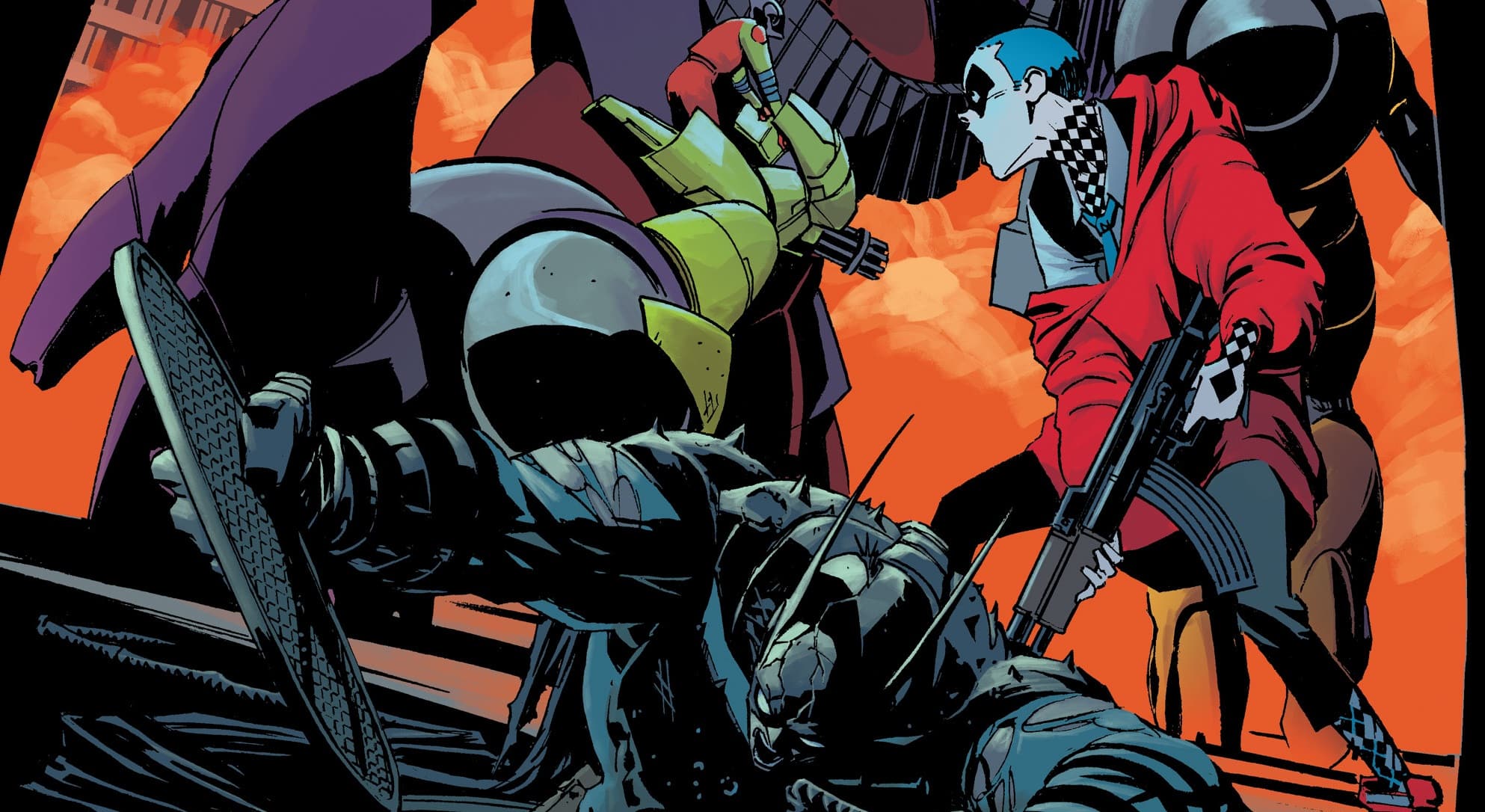
Will: This Batman is really going to have two rogue’s galleries, right? His core group of frenemies and a secondary batch like Bane, Poison Ivy and anyone else who comes along who can’t blame him (rightly or wrongly) for whatever horrible transformation that’s befallen them.
Matt: Until they collide. I would not be surprised if Grimm offers Oz, Harvey and Eddie something to get them to join up with the Ark-M project. “Bane went rogue. I’m sorry for what he did. We can help you. Just sign on the dotted line. In blood if possible.” I think Oz would take the deal in a heartbeat if Grimm held out the possibility of repairing his mangled body. And I can only imagine what horror show Absolute Two-Face is going to look like when we finally see him without the bandages.
Will: The hint in this issue about some sort of literal separation is … troubling. There’s a lot to learn about this Poison Ivy — a whole arc to come, in fact — but where do you think this version of the character is going to land when it comes to sexualization? I’m not going to say the character has to be the sexpot she once was — it can be downright creepy in the modern era — but I wonder if we’re heading toward a clean break from that aspect of the prime universe character.
Matt: It’s not like there isn’t a whole genre that ties sex and body horror, but I think we are dealing with a character more aligned with modern Ivy and her attempts to take over/regrow the world. The setup at the beginning — that the Heart Building is at a point where anything there can spread through all of Gotham, and that Ivy has created spores that can change people into creatures like she did to the cops here — seems to indicate Ivy isn’t looking to seduce anyone, but instead change all of Gotham into her plant/human hybrid creatures. A Poison Ivy who is flirting her way out of trouble and kissing men to make them her servants isn’t going to be doing that.
Will: I don’t know what it’s going to take to challenge her many and varied powers, but Bruce better have a lot of it.
Matt: There’s a lot more to talk about beyond the Ivy stuff, though. We are seeing Bruce’s life start to really fall apart here, and that’s saying a lot after all that has happened to him thus far. His friends have abandoned him. Batman has become an icon to the city, which he never expected. And surprising no one but him, apparently, he catches his mom smooching Jim Gordon. Do you think Martha has not dated anyone in the 14 years since Thomas died? Or is it the fact that it’s Jim, whom he took as a surrogate father but not in a way that made him part of a family unit, that made Bruce run off?
Will: Matt, you just threw 18 different ideas at me, good lord. I’ll take up the icon one because that interests me most. Prime universe Bruce intended to be a symbol of fear (at least causing fear in criminals, anyway) that Gotham could rally around. Absolute Bruce seems like he wanted to protect his identity and demolish crime personally, almost like he never considered the symbolic aspect of his newly adopted persona. I took him lashing out at the vendor as more of an attack against the implied profanity of it: This is a war that has caused his friends lasting physical and emotional trauma, and Bruce has gotten much of the same. (Although I guess we’re not following up on any lasting effects from his time in Ark-M.) If some guy was making a few bucks off of my misery, I’d be pissed too.
Gordon has been a criminally underused character, a clear casualty of Synder’s impulse to do so many things in this book. We’ve long speculated how Gordon-as-surrogate-father might translate into being *actual* father figure, but he hasn’t been around for that to even develop. And we also haven’t seen him deal with his election loss. Maybe those things will get picked up to some degree in this arc. But to directly answer your question there, Jim and Martha had to have had some kind of relationship previously, right? And I think any version of Gordon is probably prone to … wandering.
Matt: Oh, I think this has been going on for some time. But I think they have been hiding it from Bruce. I just wonder if Martha dated here and there after an appropriate mourning period, then she and Jim started their relationship, but they’ve been hiding it because they were worried how Bruce would take it. Or if this would be her first real relationship or even attempt at dating in all that time. The latter seems unlikely due to the amount of time, but not impossible for someone dedicated to raising a son and then working as hard as she has. Not to mention keeping her secrets. But more on that after we finish talking about what Bruce is going through.
Will: Oh yeah, because we had to introduce one more new idea before we paid off any of the old ones. *glares at Scott Snyder* We see Bruce falling farther and farther away from the rest of the gang as they become angrier at him and what they’ve become. This is not going to have a happy ending.
Matt: And there’s that one page where we also see Absolute Harley and Absolute Dick Grayson. Say whatever else you want, but decompressed this is not.
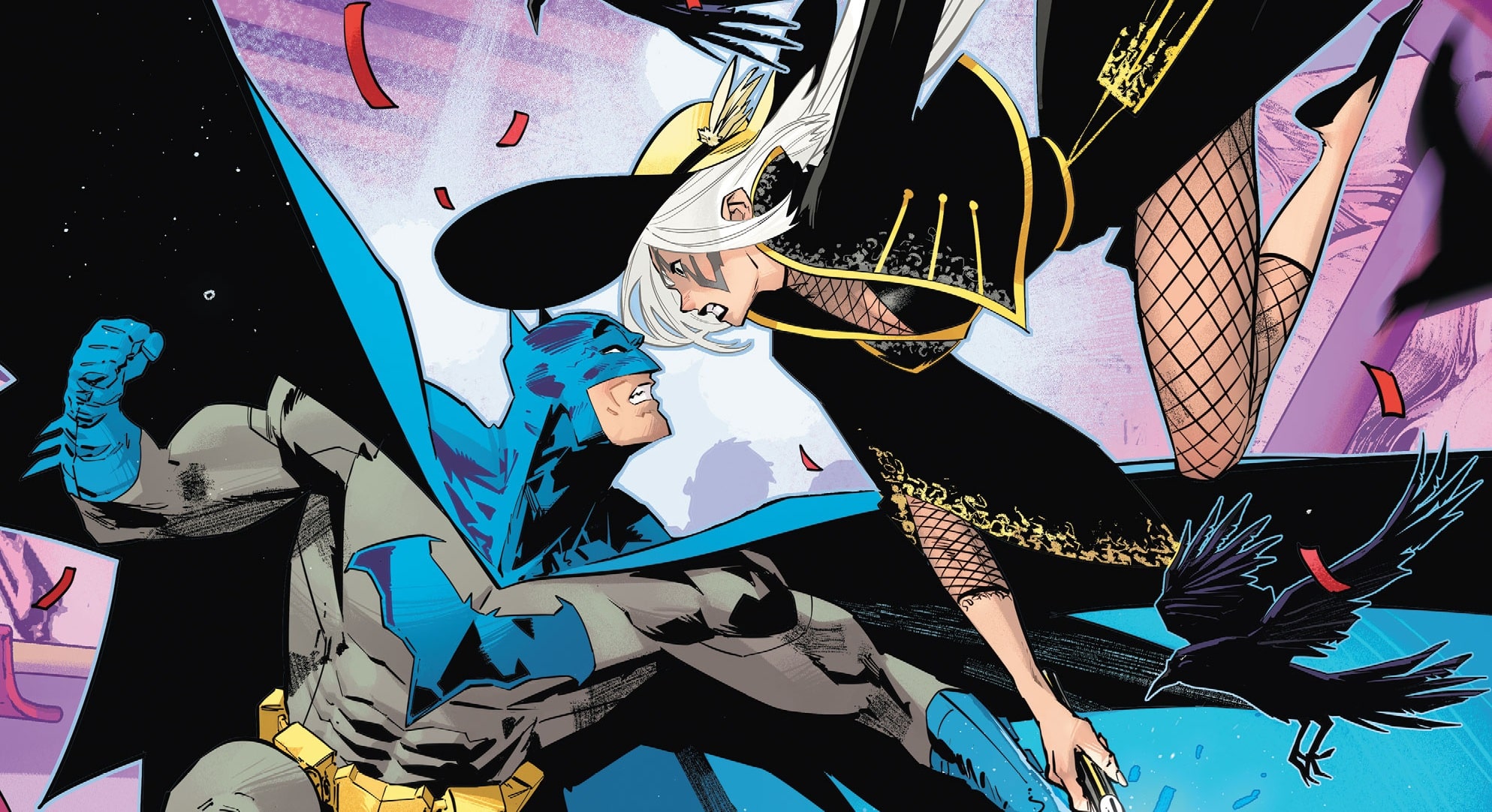
But onto that last page: Martha has a connection to the Absolute Court of Owls. And those Owls look to be closer in design to Talons than to the Owls as we know them. Are we thinking Snyder is combining the concept here?
Will: Why be the power behind the power when you can just be the power? It would be an interesting tweak on the concept, but how does Martha fit into this? Was she some sort of minder for Jim while he was mayor? That would certainly result in a change in her relationship with the Court. Did she get recruited, or was she forced? Lots of questions, not a lot of answers.
Matt: I’m leaning toward her having abandoned the Court years ago. Her maiden name is still Kane in this reality, and Kane County is still a thing. Maybe she comes from old money, and abandoned it for Thomas and a simple life away from the battle between the Court of Owls and Jack Grimm? And now that she sees what is happening, she realizes that she needs to get involved again. That’s a lot of supposition with little evidence, but if the Court is still a secret society in Gotham, wouldn’t they want to stand against the other power player looking to take over the city and make it into his own personal hunting ground/lab/etc.?
Will: This is, for the most part, Absolute Batman: Year One-ish, so we still have a status quo in Gotham that’s not built on a litany of costumed monsters carving up the city for fun and profit. Any version of the Court is going to be threatened in that situation. (Which brings to mind a free idea for any writer out there: a Court of Owls story set in the actual Year One, not whatever weird thing the New 52 attempted to do.)
Matt: I don’t expect answers on that anytime soon. We have one more part of this Ivy story, and then we get Absolute Scarecrow. I can only imagine what sort of horror show that character is going to look like.
Will: One more pants-shitting nightmare incoming.
Bat-miscellany
- Patreon backer and friend of the show John Wickham returns to challenge our commitment to doing the podcast by requesting three more Tom King comics, and not the fun ones.
Buy Absolute Batman #17 here. (Disclaimer: As an Amazon Associate, ComicsXF may earn from qualifying purchases.)

Matt Lazorwitz read his first comic at the age of 5. It was Who's Who in the DC Universe #2, featuring characters whose names begin with B, which explains so much about his Batman obsession. He writes about comics he loves, and co-hosts the podcasts BatChat with Matt & Will and The ComicsXF Interview Podcast.

Will Nevin loves bourbon and AP style and gets paid to teach one of those things. He is on Twitter far too often.