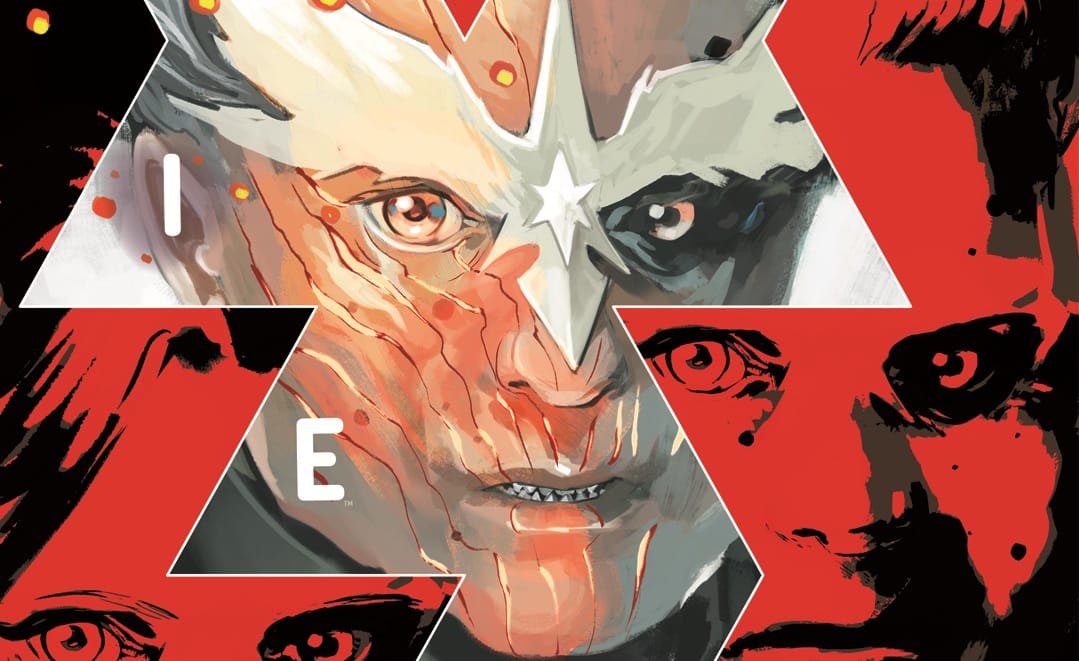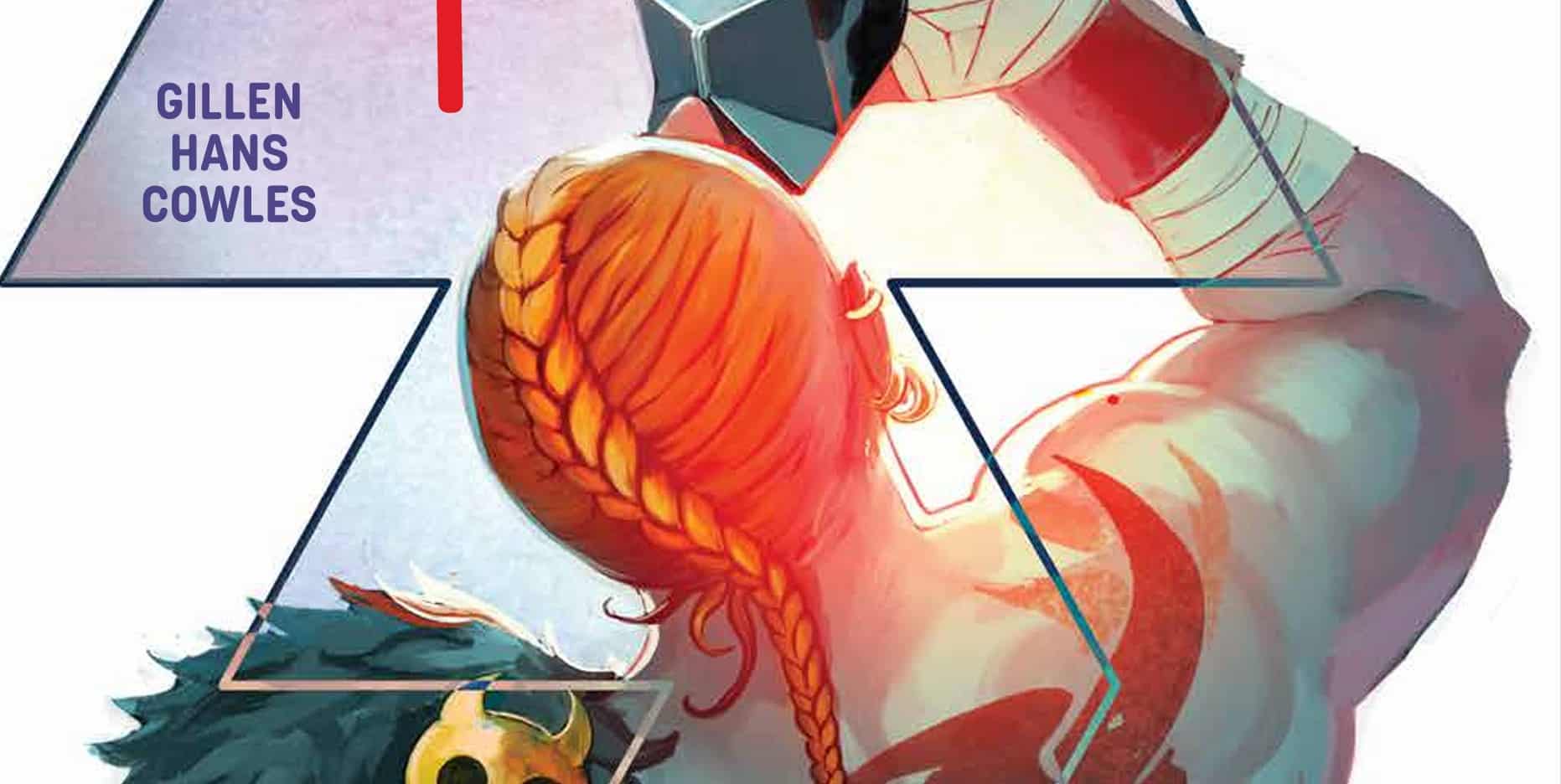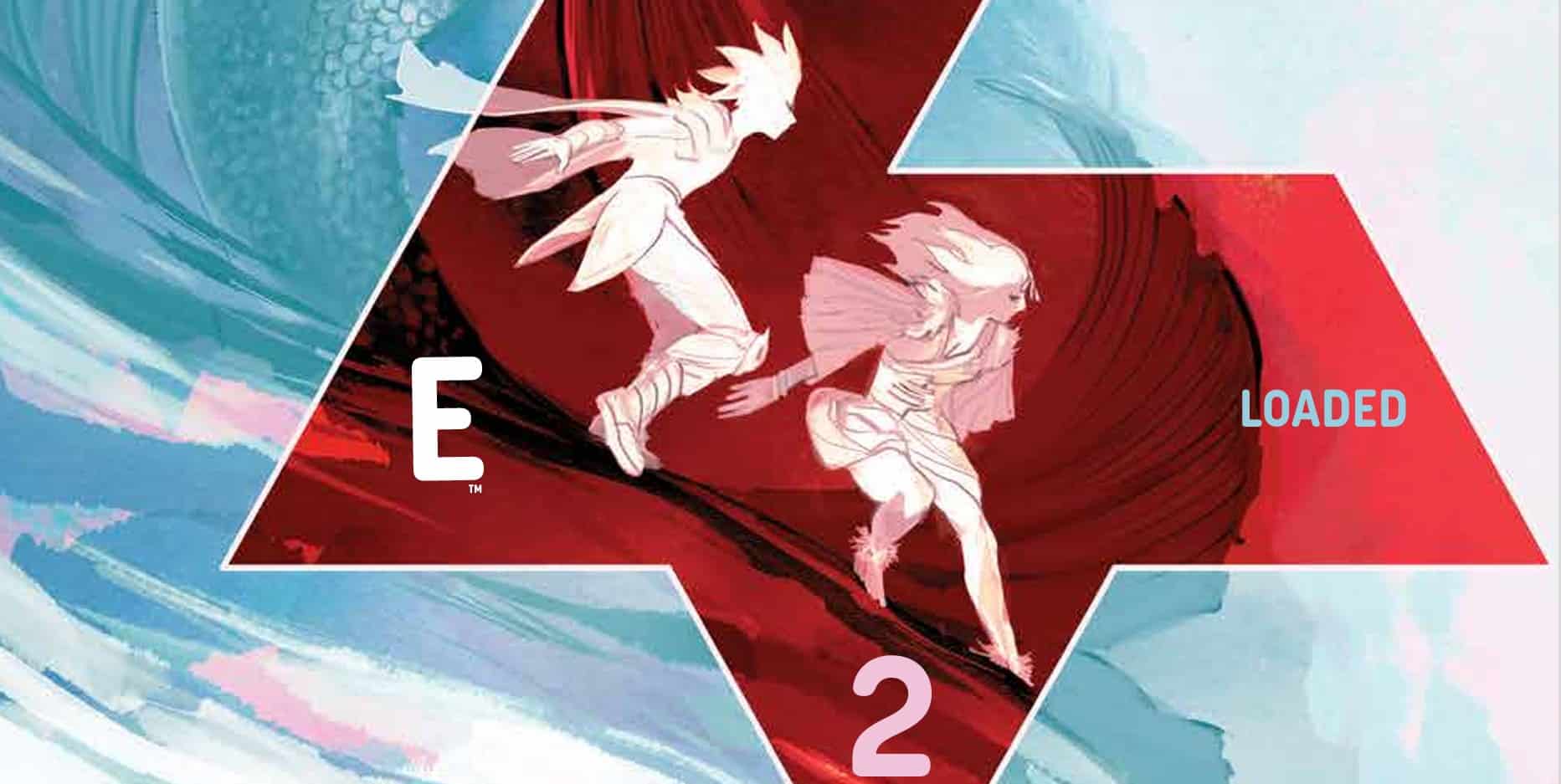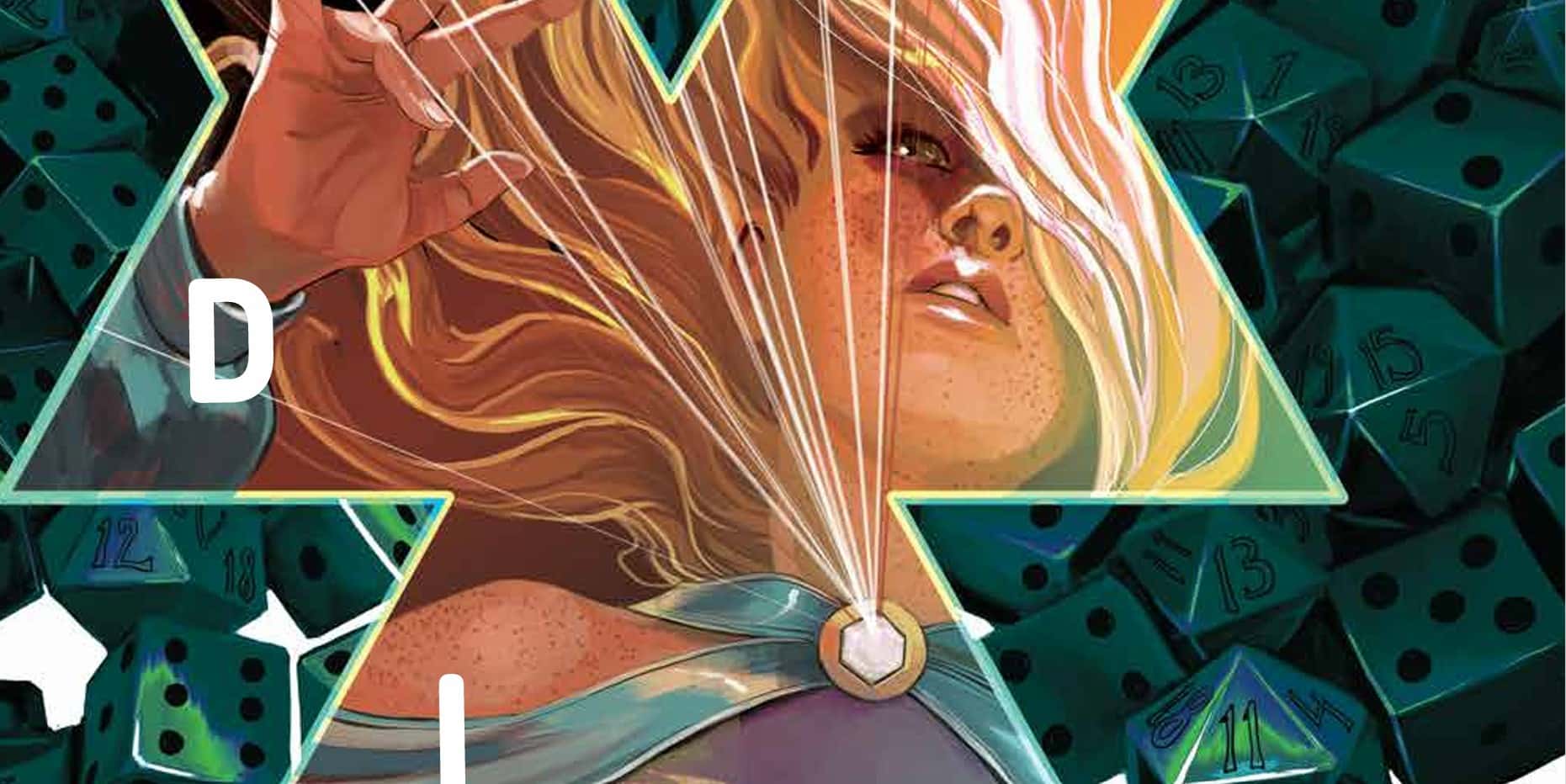
The Master is the one character that brings the rest together, and dooms them to play until all are ready to go home. What motivates such a mind? What power does the game truly bring them? Why, knowing what they know, would they choose to do any of this? Meet Violet, and find the answer to some, if not all, of these questions in DIE: Loaded #5, written by Kieron Gillen, drawn by Stephanie Hans, lettered by Clayton Cowles and designed by Rian Hughes for Image Comics.
Armaan Babu: It’s not usually this early in a tale that we hear the Master Plan, as it were. When the Master is just another player character, however, that’s a little more par for the course. This issue, we meet Violet and learn a little bit more about how all this happened, but we’re still left with a lot of questions.
Mark Turetsky: I’m sorry if this month’s installment of our little column is late. My daughter is on break from school this week, so I’m completely at the demands of my child’s overactive imagination, subject to pretend play at almost every waking moment.
Rasmus Skov Lykke: At the mercy of your offspring, who has the power to make you do whatever she wants? Sounds like a recipe for (possible) disaster, Mark!
Oceans of Possibility

Armaan: Have you ever been on a vacation with a packed itinerary? Some ambitious friend, family member or tour guide has meticulously planned every hour of your trip to help you see as many of the sights as you’re able to see, but all you want to do is linger for a day and a half in that one street with that cute cafe and the little museum that has some wings you never got to see? DIE: Loaded is starting to feel a lot like that kind of vacation — there are so many people, realms, powers and concepts I wish the story could spend more time in, but there’s just so much to see, so much to do.
Rasmus: Every vacation I’ve ever been on with my mom, Armaan. Every single one.
I’ve seen the entirety of what is worth seeing in London during one weekend. Which means I’ve seen none of it, because everything went by too fast to notice. Nothing stuck, because then we were on to the next stop. And already by the second day, we were exhausted by it all.
When you rush through things, it doesn’t matter how many things there are, because you need to dwell there in order to absorb it. And DIE has so many wonderful things that deserve absorption.
Armaan: This issue, specifically, showcases Gondol, an area that I would quite frankly love to have several entire novels set in — although technically, that’s happened. This is a realm that strays from the beaten path of your more familiar roleplaying games. It’s a realm of indie RPGs — something I’m very familiar with — and at the moment, also the realm of Ursula Le Guin, whom I’m less familiar with.
Have you read the Earthsea novels? The Tombs of Atuan, in particular?
Mark: Throw me on the pile of Bad Men Who Haven’t Read Le Guin, along with Chuck and Gary Gygax. Well, I’ve read “The Ones Who Walk Away from Omelas,” like every rightthinking person, but I haven’t touched Earthsea. Though, to my defense, I didn’t really read fantasy until relatively recently. Further sinking into the abyss of cliché, my dear wife, the English professor, has read all of them, and I was able to consult her about some of the imagery in this issue.
Rasmus: I have yet to read any of the Earthsea novels, so I didn’t pick up on the Master of the realm being Le Guin until the backmatter. I’ve only read Left Hand of Darkness for a course at university, so my exposure to her has been low. Though I keep meaning to change that.
Armaan: That’s the only Le Guin book I’ve read myself, Rasmus. It feels like we all have some catching up to do on our reading lists. Not the Tyrant, though. The Tyrant has done his reading. Sophie’s not interested in doing the same.
Brusquely using up her last favor (to the entertaining annoyance of Our Lord of Painstaking Exposition), Sophie is plunged deep into the waters of this new realm, and is promptly greeted by its custodian. A cheery little anarchist boat, sailing the waters of endless imagination (the realm of the Barnacle Witch), bringing visitors to their own islands, to play DIE their way.
Rasmus: Look, I’ve been the GM who has spent precious time preparing an encounter, writing a speech, thinking of just the right way to phrase things so my players would be enthralled, only to have them interrupt me mid-speech. So I completely get the Tyrant’s reaction here. It is in many ways entirely justified. Except for when he starts to quiz Sophie. Then he slips back into the Bad Good GM.
Mark: Anyone else think the Tyrant might be a self-insert for Kieron? The bald white guy who has written way more than could possibly fit into his chosen medium? Or at least a tongue-in-cheek version of what one might imagine one’s own worst impulses to be?
Rasmus: Considering the origin of the Barnacle Witch, I certainly wouldn’t be surprised!
Armaan: If the other realms of DIE are based off more traditional influences that went into the more traditional Dungeons & Dragons, and thus create a D&D-like game, then I like to imagine that Gondol is an area dotted with islands of other influences, that create games unlike D&D, even if they’re in a similar space.
Lyric games. Solo-journaling games. Duet games, GM-less games, Powered by the Apocalypse games and more — browse the Physical Games section of itch.io sometime and see the vast expanse of games that break out of the boundaries of D&D and bring all new roleplaying experiences to the table. It’s a realm I have devoted much of my current career to.
It’s also one of the most gorgeous realms we’ve seen so far. Stephanie Hans does magic with a simple boat trip sequence, with some of the most beautiful blues we’ve seen this entire series set against a backdrop of an open sky losing daylight, one panel at a time.
I could linger here for ages.
Rasmus: I said it in our review of the first issue, and I’ll gladly restate it: If the story was absolute garbage, the chance to see Hans’ artwork would be worth the price of admission. That was four issues ago, and she keeps improving with each issue, this being the most stunning yet. Just wonderful, evocative art. And some top-tier storytelling, too! But we’ll get to that eventually.
The New Master

Armaan: Violet — with all the powers of a Master — has an island all to herself. A place that lets her live out her own personal retelling of The Tombs of Atuan. Gillen helpfully summarizes the salient points of the book for us in the backmatter essay; the story of a girl trapped in the role of a high priestess of some strange, isolated cult, a girl who decides who lives and dies in an underground labyrinth, as part of the role she was forced to play.
Ursula Le Boat has her own judgments about what Violet has done on her particular island, reminding Sophie that art made by the young is “rarely high art and often ugly, brutal, derivative but necessary and full of potential.” It’s a harsh criticism underlined with compassion — less concerned with how good the art is and more concerned with what it can grow to be.
Art needs time. Rarely, if ever, does someone create a masterpiece the first time they pick up a brush, pen or keyboard. The advised 10,000 hours it takes to develop a skill can be tiring — unless you’re developing it through play.
What is DIE for? For a lot of people, roleplaying games offer a place to practice one’s art without it needing to be perfect. It can be fun. It can be dark. It’s a space to express yourself as best you can — the freedom to explore expression without worrying about the perfection of it. Sometimes it can be a place for outright plagiarism, twisted for your own needs. It’s important.
All that said? Violet’s fantasy is pretty dark, y’all.
Rasmus: I think for a teenage girl, it is entirely understandable.
She gets a world she can control entirely. But of course she is still in service to the Absent God. Some powerful, unseen god that seems to rule her, and who she still wants to impress.
Mark: And, from what I’ve gathered from my lovely spouse, the empty throne is an image straight from the book. She did add that the priestess in the book, Tenar, is frightened of the throne’s presence, because despite its emptiness, it feels like it’s actually inhabited by a real god.
Rasmus: Without even expressingly asking for it, Die has made her beautiful, because what teenage girl doesn’t want to be beautiful. (Which leads to a wonderful caption where Sophie, stunned, realizes she is actually happy with her body image.)
Mark: I’d posit she’s made peace with, accepted her body image, rather than necessarily being happy with it. But it’s a small distinction.
Rasmus: Violet gets to indulge in her favorite fantasy world, living in a world drawn straight from her novels. (The little nod to Critical Role makes me imagine an entirely different world that we could’ve found ourselves in.)
And most importantly — and heavily related to the first point — she gets to confront her absentee father. She gets to bring Chuck back. Her very own absent god. And this time, she’s in charge.
The (very limited) Return of Chuck

Mark: In The Tombs of Atuan, Tenar’s stewardship over the labyrinth is interrupted by the arrival of Ged, the eponymous Wizard of Earthsea, who’s searching for a quest item. This horrifies Tenar, as the labyrinth is a sacred place: Just imagine a tourist visiting a temple in search of a five-finger discounted souvenir, or an audience member jumping up onstage in the intermission of Waiting for Godot to get a selfie (something I’ve personally witnessed!). And it’s not for nothing that “Le Guin,” in the person of the Master (god) of Gondol, refers to masters (PCs) as wizards in her realm. All the more convenient that master (the class) is an analogue of the wizard class from D&D.
And it’s in this section that we get some heavy (not heavyhanded!) exposition: We learn that Violet is a beta tester for Sol’s game, well, DIE, in the DIE Discord server, and was contacted by a mysterious person there who then sent her the magic dice, along with instructions about who to distribute them to. The easy money is that it’s Sol, or perhaps the game itself, but it’s much more interesting to think about who else it might be. But also, holy mother of all that is metanarrative: We’re all members of that exact Discord server, aren’t we?
Armaan: We are! Although given that the DIE comic doesn’t exist in this world and is being written by Sol, I feel it’s safe to say we’re in a slightly different Discord server.
At least, I hope so.
We should all be careful about random DMs, just to be safe.
It is interesting to see another missing piece of the puzzle here. How does one get called to be a Master in Die? The comics — and the otherwise lore-heavy RPG — are surprisingly scant on details about this. Just how involved is the Master in what happens to their players?
Rasmus: My read is that Violet is called by Die itself. It is the game that summons players. Just like it sent Sol the dice, and the idea for the game, in the first volume, this time it is sending Violet the dice.
But I do have another theory that extends from that. Namely that Violet isn’t the Games Master for this group. Sol took the role both of Master and GM for the first party, but I don’t think Violet is really the GM for this group. The RPG has rules for non-Master GMs, and I think the comic is using that spin on things. Now we only really have the Neo left, who I’ve also posited is Matt’s dad. And I really don’t think he is in charge of everything that’s going on. So chances are I’m wrong on at least one of these theories. But I do find them interesting to consider.
Because Violet doesn’t seem like some evil mastermind, orchestrating the whole thing. She just seems like a young adult in over her head.
Armaan: Here we see that Violet wasn’t responsible for everything. She didn’t choose who the other dice would go to (though she still made sure it happened). She didn’t painstakingly craft the challenges they would face. She crafted her own personal art tribute, and let the rest of the players fall where they may.
The tragedy and horror of the Fallen is that they’re all players from the “real” world who died — and that all they need to do to come back to life is kill another player. Violet uses this to bring her father back, and try to get to know him as she guides him through a maze of her own making. It’s a spell-binding sequence Hans illustrates here, a maze we can follow, winding paths leading to little panels where we can peek in on Chuck.
It’s a dark, lonely dungeon — and not just for Chuck. With Sophie dead, Violet is as alone here as Chuck is.
While looking up this book, I found this fascinating quote from Le Guin about The Tombs of Atuan: “She rules a dark, empty, useless realm. Her power imprisons her. … By consenting to the death of “her” prisoners, Arha locks the prison door upon herself. Her whole life will be lived in a trap.”
Mark: Just a quick note about the name (or lack thereof) “Arha:” for much of the book, Tenar goes by “Arha,” because her name gets eaten in a ceremony (much of the magic in this world involves having true names and naming things), so she no longer has a name, and “Arha” means “the eaten one.” Later in the book, Ged calls her by her true name, Tenar, which gives her her name, her identity, back. And these aren’t just ceremonial gestures; removing her name and giving it back have actual effects in this world. Which is all to say that this is another huge influence on this part of the comic: people being eaten, having their identities taken and becoming Fallen, it’s all in conversation with Le Guin.
Armaan: Violet has more power than even Tenar ever had — as a Master, she can shape worlds. She chose this, and chose to let Sophie die for, quite possibly, saving her father’s life. She decides against it later because as much as Chuck has grown, he’s still Chuck. All it takes is one off-the-cuff, boorish comment from him.
Rasmus: I think that when Violet went into Die, she had a plan. To resurrect her dead, awful dad and yell at him. To get closure by telling him (quite rightly) what an asshole he was. But then he actually shows growth. He shows he has changed, that he isn’t quite the asshole she expected him to be. At least not just that. Perhaps she was mistaken? Perhaps he deserves a chance?
And then Chuck does what Chuck does and ruins everything for himself.
Armaan: And then Violet is leading him back to his death for Sophie to gain her life back by his death.
Rules-wise, it’s a clever loophole. The point of DIE, and DIE: Loaded specifically, however, is that everything here is real. Consequences matter — lives matter. You can’t choose who lives and who dies without it forever staining your soul. The panels underline this, as Sophie doesn’t just wake up from her brief time as a Fallen — she wakes up with the taste of another human being’s blood in her throat, wanting to kill Violet for what Sophie was forced to do.
We underline it again with the appearance of the Judge — here, following GM’s Best Principles. The Bad Good GM. Where the Tyrant makes the game all about himself, the Judge makes the game all about the mistakes you’ve made. She gives Chuck a terrifying wolf companion, and I wouldn’t be surprised if he didn’t gain a few handy powers or weapons instead. She’s creating consequences both for Violet’s choice and for Sophie’s choice last issue to snub the Judge. It’s elegant. It’s creative. It’s petty — but no more, no less, than the Judge himself.
Violet is a Master in the realm of Die, which means she’s presented with two paths of Dungeon Mastering to take. The Tyrant, who makes the game all about his meticulous plans, or the Judge, who punishes you for the flaws in yours. With any luck, she’s learned a thing or two from her time in Gondol and seen the sea of other options out there.
Mark: And just like in the first volume, our Master is the only one who knows how this particular game works (if only in the beta rules), assuming that fIsabelle isn’t our Neo, which I think is pretty safe. But I’d like to take a moment just to note the emotional toll this is all taking on Sophie: She’s had to compromise at every step to keep her party together. She’s had to deceive Margaret about DIE still being alive, consistently lie to Molly to keep her from coming along in her recruitment missions, to tolerate Callum’s … entire thing, and now she’s having to play nice with Violet, who just had her killed and then had her cannibalize a living person. And it’s all in the name of playing nice with others in order to get home to be with her child. It’s the stresses of parenthood writ in thousand-point font. It’s telling your kid they can watch that extra episode of TV because you’re tired of the whining that’ll happen if you don’t allow it, and after all, you deserve a break, don’t you, even if you know excessive screen time is bad in the long term. In the name of “everyone fed, nobody dead,” she’s thrust into the role of mother to three older children with some additional elder-care. And while Grandma Margaret might be able to look after the kids, her care borders on the abusive “way things were back in the day,” and so she wouldn’t want to rely on Margaret in the long term.
In short, she’s taken on much too much responsibility, opting for the speedthrough in place of the proper 100% playthrough (and who could blame her! She’s essentially Odysseus cheating his way back home to be with his wife and kid!). But it’s unsustainable. How long until she cracks?
Rasmus: It’s funny, reading your thoughts on the party, Mark, I found myself thinking of the old, wise D&D adage: No D&D is better than bad D&D.
There’s a neverending cavalcade of Reddit threads about problems in roleplaying groups. “This guy always interrupts me,” “The GM doesn’t allow the players to choose anything; it feels like we’re playing through his novel,” “The bard in the party is clearly using the entire thing to try to flirt with everyone else” and so on and so on. All while asking how to fix these issues, often looking for in-game solutions to out-of-game problems. The solution is often either A) talk to everyone as adults, voice your concerns and find a solution; or B) walk away. Because “No D&D is better than bad D&D.”
But none of our party here has that option. They don’t fit together. They don’t like each other. Hell, they’re actively hurting each other with mind control, forced cannibalism, Callum’s toxic teenage masculinity, etc. And they can’t leave. They’re just forced to suck it up and try to get through it, until the entire party agrees to end things.
Right now, the party seems in agreement. (Mostly. Who knows what Callum wants?) Let’s see what our final member thinks when they join next issue.
Roll for Miscellaneous Thoughts
- Fallen Chuck’s binary, “0101010” is a septet rather than the required octet you’d need to convert it to ascii text, so we could take it as a “resetting” alternating one and zero, but “00101010” (which is mathematically the same thing, just adding a zero at the beginning) is an asterisk, which might also be read as a reinitializing. And before you call me out for looking for meaning where there isn’t any: The Fallen in Vol. 1 had meaningful binary text, such as Fallen-Molly calling Angela “mum” in her first appearance or the Fallen in issue #2 saying “wehunger.” Anyway, having a shortened bit of binary when a Fallen comes online is consistent with Sol’s death in issue #5.
- There is a lot of fascinating thought that goes into the backstory behind Gondol, the Brontes and the world of DIE. We are opting to exasperate the Tyrant by ignoring it for now.
- Once again, that maze section is just amazingly brought to life by Hans. Having it as an actual labyrinth on the page is very clever.
- One of these days, I’ll remember to praise him in the proper review, but Clayton Cowles is doing stellar work on the lettering. The way he subtly overlaps Sophie’s dialogue balloons with the Tyrant’s almost caption-like balloons to show her interrupting is wonderful. Not to mention the many different dialogue styles he uses throughout the series, all perfectly picked, or the novel’s worth of text that Gillen throws at him, that he integrates seamlessly. Glad he finally got a well-deserved Eisner last year!
- With Chuck brought back to life, his die should have reactivated its ability, keeping him safe as long as he didn’t take anything too seriously. Though he might have said a few uncaring things, ultimately, his own sincere regret and awareness of his faults is what doomed him.
Buy DIE: Loaded #5 here. (Disclaimer: As an Amazon Associate, ComicsXF may earn from qualifying purchases.)

Armaan is obsessed with the way stories are told. From video games to theater, TTRPGs to comics, he has written for, and about, them all. He will not stop, actually; believe us, we've tried.

Mark Turetsky is an audiobook narrator and voice actor who sometimes writes about comic books. Originally from Montreal, Canada, he now lives in Northern Louisiana. Follow him @markturetsky.com on Bluesky.

Rasmus Skov Lykke
Rasmus Skov Lykke will write for food (or, in a pinch, money). When not writing, he spends his time with his wife, their daughter and their cats, usually thinking about writing. Follow him @rasmusskovlykke.bsky.social.