While the fallout from the Diamond Comic Distributors bankruptcy and sale continues to become public at a pace we can’t keep up with (shoutout to Heidi MacDonald at The Beat for staying on top of that raging dumpster fire), a new company has entered the comics distribution market.
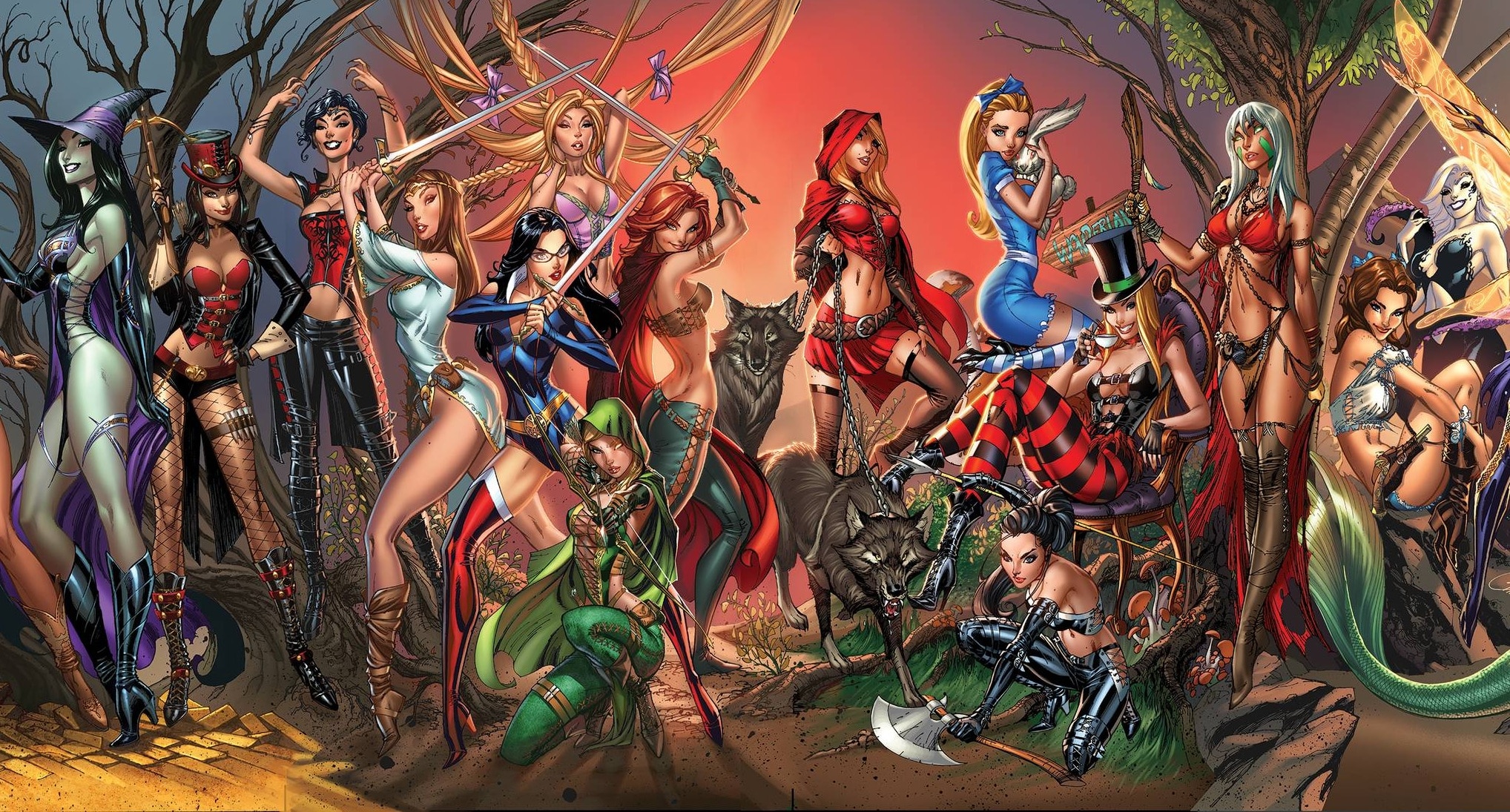
Philbo Distribution began taking orders July 1 for September and October releases, both comics and a limited number of toys. So far, Philbo is presenting itself as a distribution haven for some of comics’ smallest publishers, the ones that might have a harder time getting traction with Penguin Random House or Lunar. Among the more than 30 clients listed in its first catalog are Zenescope, known for its cheesecake-y covers of public domain and fairy tale characters; Devil’s Due, home of Josh Blaylock’s Mercy Sparx; FemForce publisher AC Comics; and Crusade, home of Billy Tucci’s Shi.
The Long Island, New York-based company is branching out from publishing into distribution. Founder Phillip Russertt’s resume includes writing (see his comic Tragedy), running conventions like the Suffolk Comic & Art Expo and CreatorCon, and even art dealing. Philbo Publishing is among those 30+ Philbo Distribution clients.
“I love this guy,” FairSquare Graphics publisher Fabrice Sapolsky said about Russertt in a post on Facebook. FairSquare has a non-exclusive distribution agreement with Philbo. “He cares about stores, about creators, about his peers.”
ComicsXF chatted July 1 with Russertt about starting up a new distributor, going as deep inside the baseball as physics would allow.
This interview has been edited for length and clarity.
Dan Grote: You start taking orders today, is that correct?
Phillip Russertt: Yes, I’m going to release the catalog at 3 o’clock. We had a little bit of a hitch with some of the publishers, but at 3 o’clock I’ll release it.
Dan: How are you feeling today, rolling into this?
Phillip: You know, I’m human. I’d be lying if I wasn’t a little anxious about it, but I’m excited. I think it’s gonna work. I think it’s a good thing. I think it’s needed. But, you know, being that it’s a new venture and especially when you have a few hiccups and you’re working with so many moving parts, you’re just like, please let everything just meld together and move smoothly.
Dan: Let’s backtrack a little bit and talk about how we got here. When did you look at what was going on and say, “I can help”?
Phillip: About a year and a half ago. I just saw certain things going on with Diamond, like everything was declining as far as the customer service; stores are complaining more. And just being 52 years old, you kind of can see things aren’t being run the same; something’s up. So I know a lot of people in the industry, and I was hearing rumblings. So I was like, you know what, it’s time for a change, because Diamond was the monopoly for so long that a free market, in my opinion, can’t exist if there’s not choice. That’s the whole point of a free market, is choice. So the little guys didn’t have a voice. They didn’t have a choice. They can’t get into Diamond if there’s a minimum order or whatever percentages they were taking. It was hard, right? It was impossible. And readership is down. The industry itself is down as a whole. And I was like, what can I do to be a part of the solution, not part of the problem? And I was like, let me try distribution, let me look into it.
So over the last year and a half, I was studying and researching, seeing how all the working parts moved, how everything goes. And, you know, I structured it, got it together. And here we go. Boom. And there’s other distribution options out there, which I still think are unfortunately not for the little guy. But it is good to have more distribution options. I believe for any business or industry to thrive, there has to be healthy competition. There has to be choice. And having said that, it’s good that there’s several distributors. Unfortunately, though, I seem to be the only one at this point that can handle the little guys that can’t do minimums and need a better percentage and things like that. But I welcome a free market and healthy competition.
Dan: How has the recruiting process been? Like, I know, just looking at the catalog that’s online now, Zenescope is kind of your big fish. And then you have all these smaller publishers in under that. Were you going to some of these folks directly? Were they coming to you and saying, “Hey, I hear you’re starting something. I want in”? What was that like?
Phillip: Well, most people actually did approach me because, you know, everybody was scrambling. I don’t mean this to be disparaging, but Diamond, with some of the practices they’ve been implementing lately, they’ve kind of forced other publishers’ hands. So like Zenescope, for example, I know one of the owners of Zenescope — not well, but I knew him. And I reached out and I said, “Hey, would you like to give this a try? And obviously, because there’s really no risk — he’s a smart businessman — he was like, “OK.” He was originally going to try one title, see how it goes. But Diamond had not released the September catalog and they had a major issue, Grimm Fairy Tales #100 with the J. Scott Campbell cover, coming out. And they were now in a lurch. So he approached me. He was like, “Hey, listen, I know your catalog’s for October launch. Is there any way you could help us out and do September?” And I’m like, “Yeah, let’s go. Let’s do it.” So they wound up onboarding all their September releases. And it’s looking good.
And then Antarctic Press, I approached them, and they were very receptive. Again, everybody’s looking for new outlets. Everything is changing in the industry. It was changing before Diamond was going down. But I think it took Diamond for people to really understand that, accept that and recognize that. So once Diamond kind of forced a lot of hands, it forced people to accept that change. And now they’re looking for those avenues of change. And I happen to be in the right place at the right time.
Dan: How big is your team?
Phillip: I have a product manager. I have a fulfillment staff of seven people. I have a graphics designer, myself. And then I have my assistant, so to speak, you know, right-hand person. So that’s pretty much my team. Keeping costs down is how I can make money with these publishers instead of off of them. And I think, unfortunately, that’s the business model of a lot of these middlemen is how can I make money off of you? And I don’t think that’s a good long-term goal. I think making money with people is how everybody succeeds over long periods of time instead of grifting and taking the meat off the carcass. And then you’re moving on to the next carcass, you know?
Dan: What were you doing before this?
Phillip: Well, I’m technically a registered nurse by day for 20 years. But as far as comics, I’ve been a collector for 40-plus years. I ran conventions starting in 2018. I was an art collector prior to that. I became an art rep. I became a publisher. I wanted to learn all the aspects of the industry, because if you’re going to be successful, you have to understand everybody else’s part in it, you know? So I’m an editor, writer, publisher, comic creator, prose book writer. So I pretty much have done everything, except I can’t draw a lick. So that’s about it. My wife is an excellent artist, though. She doesn’t know it, but she is.
Dan: What do you feel has been the biggest challenge getting your feet under you with all this?
Phillip: So the biggest challenge, and I don’t mean this disrespectfully, is the comic shop owners. Some of the owners are very set in their ways and used to certain ways of things, and I don’t think they embrace change as well. Some of them do embrace change well, but I don’t think that they trust an indie. They’re still set that Marvel and DC are the bread and butter, and I do understand that they are, but they’re not the bread and butter they used to be, and I really think that independent books are much more professional than ever. They’re even working with professionals now, you know, major — like my book, I work with Whilce Portacio, Bill Sienkiewicz, so we’re not just that little guy putting out bad art and bad writing anymore. It’s not the same, and because the world is about branding and they would rather spend $500 on the guy they know that’s not putting out something good as opposed to $100 on the little guy that’s putting out something great, I think some stores are reluctant and scared to take a chance on indie books, and we want to change that.
We’ve had a lot of signups, so there’s more willingness than I actually thought, and I’m very excited for that, but there’s still resistance with some stores, and like I had one — it was only one store — and he was complaining about our discount not being 60%, and like, we can’t do that. We’re independent. You’re not going to be ordering that much from us, and he just wasn’t correlating that you can’t do that. I can’t give you my shirt or all my food and then think that I’m not going to starve at some point. It was just one person, but there’s always going to be resistance. It’s usually more of the store owners that have been around since the ’80s that have survived through all the changes. They’re a little more reluctant, but I think they’ll come around, but we have to make them come around. We have to prove to them that indies can sell. Once you show them that there’s money to be made, I think they’ll come around, so it’s up to us to change their mind.
Dan: I think my favorite contradiction of the last five years, when Diamond first lost its grip and we got Lunar, Penguin Random House, etc. — you said it at the top of the interview, more distributors is a good thing. More choice is a good thing. More competition is a good thing, but you have that conversation with the retailer, and they may say that, but they will also give that heavy sigh and say, “ugh, but I got to order comics from three different distributors, man.”
Phillip: But you know, there’s something that some people are doing now that I think is fantastic, and they’re becoming these hubs, like Manage Comics in Canada, and there’s a few others that are springing up where they work with distributors like myself and Lunar and everything, and we give them our product data sheets, and all the stores can sign up for an account with them as a subscription, and they go there, and they can get everything from every distributor on that one site, and that one site sends us the orders and the signups from those stores so that we can fulfill all the orders of the people that we distribute to. So that’s another example of how new adjustments, thinking outside the box, working together as a community can help these changes smooth out, because you’re absolutely right. They complain about having more than one distributor, which is kind of shooting yourself in the foot, in my opinion, but these hubs are a great thing that have been popping up and helping.
Dan: There are definitely adjustments, even before this year, that the industry as a whole has had to make and is still in the process of making, like sales data, for example. Diamond used to be able to tell us what the top 100 books are or whatever, and now ICv2 has a top 50 that they do every month, but it’s a sampling of a limited number of comic shops. Listen, they’re putting the work in to give us that data, but it’s still not the complete picture. I’d love to get back to a point where we can see that, but baby steps.
But the other thing to remember, and certainly you remember this, is that this isn’t the first time the distribution system has collapsed. In the ’90s, we had the consolidation that led to Diamond becoming a — well, I guess not in legal terms a monopoly — but the lone comic distributor.
Phillip: In execution and operational terms, we’ll just say yeah.
Dan: Exactly. That court case was fought, settled law and all that. But are there lessons from that period that you think we can apply to what’s going on now?
Phillip: Well, for one thing, not to be redundant, but don’t put all the eggs in one basket. And the other thing is — and I really think this needs to be learned — is that as the industry shifts, we have to look and see what didn’t work or what worked temporarily, and recognize that what works temporarily obviously shows it’s not long-term success. So we all have to look long-term. We have to have the mindset of, this is a 15-round fight. We can’t just think about how we get through the three minutes, we have to find out how are we going to get to the finish line? How are we going to get through the entire fight? Whatever your business practice is, whatever is offered in the industry, we have to look at this. Because I do think there’s a lot of grifting in this industry that, like I said before, it was “Take the money and run; who cares what devastation I leave behind?” And that’s just not good for anybody. Because maybe you made out, but in the long run, everybody else failed. And that’s just not successful.
We all have to recognize that, what are we going to do to be our cog in this machine to keep this machine running well? Because we really all play a part in this machine. Whether you’re that publisher, or that store owner, or that distributor, or that hub that’s doing that, we all have to play for long-term gain. And I think most of the practices up until now have been short-term — “let’s just see where it goes and whatever happens.” That’s when things implode.
Dan: Do you have warehouse space?
Phillip: I do. It’s a small space right now because I’m small. It’s not far from where I live. I have a 2,000-square-foot facility right now that is temperature-controlled, insured and perfectly suitable for distribution, for shipping, receiving, packing, etc. And who knows? Maybe this blows up and we move out of there and we go someplace bigger. But I own that space, so that’s also why I keep my overhead low.
Dan: What’s next for you once you see orders start rolling in?
Phillip: It’s a nonstop “getting as many stores to sign up and join up as possible,” so that’s just the ongoing thread while we’re receiving orders. Tweaking my systems on the inside, what we could do to make the website better, make it smoother, because we’re going to figure out the kinks as we’re going, obviously, in some cases. And then it’s just making sure we get these books on time and fulfilling the first catalog. Because as you know, it overlaps. The first catalog launches on July 1, today, with a 60-day window out. But next month, I’m launching the second issue with a 60-day out, etc. So it’s just going to be launching the next catalog, continuing to get stores going. And then when these books come in, fulfill them and provide that customer service. Pack them right, pack them well, pack them on time, and make sure that this machine just keeps well-oiled, because there’s moving parts. Publishers have to get me the books in time. I’m going to get the brunt of the blame if they’re late. But if they come late, I can only ship them when I get them. So it’s just staying on top of all that. And then wash, rinse, repeat every month, just making sure it becomes that routine where it’s without a thought. Because we also send our invoices out to the publishers once the orders have been locked. And then there’s getting the books and then giving the payouts.
And there’s a lot of minor administrative things that you’ve got to keep track of. Like the data sheet, a lot of people don’t know about that unless you were in Diamond or whatever. There’s a product data sheet that you give to stores because stores can’t manually put up pictures and graphics and write synopses for all these books. You give them a data sheet that they can upload to their system and boom, they have it all up there. So it’s getting that data sheet together and making sure you have the proper information. You cross T’s, dot your i’s, and make sure you don’t miss the little thing.
Dan: Is there anything else before we wrap up that you want to put out there that we haven’t touched on?
Phillip: Well, I would like to say, first of all, Philbo Publishing is in there with two books and my book Tragedy, so please give it a try. And we have some big-name artists that will do store signings, like Whilce Portacio, Alex Sinclair and hopefully Ian Churchill.
But also, I just want to say at one point, nobody knew Teenage Mutant Ninja Turtles would be big. Nobody knew Shi would be big — which by the way, Billy Tucci, Shi is in our catalog. Nobody knew certain independents like Nexus would be big. And we always have a habit of jumping on after it’s become big, and hindsight really sucks. So all I would say is for a very small investment, if you’re a comic store, sign up for the free account, take a look at the catalog, and maybe just give one or two indies a shot. Buy a couple of books, just two books. It’s a few bucks, because you never know what’s going to be the next big IP that pops out. And right now, entertainment is dry, it’s looking for that new big thing. And you never know which it’ll be. And you’ve got possibilities right here in front of you in the Philbo catalog. So just try to expand your thoughts on this. Give something a shot. It’s a small investment with great possible reward. So sign up for Philbo. Support indie. The winds of change are here. Come with us.
You can check out Philbo’s catalog at philbodistribution.com.

Dan Grote is the editor and publisher of ComicsXF, having won the site by ritual combat. By day, he’s a newspaper editor, and by night, he’s … also an editor. He co-hosts The ComicsXF Interview Podcast with Matt Lazorwitz. He lives in New Jersey with his wife, two kids and two miniature dachshunds, and his third, fictional son, Peter Paul Winston Wisdom. Follow him @danielpgrote.bsky.social.