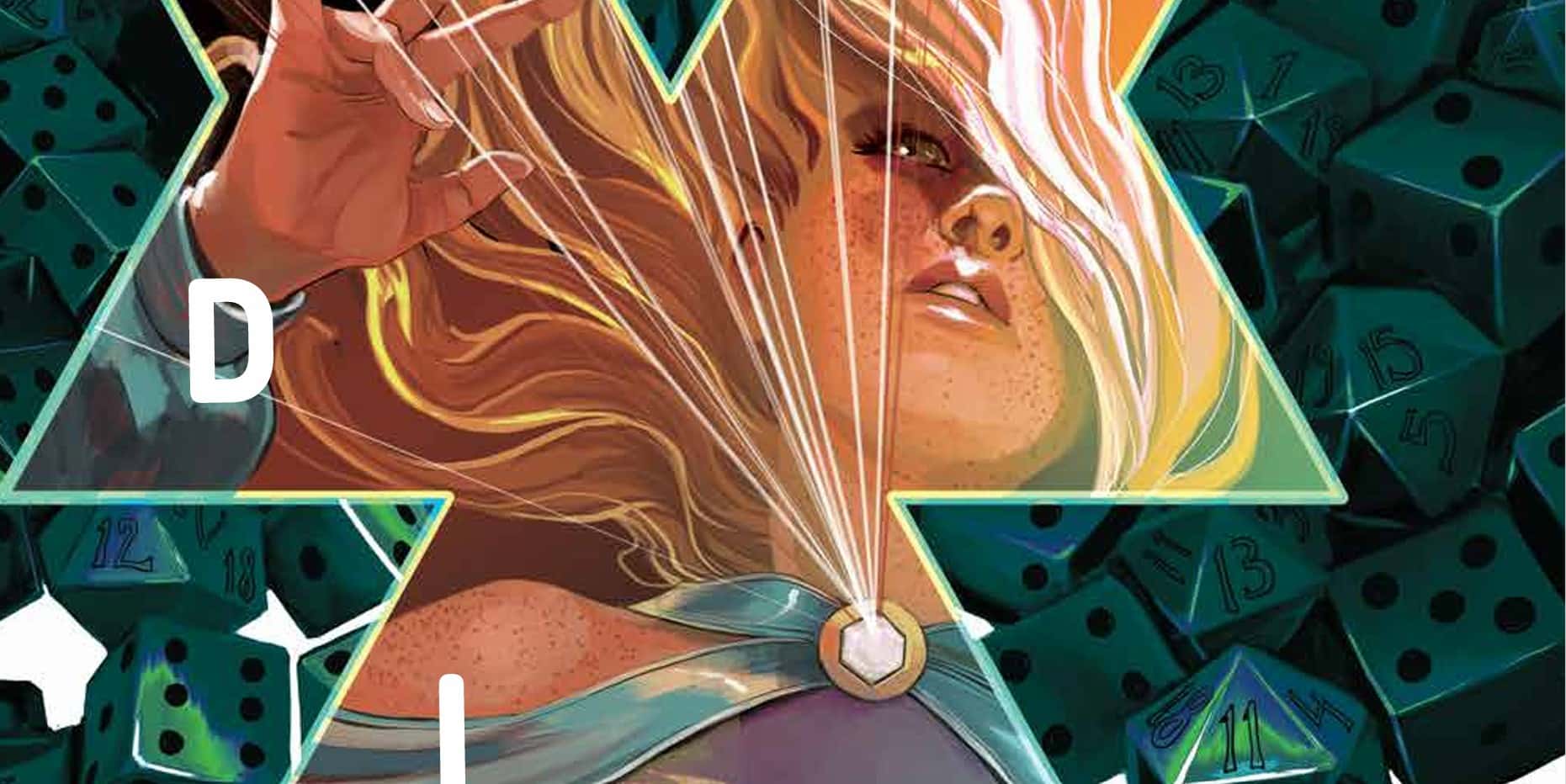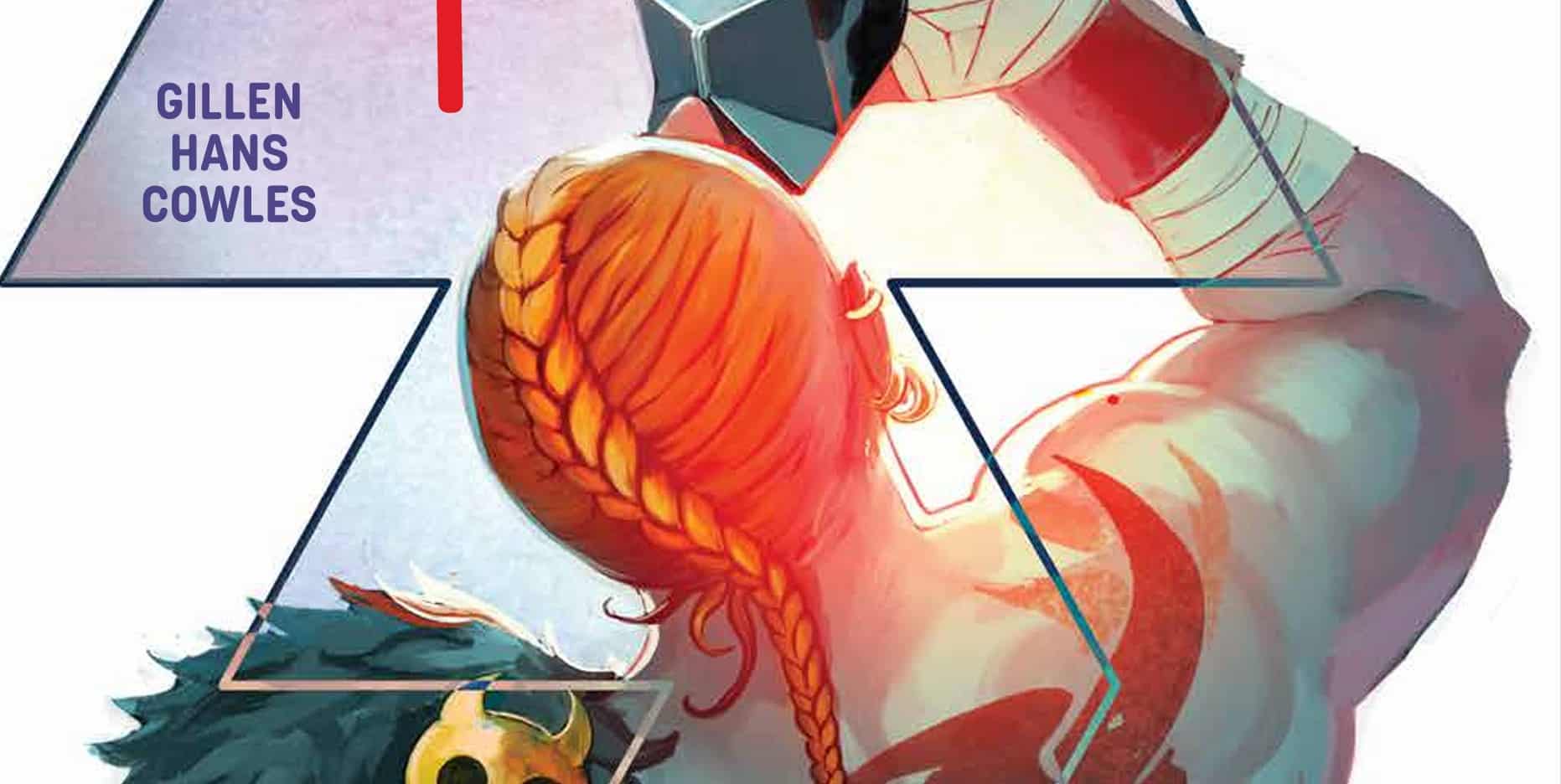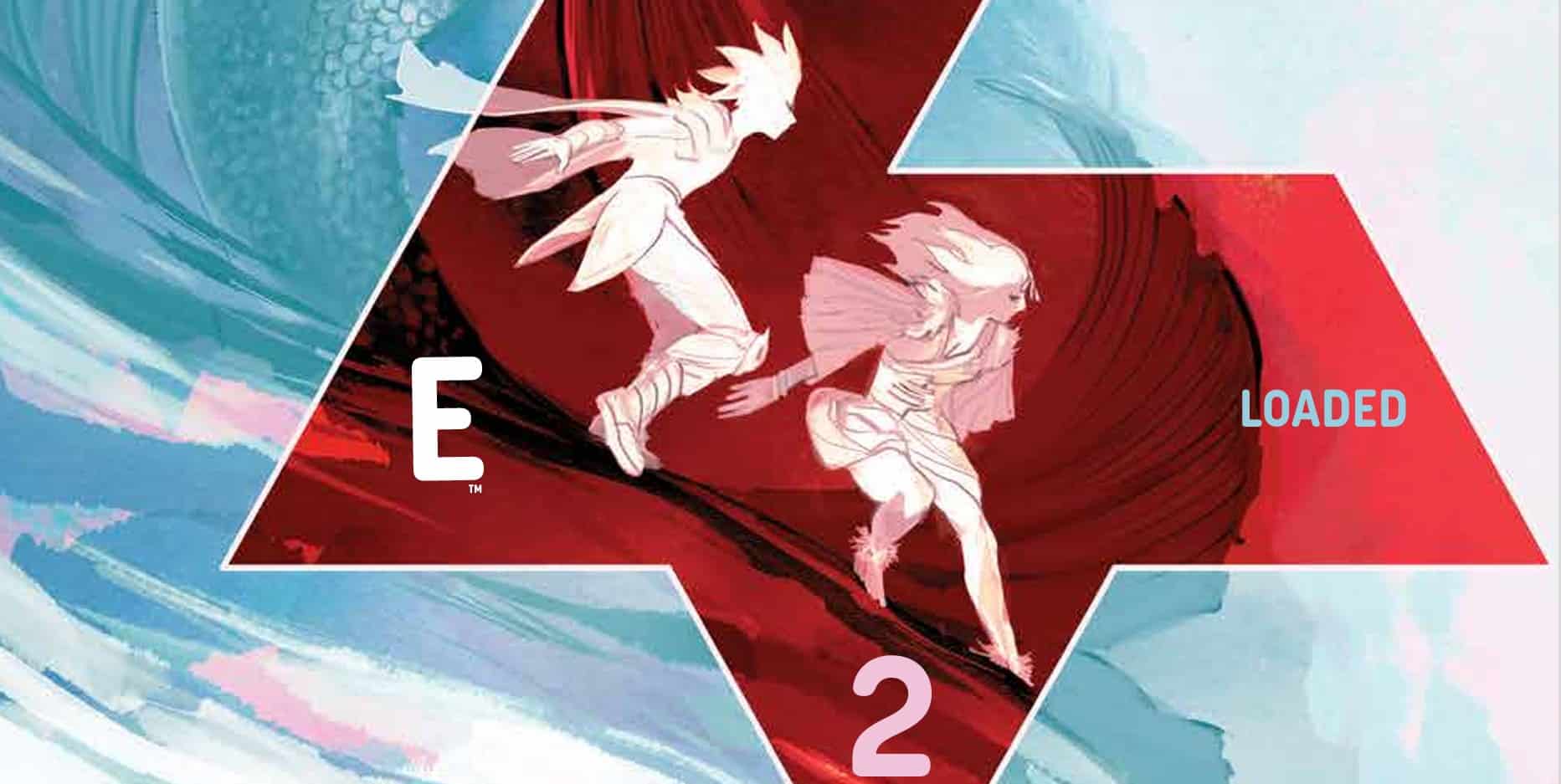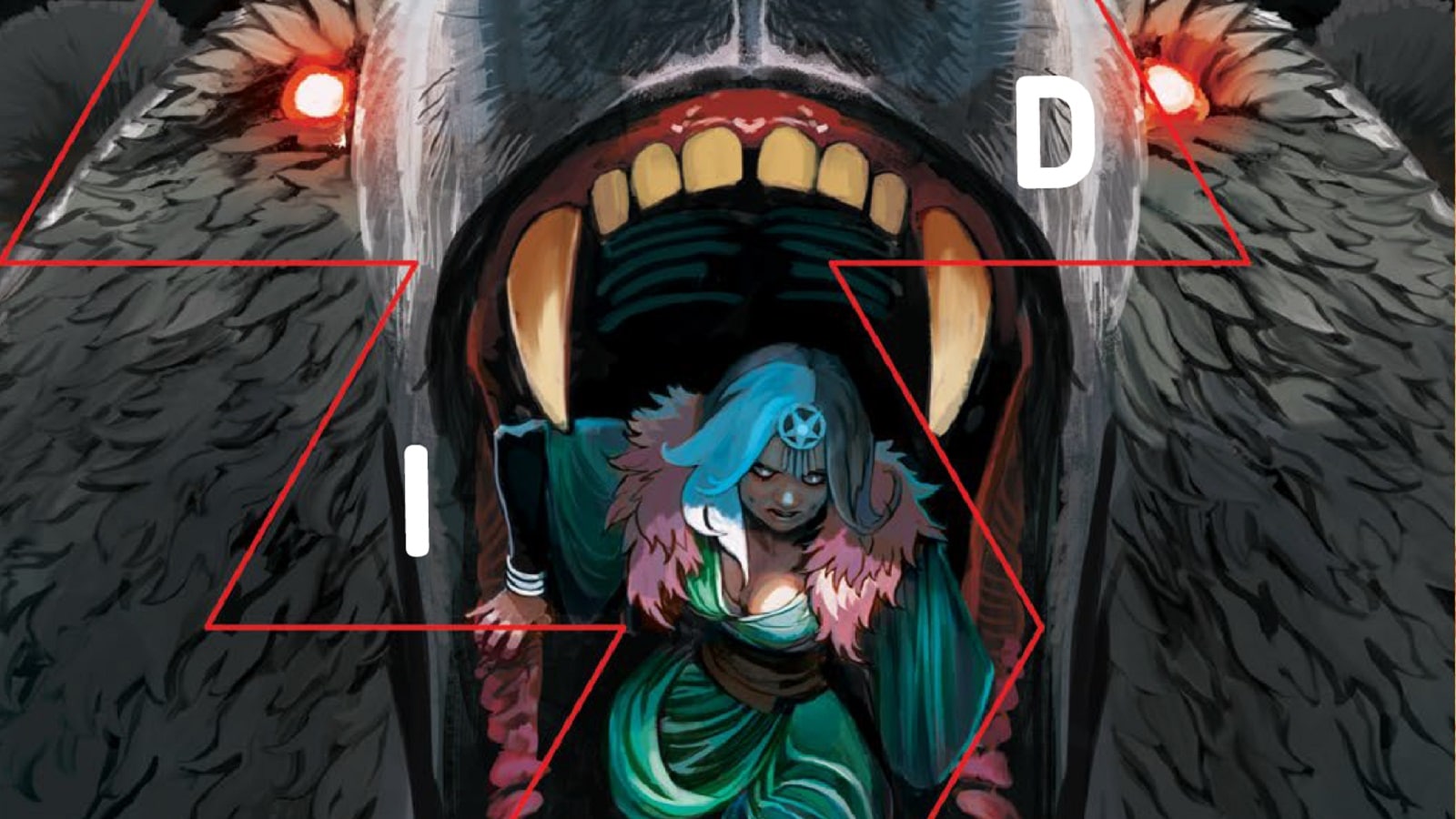
In 1991, six teenagers disappeared into a magical world based on a roleplaying game. Some, but not all, returned. In 2018, they disappeared once more — and once again, some, but not all, returned. It’s 2025, and people are about to go missing again. Could this be the point of no return? DIE: Loaded #1 is written by Kieron Gillen, drawn by Stephanie Hans, lettered by Clayton Cowles and designed by Rian Hughes for Image Comics.
Armaan Babu: Once again, we retu- no, wait, sorry, that’s the wrong Gillen comic. We’re back, though, revisiting a world everyone thought they’d escaped for good. We all loved the first volume of DIE, but it did leave a lot of unanswered questions, and a few dangling plot threads. Here, we see a few of those threads get tugged at so we can watch it all unravel. Mark, Latonya — what are your first impressions going into this?
Mark Turetsky: Oh hey, Armaan! What’s this mysterious PDF you’ve sent me? Let me just click on it and … AARGH! I’ve once again been transported into the world of reviewing DIE comics for ComicsXF. But wait, this isn’t my old party.
Latonya “Penn” Pennington: Armaan, Mark, thank you for letting me join the DIE party. My first impression of issue #1 was a lot of exclamations, especially with what happens with the world of Die. The character I thought it would happen to, it didn’t happen to. Also, this issue had gorgeous art from Stephanie Hans. She always had a mix of vibrance and darkness in the art for the previous DIE series and other works like Marvel’s Journey Into Mystery and continues this in DIE: Loaded when Sophie’s world is literally upended. The art enhances the gravity of Sophie’s situation through its use of bright colors that represent the newness of what’s happening to her and dark colors that represent something mysterious and sinister. I also think that Clayton Cowles’ lettering does something similar. For instance, the black-and-white text boxes for Ash’s internal dialogue represent their dark humor. It’s been a year since Ash returned from Die, and they are coping as best as they can.
Rasmus Skov Lykke: I had high expectations for this, and I think the issue mostly met or exceeded them!
DIE is one of my favorite Gillen comics, both when I read it as it came out and especially on rereads. And, as Kieron has mentioned several times, the world needs a fantasy world illustrated by Stephanie Hans. Even if the story was rubbish, seeing her depicting more of Die is worth the price of admission. The story is far from rubbish, though. It is both very much the next part of the story of DIE, while also clearly being its own thing. I can’t wait to see where we go from here.
DIE and the World

Latonya: The metaness of this comic is uncomfortable, but in a good way. I always appreciated the fact that DIE acknowledged the pandemic because I first read it during a time of COVID denial that’s still happening. Yet life goes on with all its changes. DIE is both a comic and a roleplaying game now, and I think it’s wonderful and thought-provoking. The theme that stuck with me from the first DIE series is how escapism can affect you for better or worse, and I’m interested in seeing how that will continue in DIE: Loaded.
Armaan: So like the comic, the Die roleplaying game draws strength from melding the “real,” more mundane world with the fantasy world its players are drawn into. The stories of human heartbreak, joy, despair, fear and more manifest in the fantasy world, the metaphor becoming a threat that’s trying to stab your eyes out. We see that with the scalpel-wielding, masked monsters that turn up later in the issue — every element of fear and pain our characters go through is just fodder for some (as yet unseen) Games Master to use against them.
Which is why I love that there is so much of a focus on the “real” (these are still fictional characters, after all) world before we get our tonal and POV shift later in the issue. It’s something to ground us, lull us into a false sense of security that makes the fantasy that comes later all the more fantastic.
Speaking of the real world, though, and the roleplaying game — when DIE first came out, the game was merely an idea. Now, however, it’s a game that’s been out for years, with a new edition coming out soon, and a game that deepens our understanding of what is happening in the comic. Now, some of us have played the game and some of us haven’t, so I’m curious as to people’s thoughts about how much reading the game’s rules changes what we’re reading here, or for those of us who haven’t played, how well the idea of the game is presented through the comic alone.
Mark: So, I haven’t really played the game, at least not beyond the preview one-shot that we did way back when. That being said, I did find myself consulting the rulebook a few times in the comic, especially in the later sequences, but we’ll get to that. I do play Dungeons & Dragons though, with a group I’ve been playing with for more than 10 years, and in that time our DM has written published third-party rulebooks. So while I’m not entirely up on the Die game, I enjoy a certain familiarity with one of the main inspirations for it.
Rasmus: It’s a very interesting wrinkle, compared to the original series. As someone who has played in our one-shot, several play-by-post online games and GMed a couple myself (not to mention my D&D familiarity as a DM and player), I think I’m decently familiar with the rules of the game. And it will be very interesting to see how that informs the story going forward, because it’s not terribly central to this first issue. It’s much more focused on the real world, establishing things there.
Mark: A thing that really strikes me in these opening pages is Ash’s embracing of their fatherhood, referring to it as another role to play. One, it’s somewhat delayed their dealing with their “gender bullshit,” as that’s something that comes with parenthood, but it also puts me in mind of Eric Berne’s Games People Play, which is an introduction to transactional analysis and one of the first modern pop psychology self-help books, so treat everything I’m about to say with appropriate skepticism.
To boil it down thoroughly, Berne believed that we play different roles with different people (not a new idea), but he whittled these roles down to three main ones: parent, adult and child. So when I interact with you folks, I’m coming to this on the basis of one adult interacting with others. And that’s healthy, but if I came to one of you in the role of child, say, needing to complain about something personal, I might be seeking an adult to tell me everything’s going to be OK and I’m a special wonder that brings light into the world, but if you come back to me telling me to pull myself together and grow up, treating it as an adult-to-adult interaction, I might take it amiss. So interpersonal conflict arises when people come with mismatched notions of the roles we might be taking in a given interaction. Now, why I bring this up is that I know about this through the podcast A History of Rock Music in 500 Songs, which I know Gillen is a fan of, and I can see those kinds of interactions playing out throughout this issue, with the special tipoff of Ash referring to their role of “Daddy.” It might be an ongoing source of tension in future issues.
Rasmus: The absence of children played a significant role in DIE, and the roles of children and parents seem to be even more significant here, so I think you might be onto something, Mark.
While we may have opened on Ash’s ruminations on his new role as “Daddy,” we end on Sophie mostly likely having to step in as surrogate mother for Molly. And if we go with what we’ve seen so far, one possibility for our new cast might be that it’s people close to the original cast. The people we see at the funeral, which seem to fit the parts best, are Matt’s dad, Sol’s mother and one of Chuck’s children. Which would give us a very interesting mix of parent, adult and child.
Armaan: Let’s take a brief moment to talk about Ash’s pronouns, because that is something that we’re not entirely clear about — though to be fair, neither is Ash. I’ve defaulted to gender-neutral pronouns while Ash figures out their “gender bullshit,” but there are arguments to be made for both he/him and she/her. The comic itself has been vague — the perils of Ash’s POV giving them the ultimate gender-neutral pronouns of I/me.
Mark: Last go-round, Corey and I defaulted to using she/her for Ash in-game, they/them for Ash the player, especially after the gender-balrog issue, but I’m open to using any as the comic itself hasn’t worked out what to do about it.
DIE at a Funeral

Latonya: The funeral made me consider how people see you when you are alive versus when you are dead. Chuck was not a saint in the slightest, but he was still a friend to some. It felt right that those who experienced Die with Chuck wanted to attend his funeral. In contrast, those who didn’t personally know Chuck, like the fans of his books, put him on a pedestal. Then there’s Molly, Angela’s kid, who comes to make a scene. Personally, I think Chuck reminded Molly of their abandonment issues regarding their mother.
Rasmus: While that is definitely part of it, I think it’s mainly that Chuck was a very shitty boyfriend to Angela as teenagers, as we saw in DIE. So being an angry teenager, he’s an easy target for her anger. For a teenager, the world is much more black and white, so she probably wasn’t able to see the good in Chuck, too. He did act a fool (and an asshole), so a lot of that anger is justified. But not all of it, which is where I think you’re spot on, Latonya. This is an excuse to vent, even if the anger is mostly misdirected.
Armaan: I think there were a lot of conflicting feelings at Chuck’s funeral. You want to honor the dead, to find the good they’ve left behind, and that gets all twisted up when you have mostly terrible opinions and feelings about the deceased. Twisted feelings are what this comic feeds on, however, and there is plenty of that, between a glimpse of Chuck’s ex-wives, Molly going full angry teenager, and Sol and Ash going head to head about the “real” world creation of the Die game nearing publication.
Rasmus: Sol was a source of a lot of anger in DIE. In this one scene, I was more mad at him than at any time previously. “Selfish cunt” indeed.
And yet … knowing Die, if not Sol, then someone else. It is among the things that happen. Nothing that can be done to change that, so why not Sol? And in a very real way, he does deserve it. He certainly suffered more than anyone for it. That doesn’t mean it’s the right thing to do, though.
Armaan: The one heartwarming part of it was seeing that Matt and Ash have grown closer in the time since returning from Die. It’s good to see some good has come out of all the misery they went through.
On another note — Chuck’s funeral twists the plot in a way that signals something dark ahead. When we last saw Chuck, he may have been dead, but he was still Chuck. Turned into a Fallen, he was teaming up with a Fallen Molly, about to go on a number of adventures on his own. There was a chance, still, for him to return, or even to just return to his old self.
With his body returned to the world above, however, and six months prior to the original DIE group returning, it would appear that Chuck’s story is cut short, and time-shenanigans returned his body six months in the past. We’re reminded that there’s an untold story yet to happen in DIE — a story that is both yet to happen and has already happened. Time shenanigans that make the tale inevitable. It’s already happened — the story we’re about to see can’t be changed. A little dread needling through our lovely funeral.
Rasmus: I was so sure that this second volume of DIE was going to focus on Chuck’s story. Sure, we’d maybe follow a new party, but they’d soon meet up with Chuck and he’d be a central part of their story. His end is the biggest dangling plotline from the first volume. And here Gillen appears to shut it down before it has a chance to begin. But he does it in a way that opens up a bunch of new questions.
Mark: We also learn that Chuck’s body appears to have died of stab wounds, where he died in the game from being fed on by Fallen Sol. I can’t help but think, because of what happens in the final “act” of the issue, that the funeral acts as a kind of funeral for the party from DIE Book 1. It gives us, the readers, a chance to see (some of) them one last time and to say goodbye to them. A funeral gives us an excuse, however terrible, to gather as families or groups, to catch up with certain people we haven’t seen in years, if only to grieve together. I don’t know if we’ll be seeing Ash, Matt, Sol or Angela again, and somehow it’s comforting to see the way they’ve grown, or not, in the intervening time. Except of course Sol is up to something, beyond merely publishing a game that may or may not destroy the world.
Rasmus: See, I actually think the original party will be playing a big part in the story going forward. We spend over half the issue with Ash as our narrator, before traveling to Die and switching narrators. Sure, this could just be to sell the twist — and allow us to say goodbye to the old party — but then there’s the gift to Ash from Chuck. A miniature that very much looks like Sophie’s character in Die. I wouldn’t be surprised to see Angela, Matt and Sol having received something similar.
The two characters we know are in Die are too closely connected to our old cast for the old cast not to play an ongoing role in the story, I suspect.
Picking up the Godsdamned DIE

Latonya: As I mentioned earlier, I was surprised at how the world of Die reappears. I also found myself hating Chuck all over again, because I felt like what happened was his fault. I enjoyed seeing the Godbinder character class show up again, though I’m not sure how the animals factor into it.
Armaan: I’m not sure how much of it is Chuck’s fault, actually. Chuck was never really great at grand plans — in fact, he very specifically gained his powers from a lack of proper planning. Whoever is responsible for bringing the players in put a lot of work into it — there might be a new Master involved. The question is who. Who would choose to bring the loved ones of the original DIE group into this world? Who has the know-how to send the dice into the world and manage to do it through Chuck’s funeral — to do it through his will?
And who is that mysterious voice asking Sophie to pick up the die so she can gain her fancy new RPG powers?
As someone who has had the background of the panel that first showed the world of Die as his background screen for many, many years, seeing this re-introductory panel display a darker, seemingly more bloody world with the ominous large statue of the False Friend was jarring, and chilling. Whoever the new Master of this realm is, they seem to have a much deadlier game in mind.
Mark: I took the mysterious voice to be Molly’s. Sophie refers to it being the familiar voice of a woman, but she’s unable to place it. Now, Molly uses they/them pronouns and is a teenager, so that might not be right, and Molly’s first reaction to Sophie showing up is to attack, so I’m likely wrong about that, but it was my first thought.
Rasmus: I am 99.8% sure the voice is Izzy.
The familiarity with how the Godbinder works is the biggest hint, I think. I suspect the “Grab the dice. It’ll protect you. It protected me.” bit is more literal than we assume at first. It’s not just that the dice worked for the person before. It’s that that die worked for them, when Izzy used the D12.
She is also the only original party member we don’t see, so it’d make sense that she’s here in spirit/voice.
The thing that speaks against it being her is that she refers to the die as dice. In DIE, she is the one who points out that that’s the wrong word for a singular dice. Though this could be explained away by her speaking to Sophie, who might not be aware.
Armaan: I’m convinced that it’s someone new — or at least, new to the world of Die. I think our adventurers are a completely new group to the game, but that’s just me.
Also, how breathtaking is that reveal of all of the Godbinder’s gods? We only got to see a handful in the first series, but Hans and Cowles go all out in terms of visual spectacle for this spread. Looking at them all at once, I can’t fault Sophie for choosing the bear — though I would have personally gone for the stylish shadow clothed in pages.
Mark: As for the animals, Latonya, the druid class in D&D is historically tied to the cleric class. In the original Player’s Handbook (first edition), druids are a sub-class of clerics, described as “priests of nature.” Later editions of D&D gave druids the option of animal affinities, the ability to summon animals, or to shapeshift into them. In Sophie’s case, foxes are associated with tricksterism, with cleverness, so watch this space as to how that’s going to manifest with Sohpie’s chosen totem.
What’s also different from Book 1 is that Sophie didn’t choose her class, she was sent a D12, so it was always going to be a Godbinder. But that means that upon picking up the dice, she has to make character creation decisions on the fly, presumably with the game world being “paused.” The god of nature (do we have a name for this bear?) acting as a kind of user interface also skirts being very amusing. It’s like the tutorial level of a game, where your swordfighting trainer, voiced by, let’s say, Liam Neeson, is telling you to “hit the B button to block, then parry by hitting the left shoulder button.”
Armaan: It’s worth noting that in DIE: The RPG, the game says that when players enter the RPG world for the first time, they’re human. It’s not until they pick up their die that they transform into the RPG characters they’ve created. That’s something that was glossed over in Volume 1, and I suspect this scene here was meant to underline the importance of the dice in this game, and yes, it’s very much a tutorial.
I want to make a note of the word “roles” here. As I mentioned in the advance review, Gillen loves a good pun — and not just for humor’s sake, but to elevate the meaning of a word, to give it more narrative weight. The word “role” comes up a lot here — obviously for the role-playing game, as well as the role players take on; their in-game persona. With a slightly different spelling, it’s “roll” — something that luck (or dice) decide. Something that’s chosen for you, that’s out of your hands, and you play it as best you can. In the RPG, players don’t choose which class they play. The Games Master picks it for them. Their roles are as out of their hands as their roll.
Mark: Also, have we figured out what Molly’s class is? They seem to have some evil chains emitting from them, and it’s unclear if they’re holding the chains in their hands or not.
Rasmus: Pretty sure Molly’s class is Omega Red.
After zooming in really close, searching for any sign of Molly’s die, I came up empty. I think we can rule out Dictator and probably also Neo, so I’d put my money on either Fool or Rage Knight, but I think it’s too early to tell yet.
Armaan: I feel their prehensile chain weapons are far too deadly for a Fool. The Godbinder is, of course, taken, and the Dictator does not need weapons. The Neo tends to be a mix of cybernetics and fantasy (though there’s nothing that says it has to be that way). That leaves the Emotion Knight … or, for a big twist, a Master that’s also a player.
Mark: Let’s consider that maybe this time around, we’ll get a party made up entirely of Godbinders. Could Molly not be an acolyte of the S&M god on the far right?
Roll a D6 for Miscellaneous Thoughts

Latonya: I found the magpies’ appearance in this comic similar to their appearance in Journey Into Mystery, which Gillen and Hans wrote and drew. In JIM, the magpie served as the embodiment of Kid Loki’s older evil self. However, in DIE: Loaded, the magpies resemble a flock of crows, and a flock of crows is also called a murder. Whether all of this is a coincidence remains to be seen, but I can’t wait to see what the magpies represent in this book.
Armaan: So some quick internet research tells me that four magpies — like the four we see above Stuart’s crib — can represent a few things in that old rhyme. Four magpies are for a boy, a birth or a death, depending on which version of the old rhyme you’re referring to. Knowing Gillen, and his love for cramming multiple meanings into a single thing, it could be all three. Four magpies for a boy — Stuart — also possibly a mean nod to Ash’s undecided “gender bullshit.” Four magpies for a birth, again for Stuart — but are they also signaling a death? If so, whose? We already know Molly is dying in DIE at some point soon — but is it possible that a future version of Stuart will likewise be dragged into that world?
It’s also worth noting that there’s a panel of Sophie in the time when Ash was gone, trying to piece together the clues of Ash’s disappearance. Two magpies for joy, or mirth. Are we going to find out that Sophie was actually happier when Ash was gone, or am I reading far too much into it at this point?
In any case, the magpies are important — Sophie has told us as much, and I can’t wait to find out what they’re about later, either.
Rasmus: One out-of-text thing that has struck me about DIE: Loaded is that in the marketing for it, as well as the back cover, the D12 have been featured quite prominently. With the first volume it was the D20, which also forms the logo of the series. For the first volume, this also signaled that the series was going to end at issue #20. Is this a veiled reference to when this second volume will end?
Mark: I’ve seen some comments from Gillen hinting that it might not be done with #12, and a reiteration that they didn’t announce the length of the first series.
I’d like to make a quick note about the quote on the back cover, from Ludwig Wittgenstein’s Philosophical Investigations: “And I shall say: ‘games’ form a family.” It’s part of Wittgenstein’s description of the philosophical idea of Familienähnlichkeit, or family resemblance. Family resemblance is basically classing things that don’t share one particular trait, but things that all pull from a set of traits. There’s no single trait that unites them all, and no thing in the group has all of the traits. He uses the concept of games as an example. We know what games are because they all pull from a set of features, but there’s no common feature that applies to all games.
Now, of course Gillen is using the quote rather cheekily, using “family” in its layperson’s, non-philosophical sense, to tie it in with the fact that we’re getting family members of the original party in this volume, but the philosophical idea of family resemblance is an interesting concept, and one we might want to keep in mind as we read on.
Armaan: I definitely think that’s going to be a strong recurring theme through this comic — Mark, you’ve given us a lot to keep an eye out for!
Buy DIE: Loaded #1 here. (Disclaimer: As an Amazon Associate, ComicsXF may earn from qualifying purchases.)

Armaan is obsessed with the way stories are told. From video games to theater, TTRPGs to comics, he has written for, and about, them all. He will not stop, actually; believe us, we've tried.

Mark Turetsky is an audiobook narrator and voice actor who sometimes writes about comic books. Originally from Montreal, Canada, he now lives in Northern Louisiana. Follow him @markturetsky.com on Bluesky.

Latonya "Penn" Pennington is a freelance contributor whose comics criticism can be found at Women Write About Comics, Comic Book Herald, Newsarama and Shelfdust, among others. Follow them @wordsfromapenn.com on Bluesky.

Rasmus Skov Lykke
Rasmus Skov Lykke will write for food (or, in a pinch, money). When not writing, he spends his time with his wife, their daughter and their cats, usually thinking about writing. Follow him @rasmusskovlykke.bsky.social.