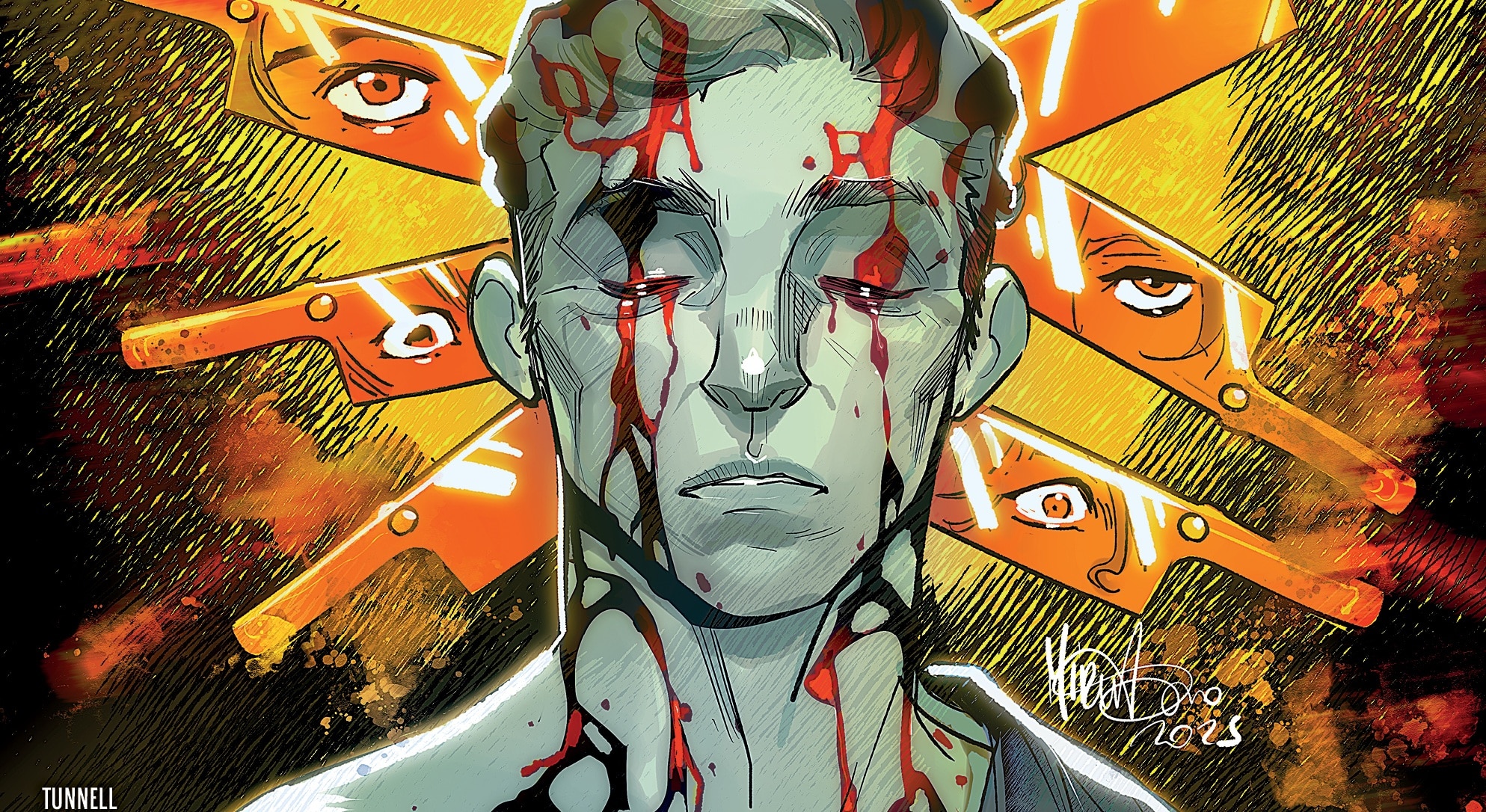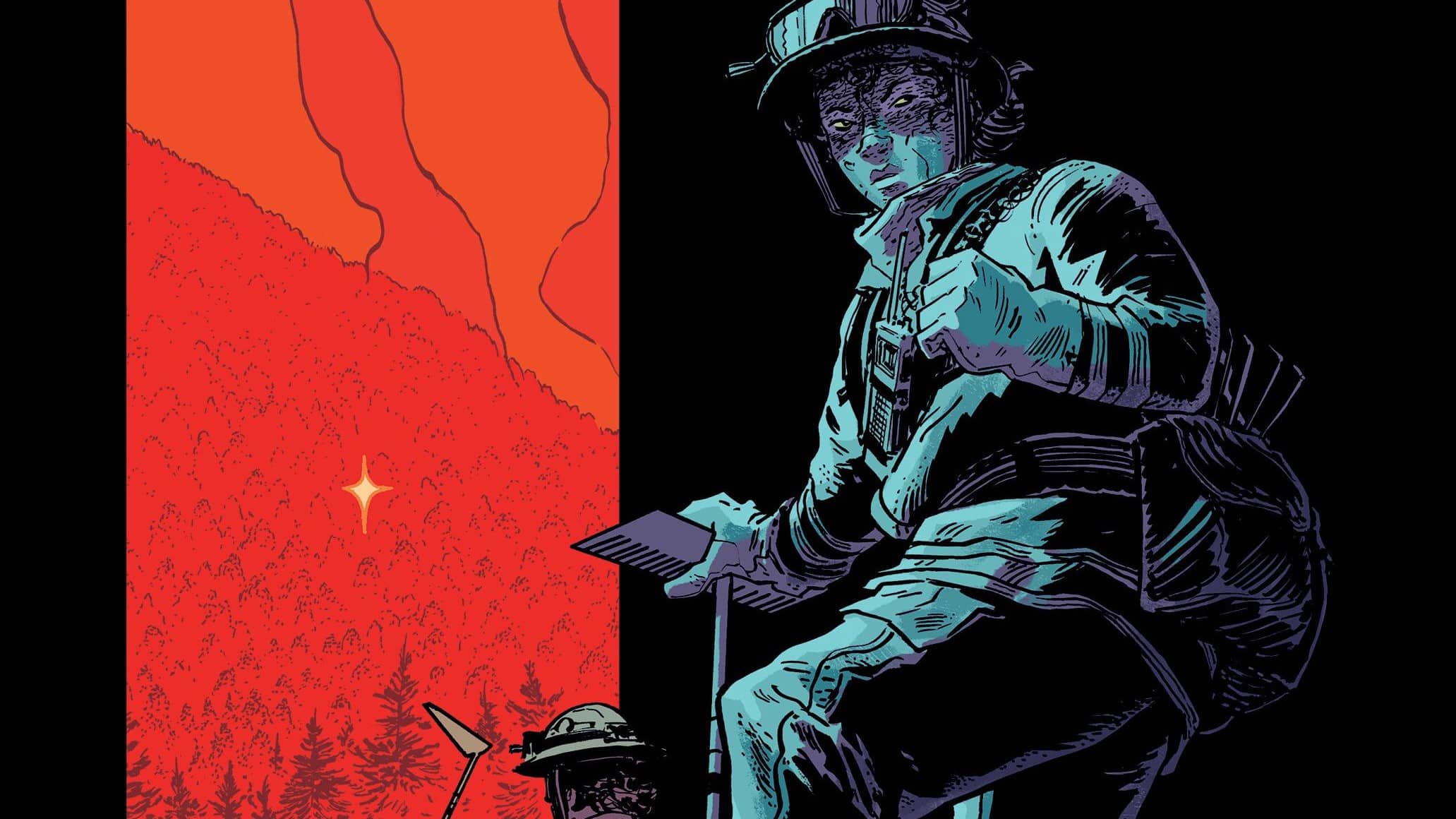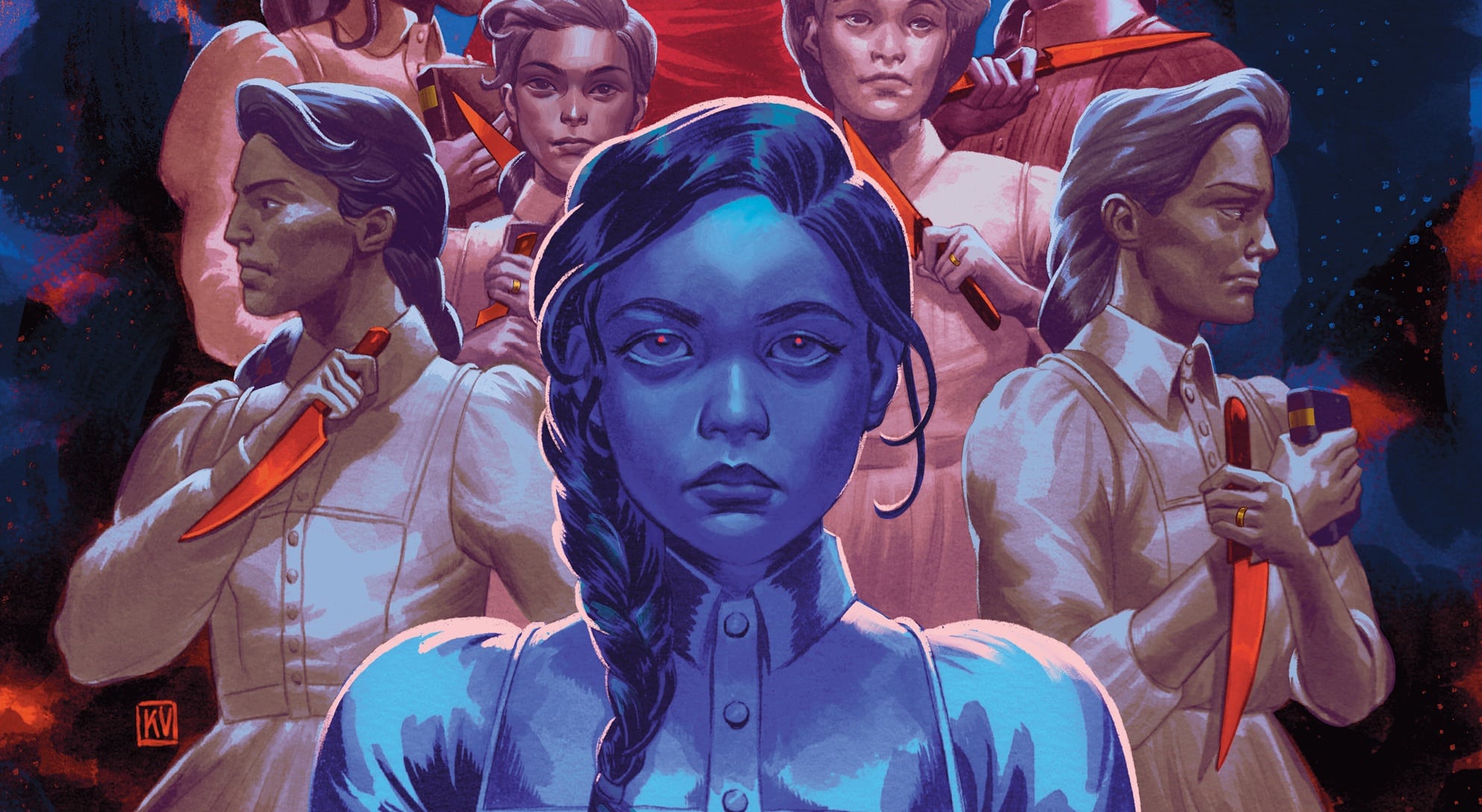
Matthew Dunn’s killer remains a mystery, but there’s something much worse to be uncovered than the killer’s identity. That Matthew treated his wives cruelly comes as no surprise, but as our detectives continue to hunt for the truth, the true extent of his depravity comes to light. Witness, if you dare, the stories of Seven Wives #2, written by Zoe Tunnell, drawn by Tesslyn Bergin-Dicoi, colored by Antonio Del Hoyo, and lettered and designed by Brian Kolek.
Does it matter whodunnit?
Seven Wives is framed around a mystery, and in this second issue, that mystery continues to be the least interesting aspect of the book. Who killed Matthew Dunn? Who cares?
Any of the titular seven wives have reason to, especially in the light of this week’s big reveal. While we haven’t seen all of their stories, every one we have seen showed a cruel man, obsessed with power, and one who gleefully harmed those in his grasp as a show of that power. What’s more, the murder was done in public — during sacrament, a public gathering. There were witnesses. Anyone who didn’t stop any of the 49 stabbings is complicit.
Actually, speaking of the sacrament, let’s take a moment here. The circumstances behind the murder are confusing. How public was this sacrament? Neither the art nor the telling makes it clear how many witnesses there were — in fact, on first read, I’d assumed Matthew was simply practicing his sermons alone when he was confronted by his killer/s. If it happened during sacrament, in a compound so fundamentally religious as Matthew’s is, wouldn’t all 49 residents have been there? If not, what made this sacrament special? If so, why isn’t anyone reacting like they’ve witnessed a murder? Why aren’t they being questioned like they were witness to a murder? It’s frustrating to get a clear picture of the murder itself, and not in a way that serves the story.
It feels like the creative team finds the actual murder as uninteresting as I do. So why not move on and stop asking so many questions about it?
The problem is that the murder mystery is this comic’s framework. Every new story we get is built around that framework. Suspects are questioned. Guilt is discussed. Every new facet to this story that’s uncovered is done in service of finding out who’s responsible for Matthew’s death. The carelessness of the framework means that the story, as a whole, feels weak in points. The police question a suspect, whose story we readers learn (a story which, incidentally, is not always congruent with the story that’s given to the police), and the police are asked to question a different suspect with their own story to tell. It’s hopping along from one suspect to another, with little actual detective work being done by the police — no choices made, no smarts shown; they simply follow the leads that are handed to them. It leaves a trace of staleness over the otherwise deeply compelling stories that Seven Wives presents.
Those stories are where the book shines, and why you should be reading this comic. The stories of how these women were drawn into Matthew’s web — and what’s keeping them there. The viciousness of a cult that clings to power. And the smallness of a man to whom everything has been handed, the illogical (but all too real) extension of male privilege and patriarchal power.
A portrait of a man, in flashbacks
We have three stories. There is the one we knew was coming the moment we saw Mary. A story of a man who saw someone young, innocent and sweet, and immediately wanted it for himself. Bergin-Dicoi’s talent with character expressiveness shines especially strong here. There’s a grotesqueness to the art — the cartoonish style makes everyone look like warped, wax puppets. There’s an attention to emotive detail present in every character, yes — you can read so much in the way a character sits, leans, stands around. In moments of emotional intensity, the grotesqueness deepens. Mary’s broken horror as she’s forced to think — even momentarily — of the trauma she’s gone through. Matthew’s vicious glee in the pain he brings Mary, in commanding control. His smug, sanctimonious sneers. You think you’re looking into the face of a monster.
Monsters, however, are strong.
It’s Galilee’s story that reveals him for what he is. Galilee is known among the other wives as the outsider; she wasn’t “born into the faith.” She even went to high school with Detective Aguilar, not that Aguilar recognizes her. With Galilee the outsider, we gain an outsider’s perspective. We see the appeal of the life she’s chosen — not just of Matthew, but of the faith he represents, the strength it brings her. More than that, though, as the years pass on, we see his weakness. One incident is particularly revealing; his rage at Galilee suggesting going out for simple medical supplies for one of the wives’ sprained wrist. The focus of Matthew’s anger is telling; it’s not that Galilee is somehow speaking out of turn. It’s that she dared mention the outside world. Dared to challenge the faith by even mentioning medical knowledge. Dared to even imply that she knew something that Matthew didn’t.
Faith is a frail and fragile thing. It’s eroded by doubts both big and small; it weakens the longer you have to hold onto it when it fails to give you the answers and strength it once did. Faith is something you choose, when you embrace its absurdity in the face of all that would break it down. Faith used as a cudgel, however, and as a means of control, goes directly against the power of choice, and that heightens its fragility. Those who’ve used it to gain power must go through increasingly extreme measures to hold onto that power, to keep people from questioning that faith, to keep them from making their own choices. It’s unsustainable. But until someone snaps and stabs their authority figures 49 times, right to their face, followers suffer.
It’s here that it becomes clear that Matthew isn’t a monster, dealing out his punishments through his own inherent strengths. He’s a man — a small, weak and not very smart one, grown smug and entitled from the power bestowed upon him by his church. He has no real strength of his own — he wields Christianity like a weapon; he is armored in the paranoia and systems of control that form around cults like these. He deprives the women in his household of funds, of paperwork, of their very identity, isolating them from the world and doing everything he can to make sure they forget about it.
Our last story in this issue is not from one of the wives, but from Matthew’s son, Jeremiah, and it’s telling in its own way. We get to see what Matthew is like around other men. He’s as harsh as ever, quick to anger, quick to strike, and always, in every moment, perpetually smug — but for the first time, we see words of encouragement that might actually be more than just patronizing lies. Matthew wants to give his son the world. He’s inviting Jeremiah into the world of privilege that Matthew enjoys — just so long as Matthew doesn’t have to give up an iota of his own control.
People complain of a “male loneliness epidemic.” Here we see one of the reasons for it. There are men, bolstered by a patriarchal society while simultaneously made paranoid by it, who cannot comfortably spend time with other men unless they know they are the ones in control of the room. A constant need to be the unquestioned and uncontested alpha, and everything in Matthew’s world supports the idea that he’s exactly that.
It leads to a madness of sorts. Not to absolve Matthew, but his obsessive need for power and control is something that this isolated cult actively encourages, and worsens. There is a bottomless pit in men like these, a need for more power, more depravity, more expressions of cruelty, and more people all in service to him. Nothing will ever be enough for a man like Matthew. When one wife isn’t enough, he gets more. He begins looking outside the church. He begins looking for younger women. He takes his own daughter as a wife, because with the bare minimum amount of justification from the so-called Good Book, he believes there is no desire in his sick, twisted mind that shouldn’t be his by right.
It’s in the flashbacks that the creative team comes together the strongest. The red lighting of violent memories. The casual, bloody cruelty. The intensity of Matthew’s beliefs, in the lettering, in the writing, as he warps the world around him, beating it into shape with his weapons of faith.
Seven Wives is not keeping me on the edge of my seat, eager for what comes next. Last issue‘s last-page reveal is not touched on here, and this issue’s reveal — while shocking — is no cliffhanger that leaves me wondering what happens next. What the book does instead is create a horrific and fascinating world, slowly revealing the whole of it one fractured facet at a time. It’s a powerful story, and a tragedy that’s hard to peel your eyes away from. While there are men, both fictional and otherwise, who are as revolting as Matthew is, this comic’s strength is in how viscerally it is portrayed. I look forward to the next issue not because of how eager I am to find out what happens, but because the storytelling of this book when it’s at its best is so strong.
This is a mixed review, yes, but I am certain of this much: This is a comic you should be reading. Then taking some time away from.
Then reading again.
Buy Seven Wives #2 here. (Disclaimer: As an Amazon Associate, ComicsXF may earn from qualifying purchases.)