Editor’s note: This commentary contains spoilers for Avengers: Armageddon #4. Seriously, you’ve got like one more paragraph before the whole thing is spoiled. Turn back now, read the issue and come back. We’ll be here.
Last week, Marvel’s Avengers: Armageddon #4 hit stores, delivering on the promise of being the most earth-shaking moment Earth’s Mightiest Heroes have faced since 2004’s Avengers: Disassembled.
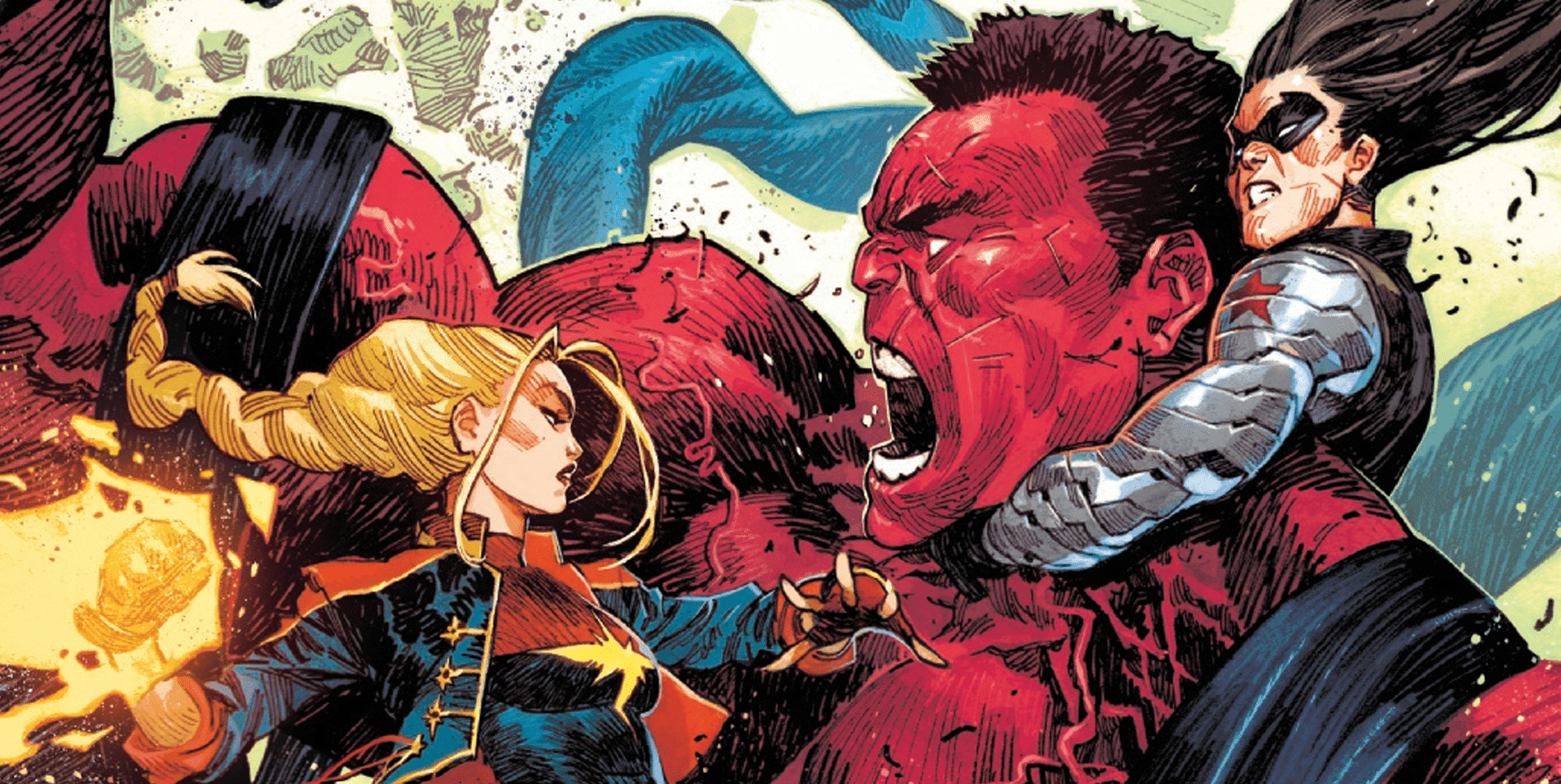
In the comic by Chip Zdarsky, Delio Diaz, Frank Alpizar, Jesus Aburtov and Cory Petit, after Captain David Colton disarms most of the world’s nuclear arsenal, the Russians take advantage of that to launch an attack on American soil. Thunderbolt Ross, the Red Hulk, is overloaded with gamma energy, transforming him into a human bomb. The world’s heroes stop all but one of the nukes, with Sue Storm containing the explosion they couldn’t stop in one of her force fields. Ross detonates, leveling a Russian city, killing Bucky Barnes and severely injuring both Carol Danvers and Colton.
And that’s where the issue decides to twist.
Because one of the mysteries of the past year is exactly which godlike hero from Earth-6160, the new Ultimate Universe, Colton got his powers from.
And to everyone’s surprise, it’s not the Sentry. It’s not Captain Marvel (Mar-Vell). It’s not Captain Marvel (Genis). And it’s not Captain Marvel (Carol Danvers).
With one word, it’s revealed that Colton is someone no one guessed.
Kimota.
David Colton is Miracleman.
And frankly, our reaction ranged from “so what” to “what the @#$%” to “who cares?”
Captain Marvel but not that Captain Marvel

Miracleman started his life, funnily enough, as Captain Marvel.
Fawcett Comics’ Captain Marvel — sometimes called Shazam, after the acronym he shouts to become a hero — was massively popular following his 1939 debut, challenging DC Comics’ Superman for dominance of the sales charts and outselling the Man of Steel for much of the 1940s.
Many fans incorrectly state that this led to lawsuits from DC Comics that found that Captain Marvel was a copy of Superman. The truth is much more complicated, finding that the character himself was not, but certain feats and powers were, while DC was negligent in protecting its own copyrights, among other things. The legal battles dragged out for years.
What was true was that between the cost of multiple lawsuits and the decline in popularity of superhero comics, Fawcett agreed to stop publishing Captain Marvel and its line as a whole in 1953.
The hitch was, Captain Marvel was still massively popular in the United Kingdom. So instead of ceasing publication there, L. Miller & Son contracted artist Mick Anglo to create a new (admittedly derivative) character — Marvelman. The character gave the series a second wind until it too eventually lost popularity, ceasing publication in 1963.
In 1982, Dez Skinn revived the character in the anthology Warrior, hiring comics superstar Alan Moore and artist Gary Leech (later followed by Alan Davis and Rick Veitch) to craft the story. Moore’s Marvelman was simultaneously a deconstruction of superheroes, an examination of the philosophical idea of the Ubermensch and a satire/condemnation of Margaret Thatcher’s Britain. After concluding his run, he handpicked his successors, Neil Gaiman and Mark Buckingham, while Skinn dealt with behind-the-scenes legal issues caused by the fact that he never actually had the legal right to publish Marvelman (renamed Miracleman in the American publication of the stories).
The character would remain in Limbo until Todd McFarlane bought the assets of Miracleman’s American publisher, Eclipse Comics, incorrectly believing he was buying the rights to Miracleman. This triggered lawsuits between McFarlane and Gaiman, who were already hostile to each other over complicated work-for-hire contract disputes.
(I’m grossly oversimplifying, because this could have entire books written about it.)
The legal battles would lead to everyone involved, including Marvel Comics, learning that the rights resided with Anglo all along. This would render the claims from Skinn, Eclipse, McFarlane and Gaiman all invalid. Marvel would then step in and license the character from Anglo and his estate in 2009, restoring the original stories, Moore’s revival and continuing Gaiman’s stories.
This also led to teases that the character would be coming to the prime Marvel Universe in some way, shape or form since 2021’s Timeless one-shot.
And yet

But here’s the deal.
It’s been 17 years since Marvel acquired the rights to Miracleman (My research had conflicting descriptions of whether the company licensed MM from Anglo’s estate or bought it. I assume the latter given all of this). Before that, the property was a well-liked revival of a Captain Marvel pastiche that was rooted deeply in British storytelling and some of the concerns, politics and fears of the era. The primary creators were one of the greatest writers in comics history (who’s been burned over and over again by the American comics industry) and an alleged sexual abuser. And the rumored creator who was going to shepherd the character at Marvel, Donny Cates, hasn’t been active in the comics industry since suffering a traumatic brain injury in a car accident in 2022.
So in the end, who is this all for? Why is anyone bringing this character back at all? Why are they bothering to completely remove Miracleman from the context that made the ’80s stories so great? Most of all, who cares (except for the accountants demanding ROI on the price paid in 2009)?
I really like Colton. There’s a joke that Marvel Comics creates a Spider-Man every decade (Nova, Speedball, Darkhawk, Miles Morales, Kamala Khan, etc.). But it makes sense that the sensational character find of the 2020s is a millennial war veteran with PTSD, a crippling disability, a mistrust of the system, and once given godlike power immediately begins dismantling those systems that ruined his life. Instead of a Spider-Man, it’s a Captain America for the 9/11 generation.
It’s a premise that stands on its own, and frankly one that most American millennials — aka Marvel’s current average reader — lived through, superpowered military service or not. We all watched the American Century end, the ooh-rah nationalism and Islamophobia that followed 9/11, and the endless war leading to a resurgence in fascism that’s devastated our culture and economy since. It’s compelling to have a new superhero step out of that, but adding Miracleman to the mix is a hat on a hat.
And frankly, after a decade of rampant Marvel nostalgia and storytelling that’s looked backward rather than forward, it seems that it’s one last hat being forced on our heads in the dying gasps of one editor-in-chief’s at times disastrous tenure.
And in that way, it’s kind of fitting, even if it’s still not welcome.
Buy Avengers: Armageddon #4 here. (Disclaimer: As an Amazon Associate, ComicsXF may earn from qualifying purchases.)

Tony Thornley is a geek dad, blogger, Spider-Man and Superman aficionado, X-Men guru, autism daddy, amateur novelist and all around awesome guy. He’s also very humble. Follow him @brawl2099.bsky.social.