In the eras of comics past, the major companies would have contingency plans if a story came in late.
Listen, as a writer, I know how it goes sometimes. And when you add onto that the other creators involved with every single issue of a comic, the opportunity for delay increases exponentially.
Thus, inventory stories were born. These issues were completed and ready to go should there be a delay with an ongoing title. Sometimes these stories would come out within months, but sometimes they sat around for years before seeing the light of day. And sometimes they never did.
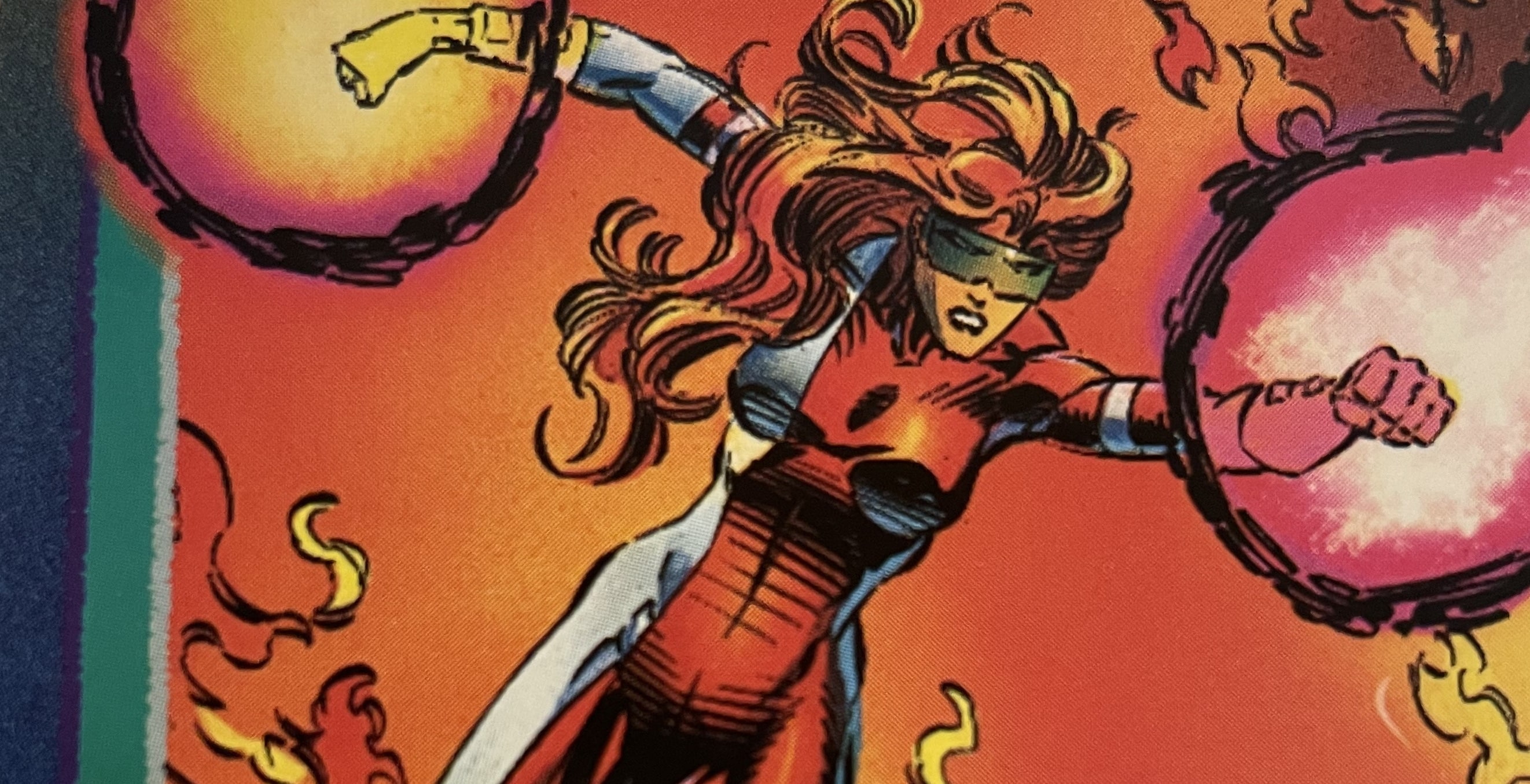
So imagine my surprise when I was browsing online comic art auctions and found the opening splash page of an Alpha Flight issue I had never seen before.
A little bit of background: I wrote a 512-page book about the first volume of Alpha Flight and never knew this existed, despite my extensive research into all of the eras of that series. What’s more, it was penciled by the legendary June Brigman, best known for her run on Marvel’s Power Pack but who also drew several issues of Canada’s preeminent superteam. Inked by Bruce Patterson, the art was gorgeous. And it was by a writer I was unaware had ever touched Alpha Flight. What a mystery!

Let’s cover the context clues to place this lost issue before we dive into the story behind it. The most prominent member of the team we can see is Heather Hudson, and she is wearing the team uniform. That puts us in the 1990s, near the end of the series. This was likely an inventory story created during Simon Furman’s run, which was interrupted by not one but two Infinity crossovers. Furman had no shortage of ideas for Alpha Flight, so this issue was an insurance policy should something run a bit late. Additionally, Rob Tokar is listed as the editor, which puts this issue’s creation firmly during Furman’s run.
Now it’s time to get into how this inventory story was created. Writer Frank Lovece’s name is one I hadn’t come across in my scholarship, so the first step was trying to track him down. Luckily, he was not only kind but very quick to respond.
Lovece gave a rundown of his comics career leading up to pitching Alpha Flight: “By then I had done the creator-owned Epic Comics miniseries Atomic Age and a couple of Hellraiser anthology stories, so I guess I was one of several people in the mix whom editors knew could deliver something on time that would at least be publishable” he told me. “I don’t remember if I had already gotten assignments for the Ghost Rider Annual and Incredible Hulk Annual stories I did.” Both of those annuals were published in August 1994, a few months after the first volume of Alpha Flight ended.
It’s entirely possible then that this inventory story was shelved because the series was pretty abruptly canceled and there was literally no home for it in the publishing line. The year prior, Lovece had worked on Hokum & Hex for Marvel’s Razorline imprint, which was brought to the publisher by horror novelist Clive Barker.
Lovece said he pitched two Alpha Flight stories to Tokar; since he and Rob were friendly, the pitches were welcomed. Lovece sent me the outlines of both stories, both of which would have made excellent issues. This story was the second one on that list, and the one Tokar was most interested in.
The basic idea is that the evil Canadian government (remember, Marvel’s Canada is run by a pretty authoritarian regime) is reneging on an agreement they made with First Nations people because they want to drill for minerals on land they had previously granted back to them (and really, the audacity — it was stolen land in the first place). The First Nations people are (rightly) upset about this, so the government sends in Alpha Flight to try to smooth things over. However, the team is not welcomed — the First Nations group points out they are a trifle insensitive, as they didn’t even invite First Nations team member Shaman to come with them.
Heather realizes her mistake and places a call to summon Shaman, while at the same time regretfully informing the First Nations people that the uranium-rich mine is property of all of Canada. (This, uh, really plays into my thesis that Heather Hudson is not necessarily a good leader for a team supposing to be the “good guys.”)
As the team moves to secure the mine, it is attacked by mutated bears and an Alphan is injured. It turns out there is a whole group of these mutated bears and they can really mess you up with their gigantic claws. Shaman arrives and confirms the bears are not any sort of Great Beast — one of Alpha Flight’s regular foes — they’re just mutates. His presence temporarily cools down the situation, but the tribe is still upset by the government’s actions and has occupied the exterior of the mine, as they now see the value of what is on their land and seek to exploit it just as the government had planned to do.
Alpha Flight then proceeds to battle the bears and subdues them before the military shows up and kills all the bears. Alpha Flight prepares to leave, despite the government liaison telling them it is their job to help secure the mine for the government. Heather responds that it is not their place to deal with politics. She flies up into the sky and seals the mine shut, meaning neither the tribe nor the government will have access. The bears, caught in the dispute between the two parties, now have a peaceful final resting place within the mine.
That’s one heck of a story, isn’t it? There’s a lot to dig into here. Best to let Lovece tell it:
“I wanted to try writing a superhero-team story. I soon learned that this requires different muscles than writing a solo-hero story — like playing football as opposed to playing tennis,” he said. “I wanted to write a character-driven story about the effect of extraordinary events on ordinary people.”
Specifically, about Alpha Flight, he said, “I was familiar with the characters since we all received the regular bundles of new comics, and as a freelancer only two or three years in I didn’t think I had any business pitching a Fantastic Four or X-Men inventory story. I learned how much harder it is, for me at least, to write a group book than a solo book. I did a perfectly respectable job and I think most readers would have liked it, but it wouldn’t have knocked their socks off.”
The story itself involves some very Canadian themes, especially since the province of Nunavut was still a few years off from being established. There were some very contemporaneous conversations being had about the rights of First Nations peoples when it came to their relationship with the Canadian government.
“Anytime anyone writes a story, you ask yourself what makes this day different? What things are specific to this locale/situation/milieu? What makes these characters different from those characters — what are their specific traits that make the team Alpha Flight, not the X-Men or the West Coast Avengers?” Lovece said. “I guess it just seemed that since they’re specifically Canadian heroes it made sense in a one-off story to involve a specifically Canadian issue/theme. A superhero story can do this in, obviously, the same way a Twilight Zone episode could, using allegory. And I tried to make this particular story not feel one-sided or didactic. The First Nations protesters at the end decide to cash in on the mining discovery, getting in bed with the corporate/government exploiters — prompting Guardian’s final action in response.”
Producing the issue went smoothly, and Lovece said art was completed for the whole thing.
“I felt lucky to have June draw it,” he said. “I did ask for one adjustment throughout a two- or three-page sequence because I probably wasn’t as clear as I should have been in my plot. Rob graciously conveyed this and it got done — either by the bullpen or June, I don’t know.”
Asked for his feelings about this lost story finally seeing the light of day (by its first page appearing for sale), Lovece said, “It’s gratifying and I’m grateful. I’ve mentioned to people I wrote an Alpha Flight inventory story, and it’s great to finally have proof!”
Lovece would continue to work for Marvel until massive layoffs at the company in 1996 spelled the end of his tenure at the House of Ideas.
I, too, am glad we are able to get this look into an Alpha Flight story that never was. Perhaps someday, other pages will surface so we can piece it all together to enjoy.
Daryl Richard Lawrence is an author (when he’s not working at his actual job), and his most recent book, True North, is a comprehensive companion to Alpha Flight’s first volume. It can be found on Amazon and Barnes & Noble. His next book, covering the music of Stevie Nicks, is out this spring. Follow him on Bluesky and Instagram @maconfleetwood.
Buy True North: A Complete Reference Guide and Analysis of Alpha Flight’s First Volume here. (Disclaimer: As an Amazon Associate, ComicsXF may earn from qualifying purchases.)