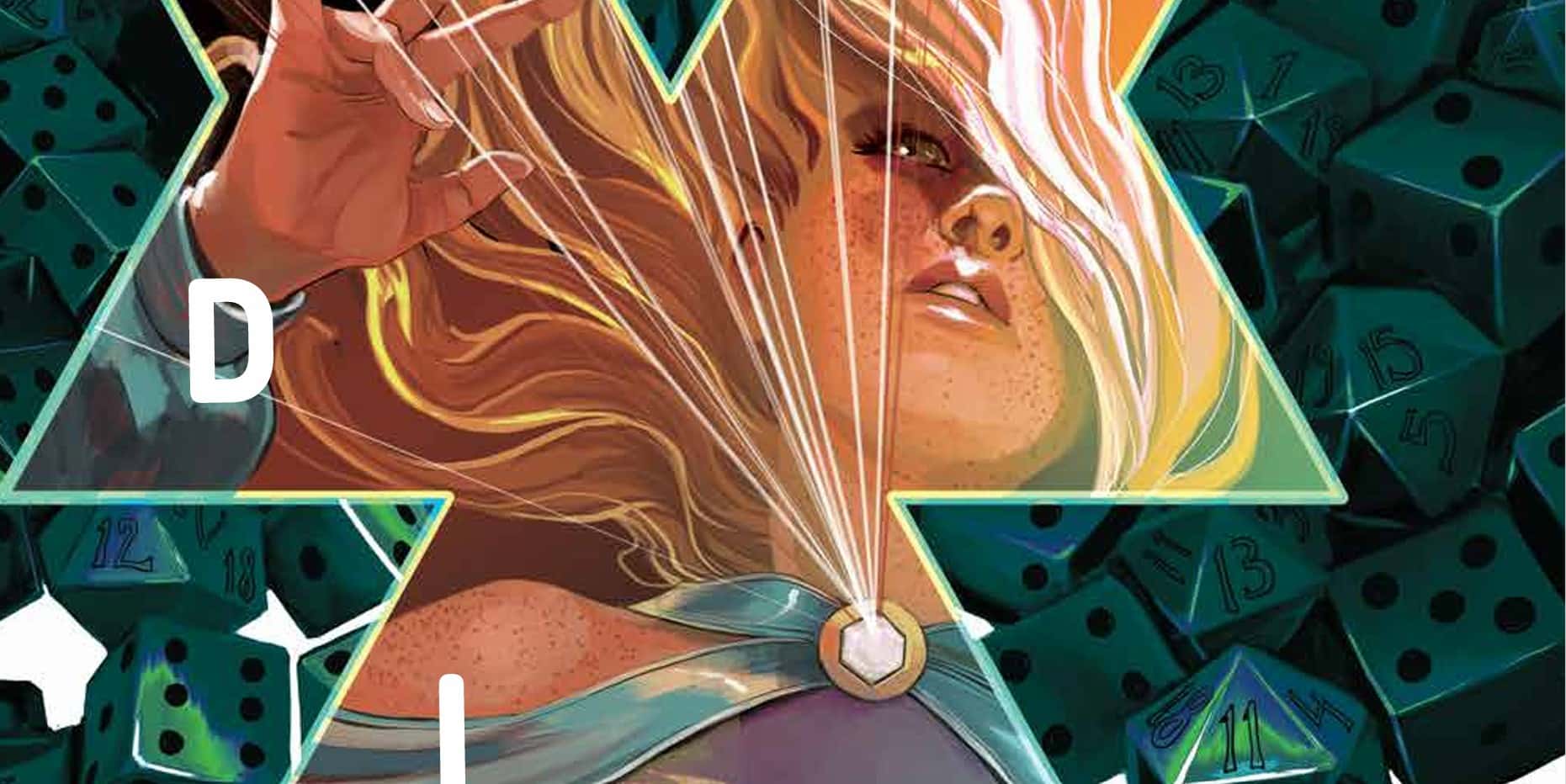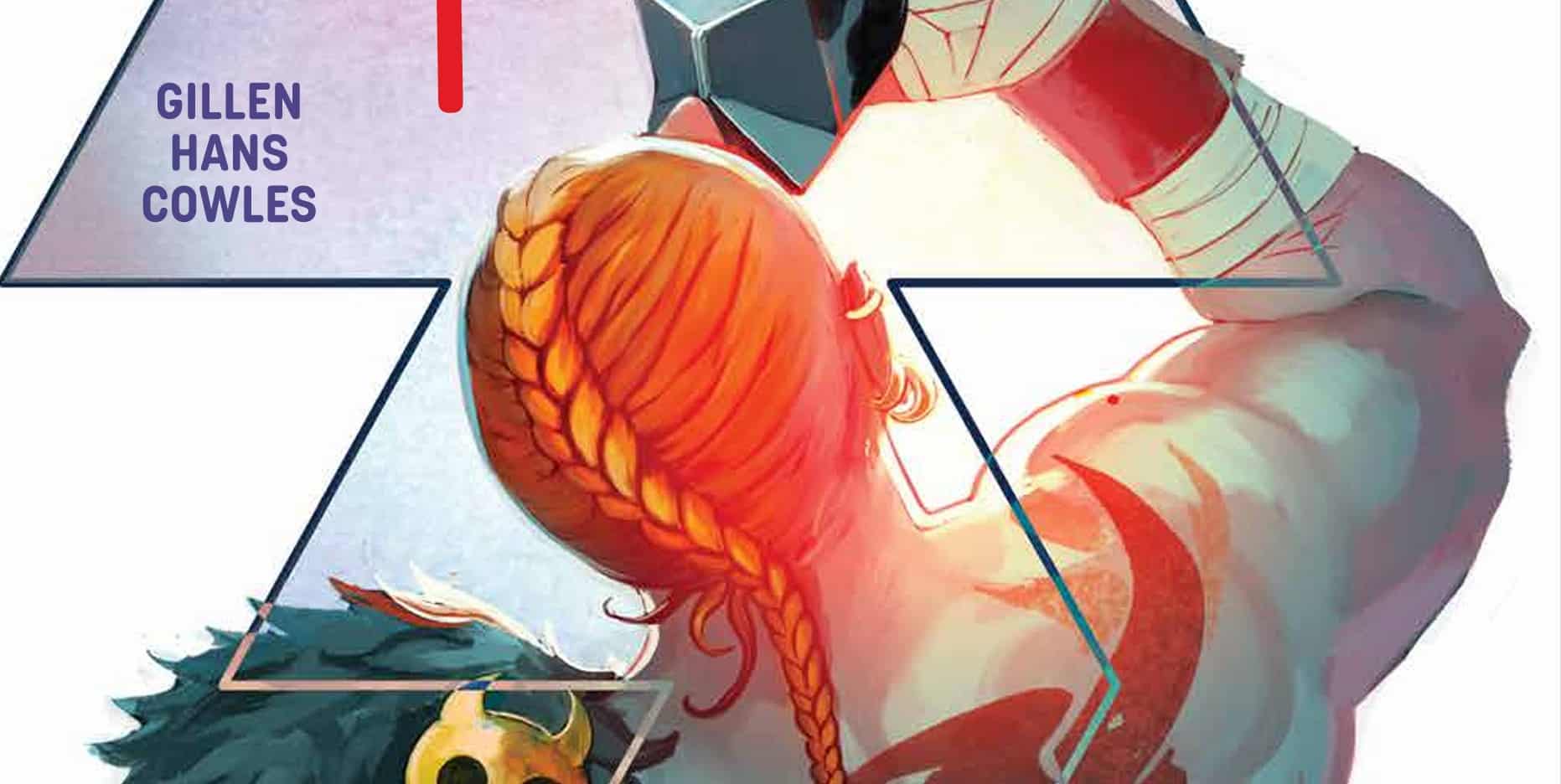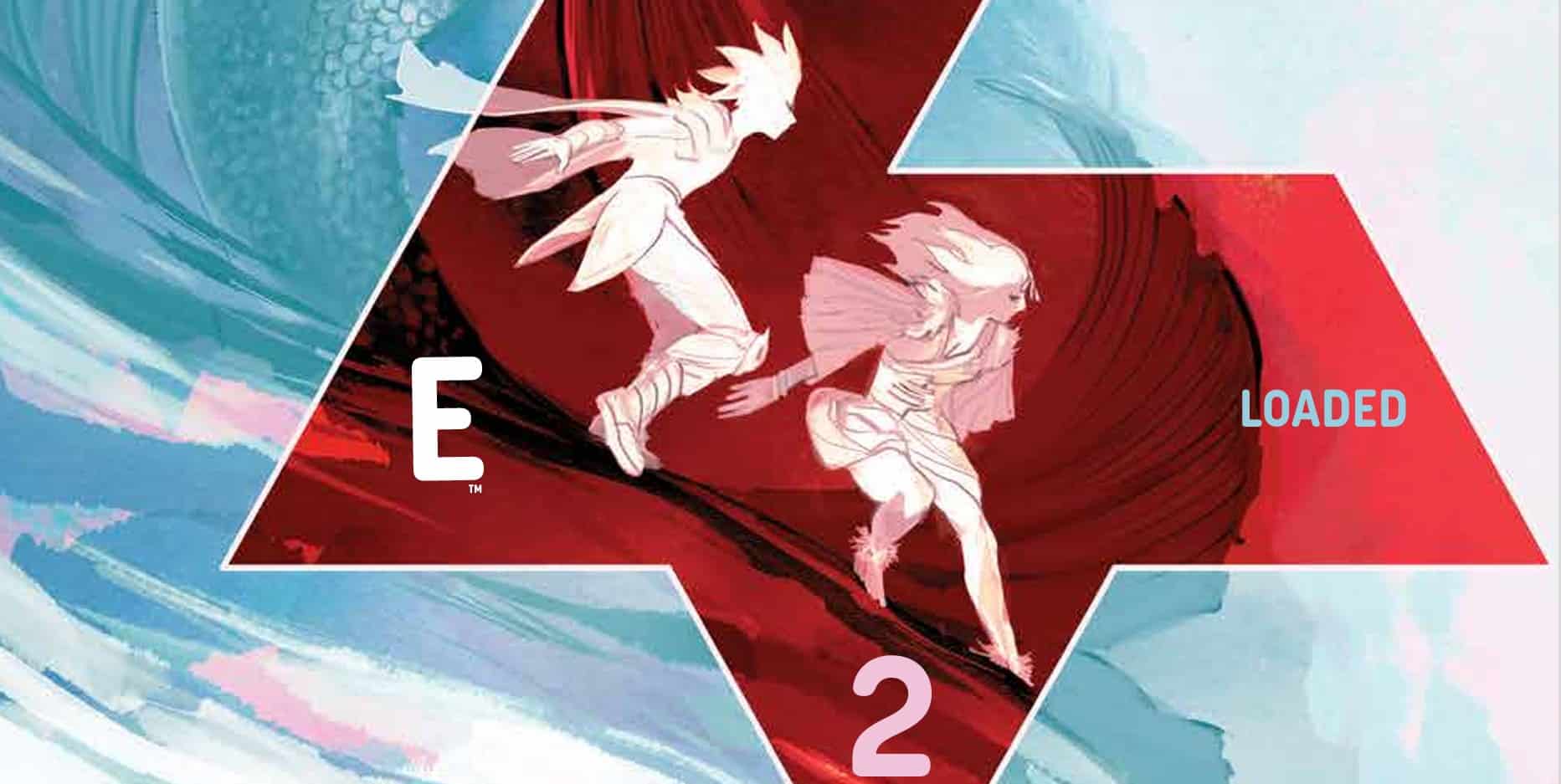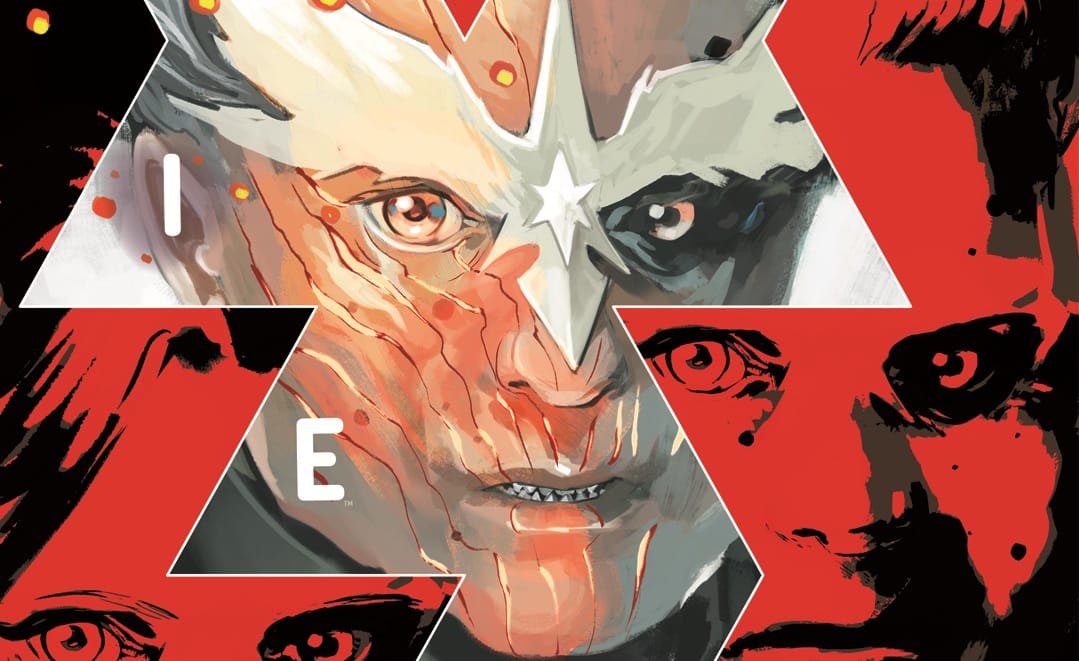
Three players have died. Their murderer has fled, living in a world of his best fantasies come to life — and without him, the surviving players have no way to get home. Everything’s a mess — so what better time for a cosplay competition? Put on your best Earther costumes for DIE: Loaded #7, written by Kieron Gillen, drawn by Stephanie Hans and lettered by Clayton Cowles, with design by Rian Hughes, for Image Comics.
Armaan Babu: Alright, we took a bit of a break last issue, but things were progressing well — we figured, what’s the worst that could happen?
Wait. Molly’s dead already? Violet and Margaret are also dead? Callum killed them, and he’s nowhere to be found, and until he is nobody can go home? I swear, we turn our backs for one issue …
Mark Turetsky: That’s why you always leave a note!
The game doesn’t end here

Armaan: Let’s start with a bit of a recap. In the ’90s, six kids fell into a roleplaying game, living out their worst fantasies in a world of their own making. They mostly returned, but in the lead up to 2020, they were drawn back in again.
They mostly returned. Chuck didn’t.
Now, the friends and family of the original crew find themselves trapped in the world of DIE once more. Our protagonist, Sophie, is doing everything she can to make sure her party survives. She’s not doing great. While finding the group’s Neo, Chuck’s eldest son murdered the remaining three members of the party in a bid to be able to stay in DIE forever — because he’s the Fool, and so long as he takes nothing seriously, everything is going to work out great for him.
What a terrifying power to give a teenage boy.
Anything else of note you would like to add?
Mark: I think that covers it pretty well!
Armaan: One thing I would like to discuss is Violet’s role as the Master here. Now, in your typical game of DIE, the Master is the one pulling all the strings. They not only lure their players into the world of DIE, but they orchestrate the challenges their players will face, create temptations so that the players can keep playing, and create warped reflections of the real world so that players can fight their inner demons in the guise of sometimes literal demons wearing the faces of their parents or what have you. The Master is also the one who chooses your role in the game. As a player, you can say you want to play a Godbinder, or the Fool, but it’s all ultimately the Master’s choice if you’re playing by the rules.
This doesn’t seem to be the case here. Yes, Violet is the one who drew them all into DIE — and she did craft herself an island that is a warped reflection of her own inner issues — but how much agency did she have beyond that? She barely knows Sophie, Molly, Margaret or Tommy. She knows enough of the rules to know that giving Callum the Fool role is a terrible idea. The challenges that the players have faced so far seem to be less her design than they are the workings of the omniscient, amoral god that DIE-the-entity is. Violet is as much of a pawn as the rest of the players.
Mark: I would say that that’s the Master’s role in the real-world TTRPG, where the game master plays a role with their own stat sheet and everything, and it’s what we thought was going on in the first volume of DIE, but, of course, we were all of us deceived, for another master existed, and that was DIE itself. I’d say Violet is in much the same position Sol was at the end of DIE. He might be the creator of the game, but the game has its own agency over everyone playing it, including the Master.
Armaan: She just knows how to cheat. She’s aware of the rules, enough to mess with them to be able to speak to her father with (relatively) minor consequences. She’s aware of what the game wants from its players (though not necessarily what the game is for), and she’s aware of genre conventions, being the only one who recognized the danger the Prancing Pony posed, a moment in literary history doomed to repeat itself. Sure, it didn’t help her, but she has an awareness of the metagame here that the others don’t. Her position is, interestingly, more powerful and less powerful than Sol’s was.
Mark: She and Callum both also present as two different types of modern-day gamers. Where the original party came into DIE in a time when TTRPGs were very much a new thing, the medium has matured significantly in the intervening decades, so Violet is drawing on a gaming tradition that just didn’t exist when Sol et al got sucked in. Games that are much more centered on feelings and personal relationships are much more de rigueur these days (though I wouldn’t say they didn’t exist prior to our contemporary moment, just look to the freaking Brontë siblings for an antecedent literally (literarily?) hundreds of years old. And Callum is coming from a tradition of games (largely the video variety) as dopamine delivery systems, where game mechanics exist solely to addict players in a neverending cycle of increasing challenges and rewards. Click on an item/character to take/kill/sex up. So for Callum, it’s not a means of growing psychologically, it’s just a version of World of Warcraft with immersive fucking.
Armaan: We see Sophie trying to track Callum down — and interestingly, the gods don’t seem interested in helping Sophie find the boy. It would end the game too soon. Which brings us to an interesting question: What are the gods of DIE for? Sure, they all have their own individual purposes within the game world, but is there something more to them? I have a thought on this, but I’ll get back to it later.
The Bear wants Sophie to take a life in return for bringing Callum back to the party. It’s not something Sophie is willing to do, especially not when she’s seen so much death already. Back at the inn, Molly hasn’t seen enough death — in a rage, she is killing Violet, again, and again. Violet falls, but then pops up again, giving Violet quite an outlet. Sophie worries whether there’s a price, and there is. From the RPG’s rules: “The sheet does not tell the player what dying as a Fallen means, but hints that it’s bad. That most Fallen have no personality speaks to that. It’s obvious what happens to those who remain Fallen eventually.”
Most of the Fallen we’ve seen so far are mindless drones, hungering only for the kill. How many deaths do Violet, Molly and Margaret have before they get there?
Mark: This brings me to a question about the nature of the Fallen. We’ve got a world that’s teeming with Fallen, and DIE reveals that they’re the remains of the hordes of players who will someday be sucked into the world of DIE. And we also know there’s something odd going on with the way time works between the game and the real world. But we haven’t really seen other personas from the real world showing up in the game. Like, at all, besides the paragon parties of this and the previous volume. So, to quote Enrico Fermi, “Where is everybody?” I feel like there’s space to discuss this more later in this issue, though.
Armaan: Another question worth asking: If you are a Fallen, can you kill players from other parties to come back to life? Or do you only come back to life if you kill someone from your own party, or someone you have a connection with?
Mark: I think that’s partially answered by Chuck and Sophie trading kills earlier in this series.
Armaan: Also an important question: If you’ve been left behind by your party, like Chuck has, is there any way for you to get back to the real world, even if you do come back to life? The people you must vote with are gone, after all.
Questions aside, a desperate Sophie turns to the Tyrant, because if anyone’s going to help further the story along, it’s him. He’s been itching for them to go on a proper quest. He’s even kindly, considerately, given them a silly, fun, non-combat quest: a cosplay competition. Where’s the harm in that?
Have you tried Linux?

Armaan: You ever think about how embarrassing it must be to be a celebrity entering a celebrity lookalike contest and lose? It’s the kind of thing worthy of an existential crisis. You enter a competition in being yourself, and lose. That’s pretty much what happens here.
Mark: In my theater conservatory, we performed an evening of one-acts where one of the plays had as its protagonist one “Mark McGretzky.” Only I and one of my colleagues auditioned for that part, and I avoided this existential crisis as the play was pulled for other reasons I won’t go into here, so I never had to face the horror of losing a role that was a perfunctorily disguised version of me.
Armaan: This scenario is more of a reverse cosplay competition; the fantasy denizens of DIE have (somehow) learned a bit of human culture, and are having a good laugh trying to dress up as them. Sophie’s biggest competition is an elf dressed as an IT guy. She’s actually from Earth. It should be a shoe-in.
That it was so easy a task sent down from a god should have been Sophie’s first clue that something was going to go bad. The fact that another god named Mistress Woe helped her out for free — well, signs don’t get much more clear than that, do they?
Mistress Woe helps Sophie change into her “costume.” Her real self. A mom from the midlands. Compared to the cheers the IT guy got, Sophie’s met with surprising silence — and then, she’s called out by a member of the audience for being a reality-warping, dice wielding Paragon. A face in the crowd, yelling at her for not being a real mother.
It’s a moment that doesn’t make a lot of sense. It’s a cosplay competition, none of the contestants are pretending to be real. Sophie, however, was just trying to be herself — and is called out for being an imposter.
Mark: I think it’s playing into Mistress Woe’s need to torture players, and it’s purely playing into Sophie’s anxiety and self-doubt about her own motherhood. If God, or fate, or The World wanted her to be a mother, it would have made her one naturally. Instead she had to play god and make herself a mother through unnatural means. Or at least that’s what the nagging voices in her head have been telling her likely ever since she started trying to become a mother. It’s not about the rules of the cosplay competition, it’s about Mistress Woe needing to make things as messy and fucked up for her players as possible.
It’s also reminiscent of a scene way back in DIE #4, where Isabelle, that party’s godbinder (speaking of which; have we learned yet who the fake-maybe-Isabelle is in this series?) is brought into the Temple of Mistress Woe in Glasstown and forced to read her teenage diary to the congregation as if it’s a sacred text. Mistress Woe may be inventive in ways to torture godbinders, but why change something that works? It’s even further alluded to by having the crowd at the cosplay competition decry Paragons because the last ones destroyed Glasstown.
Armaan: It was never confirmed, but I believe Violet was the person impersonating Isabelle. It’s also worth mentioning, because I don’t think the comics have stated it explicitly, that while a world like DIE may have more adventurers than you can shake a stick at, only the dice-empowered humans from Earth are actually Paragons.
With Sophie’s poor showing, we have only one (living) Paragon left to save the day. Enter Tommy.
On Neos, gods and GMs

Armaan: Here’s the fascinating thing about Neos. They have a built-in hook. Tempt them, tempt them with treasure, because if they don’t get it then there’s not a lot they can do. Take risks, make mistakes, get messy — but most important, get that godsdamned gold. The gold is a metaphor. What it’s a metaphor for depends on the Neo.
Hospitals can be terrifying things. No, scratch that. Hospitals can be humiliating things. Nurses, doctors, even your own family members can look at you like a misbehaving child just because you are hoping to exercise a little agency. You don’t get to pick your clothes. You don’t get to sit up when you want to, and even trying panics everyone the frick out. Depending on where your health is at, you might not even be able to go to the bathroom on your own.
Our Neo’s AI is a doctor. A helpful doctor — or a nurse — telling you what you can and cannot do. And medical bills pile up (more in some countries than others, but that’s another conversation). Every pill, every piece of advice taken, every exercise and concession to your diet and preferred lifestyle choices is another step toward getting out of this whitewalled place and back toward your own agency. All while you are at your most fragile.
Tie that in with dementia. People don’t trust you. People worry about you. Most of the time you feel fine. Your ability to judge how fine you feel, however, is constantly being called into question. You don’t want people to worry because you love them. You also don’t want people to worry because that’s when they call the nurses and doctors in, and suddenly your life is no longer yours again. So you lie, a steady stream of deceptions you make just so you can go to the bathroom without having to check in with someone else.
Sophie talks of the world as Die’s game — Die the dice-headed entity in fabulous armor, not the world, though the difference between the two may just be academic at this point. Perhaps that’s what the gods are for. If the Master is just a player who knows the rules and how to mess with them, then they’re not a proper GM. Perhaps that’s what the gods are for — stand-in GMs, facilitators of the plan for the actual GM. The gods will let you go, but only when you’re ready. When you’ve fulfilled all of the conditions of the game, and have paid off your debt.
To that extent, the AI is a GM, too. Someone in charge of your fate, someone who forces you to engage with the game’s mechanics, and someone who empowers you once you learn to play the game the way you’re supposed to play it. And Die’s rules are not just about engaging with the mechanics; the rules force you to engage with the uncomfortable parts of yourself you’d rather not think about by cloaking them in relevant metaphors.
They’re not subtle metaphors. But the cloaking lets you play with them nonetheless. In the conceit of the comic, however, and not the real-world game published by Rowan, Rook & Decard, the consequences of your choices are very, very real. Just ask Molly, Margaret and Violet.
Mark: Well observed. I’d also like to talk about the prize they end up with: the magical artifact that produces (at least) three fair gold every day. First off, it seems like it breaks, or at least subverts, the rules of the game. The need to hunt down fair gold is fundamental to the Neo. It’s meant to be the Neo’s addiction, a need to get a fix every day just to make things right. But I suppose it’s a boon from a god, so it can at least bend the rules a little bit.
But also look at the form the artifact takes: a daily pill caddy. As a middle-aged man, it’s a shape I’m well-acquainted with. I’m in reasonably good health, but I still need to take a battery of medications to stay that way. Perhaps it’s reflective of Tommy’s privileges under Britain’s National Health Service, which is, to my understanding, a huge point of pride among all Britons but somehow also a disgusting waste of money and resources according to certain quarters. Look, I’m not British myself, so I’ve only gleaned these things by osmosis, so take precisely nothing I say seriously.
And it ties in with the Neo’s association with disability. In DIE it was Angela’s missing arm that she made up for with Neo powers, while Tommy is dealing with dementia. An important distinction, though, is that she lost her arm in the game and brought that disability back to the real world, whereas Tommy has brought his dementia into the game with him. Here he’s now got a magic pill caddy which will help him keep the party’s Fallen members under control, and that will take all three of his fair gold coins. How long until the game offers him a temporary cure for his dementia, but say that takes a coin to do. Suppose it takes two coins? How would he balance his needs versus the needs of the group? Would it even be fair to ask him to do that? Suddenly that three-coin budget doesn’t seem very adequate, does it?
Armaan: It is the nature of DIE to ask you what you want, and give it to you. Then ask you how badly you want it — and what you’ll do to keep it. Like actual medication, there’s a danger of this particular brand of Fair Gold becoming addictive — not to mention its form being a cruel joke for a man who’s likely had to face a pill box just like that one every day for a while now.
Mistress Woe is certainly having a good time of things. Especially as Chuck’s come back — and with the aid of his god-summoned wolf, he’s slaughtered Violet, Molly and Margaret. Like father like son, I suppose.
It’s one hell of a cliffhanger for sure, but next issue? We’re rolling initiative.
Roll for miscellaneous thoughts
- One of the human cosplayers is, hilariously, a French mime with a baguette.
- It feels like the veil between the worlds is at its thinnest, with all of these Earth cosplayers. I worry that a blood-dimmed tide of players may pour into DIE at any moment.
- The green-skied, open seas that made up the opening panel might be the most gorgeous piece of art that Hans has put out in this comic so far, and that’s a high bar to clear!
- Killing Fallen like Violet, Margaret and Molly does nothing for Chuck, but if he kills Sophie or Tommy? He comes back to life — and one fewer person gets to go back home.
- It’s notable that Paragons lose their powers when they become Fallen — though Molly still has control of her weapons, it’s notable that her weapons are, for the first time, silent.
- Also of note: Tommy can hack the Fallen, freeze them in their place. He’s loaded up on Fair Gold, just in time to be able to hack into Chuck if necessary, but what about Chuck’s mount?
- If you’re reading Die: Loaded but are not reading The Power Fantasy — but still plan to — you might want to avoid the letters page, as there is a pretty large spoiler there for the end of the latest arc.
Buy DIE: Loaded #7 here. (Disclaimer: As an Amazon Associate, ComicsXF may earn from qualifying purchases.)

Armaan is obsessed with the way stories are told. From video games to theater, TTRPGs to comics, he has written for, and about, them all. He will not stop, actually; believe us, we've tried.

Mark Turetsky is an audiobook narrator and voice actor who sometimes writes about comic books. Originally from Montreal, Canada, he now lives in Northern Louisiana. Follow him @markturetsky.com on Bluesky.