A couple of weeks ago, me and my one and only Adam Reck attended Super Jersey Comic Expo in Hillsborough, New Jersey, where we spent several hours browsing longboxes and folding tables festooned with subjectively valued trash and treasure. When perusing such wares, I rarely search for anything in particular. While I own a lot of comics and books about comics, collected over a span of many years, I don’t consider myself a comics collector; I’m just a comics fan who’s sometimes also a comics critic and comics scholar.
But I do have particular desires for particular kinds of objects. To the degree I’m searching for anything at a con, I’m searching for something with a shimmer of strangeness or a tantalizing twinkle of romanticized relevance. In other words, something sorta weird and personally meaningful — the kind of thing you’re not looking for until you are, because it finds a way to find you, at which point you’re suddenly struck with a surge of sureness about the absolute necessity of adding that very particular thing to your sprawling non-collection of sorta weird, personally meaningful misfits. At Super Jersey, one of those things was Wonder Woman: A Ms. Book. Originally published in 1972, this book includes reprints of Golden Age Wonder Woman stories personally chosen by Ms. magazine editor and co-founder Gloria Steinem, who also writes an introductory essay and briefer introductions to each thematic section.

When I welcomed Steinem’s book into my arms, I had no way of knowing the famous face of second-wave feminism would pass away four days later, at the age of 92. Steinem’s death ushered in a flood of glowing tributes as well as rigorous reminders of her many perceived imperfections, as observed by the usual conservative commentators as well as some leftists and feminists. Several of the latter critiques are valid, particularly the longstanding charge that the second-wave feminism Steinem personified tended to privilege the perspectives of straight, cis, middle-class white women, helping inform neoliberal compromises with the capitalist, patriarchally informed “establishment.”
As someone who’s taught university courses called “Gender Studies” and “Subversive Feminist Comics,” I’m very aware of these critiques of second-wave feminism. I’ve repeatedly shared them with students, occasionally accompanied by representative images of Steinem displayed on giant screens, her memorable visage towering over folks who never knew a world without Title IX or the Equal Credit Opportunity Act. While I’ve also duly noted the many important accomplishments of second-wave feminism, I’ve sometimes fallen into the trap of scapegoating Steinem for the inevitable shortcomings of a movement that was far vaster and more varied than the views of any specific woman.
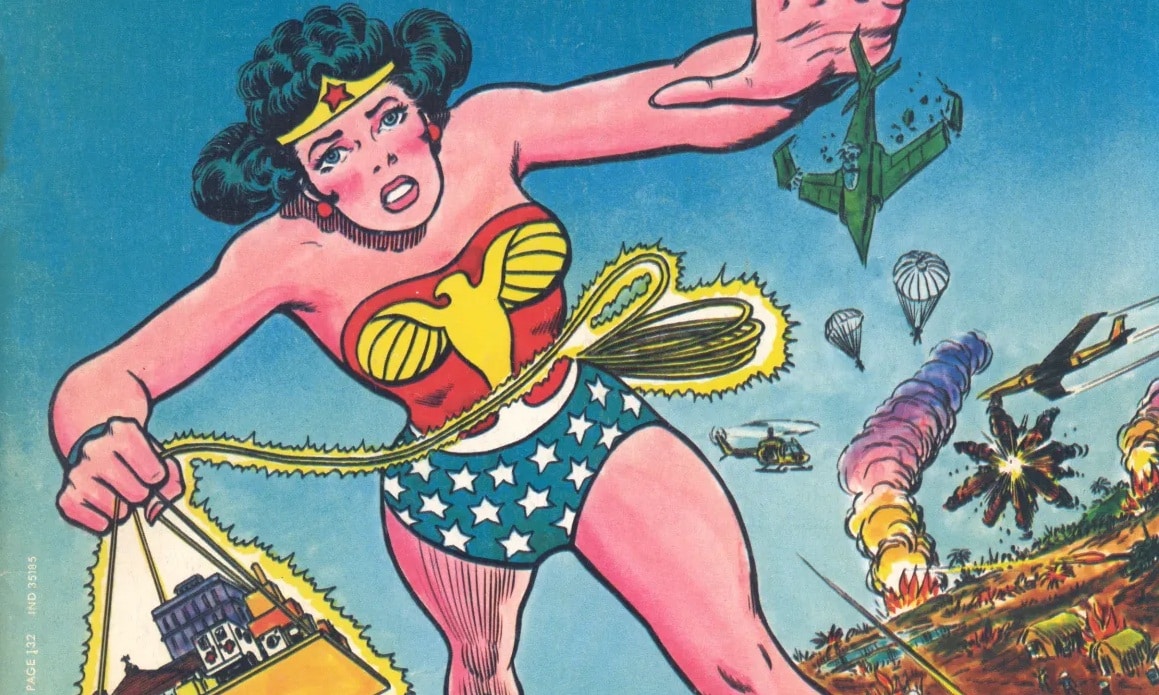
This diversity is on full display in the first issue of Ms. — the one with a cover drawn by Murphy Anderson showing Wonder Woman swatting warplanes out of the sky and bold text declaring “Wonder Woman for President.” Behind its famous cover, this debut issue includes features such as an interview with Simone de Beauvoir spotlighting what the much-quoted philosopher characterizes as her interestingly radical feminist politics; a first-person essay with helpful tips and tricks for engaging in lesbian sex and romance; profiles of women from Appalachian mining towns proposing common cause between feminism and environmentalism; and practical advice for talking to male car mechanics and campaigning to support the Equal Rights Amendment. In a feature written by Joanne Edgar (who stepped in for Steinem when the latter was struggling to meet deadline for her own feature on women’s voting patterns), it also reprints the origin story of Wonder Woman and teases Wonder Woman: A Ms. Book.

Like the second-wave feminist movement writ large, the original Ms. magazine was messy; you can tell it’s trying to include the voices and concerns of folks who aren’t middle class straight white women, but these efforts can feel clumsy and tokenistic or, in contemporary parlance, cringey. Nonetheless, it’s an ambitious effort to propose a pop cultural compendium for the politics of sisterhood. And in that, it’s excitingly powerful. When teaching and talking about second-wave feminism, I fear I’ve often neglected to underscore this exciting power as a counterpoint to the movement’s problems. I’ve also never actually spoken, with any of my students, colleagues, friends or loved ones, about what the particular personage of Gloria Steinem meant to me, in my identity as a feminist and, more specifically, in my identity as a feminist comics fan and scholar.
I’ll start to make up for this neglect by saying: I didn’t purchase Wonder Woman: A Ms. Book for Wonder Woman. I purchased it because I wanted Steinem’s essay, which I’d read before but never like this — in its alluring original printing with dogeared creases from when my late mother was young, when she and so many other women of all ages were fighting for rights I try not to take for granted but nonetheless inevitably do. In honor of Steinem’s passing, I reread her personal reflection on her fiercely complicated love for a deeply flawed yet undeniably powerful fictional female superhero and found myself revisiting my own complicated affection for a real woman with real flaws who nonetheless really inspired me. Which is what the rest of these words are about.
Steinem’s essay opens with a deeply relatable confession: “Comic books were not quite respectable, which was a large part of the reason I read them.” This can be considered true of comics in general, which are still too often perceived as an illegitimate form of reading. But in my experience, this illegitimacy is doubly true when girls and women read comics. Case in point: the many men who’ve stared at me in comic book stores or the guy I encountered selling old X-Men comics at the Chelsea Flea Market last fall, who shook his head, dumbfounded, and told me he’d never seen a woman read a comic. Feeling excluded from comics culture can be sucky (more on that later). Yet it can also be fun to read stuff you’re not supposed to. For both me and Steinem, superhero comics were a forbidden fruit, and I’m pretty sure she’d agree Eve was right to eat the apple.

Steinem stays relatable when she discusses the universal appeal of stories about “heroes who can see through walls or leap over skyscrapers in a single bound,” paired with disappointment about how few of such heroes are women. The consequence of this discrepancy, writes Steinem, is that “the female child is left to believe that, even when her body is as grown-up as her spirit, she will still be in the childlike role of helping with minor tasks, appreciating men’s accomplishments, and being so incompetent and passive that she can only hope some man can come to her rescue.” Steinem claims she was “rescued from this plight” by a woman — specifically the Golden Age version of Wonder Woman created by psychologist William Moulton Marston and artist Harry G. Peter, which Steinem loved as a child.
The affection Steinem feels for Marston and Peter’s Wonder Woman extends from both the fact and methods of the character’s tremendous power: “[Wonder Woman’s] creator had also seen straight into my heart and understood the secret fears of violence hidden there. … Here was a heroic person who might conquer with force, but only a force that was tempered by love and justice.” Steinem further locates feminist politics and purpose in Wonder Woman’s ability to convert her enemies through the transformative power of truth, which is given literal form in the Amazon’s magic lasso. Wonder Woman, writes Steinem, “was beautiful, brave, and explicitly out to change ‘a world torn by the hatreds and wars of men.’” The importance of sisterhood is another recurring refrain: “Wonder Woman’s family of Amazons on Paradise Island, her band of college girls in America, and her efforts to save individual women are all welcome examples of women working together and caring about each other’s welfare.”
Yet Steinem also acknowledges that even her most beloved Wonder Woman stories are far from perfect. She’s critical of the contradictory philosophies of power these comics communicate, which often tout a belief in universal human rights while simultaneously suggesting dualistic binaries wherein either men or women are always on top. For Steinem, this confusion manifests most often in Wonder Woman’s love life, wherein, “she can only love an equal. But an equal never turns up, and sometimes she loses her grip on herself and falls for the masculine notion that there must be a permanent winner and a permanent loser, a conqueror and a conquered.” In contrast to this hierarchical duality, Steinem argues that “most feminist philosophy supposes that the hierarchy itself must be eliminated; that individuals who are free of roles assigned because of sex or race will also be free to develop the full range of human qualities.”

Steinem is additionally critical of the various turns Wonder Woman comics took in the wake of Marston’s death, especially the 1968 debut of “The New Wonder Woman,” a storyline wherein the Amazon princess relinquishes her superhuman powers and home on Paradise Island to become “a mere mortal who walked about in boutique clothes and took the advice of a male mastermind named ‘I Ching.’” Part of Steinem’s project, both here and in the spotlight she shines on Wonder Woman in the first issue of Ms., is to campaign for the return of what she calls “my Wonder Woman,” meaning a restoration of what she perceives as the Amazon’s feminist purpose.
Part of Steinem’s campaign was successful. A year later, Wonder Woman regained her powers and original costume, though whether her 1970s stories fully embraced a feminist purpose is debatable. How directly Steinem influenced comic book storylines is also up for debate. As Brian Cronin recently discussed in his “Comic Book Legends Revealed” column, the timing of Steinem’s campaign and Wonder Woman’s return to her classic look may be purely coincidental. But it doesn’t really matter, because Steinem’s campaign was about much more than bringing back Paradise Island and the invisible plane, let alone the nationalistic stars and stripes for which Steinem expresses both nostalgic affection and retrospective unease.
Steinem’s vocal assertion of Wonder Woman’s feminist legacy is an important assertion of presence within cultural histories that have traditionally excluded and marginalized girls and women. Moreover, by tying Wonder Woman’s feminism to her own personal history and ancient Amazonian myths, Steinem all but credits Wonder Woman for her own strength and vision of second-wave feminism. This presentation of Wonder Woman as a neglected feminist icon inspired by neglected myths is about creating feminist lineages from which new dreams and societies might be born. In this, Steinem’s feminist Wonder Woman becomes symbolic of the method of critical thinking called “consciousness raising,” wherein folks are encouraged to rethink accepted norms in search of deeper truths about how those norms might be cultural rather than natural — a lot like Wonder Woman converting baddies with her magic lasso.
One such accepted norm is the belief that comics have only ever appealed to boys and men, and that superheroes have never, and can never, reflect anything besides boringly prepubescent patriarchal power fantasies. In her own time, Steinem was speaking back to stuff like Jules Fieffer’s 1965 book The Great Comic Book Heroes, often described as the first extended critical reckoning with superhero comics. In this otherwise enjoyable collection of essays, Fieffer writes: “I can’t comment on the image girls had of Wonder Woman. I never knew they read her — or any comic book. That girls had a preference for my brand of literature would have been a more frightening image to me than any number of men being beaten up by Wonder Woman.” This is a self-deprecating anecdote, but that doesn’t mean it’s not depressing, underscoring as it does the ways in which girls reading comics can be considered far more impossible than x-ray vision or bulletproof skin.
In her tellingly titled 1996 book The Great Women Superheroes, cartoonist and historian Trina Robbins recounts many more men who were contemporaries of Steinem dismissing the value of Wonder Woman. In 1970, two years before Steinem publicly registered her Wonder Woman fandom, the book All in Color For a Dime includes an essay in which Jim Harmon calls the touchy-feely sisterhood of Golden Age Wonder Woman comics “a very sick scene.” And The Steranko History of Comics, also published in 1970, characterizes Wonder Woman as a scold who “delighted in beating up men.” Robbins additionally cites Richard Reynolds’ 1992 book Super Heroes, a Modern Mythology, where he focuses on how Marston and Peter’s Wonder Woman comics “developed with a frank appeal to male fantasies of sexual domination.” This is an important part of Wonder Woman’s story, from her bondage-heavy debut to her objectively objectified present. But Steinem’s unapologetically passionate recollection of all the other things Wonder Woman can do reminds us it’s not the only story.

More than three decades after Steinem wrote her essay on Wonder Woman, when I was first falling in love with comics and starting to read and write about them critically, male and masculine perspectives on comics and superheroes continued to prevail. Many of the first books I read about comics had titles like Of Comics and Men: A Cultural History of American Comic Books and Comic Book Culture: Fanboys and True Believers, advertising, right in their titles, that they viewed the history of comics as an exclusively male story. There was no room within these versions of history for the fact of Steinem’s Wonder Woman, let alone its implications.
Which is exactly why Steinem’s essay matters, and why it meant so much to me when I first encountered it in an online forum more than a decade ago. Back then, it was still pretty lonely being a feminist woman who saw the many flaws of superhero comics but loved the good parts anyway, and who wanted a way to talk about those feelings that didn’t make me feel like a bad feminist for feeling them. Knowing that an icon of second-wave feminism shared some of my ardent, lonely feelings made me feel seen and offered intellectual scaffolding for my suspicion that superhero comics are more complicated than the reductive recounting of too many boring boys. In short, Steinem’s history of reading and loving Wonder Woman gave me a history too, which made my present reality realer.
Steinem not-co-coincidentally concludes her essay on Wonder Woman by speaking directly to the importance of recording and believing in feminist history, which she presents as a form of sisterhood stretching across years and eons and a union of dreams and deeds:
“The Amazon cultures may one day be proven as fact. Meanwhile, the fascination that brings them up as fantasy again and again may itself be some psychic evidence of their existence. If so, Wonder Woman becomes just one small, isolated outcropping of a larger human memory. And the girl children who love her are responding to one small echo of dreams and capabilities in their own forgotten past.”
In Steinem’s reading, ancient misogynistic myths of female warriors and 20th century comic books starring superpowered women in bustiers and star-spangled miniskirts can be feminist if you want them to be. Which doesn’t mean ignoring messy contradictions but does mean seizing on your bone-deep belief in the possibility of building something better on sometimes-flawed foundations.
As a feminist comics fan, critic, and scholar, this is something I’ve tried to do, with the help of many other women with many other similar and different feelings and theories about superheroes. Steinem’s essay was arguably the first time a prominent feminist proudly proclaimed the emancipatory potential of superhero comics. But it wouldn’t be the last. After encountering Steinem’s essay, I started searching for other feminist historians and theorists who loved superheroes and quickly found Trina Robbins, Lillian S. Robinson, and Roz Kaveney. More recently, I’ve been lucky to listen to and learn from folks like Carolyn Cocca, Margaret Galvan, Rebecca Wanzo, Joan Ormrod, Sam Langsdale, Deborah Elizabeth Whaley, Esther De Dauw, and many, many more.
But within feminist sisterhoods, it’s okay to have particular feelings about particular heroes. It’s also okay if they’re less than perfect. One of Steinem’s imperfect heroes was Wonder Woman. And one of mine is Gloria Steinem.

Anna Peppard
Anna is a Ph.D.-haver who writes and talks a lot about representations of gender and sexuality in pop culture, for academic books and journals and places like Shelfdust, The Middle Spaces and The Walrus. She’s the editor of the award-winning anthology Supersex: Sexuality, Fantasy, and the Superhero and co-hosted the podcasts Three Panel Contrast and Oh Gosh, Oh Golly, Oh Wow! Follow her @annapeppard.bsky.social.