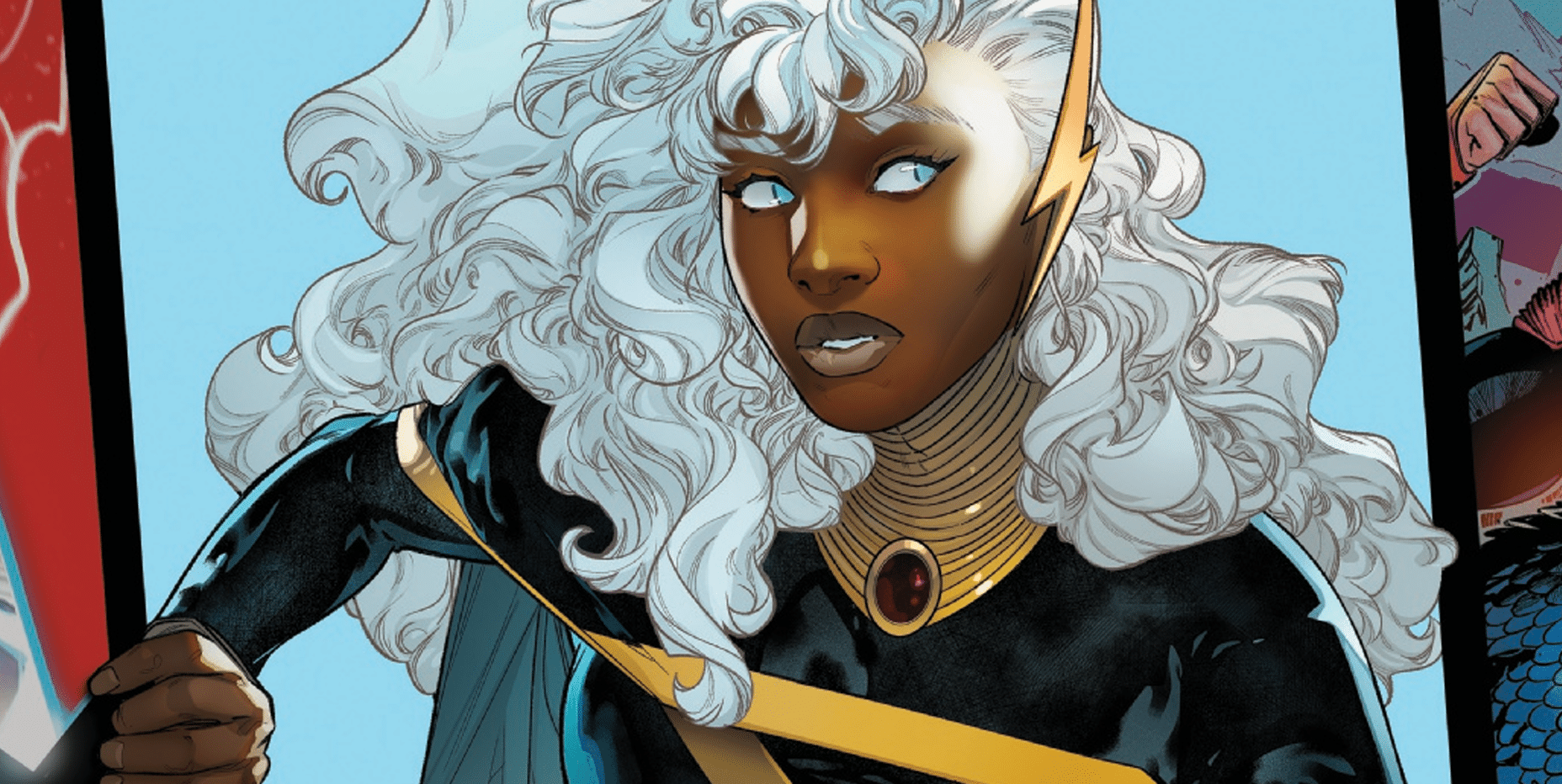
To save Storm from the War Above All, a mysterious entity abducts Ororo from the multiverse completely. Storm must find her way back to Earth-616 by any means necessary. Storm: Earth’s Mightiest Mutant #3 is written by Murewa Ayodele, drawn by Federica Mancin, colored by Java Tartaglia and lettered by Travis Lanham.
I came across a joke a few days ago: “I overheard a woman using ‘mansplain’ wrong, and I had to just shut up.”
Queue rimshot.
Well, I thought that was funny.
Even if you don’t agree with my humor (which means you have no humor), maybe you’ll agree with the sentiment I took from the quip: that we should question when, if and how we interject ourselves into others’ conversations.
And if you agree with that sentiment, then maybe, like me, you’ll do some self-reflection and ask: “Am I really the right person to give this critique, or should I just shut up?”
Going down the representation rabbit hole can feel a bit confounding, a bit overwhelming, maybe guilt (and anger) inducing: Who has the right to tell whose story? What qualifies as authentic and good? How authentic does something have to be to be good? What does good representation look like, and if that representation isn’t there, does it mar the entire work?
Lots of questions, and no easy answers.
I’ve been critical of Storm since its inception well over a year ago (man, time flies … except when you realize it’s moving slow and you still have three more years to go … hopefully). A decent part of my critique is centered on those same representation questions: Is a man of any ethnicity the right person to tell the story of a Black woman, when so few Black women have the opportunity to write? When I see things I question, do I look at them through a purely thematic/story-based lens, or must I (should I?) use a sociological lens to ask why and why not?
Et cetera, et cetera.
I’m not writing this to answer those questions; I’m not sure if there’s even an answer. Every work is different, every writer is different, every voice is different, and thus, every standard is different. I am, however, writing this to say that it’s worth the effort to ask those questions, for sometimes — including here, in Storm: Earth’s Mightiest Mutant #3 — you might get an answer you like.
Is the story still unnecessarily convoluted, with so much thrown in each issue it feels almost overwhelming to read? Absolutely. We have dead X-Men (or their discarded corpses at the least) reanimated by Doctor Voodoo to kill gods (Orisha) in the hopes of attracting a granddaddy god (Olorun, the supreme Youruban deity). We have Storm, enraged that someone was killed in her sanctuary (and on her watch), pulled from reality by an alternate version of her mother, warning her that, yet again, the fate of the universe lies on her shoulders. And we have, as per normal, a bevy of other side quests, cameos and implications that may or may not directly affect this issue, or the next.
But what we do have here, which we haven’t had in such a long time, is an active-voiced Storm. A Storm who thinks for herself, who acts with agency, who mourns and cries and shows anger. We have a whole mutant, a whole woman, who acts, as opposed to just being acted upon. We finally have a character empowered to lead her own book, even if she’s still largely (and self awarely) moving at someone else’s whims. I’m tired of her battles constantly being chosen for her, but to see Storm tired of this too makes the exhaustion relatable, and supports the story’s overarching arc. Her voice is an answer to a question I’ve posed over and over again, and I’m happy to finally hear that answer in her voice.
This is unambiguously a good thing, an answer to years’ worth of questions and commentary, even if the story itself is still largely just OK.
____________________
There is only one comic book printed by the Big Two that centers on a Black woman — maybe two if you count Absolute Green Lantern’s Jo Mullien.
There is only one comic being written by a Black woman in the Big Two — Eve Ewing’s X-Men Academia, err, United.
It is, of course, unfair to ask one person to represent an entire people; it’s maybe unnecessary to have the subject of a book be written by the people they share a background with (see how well Al Ewing’s written both Jo and, well, Storm). While I have the gravitas and background to critique some aspects of the book, going down the rabbit hole of who should write what for whom, while important, is still subservient to a larger question about this work and any work of art:
Does this work do what it needs to be good?
I’m still not sure Storm does: It’s still a mess, though more endearing than it was in the past. But, again, what it lacks in cohesion, it more than makes up for in effort: an effort to represent cultures that have been overlooked, and a newfound desire to allow the lead to speak for herself. In an environment so short on voices — on those who not only want to make an effort, but will do the work to insert the effort into the work — I will meter my complaints.
Storm is as necessary as it is imperfect and, really, what could be a better representation of humanity (or mutantdom) than that?
Buy Storm: Earth’s Mightiest Mutant #3 here. (Disclaimer: As an Amazon Associate, ComicsXF may earn from qualifying purchases.)

A proud New Orleanian living in the District of Columbia, Jude Jones is a professional thinker, amateur photographer, burgeoning runner and lover of Black culture, love and life. Magneto and Cyclops (and Killmonger) were right. Learn more about Jude at SaintJudeJones.com.