A new school has opened for mutants, this time in a psychic space. Who pulled the psychic fire alarm? And what’s Captain America doing in the teacher’s lounge, other than trying to sell a few more comics to people who mostly don’t read about mutants? Find out in X-Men United #2, written by Eve Ewing, drawn by Tiago Palma, colored by Brian Reber and lettered by Joe Sabino.
I’m afraid Adam was right.
About a month ago, a new semi-flagship X-book, the latest in a multi-generation line of school-based books (New Mutants, Generation X, New Mutants: Academy X and so on), hatched from the still-smoking ruin of the “Age of Revelation” event, helmed by Eve Ewing and drawn by Tiago Palma. The new school exists in a psychic pocket dimension, everywhere and nowhere at once, finding, rescuing and recruiting new mutants through its own version of Cerebro, the emotion-driven Empathy Engine.
ComicsXF’s Adam Reck thought the book a dud through and through. I disagreed.
Buoyed by the memory of Ewing’s Exceptional X-Men, happy about Ewing’s version of Kitty Pryde, delighted by the return of the teens she created, and willing to credit Palma’s sped-up, cartoonier style as a fine second choice absent the great Carmen Carnero (who drew a lot of Exceptional), I put my trust in this traditionally structured opener, and in the tensions it started up: between Emma Frost (who always wants to open a school) and other teachers’ reservations; between Kitty (who prefers honesty) and Emma (who likes hiding her master plans); between the impulse to throw a punch (always present in superhero books) and the many teachable calm-the-fuck-down moments; between the most methodical adults and the most impulsive kids.
I found myself willing to forgive the how-many-mutants-can-you-fit-into-an-elevator cast list; the unusually contrarian, even cranky Cyclops (who thinks it’s too risky to start any school); and the under-explained science-fictional premise.

I set out to find things to like in this second issue, too. I found a few. Kitty’s still in character, trying to do the right thing by everyone, and stressed out by the attempt. Ewing’s version of Prodigy, practical and serious, works beautifully, and Palma draws him expressively and carefully, a hero who knows he doesn’t have physical powers but figures out how to contribute anyway. Ewing’s A-plot asks X-readers to recognize (or discover) the excellent and very serious Truth: Red, White and Black, which introduced a still-canonical extra backstory for Captain America: The U.S. Army created super-soldiers before they settled on Steve, but the earlier experiments — conducted on Black subjects — had far worse results. Like the real-life Tuskegee experiment.
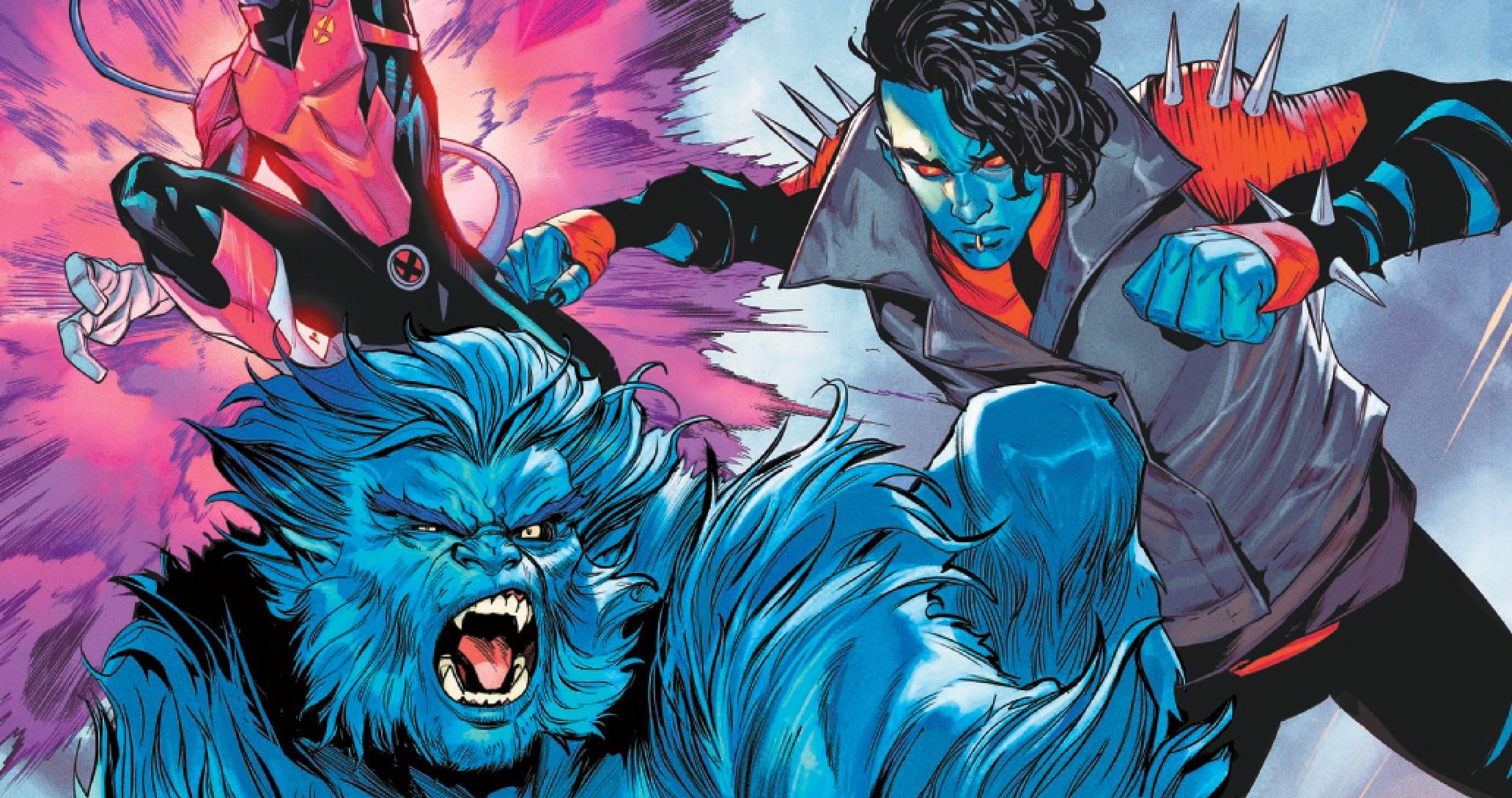
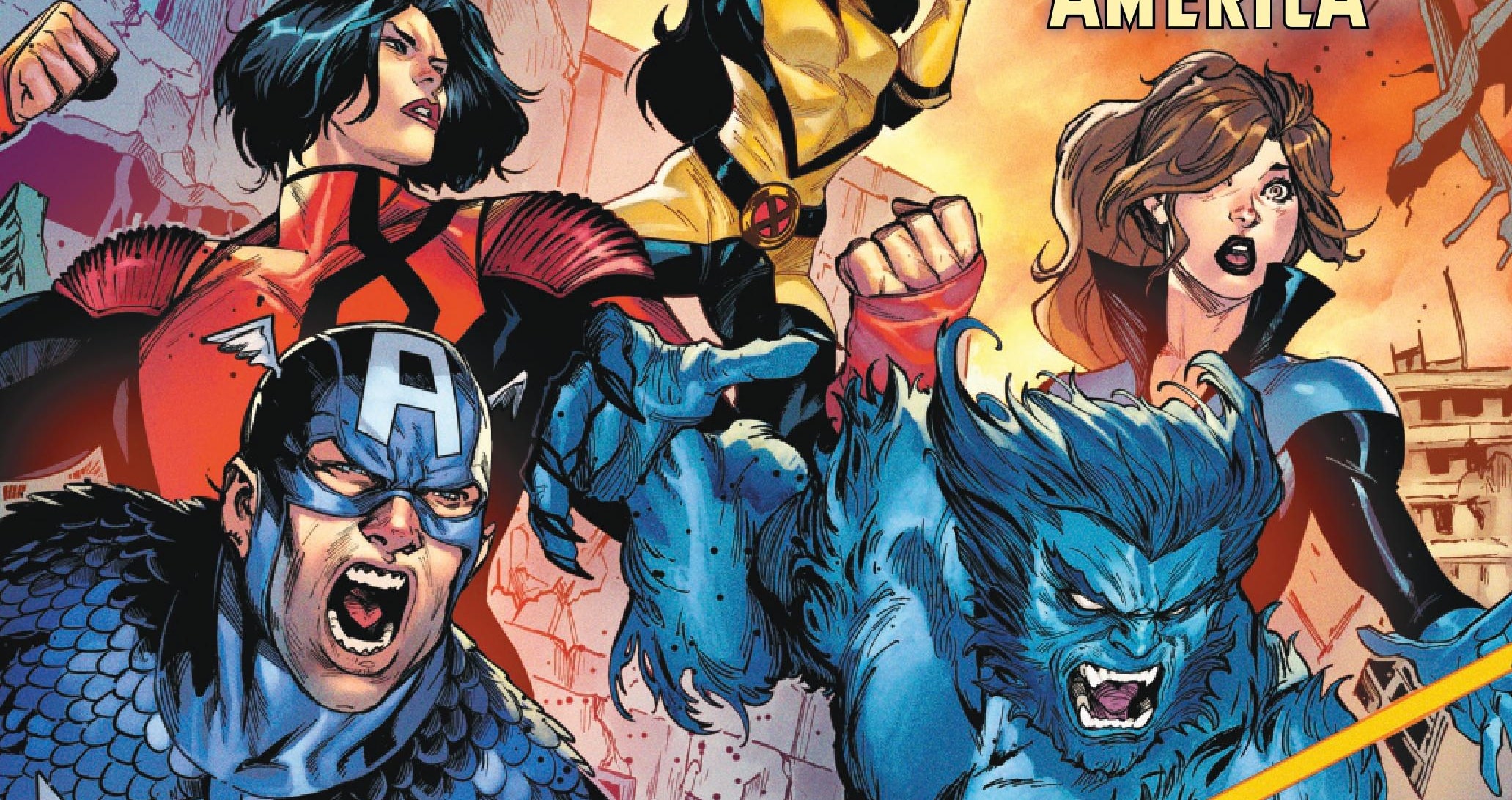
Palma draws Cap well, too: noble, well-muscled, occasionally brooding, always conscious that he stands for America, whatever America means. Palma and colorist Brian Reber do a bang-up job with the backgrounds and landscape: fire burns, trees flourish in fictional sunlight, and the various psychically constructed environments have the pizzazz I’d expect from a Star Trek holodeck (complimentary). Also Beast gets to deliver technobabble monologues while hanging upside down like a trapeze artist: a good look for Hank.
That’s about it for the good parts. The first issue ended as somebody (who?) tried to burn down the whole school (why?), with a hint that Scott wanted the blaze (what?). A long-running whodunit? A multi-issue trail of breadcrumbs leading to a surprise not-quite-bad-guy? Nope, here the whole emergency ends in five pages, revealing the fire as an illusion created by Quentin Quire at Scott’s apparent behest, in order to test the school’s ability to respond.
As if Emma couldn’t discover the ruse almost immediately (she does). As if Scott had nothing better to do than test Emma (he does, in other X-books, right now). As if Scott would trust Quentin with, honestly, anything (would you?). As if Scott remained semi-obsessed with Emma, though they haven’t dated since the Utopia era, when he (unwisely) broke up with her. Ewing’s Scott also speaks in clichés (“You’re being reckless, Emma. You’re going to get people killed. Our people”), like the Animated Series straight arrow. I might almost believe it’s the real comics Scott if Palma had not drawn him to look like a teen himself, or if Palma hadn’t given us a round-cheeked, almost anime-style Emma, alternately smirking and grinning and flirting with her facial expression and her body language, even when she’s trying for the dignity she needs (and has shown before). Iceman, who looked and acted like his grownup self throughout Exceptional, smirks too, and mocks Prodigy’s seriousness: His lines would make more sense coming from Quentin, and he looks (that is, Palma draws him) less like adult Bobby than like an ice-encrusted Joker.
And that’s before Ewing introduces her main plot: Captain America has come to the school for help finding the last survivors of the Truth experiment, so he can “reconcile with them.” Apparently the Empathy Engine can locate them, using Cap’s memories as a guide. I thought it could only zero in on mutants: If it can really find anyone anywhere, shouldn’t the more law-abiding teachers (Kitty, for example) ask about other uses (like locating kidnapping victims or secret-police detainees)? Why does Bobby tease Cap — cruelly and insistently — for being old? (Is that really Bobby?) Shouldn’t Steve Rogers know better than to make the Truth story all about himself? He learned better in the last issue of Truth.
Should the school help Cap? Kitty asks Magneto for advice, but Magneto just thinks the U.S. government and its agents (Cap included) have done so much harm as to make apologies pointless. “There is no repair.” It’s a useful real-world argument about real-world apologies, offered by well-meaning real politicians, and I like how Kitty and Magneto stage it. But I do not believe Kitty — the Kitty that Ewing wrote so well when Kitty lived in Chicago — would simply abstain from a vote about what to do. Nor that Bobby would suddenly turn serious when accusing her (rightly) of copping out. Also, since when does Laura Kinney chew bubblegum? Isn’t that usually Jubilee’s thing? Or Gabby’s?

Cap found the school because Emma invited him, but why does Emma want to sponsor this belated apology tour? “It’s called soft diplomacy. … This serves as public relations. And amazing mission practice for our students.” Does Emma want the school fully public, and famous, the way Cassandra Nova in the body of Professor X did way back in the Morrison run? If that’s not what she wants, why care about public relations? Does she just want to make nice with the First Avenger (by reminding him that his origin story involved racist cruelties)? And if she wants any challenging “mission practice” for her away teams, why would she confect a mission that’s supposed to involve nothing more than visiting the disempowered elderly, so Steve Rogers can say “Nice to meet you, I’m sorry”? Does she think this kind of assistance in conscience-clearing will give her new school the kind of favorable PR that could restart Xavier’s Dream? Why not just go assist firefighters, or take down white-collar crime, if she wants PR?
Maybe she’s got a big plan for it all. But I doubt it, because the Empathy Engine — powered by Beast’s dodgy super-science — goes wrong, and sends the members of our away team (Laura, Cap, Melee and Jitter) to the same place, and the same guy, in different decades. They’re all on their own, thanks to “temporal instabilities.” Also the guy they find is a mysteriously powerful mutant, whose oldest form manifests a villain costume. Did Emma intend for her students to encounter him? Our mutant away team is gonna need another mutant away team to save their butts and figure out what’s going on, if they ever do.
Usually when an A-lister shows up this early in a new Marvel comic, he’s there to boost sales (see Logan’s appearances, for example, in early Ms. Marvel, or in Runaways). And yet it’s hard to believe that this script got written before sales figures came in for the first one. The whole thing feels, compared to the debut, phoned in — and for no good reason, except “make sure you go read Truth” (which, in fairness, you should). As for my favorite baby mutant rescue lady — one of two teachers (the other being Prodigy) who really seems to care how the students live — if I were Kitty I’d have my resume out to Avengers Academy already, except that that wondrous school shut its doors last year.
Maybe Ewing can rescue this plot. She’s done it before. But I fear she, and Palma, and Emma, and Kitty, like too many real-world teachers before them, have been tasked to do too much, too soon.
After-school specials
- Magneto has taken up bonsai. Good for him. Those tiny branches make one thing over which he really can exert total control. (Missed chance to see him using his powers to manipulate trimming shears, though.)
- Prodigy’s yellow jacket, capsule sunglasses and blue jeans make him a natural for stealth cosplay, though only for those fans who can grow his locs, too.
- Whoever thought, last issue, that Scott really did mean to burn the school down was correct, but only for certain specialized values of “really” and “mean” and “burn.”
- Palma may swing and miss when he draws adults’ faces, but boy does he know how to draw a superhero science lab. Graphs, charts, screens, condensation tubes, beakers, open staircases and all.
Buy X-Men United #2 here. (Disclaimer: As an Amazon Associate, ComicsXF may earn from qualifying purchases.)

Stephanie Burt is Professor of English at Harvard. Her podcast about superhero role playing games is Team-Up Moves, with Fiona Hopkins; her latest book of poems is We Are Mermaids. Her nose still hurts from that thing with the gate.