Gerry Conway, who passed away in April, belonged to the letters column generation of superhero comics creators: Before they were 1970s and 1980s writers, they were 1960s and 1970s fans, buying comics from drugstore racks and writing teenage letters to the editor. That generation (Conway was one of the oldest; Kurt Busiek and Cat Yronwode might be the youngest) took their models, as writers, from earlier comics, including teen romance, space adventure and EC horror. They did not blow open the form. Instead, the best of them did fine work within it.
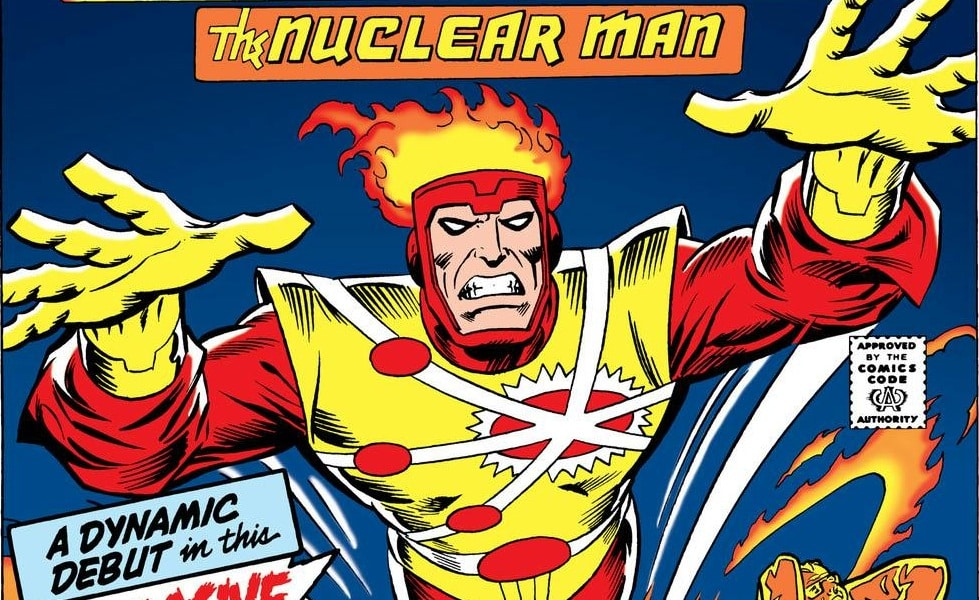
Conway’s remembered for iconic Marvel moments: He wrote the Spider-Man issue that killed Gwen Stacy, and later co-created the Punisher (intended as an antagonist, never a role model). We should remember Conway, too, for the stories he told about less famous characters, some of whom he made up. The best of them hold the interest of adults, but the Conway of the 1970s also wrote for younger readers, for comic book fans who looked at teenagers with powers as versions of people we might soon become. That’s how a very young Stephanie saw Firestorm, the Nuclear Man, co-created by Conway and artist-editor Al Milgrom. I have no idea whether I bought Firestorm #1 (1978) from our local Mini-Mart (I was 7 and tried to read everything) or if I collected it later, but I stayed with the character. Now I know why.
The Nuclear Man begins from a worn-out trope: A high school boy gets powers in a science accident while trying to impress a girl. Rather than a bespectacled nerd, though, Ronnie Raymond is a well-meaning jock. One bully calls him “a mental midget hung up on violence.” (#3). Moreover, his powers come with a grown-up science genius — literally an absent-minded professor — inside his head. When Ronnie and Professor Martin Stein merge to become Firestorm, the resulting body sports a yellow and red vest and tights, a head brace (as if to keep both personalities together), and — above it all — flames punctuated by Kirby crackle. This hero wasn’t just a teenage hothead: He ran (and flew) around with his hair on fire.
The brilliance of Firestorm came from his life as two heroes at once, an impulsive kid and a troubled professor — the kid controls the body. When they combine, Martin appears as a lightly shaded, see-through talking head, visible only to the full-colored Ronnie. “The professor never remembers being Firestorm … because he was unconscious” during the nuclear accident (#3). Firestorm might or might not fit dissociative identity disorders, aka systems. People who live like that read Moon Knight, if they read cape comics (if you want indie comics about life as a system, try the great L.B. Lee.
Instead, Conway’s hero fit my own experience. Adults said I didn’t sound anything like a kid; a science professor spoke with my voice, saying things a science professor would say. Sometimes I melted down in tears or ran around panicked (hair on fire). Adults who knew Spider-Man — along with two friends (one’s still close) who read comics with me — expected me to identify with Peter Parker, or maybe Tony Stark: misunderstood, apparently straight science dudes who became their best selves in costume.

I didn’t want to be that kind of boy. I didn’t want to be a boy at all: I wanted to be, and in some sense still am, Kitty Pryde (created in 1980). But I also wanted to know how boys felt, how being a man might feel. And I also wanted to avoid (still do) the reverse snobbery that lurks in many lesser superhero comics, the attitude that has since congealed into Elon Musk/Peter Thiel-style techno-libertarianism, where nerdy dudes are always right (and always white). Jocks were people, too. Some jocks were nice to me. And they didn’t always get the girl. (Sometimes nobody did. Or a girl did, though girl jocks are another story.
Firestorm depicted the kind of boy I had to understand. He took his friendships, and his basketball, seriously: His worst fear (other than dying) was getting kicked off the school team. And his adventures were science education: a fusion-based hero who owes his origin to late-1970s defective nuclear safety (as in Three Mile Island), whose blasts turn elements into other elements, compounds into other compounds. Multiplex boasts “the power of atomic fission,” “one man who can become two — or four — or sixteen!” (FoF #15) And he punches “with a strength that is each of their strengths squared!” (#2). Killer Frost’s ice powers come from endothermic reactions: Firestorm neutralizes her by locking her in a refrigeration unit — the first, and not the last, time Ronnie learns about thermodynamics (#3). A reclusive billionaire builds himself a containment suit to become the villain Tokamak, a living “plasma bottle” full of “high-energy gases,” like the ones that “contain fusion reactions in experimental power plants” (FoF #19). Physical Review Letters it’s not. But basic intro to the physical sciences? That it is.
Conway’s fusion-based hero spoke, repeatedly, to the ways in which kids and teenagers have to learn to live with, and get assistance from, flawed adults. And they speak both for parents and for kids: Stein, constantly teleported to who knows where because a teenager needs him, reminds me of my mom, and now of myself, constantly interrupted by real teens who need a ride. (Professor Stein to Ronnie, as our hero falls — almost drowning — through a haze of water in Fury of Firestorm #8: “Will you please pull ourselves together?”) Conway wrote divorced guys, and dads, and authority figures who screwed up, and then apologized: “I’ve been under considerable pressure. Taking it out on you is unforgivable” (FoF #9). It’s something kids deserve to see.
They also deserve — if they want it — geography and current events. Most famous DC comics take place in Metropolis or Gotham City; Conway’s Firestorm depicted New York, like a 1970s Marvel comic that happened to come out from DC. Events took place at JFK airport, in an “upper Manhattan” that looked and felt like Riverdale (the real one), or on the 1 train, with asides about unemployment, and cable TV, and “Mr. Murdoch’s paper,” the sensationalist New York Post (FoF #12). Ronnie’s girlfriend’s troubled sister, the Hyena, gets treated on the Upper East Side: “Unlike Bellevue to the south and Lennox [sic] Hill to the north, Eastside Hospital is a private institution … the uninsured public need not apply” (FoF #10).
Comic books have always been political. They’ve also always been self-referential. When the Hyena gives a villain speech, Firestorm answers, “Who writes your dialogue, Bow-Wow Breath? Smilin’ Stan?” (FoF #11). Spectators mistake Firestorm for Starfire and other members of the more popular Teen Titans. Chris Claremont wrote real-life NPR reporters into X-comics; Conway parries with Roland Hedley from Doonesbury (FoF #16). Firestorm’s foe-turned-colleague-turned-girlfriend Firehawk looks, sounds and soars like Jean Grey as Phoenix, right down to her opening lines: “I had a name once … but the silence took it away … I am Firehawk! I am you and you are me!” (FoF #17) Not fire and life incarnate, but it’ll do.

Firestorm always casts himself as a try-hard; sometimes he throws up his hands, and sometimes (as Superman comments) “he’s so eager, so desperate to succeed … he makes the Red Tornado look like an under-achiever!” (#2). Kal-El’s comment hits extra-hard if you recognize the 1970s Red Tornado as DC’s answer to the Vision: a synthetic, hairless he/him who wants to be a hero but cannot become a real man. RT even sported a whirling vortex of air below the belt, instead of a crotch.
Is Conway’s Firestorm feminist? No. But it does resist macho nonsense. Ronnie’s girlfriend Doreen complains that men “always form a private club,” a fight club: “If you get in a fight I’m finished” (FoF #8). Firestorm’s power set makes him a terrible model for boys who wanted to muscle up. His signature moves turn bullets into popcorn, steel into tinfoil or a getaway car into a wax pumpkin (#5), as if to imply that fistfights in cape comics are a regrettable necessity: The soap operatic character work is the point.
Like many well-meaning male writers at the time, Conway tried to depict, and understand, and contain, women’s rage: Killer Frost’s heel turn comes after Martin rejects her — he’s the only man who gets her brilliant mind (lecherous other scientists just want her body). Summer Day, the Hyena, gets her powers from “the anger you feel towards your parents and your society” (FoF #11). She passes her were-curse on to Firestorm, who has to visit Kenya and suffer — alas — through “African” stereotypes to get cured.
Firestorm’s first title ends after five issues. His story continues in the long-running Fury of Firestorm, launched in 1982, written by Conway and initially penciled by Pat Broderick, all detailed shadings and parallel lines. The new series starts with the painfully dated Native American baddie the Bison. Better to skip him and start at #5, where Ronnie’s new crush Lorraine wants to date him as Firestorm. Our hero also faces the Pied Piper, an old Flash foe: Whoever hears his music “is drawn to its source like an electron to a proton” (FoF #3). Broderick leaves for a handful of issues, then returns, improved: By the time he draws Multiplex again, in close-up and then as a one-man crowd scene, we’re close to George Pérez levels of line-art goodness (FoF #16). Artist Gene Colan, known for moody horrors like Tomb of Dracula, co-created Conway’s magnificently repellent one-shot villain Goldenrod, who looks like a slimmed-down Swamp Thing and kills using pollen. Readers whose allergies kept us indoors could relate (FoF #21).
Given a title unlikely to get canceled, Conway could finally play the long game. Fury of Firestorm brings together, over two dozen issues, Martin’s ex-wife; a reclusive billionaire; Multiplex redux; Lorraine and Lorraine’s dad, a liberal senator; Reagan-era corporate consolidation; atomic energy regulators; and Claremontian mind control. Firestorm falls in love with Firehawk, who is also Lorraine. It makes sense for Ronnie but creeps out Martin, who’s way too old — especially more since Ronnie’s dating Doreen. Our hero’s life becomes an emotional roller coaster, akin to the Coney Island Cyclone he rides before fighting computer-themed Bug and Byte, who blame their mom — wrongly — for leaving their dad (FoF 24). It’s at least the fourth time Conway depicts a divorce, a drinking problem and a repentant husband or ex-husband whose neglect has harmed his kids.

By this point Firestorm, the Nuclear Man, has become a comic about the ongoing flaws in the nuclear family, a set of people told to stick together no matter what — to fuse, so to speak — without the social support that could let them succeed. No wonder Conway’s adults retreat into bottles (including plasma bottles). His girls and women want to fly off, like Firehawk, or exact revenge, like Killer Frost. And his boys, like Ronnie, feel baffled and shamed, till they see a fight they can defuse. U.S. divorce rates rose sharply throughout the 1970s, plateauing in 1980 at 2.3 per hundred marriages (early 1980s headlines announced a crisis. Half the kids I knew had divorced parents). Heroes, apparently, tried to keep people together. Villains, like Multiplex, tried to split everyone up. And women’s rage could be men’s fault: Few men, in Conway or IRL, could treat their partners as equals, the way that our hotheaded hero — a sort of blended family in just one body — learns to treat Firehawk.
Maybe teen romance, conducted well, offers solutions. Or maybe a writer, like Conway — a straight Boomer white guy stuck, like Professor Stein, with a teen he cannot control (it’s not like he owns DC Comics) — doesn’t know what else to do. His run ends, unfortunately, with the return of Bison, now a mind-controlling would-be revolutionary “committed to a resurgence of Native American power” (FoF #26). Sometimes a liberal hero in a company-owned cape comic gets to fight capital in the nation’s capital (where child-me also lived). Sometimes he has to punch violent radicals whose real-life analogues pose no threat to (you guessed it) the literal Statue of Liberty.
Over the next decades, someone else (Jason Rusch, sometimes Rausch) became Firestorm, while Conway wrote other heroes for DC and Marvel. A version of Rusch appeared on TV. In comics, Ronnie died, and came back, and all three Firestorm personas teamed up with Firehawk, But Ronnie and Martin weren’t done with him yet. When Conway returned to the character in Legends of Tomorrow (2016), an anthology series that brought back 1980s writers, Ronnie played football, his mom was alive and attentive, his dad was nowhere, and the Nuclear Man was an unstable fusion of Ronnie and Jason. Art by Eduardo Pansica, Rob Hunter and Andrew Dalhouse gave a full-color, 3D sheen to the explosions and Kirby crackle, and do well with the artist’s nightmare of drawing (in the same panel) Multiplex after Multiplex after Multiplex.
Conway’s last Firestorm story looks great. It also feels like the ones from before: a throwback soap-opera plot with modern art and more inclusive values. Jason and Ronnie both ask out their hot friend Tonya, who responds: “Uh, guys? You do know I’m gay right?” Conway’s non-powered women now appear as neither sidekicks nor schemers. Instead they act far more put together than the men, who still can’t figure out what to do or how to integrate their impulses.
Conway, through Stein, in Legends of Tomorrow, explains more basic science (phase sync, wave deformation, quantum wave-particles). Then he finds a final way to use the metaphor that defines the character. The Nuclear Man now stands, not for boyhood, big feelings and growing up, not for divorce and the nuclear family, nor for a little professor and her nascent transness, but for the way that solo superhero books like this one aspire to turn into team books, the highest and best realization of cape comics goals. William Butler Yeats, who would have written superb cape comics, wrote that his stage plays sought “character isolated by a deed.” Conway’s Firestorm found himself, or themselves, isolated by their deeds, too: They had to keep learning to work together instead, just as all those divorced husbands had to learn to work with their let-down exes, and the boys had to stop fighting (even Ronnie’s bully reformed).
Multiplex wants to replace the world with himself (and to replace all his pencilers’ wrists with bandages). Ronnie and Jason and Martin, and Tonya and Firehawk, want to make room for other people instead. As Martin tells Ronnie, “some things we cannot do alone” (LoT #4). Or else we can, but after a while they suck. I stopped reading Firestorm, and stopped reading X-comics too, because I had other things to do, and because the ’90s were the ’90s. When I came back as a grownup I was a girl, and Firestorm was Jason, and then he was a de facto team-up of all the people ever involved with his powers, the way it should be.
In Legends of Tomorrow, Multiplex schemes to make another quantum universe take the place of this one: “destroy one reality and another can take its place.” That’s the wrong kind of escapism, just as Musk and his IRL techbros are the wrong kind of power fantasy. But giving up your improbable powers and learning to live in the so-called real world is another bad choice: If you’re Ronnie, or Jason, or me, that might kill you. Instead you have to find the right super-team. That’s almost the last thing that Conway’s Ronnie says, turning down — of course — a prep-school offer so he can keep playing football for Bradley High: “If I let the team down, I let myself down.” Conway, and Firestorm, didn’t let down their team.

Stephanie Burt is Professor of English at Harvard. Her podcast about superhero role playing games is Team-Up Moves, with Fiona Hopkins; her latest book of poems is We Are Mermaids. Her nose still hurts from that thing with the gate.