Polaris finds her way home and the X-Men’s gym tries to kill them while Professor X mourns Magneto in “Danger.Exe” X-Men ’97 Season 2 Episode 6 was written by Beau DeMayo, Mariah Wilson and Bailey Moore, and directed by Emmett Yonemura.
X-Men ’97 is meant to be set in 1997, but with “Danger.Exe,” it takes some big steps into the comics’ 2000s-era storytelling.
We get X-Corp, as well as fits lifted from the Grant Morrison/Frank Quitely New X-Men run (and the contemporaneous Joe Casey and Chuck Austen runs of Uncanny X-Men). The new student body is populated with characters from the Academy X/New X-Men books (and the ’90s-era Generation X). Even Reverend Stryker’s tricked out, high-tech Purifiers are on hand (Stryker and the Purifiers had a resurgence of sort circa 2002 on the back of the success of X2: X-Men United).
And arguably biggest of all, Danger is taken directly from the second arc of Joss Whedon and John Cassaday’s Astonishing X-Men. Because while most of the other 2000s elements are mostly window dressing, Danger is at the center of this episode’s story. And whereas on the surface, the use of Danger feels like another case of the show speedrunning through a list of notable storylines, Danger’s emergence is actually tied in with recent events and used to push several character arcs forward, making this both one of the plot-iest and most character-driven episodes of the season even amid its avalanche of early aughts Easter eggs.

Following last week’s Wolverine-focused diversion, “Danger.Exe” opens in the aftermath of Magneto’s death, with Professor X replaying the moment over and over in the Danger Room as a form of therapy. He does this while being watched by the Danger Room computer, which engages him in a conversation filled with enough careful phrasing to make anyone who’s watched Star Trek suspicious.
Meanwhile, X-Factor is going after the Purifiers, and when Polaris goes a little too Magneto-y on them, she gets cut from the team, forcing her to return to the newly reopened Xavier’s School for Gifted Youngsters, where Professor X is in the midst of introducing a new class of students to their headmistress (Storm) and their potentially murderous gym. Before long, in an effort to meet Xavier’s desire to be stronger and better prepared for the post-Magneto world, the potentially murderous gym becomes the gleefully murderous Danger, setting up a showdown on Genosha between the child of Magneto and the figurative child of Xavier.
Relative to her introductory comic book arc, the broad strokes of Danger’s arc are familiar: After years of service, the Danger Room gains sentience, adopts a sexy robot form, and attacks the X-Men. But the animated adaptation alters her story in a couple of key ways. For one, while in the comics, her initial emergence is facilitated by the death of a student within the confines of the Danger Room, here the X-Men are able to save the life of Wing, the same student who dies in the comics (why Storm blasting Bishop who blasts Wing back to life is appreciably different than Storm just blasting Wing directly, I can’t say). For another, while Danger’s emerging sentience is here presented as a shock and surprise to Professor X, in the comics, Danger’s “birth” is another in a chain of stories that tarnish the squeaky-clean image of Professor X as an upright, moral visionary, with the retcon that Professor X was aware of Danger’s sentience for years before Wing’s death enabled her to break free, and he chose to keep that intelligence locked up in the name of ensuring his students were as prepared as possible.

On the surface, both changes soften the narrative of Danger considerably, but they are choices that make sense for the different medium and, frankly, are probably better in any medium. In the comics, Danger eventually makes peace with the X-Men and works alongside them, and though they are hardly strangers to having people with dark pasts on their roster, untethering Danger’s existence from Wing’s death is likely better for the character (assuming she’ll return in some form).
Similarly, while I’m generally in favor of a Professor X with a few skeletons in his closest, someone whose ideals are made all the more powerful by the fact that they’re espoused by a deeply flawed and often not very nice (“Professor Xavier is a jerk!”) person, writers were piling it on a little too thick in the ’00s in terms of “darkening” Xavier. Xavier can still be a flawed, complex character without tying him and, indirectly, the success of the X-Men to the knowing decades-long imprisonment of a sentient being.
The other key player in this episode’s drama is Polaris, and her presence is an example of the series’ gaining something by not being afraid to remix the established comic book stories a bit. Polaris and Danger are not characters with much history together; outside of the time they served on the corporate X-Factor team in the 2010s’ All-New X-Factor, I’m not sure they’ve ever interacted directly on page. Polaris is also a character without a ton of animated appearances under her belt; while characters like Forge and Bishop (and Morph) weren’t recurring characters in the original series, they made numerous appearances, making their elevated profiles here a logical progression. But Polaris just popped up in that one episode with Iceman (and X-Factor) before her increased role in X-Men ’97.
Yet putting her in the spotlight here both enables her to serve as an audience surrogate for the reintroduction of Xavier’s school (despite being established as one of the original — or at least oldest — X-Men, and no, we still don’t know why Angel shows up in those pictures despite no one seeming to know him when the cartoon first introduced him) and, by leaning in to her relationship with Magneto, allows her to serve as a vehicle to address the fallout of Magneto’s death and in the process serve as a thematic counterpart to Danger, two women trying to escape the legacies of their flawed father figures by embracing their own power.

The end result can certainly be included among the series’ ongoing pacing problems; it essentially takes all of one battle with a killer robot for Xavier to come to terms with Magneto’s death and for Polaris to accept her wilder tendencies. And the conventions of the genre require Danger to remain trapped in a Black Hat role, her catharsis coming mostly because she gets defeated, rather than because she experiences any kind of emotional epiphany.
All that remains a limitation of the show’s structure — at ten 30 minute-ish episodes, there’s not a lot of room to spare, and the creators should be applauded for letting the death of Magneto linger. It would have been all too easy to just have Xavier deal with his grief off-screen, between episodes (like Wolverine, absent from this episode, is presumably doing following the events of the previous episode).
At the same time, by making the creation of X-Corp an extension of that grieving process, it ensures that the aftermath of Magneto’s death will continue to be felt, however indirectly, in subsequent episodes — even if the show is done with the part where Professor X deals with his grief by torturing himself in the Danger Room rather than by seeking any actual therapeutic help.
X-Traneous Facts
- Once again, an animated version of the cover to X-Factor #71 makes it into the opening credits.
- Name-dropped here, Reverend Stryker made a brief appearance in Episode 8 of the previous season; notably, he is still a reverend, as in the comics (whereas the movie adaptations, presumably fearing backlash, rejiggered him into being a military figure).
- Polaris unabashedly being Magneto’s daughter is another 2000s thing about the episode, that being the time when the comics circled back around to saying that (after the declaration of their relationship in her first appearance back in the ’60s was later retconned into being untrue), something they’ve stuck with ever since.
- Val Cooper’s cat looks an awful lot like Professor Xavier’s cat Mystique in Ultimate X-Men. That cat turned out to just be a cat named Mystique, but there is a history in the comics between Mystique and Val Cooper — with Mystique even impersonating Val without anyone (including the readers) knowing it for a time.
- In showing us Lorna’s old, “just like she left it” room, this episode continues the comics’ proud tradition of somehow maintaining highly specific decor and mementos within rooms of the mansion despite the mansion having suffered tremendous devastation and in some cases outright destruction that would have realistically impacted the existence of said decor and mementos.
- In a nice bit of inter-series continuity, Forge’s time as the leader of X-Factor (from Polaris’ one earlier appearance in “Cold Comfort”) gets referenced.
- I’m not sure why Beast, Cyclops and Jean are all wearing the Quitely/Morrison suits on Genosha, before Xavier has established X-Corp and the likes of Rogue and Nightcrawler show up wearing their corresponding early ’00s looks. It was, frankly, a bit jarring.
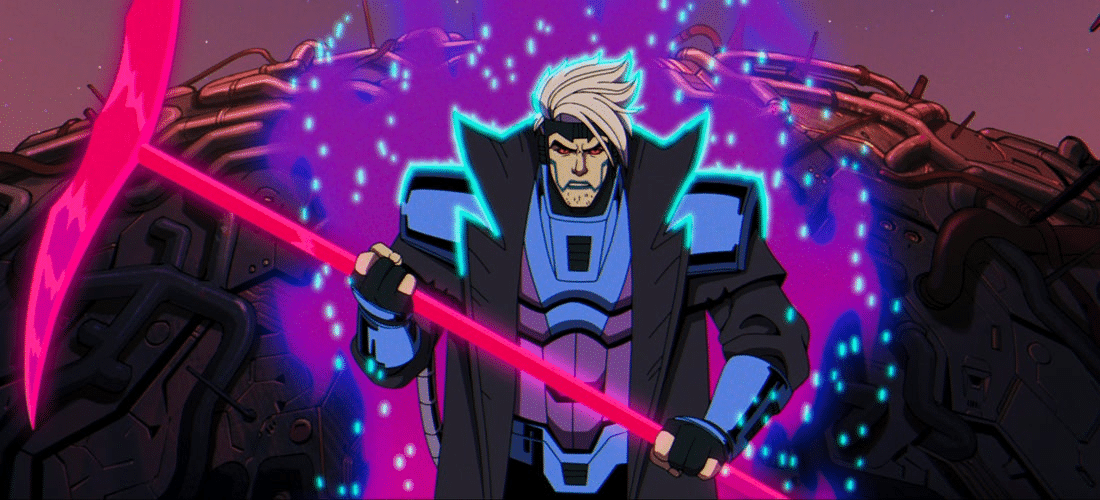
- My favorite part of this episode is in the post-credits tease (that happens before the credits roll), when Apocalypse is zapping Gambit’s body in a room by himself, then declares out loud, “increase the power!” shortly before the camera cuts to his right hand lifting up a lever.

Austin Gorton also reviews older issues of X-Men at the Real Gentlemen of Leisure website, co-hosts the A Very Special episode podcast, and likes Star Wars. He lives outside Minneapolis, where sometimes, it is not cold. Follow him @austingorton.bsky.social.